




July 23, 1997
I could have told them what they'd find on Mars,IN recent weeks the interest and imagination of the American public have been captured by a mission to Mars characterized less by its technological innovation than by its economy and expedience. The nation has watched as the mission's team of scientists direct Sojourner -- a high-tech version of a radio-controlled car -- on its tour of the landing site. The mission team was delighted when the first chemical analysis of a Martian rock yielded a rich content of quartz, a compound recognizable to any earthling with even a passing familiarity with terrestrial geology. Further evidence confirmed previous scientific theories of a huge deluge that swept the surface of Mars more than a billion years ago.
Having inhabited the place since birth:
Another unmysterious, lunar lump,
Another Earth,
With all those delicate scrawls disclosed as Jersey,
That pale and promising patch resolved to Rye,
Those lyrical canals, routes 1 and 7,
The lower forms they longed for, I.
--Lionel Wiggam, "Outer Space" (The Atlantic Monthly, November, 1965)
The analogies have been irresistible: the Martian flood was of "Biblical proportions," the new efforts of the space program are like the first European explorations of America. With Martian rocks playfully named after Barnacle Bill and Yogi Bear -- and with the rover itself named for the Civil War abolitionist Sojourner Truth -- it may be hard for Americans not to feel some connection to this extraterrestrial world and NASA's exploration of it.
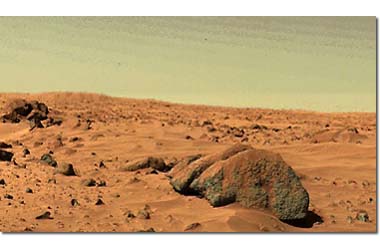 |
| A View of the Martian surface, acquired at the Viking Lander 1 site. |
Long before televised and cinematic representations of astronauts' life in space became common, Hartley E. Howe wrote "Keeping House in Outer Space" (October, 1957), wherein he identified the basic logistical problems of survival in a spaceship that would have to be solved before a manned vessel could be launched successfully.
In "The Astronomer's Stake in Outer Space" (November, 1958), Donald H. Menzel enumerated the scientific questions that could be addressed through further commitment to the American space program, and urged public support for further efforts.
Similarly, Robert Jastrow and Homer E. Newell's article, "Why Land on the Moon?" (August, 1963), considered public criticism of the Apollo project, and countered with an argument in support of lunar research and other endeavors. The authors wrote that "space exploration also has a general consequence for the physical sciences as a whole, and for science education," and further argued that a successful space program would offer an invaluable contribution not only to scientific knowledge, but also to the United States' self-determination as a country.
Alton Frye, in "Our Gamble in Space: The Military Danger" (August, 1963), explored an issue which, particularly at that time, was at the forefront of discussions of the space program: the potential use of space for military purposes. The article offered speculations about Soviet-American relations and their implications for the political definition of the American presence in space.
Twenty-five years later The Atlantic published "Are We Alone?" (August, 1988), by Gregg Easterbrook, a discussion of the possibility of extraterrestrial life and of the potential ramifications should it be discovered.
Copyright © 1997 by The Atlantic Monthly Company. All rights reserved.
 |
 |
 |
 |
 |
 |