




Introduction by Lloyd Schwartz
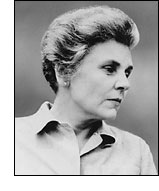 |
| Elizabeth Bishop |




(For help, see a note about the audio.)
Related links:
The Academy of American Poets: Elizabeth Bishop
A feature on the Academy's Web site devoted to Elizabeth Bishop, including a number of her most famous poems, related links, and audio.
Previously in Soundings:
John Clare, "I Am" (December 8, 1999)
David Barber, Carolyn Kizer, and Christopher Ricks read the underappreciated English Romantic poet John Clare's greatest poem, "I Am." With an introduction by David Barber.
William Shakespeare, "Sonnett 116" (October 27, 1999)
Mark Doty, Linda Gregerson, W. S. Merwin, and Lloyd Schwartz read Shakespeare's famous sonnet ("Let me not to the marriage of
true minds..."). With an introduction by Linda Gregerson.
Emily Dickinson, "I cannot live with You" (April 14, 1999)
Lucie Brock-Broido, Steven Cramer, and Mary Jo Salter read Dickinson's poem of hopeless love. With an introduction by Steven Cramer.
Robert Frost, "The Wood-Pile" (February 3, 1999)
Peter Davison, Donald Hall, and Maxine Kumin give voice to this poem by Robert Frost. With an introduction by Peter Davison.
Thomas Hardy, "During Wind and Rain" (January 6, 1999)
Donald Hall, Philip Levine, and Rosanna Warren give voice to this poem by Thomas Hardy. With an introduction by Philip Levine.
Ben Jonson, "My Picture Left in Scotland" (November 25, 1998)
Robert Pinsky, Gail Mazur, and David Ferry read aloud this great poem of unrequited love. With an introduction by Robert Pinsky.
Walt Whitman, "As I Ebb'd with the Ocean of Life" (October 8, 1998)
Frank Bidart, Marie Howe, and Galway Kinnell read Whitman's stunning poem of self-doubt. With an introduction by Steven Cramer.
W. B. Yeats, "Easter 1916" (February 4, 1998)
Richard Wilbur, Philip Levine, and Peter Davison give voice to one of the century's greatest poems. The first installment in a series of classic-poetry readings by contemporary poets, with an introduction by David Barber.
More on poets and poetry in Atlantic Unbound and The Atlantic Monthly.
Join a conversation on poets and poetry in Post & Riposte.
SonnetIn 1978 Bishop told me she was working on "a little sonnet." I was guest-editing an issue of Ploughshares, and I asked her if she'd let me publish the poem when she finished it. But she couldn't, because of her first-refusal contract with The New Yorker. Sadly for me The New Yorker's poetry editor, Howard Moss, was thrilled to have it. He'd been devoted to Bishop and championed her work. When "Sonnet" kept getting delayed, however, Bishop got more and more frustrated. She liked Moss, but she vented her irritation in a satirical quatrain for her friends:Caught -- the bubble
in the spirit level,
a creature divided;
and the compass needle
wobbling and wavering,
undecided.
Freed -- the broken
thermometer's mercury
running away;
and the rainbow-bird
from the narrow bevel
of the empty mirror,
flying wherever
it feels like, gay!
All our poemsLike Emily Dickinson (even down to the dashes), Bishop was a complicated mixture of formalist and formal maverick. She wrote sestinas long before they became common assignments in creative-writing courses. But she also loved to play with form. Her only previous mature sonnet, "The Prodigal," written nearly three decades earlier, was a double sonnet. Her remarkable villanelle, "One Art," altered tradition by varying the refrain lines, though the rules insisted on their being repeated verbatim. These dramatic "deviations" are, of course, one of the glories of "One Art."
rest on the shelf
while Howard publishes
himself.
"Sonnet," with its unusually short lines, is a playfully bottom-heavy inversion of the traditional sonnet form. Bishop's octave (including two images of being "freed") follows rather than precedes the sestet, with its two images of being "caught" (thereby giving more room to being free than to being trapped). Many of the rhymes (and delicious half rhymes) come not where you'd expect them or where they're supposed to be -- that is, the rhyming pair doesn't always appear at the end of a line: "bird" rhymes with "freed"; "rainbow" and "narrow" fall mid-line; the rhyme in "thermometer's mercury" comes at the beginning rather than at the end of the words. Like the "moon in the bureau mirror" in her poem "Insomnia" (1951), which looks out at a world "inverted," the newfound freedom depicted in "Sonnet" (including a liberation from traditional form) presents a topsy-turvy solution, an upside-down resolution, that doesn't fit the usual formula.
This solution, this resolution, is death -- the solution to all conflict, to all illness, to all decision-making, to all the claims and pulls that upset the balance of one's life. The more you know about Bishop, the more directly autobiographical this poem begins to seem. She was, like the bubble in the spirit level, "a creature divided," both accepting and nervous about her homosexuality (she said she wanted to restore the last word of the poem, "gay!," to what she called its "original" non-sexual meaning), needing to drink yet ashamed of her self-destructive compulsion (in the version of the poem published in The New Yorker, the line "a creature divided" appears as "contrarily guided"). She loved living in Brazil, away from New York literary politics and gossip, yet it was hard for her to be separated from her native country and language, and from the recognition of her admirers. "Dear, my compass/still points North," begins a love poem she wrote in Brazil but never published, still wavering about her true home. And she was never completely convinced that her poems had any lasting value.
The "rainbow-bird" in the last and most complex image of "Sonnet" is clearly self-referential. "Rainbow" is a key Bishop word. Her most famous poem, "The Fish," ends with the ecstatic "rainbow, rainbow, rainbow!" (and with another one of her rare exclamation points), as she prepares to set free the tremendous fish she caught (another trapped creature). In "Song for the Rainy Season," her love poem about the house she and her Brazilian companion were living in way up in the mountains outside of Rio, she calls the landscape "rainbow-ridden."
Hidden, oh hiddenThe most poignant -- and frightening -- image in "Sonnet" is the empty mirror. Always shy and self-conscious, Bishop hated the way she looked, hated looking at herself. She'd grown heavier from the years of cortisone she had to take for her asthma; her hair had turned gray. She felt old and bloated, though everyone else thought she looked more elegant than ever. I was visiting her the day her copy of Richard Howard's coffee-table anthology Preferences arrived, with a beautiful full-page photograph of her by Thomas Victor. She excused herself, went into her bedroom, and tore the page with the photograph out of the book. She would have preferred to look into an empty mirror, even given the sinister implications.
in the high fog
the house we live in,
beneath the magnetic rock,
rain-, rainbow-ridden,
where blood-black
bromelias, lichens,
owls, and the lint
of the waterfalls cling,
familiar, unbidden.
Bishop had been plagued by various illnesses all her life, from persistent eczema (like a pink dog?) to the chronic, sometimes life-threatening asthma for which she was repeatedly hospitalized. In the 1970s her beloved Aunt Grace, in Nova Scotia, was showing signs of Alzheimer's disease. Bishop was morbidly worried about an old age of illness after lingering illness, and was terrified of becoming senile. I think if she could have known that she would die of an aneurysm, suddenly and without warning, at sixty-eight, as she was putting on her shoes to go out to dinner, she'd have lived a happier life.
Though she had been in relatively good health at the time she wrote "Sonnet," dying seemed increasingly on her mind. In these lines from another unpublished love poem, "Breakfast Song," from 1974, she wrote:
Last night I slept with you.Here she raises the disturbing idea that someone might actually want to die. But -- in love -- she talks herself out of it. "Breakfast Song" reveals feelings, especially sexual feelings, that were probably too personal for Bishop to allow herself to make public. In "Sonnet," however, she finally confronts, though with characteristic indirectness, her death wish, her desire for the freedom death brings. Maybe because of that indirectness (the poem has no "first person"), and the secret delight she took in her witty formal inventions and imagistic dazzle, she was especially pleased with this "little" poem and couldn't wait to see it in print.
Today I love you so
how can I bear to go
(as soon I must, I know)
to bed with ugly death
in that cold, filthy place,
to sleep there without you,
without the easy breath
and nightlong, limblong warmth
I've grown accustomed to?
-- Nobody wants to die;
tell me it is a lie!
But no, I know it's true.
It's just the common case;
there's nothing one can do.
these poets read Elizabeth Bishop's "Sonnet":
(For help, see a note about the audio.)
Hear Mazur, Pinsky, and Schwartz read their own work from The Atlantic's pages in Atlantic Unbound's Audible Anthology.
Gail Mazur is the poet-in-residence at the Emerson College M.F.A. program. She is the author of The Pose of Happiness (1986), and The Common (1995), and the forthcoming They Can't Take That Away From Me, due out in 2001.
Robert Pinsky is the Poet Laureate of the United States. In 1998 he received the Lenore Marshall Poetry Prize from the Academy of American Poets. He is the author, most recently, of Jersey Rain (2000), and the editor, along with Maggie Dietz, of Americans' Favorite Poems (1999).
Lloyd Schwartz is co-director of the Creative Writing Program at the University of Massachusetts at Boston. His most recent books of poetry are Goodnight, Gracie (1992) and the forthcoming Cairo Traffic (2000). He is the co-editor of both Elizabeth Bishop and Her Art (1998) and, with Robert Giroux, the Library of America's forthcoming Elizabeth Bishop: Collected Poetry and Prose. In 1994 he was awarded the Pulitzer Prize for criticism.
Mark Strand is the author of numerous books of poetry, including Blizzard of One (1998), which won the Pulitzer Prize for poetry. His most recent book is Weather of Words (2000), a collection of prose.
Copyright © 2000 by The Atlantic Monthly Group. All rights reserved.
 |
 |
 |
 |
 |
 |