


Return to this issue's Table of Contents.
M A R C H 1 9 9 9
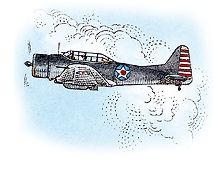
 ICTORY took only a bit longer in the American colony of the Philippines. At his Manila headquarters Douglas MacArthur, commanding general of U.S. forces in the Far East, learned early in the morning of December 8 that Pearl Harbor had been attacked. Incredibly, and unforgivably, he made no use of the next nine hours to mount a counterattack against Japanese positions on Formosa (Taiwan), as his air commander urged, or even to launch or disperse his own aircraft. They were caught bunched on the ground -- "On the ground! On the ground!" President Franklin Roosevelt exclaimed incredulously -- when Japanese bombers and fighters appeared overhead shortly after noon. Within minutes MacArthur's force of some three dozen B-17 bombers, on which he had obstreperously premised his claim to be able to defend the Philippines indefinitely, was severely damaged.
When the Japanese began landing troops on the principal Philippine island of Luzon, on December 22, MacArthur speedily jettisoned his always dubious scheme to repel the invaders on the beaches and on the central Luzon plain, and began gathering men and supplies for a retreat into the Bataan Peninsula and the island fortress of Corregidor, where he set up his command post. MacArthur, sometimes accused of being a legend in his own mind, soon earned himself the derogatory nickname "Dugout Doug," bestowed on him by his suffering troops on Bataan while he sat in the relative comfort of Corregidor, only once making the brief torpedo-boat run across to the peninsula to hearten his men.
"The Growth of Our Foreign Policy," by Richard Olney (March, 1900)
"If not bound to buy the Philippines ... was it our interest to buy them?.... The Philippines inevitably make our navy larger than it would have to be without them."
Related link:
Mike Weaver, Bataan Death March Survivor (b. Jan 28, 1920-d. Feb 1, 1998)
A Bataan Death March survivor's memoirs of his World War II experience. From a taped interview transcribed and posted by the soldier's son.
Knowing that the Philippine garrison was doomed, Roosevelt ordered MacArthur to depart for Australia. On the night of March 12 the general and his family and personal staff were evacuated from Corregidor in four PT boats, leaving General Jonathan M. Wainwright in command. With characteristic self-regard and uncharacteristic lack of orotundity, MacArthur announced, "I shall return." As a face-saving measure -- and as a prophylaxis against backlash from the general's many political friends -- the President simultaneously conferred upon MacArthur the Congressional Medal of Honor.
The medal was small comfort for the masses of sick soldiers and civilians left behind in the Philippines. Though MacArthur fulminated by radio from his new base in Australia that his troops should break out of Bataan and take to the mountains as guerrillas, Wainwright knew the notion was fatuous. The Bataan contingent surrendered on April 9, and on May 6 an emaciated Wainwright, hopelessly holed up in Corregidor's putrescent Malinta Tunnel, tortured by the resonant moaning of thousands of ill and wounded men crammed into the dank thousand-foot-long shaft, finally capitulated. In his diary Dwight D. Eisenhower took note of these events: "Corregidor surrendered last night. Poor Wainwright! He did the fighting ... [MacArthur] got such glory as the public could find.... MacArthur's tirades, to which TJ [MacArthur's aide, T. J. Davis] and I so often listened in Manila, would now sound as silly to the public as they then did to us. But he's a hero! Yah."
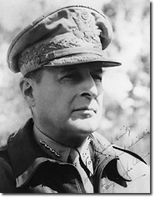 |
| Douglas MacArthur (Photo courtesy of The Naval Historical Center) |
Japanese military leaders had adopted the ancient samurai ethos of Bushido to develop a military code that engendered what two scholars have described as "a range of mental attitudes that bordered on psychopathy," including the notion of "surrender as the ultimate dishonor, a belief whose corollary was total contempt for the captive." That contempt the Japanese troops now vented savagely on the American and Filipino captives they herded along the route of the "Bataan Death March," a grisly sixty-five-mile forced trek to crude prisoner-of-war camps near the base of the Bataan Peninsula. Japanese guards denied water to parched prisoners, clubbed and bayoneted stragglers, and subjected all the captives to countless humiliations and agonies. Some 600 Americans and as many as 10,000 Filipinos died along the route of the march. Thousands more perished in the filthy camps. This death march presaged the pitiless inhumanity that came to possess both sides in the ensuing three and a half years of war in the Pacific.
"The closest squeak and the greatest victory."
-- George C. Marshall on the Battle of Midway
 UCHIDA'S fliers at Pearl Harbor had seen to it that not a single battleship remained in action in the U.S. Pacific Fleet. But battleships were the capital weapons of the previous war. In the war that was now so bloodily begun, aircraft carriers would be trumps, and no U.S. Pacific Fleet carriers had been at Pearl Harbor on December 7. The Yorktown had been detached in April for duty in the Atlantic. The Saratoga was stateside for repairs. The Enterprise and the Lexington were at sea near Wake and Midway Islands respectively. Fuchida's raiders had also failed to damage Pearl Harbor's repair shops. More important still, they had left intact the enormous fuel-oil tank farm. Loss of that fuel supply, every drop of it laboriously hauled from the American mainland, would probably have forced the U.S. Navy to retreat to its bases on the West Coast, at a stroke sweeping the western Pacific of American ships more cleanly than any other imaginable action. But Nagumo rejected suggestions that he undertake a second strike, against the repair and fuel facilities, or linger in the area to search for the missing carriers. He seemed paralyzed by the very ease of his victory. He had lost but twenty-nine aircraft, and his fleet remained unsighted. In the historian Gordon Prange's apt words, he must have felt "as if he had rushed forward to break down a door just as someone opened it." For Nagumo, what he had achieved on the morning of December 7 was victory enough. Yet his failure to return for the final, definitive kill risked eventual defeat.
 For his part, Adolf Hitler made less than optimal use of the Pearl Harbor attack. Though the strict terms of their alliance with Japan did not require it, since Japan had been the attacker, not the attacked, Hitler and Mussolini on December 11 somewhat impetuously declared war on the United States, which then recognized a state of war with Germany and Italy.
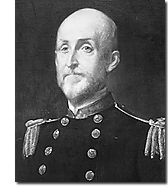 |
| Alfred Thayer Mahan (Photo courtesy of The Naval Historical Center) |
The string of relatively easy Japanese victories in the first four months of the war provoked a heated debate among Japanese military planners about what their next step should be. The success and momentum of the Southern Operation seemed to dictate one answer: consolidation and buildup of the bases tenuously established in New Guinea and the Solomon Islands, followed by further advances into New Caledonia, Fiji, Samoa, and perhaps eventually Australia. But Yamamoto put the full weight of his authority behind a contrary plan. Finish the job begun at Pearl Harbor, he urged, by seizing Midway Island, some 1,100 miles west of Hawaii. Politically, Midway in Japanese hands would menace Hawaii with the threat of invasion, providing a potent bargaining chip with which to force the Americans to negotiate a settlement. Militarily, a Japanese presence on Midway would lure forth the remaining elements of the U.S. Pacific Fleet for the "decisive battle." Toward the waging of that battle Yamamoto's career and the training and preparation of the entire Imperial Japanese Navy had long been consecrated.
The doctrine of the decisive battle was distilled from decades of Japanese planning about how to wage war against the United States in the Pacific. That planning derived in turn, ironically, from the theories of the American naval strategist Alfred Thayer Mahan. A U.S. naval officer and the president of the Naval War College, Mahan argued in his influential work The Influence of Sea Power Upon History (1890) that command of the sea was the key to success in war, and that the way to secure the sea was to engage the enemy's main force and destroy it. As Japanese planners adopted this thinking for possible war against the United States, they envisioned the swift capture of the Philippines and Guam, thus forcing the U.S. fleet to battle. As the U.S. Navy transited the Pacific, Japanese submarines would harass it in the eastern Pacific, and land-based aircraft would strike as it passed through the Marshall and Gilbert Islands. When the weakened fleet approached the Marianas or the Carolines, or perhaps the Philippines, it would confront a fresh, overpowering Japanese naval force and be decisively defeated.
Yamamoto had argued in 1941 that rather than lie in wait for the U.S. fleet in the western Pacific, the Japanese navy should employ the First Air Fleet, embarking some 500 high-performance aircraft, flown by magnificently trained pilots, to mount an attack directly in mid-ocean, at the U.S. base in Pearl Harbor. That task Japan had only partly accomplished on December 7, Yamamoto insisted. Now was the time to hit the Americans again at a place they would be compelled to defend with their full strength -- Midway -- and destroy the U.S. Pacific Fleet once and for all. With the Pacific cleansed of American ships, Japan would have an unchallenged defensive perimeter, stretching from the North Pacific through mid-ocean to the South Pacific. The Southern Operation would be impregnably secure. Within its perimeter Japan would hold Guam and the Philippines as hostages, and perhaps Hawaii and Australia as well. Safe behind this barrier, Japan could easily sustain a strategically defensive posture, and sue for a negotiated peace on terms it dictated. These were heady notions. In May of 1942 they intoxicated even such a calculating pragmatist as Yamamoto. The faint prospect of victory that had earlier swum mistily at the outermost rim of his imagination, the military historian John Keegan has written, now "seemed to lie only one battle away."
 MERICAN strategic doctrine for war against Japan was virtually the mirror image of this Japanese thinking. Code-named the "Orange Plan," it had first been formulated early in the century, and also reflected Mahan's influence. The Orange Plan assumed an early Japanese capture of the Philippines, and made relief of the Philippines the main U.S. objective. The American garrison there was supposed to hold out for three or four months while the U.S. fleet crossed the Pacific, engaged the main body of the Japanese fleet, destroyed it, and thereby ended the war. Always unrealistic, the plan was revised in 1935 to provide for the capture of the Marshall and Caroline Islands as staging areas for the main engagement with the Japanese fleet -- a tacit admission that the war would last years, not months, and an admission as well of the cynicism that had always underlain expectations about the sacrificial role of the Philippine garrison. Yet whatever its flaws, the Orange Plan constituted the foundation of the U.S. Pacific war strategy in 1942, and would in many ways continue to do so
right down to 1945. In the two interwar decades war games were fought at the
Naval War College on these assumptions no fewer than 127 times, planting the
Orange Plan's premises deep in the American strategic mind.
MERICAN strategic doctrine for war against Japan was virtually the mirror image of this Japanese thinking. Code-named the "Orange Plan," it had first been formulated early in the century, and also reflected Mahan's influence. The Orange Plan assumed an early Japanese capture of the Philippines, and made relief of the Philippines the main U.S. objective. The American garrison there was supposed to hold out for three or four months while the U.S. fleet crossed the Pacific, engaged the main body of the Japanese fleet, destroyed it, and thereby ended the war. Always unrealistic, the plan was revised in 1935 to provide for the capture of the Marshall and Caroline Islands as staging areas for the main engagement with the Japanese fleet -- a tacit admission that the war would last years, not months, and an admission as well of the cynicism that had always underlain expectations about the sacrificial role of the Philippine garrison. Yet whatever its flaws, the Orange Plan constituted the foundation of the U.S. Pacific war strategy in 1942, and would in many ways continue to do so
right down to 1945. In the two interwar decades war games were fought at the
Naval War College on these assumptions no fewer than 127 times, planting the
Orange Plan's premises deep in the American strategic mind.In early 1942, however, the United States could not possibly muster a naval force that would even begin to make Orange operational. The only event that had conformed to the plan's predictions was the loss of the Philippines, and it would take not three months but more than three years to retrieve them. As a partial and weak substitute for the great fleet action envisioned by Orange, small strike forces engaged in hit-and-run raids on scattered Japanese island outposts.
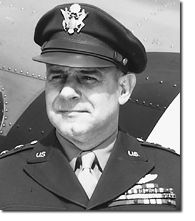 |
| James H. Doolittle (Photo courtesy of The Naval Historical Center) |
The Doolittle raid did little material damage. The Japanese government made no official acknowledgment of the attack, even to its own citizens, to whom the scattered and mostly harmless explosions of April 18 remained somewhat mysterious. But Doolittle's B-25s packed a momentous psychological wallop. They vividly demonstrated to Japanese military leaders the vulnerability of their home islands through the Midway slot in Japan's defensive perimeter. To all of Yamamoto's already weighty arguments about the attractions of an attack on Midway, the necessity of sealing that slot was now added. Debate ceased in the Japanese high command about the relative priority of the South or Central Pacific. Both operations would now go forward, straining to the utmost the already stretched resources of the imperial navy.
Summoning Nagumo, the hero of Pearl Harbor, Yamamoto began to fit the First Air Fleet for an offensive operation against Midway Island. Nagumo's orders this time were to land an occupation force on Midway and begin its outfitting as a forward base, which would lure the Americans to the decisive battle, and which might serve in time as a launching ground for the invasion of Hawaii. It was Yamamoto's most ambitious plan ever, overshadowing even the audacity of the December 7 attack, and it demonstrated that not even this prudent planner was immune to the recklessness induced by "victory disease."
Nagumo believed that his failure to find the American carriers in port on December 7 had been handsomely redressed in May of 1942 at the Battle of the Coral Sea, where Japanese pilots had reported sinking two American carriers. Though two Japanese carriers, the Shokaku and the Zuikaku, were sufficiently damaged or had their air squadrons so shredded at Coral Sea that they could not take part in the assault on Midway, the First Air Fleet retained the Akagi, the Kaga, the Hiryu, and the Soryu, a still-potent quartet of fleet-class carriers that embarked more than 270 warplanes. Nagumo also trusted in the complicated battle plan for the Midway operation, which called for a diversionary raid on Alaska's Aleutian Island chain, to draw off American naval strength. And of course Yamamoto and Nagumo both took comfort from the reflection that they held again, as they had so triumphantly at Pearl Harbor, the hole card of secrecy. Anticipating the decisive battle that would crown his career and seal his nation's dream of empire, amid lavish pomp and ceremony on May 27, the anniversary of the Battle of Tsushima Strait, Nagumo sortied the First Air Fleet through the Bungo Strait from Japan's Inland Sea -- and into the jaws of a trap.
While Yamamoto and Nagumo had gathered the nearly 200 ships of the Midway strike force from over the far horizons that bounded Japan's immense area of conquest, American cryptanalysts had feverishly studied their transcripts of the swelling volume of encoded Japanese radio traffic, trying to determine where Japan would strike next. The collective effort to crack the Japanese codes was known as "Magic," and in the upcoming Battle of Midway, Magic would demonstrate its military value along with the aptness of its name.
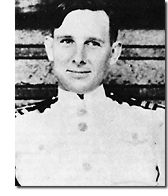 |
| Joseph J. Rochefort (Photo courtesy of The U.S. Navy) |
Station Hypo's nemesis and obsession was the Japanese naval code, JN-25. It was an immensely complex cipher, and Rochefort and his colleagues could make sense of only 10 to 15 percent of most intercepts. But in the welter of communications traffic that Hypo was monitoring in the spring of 1942, one term recurred with unsettling frequency: "AF," obviously the name of the next major Japanese target. Where or what was "AF"?
Rochefort had a hunch, and he played it shrewdly. Guessing that AF was Midway, in early May he baited a snare by arranging for the small Marine and Army Air Force garrison at Midway to radio in clear that their distillation plant had malfunctioned and they were running short of fresh water. The ruse worked. Within two days Station Hypo received confirmation of a coded Japanese message that "AF" was low on fresh water. Jackpot! Midway it was, then, and Hypo had proved it. The U.S. Navy would be there, ready and waiting.
The online version of this article appears in five parts. Click here to go to part one, part three, part four, part five.
David M. Kennedy is the Donald J. McLachlan Professor of History at Stanford University. His article in this issue will appear, in slightly different form, in his book Freedom From Fear: The American People in Depression and War, 1929-1945, to be published by Oxford in May.
Illustrations by Laszlo Kubinyi
Copyright © 1999 by The Atlantic Monthly Company. All rights reserved.
The Atlantic Monthly; March 1999; Victory At Sea; Volume 283, No. 3; pages 51-76.
 |
 |
 |
 |
 |
 |