Que Viva la Pepa: Introducing The Experiment
The United States started as an experiment. On this new show, we check in on how that’s going.
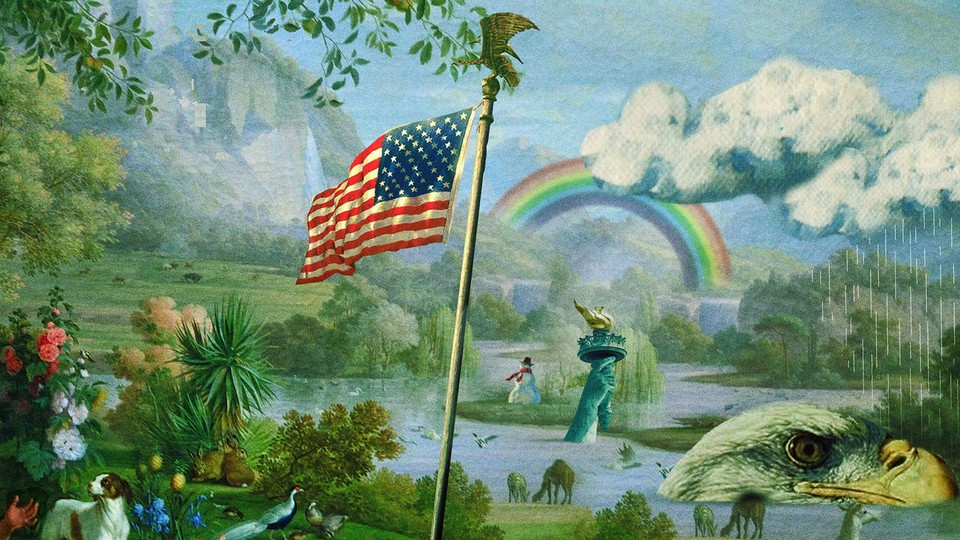
It’s easy to forget that the United States started as an experiment: a government of the people, by the people, and for the people, with liberty and justice for all. That was the idea. On this weekly show, we check in on how that experiment is going.
The Experiment: stories from an unfinished country. From The Atlantic and WNYC Studios.
Be part of The Experiment. Use the hashtag #TheExperimentPodcast, or write to us at [email protected]. Listen and subscribe: Apple Podcasts | Spotify | Stitcher | Google Podcasts
Music by Ob (“Ghyll” and “Mog”), Parish Council (“Socks Before Trousers” and “Durdle Door”), and water feature (“richard iii (duke of gloucester)”). Additional audio from C-SPAN, Senator Chris Murphy, Lawrence University, the House Judiciary Committee, the Washington Post reporter Rebecca Tan, and the City of Lake Worth Beach.
A transcript of this episode is presented below:
(Over nighttime ambience and the hum of crickets.)
(Driving, rhythmic Cuban music plays.)
Julia: I want to start things off with my aunt Margarita—
Julia: —because whenever my big Cuban family gets together in Miami to drink and dance and argue about politics, my aunt will get a few tequilas deep, and she’ll always say this thing.
(Music changes tone, becomes softer, more strings-heavy. A wine glass clinks.)
Julia: And she doesn’t just say it; she’ll, like, revel in it, and take it into her soul and, like … (Laughs.)
Julia: “¡Que viva la Pepa!”—long live “la Pepa.” Whatever that means.
Julia: I mean, for me, it has always just meant that Tía is drunk. But recently I looked it up. It turns out what my aunt was drunkenly celebrating all these years … is democracy.
(Music changes tone again, becomes smoother and more electronics-heavy.)
Julia: “La Pepa” is a nickname for an old and dead constitution. Back when Cuba was a colony, Spain wrote “La Pepa,” and promised Cuba that they would have representation in government. They promised them democracy. And I guess people were into this. And so they started saying:
Julia: “Long live the constitution!” Of course, that promise … died. Democracy never came. Many revolutions were fought. But the saying stuck. And over 200 years later, you can still find tipsy aunts and uncles toasting to its everlasting life.
(Music shifts tone once more, becomes more somber.)
Julia: You know, a toast is not a statement of fact. It’s more like a prayer, like a repetition of a hope. And I wonder if what my aunt was doing was trying to will an ideal into existence.
Julia: I’ve been thinking about this a lot in the moment we’re living in now, in the United States—
Julia: —when the ideals of our own Constitution can feel far away.
(A sudden and shocking silence.)
Julia: This show is about the experiment of democracy. It’s about the ideals that we pledge to and toast to, even when they feel far away. And it’s about the messy work we do when we try to bring those ideals down to Earth.
(Music plays.)
Julia: I’m Julia Longoria. This is The Experiment, from The Atlantic and WNYC Studios.
(The music fades into the sound of crickets, which, after a moment, fades away too.)