Don’t Underestimate the Japanese Beetle
America is playing whack-a-beetle with crop-eating pests.
This story was originally published in High Country News.
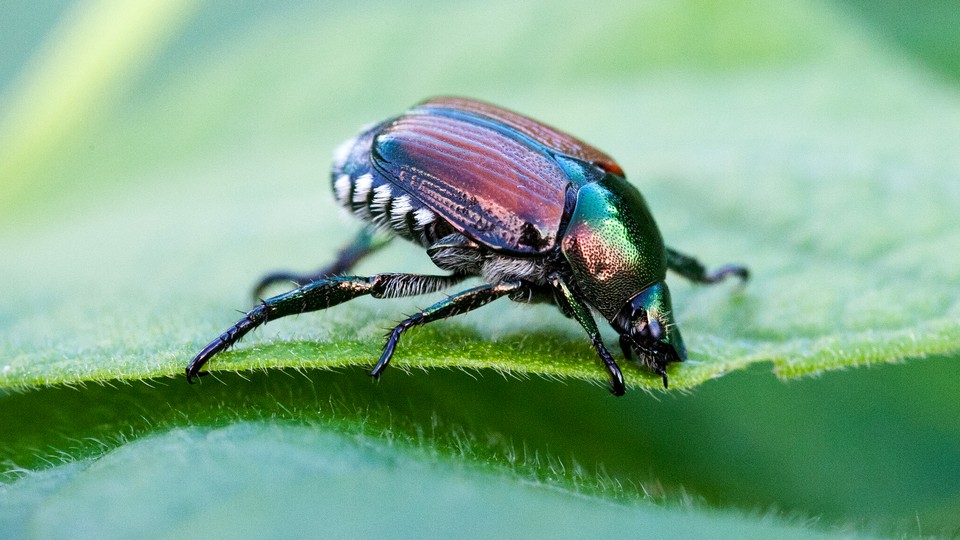
On an early July day, Amber Betts spent the afternoon in the community rose garden in Grandview, Washington. Several weeks earlier, invasive Japanese beetles had emerged in droves everywhere in Grandview, a town in central Washington’s Yakima Valley. The infestation had since quieted, but she still spotted a few insects: A cluster of fingernail-size iridescent green beetles, their coppery wings shining, were devouring a rose.
Unchecked, Japanese beetles’ numbers can skyrocket, and the insects can do extensive damage to plants, Betts, a public-information officer at the Washington State Department of Agriculture, told me. Cherries and hops, which collectively generated more than $800 million of revenue for the state last year, are among the 300 plants the beetles are known to eat. Although a population has taken up residence in Grandview, the beetles have not yet spread throughout Washington. Greg Haubrich, the manager of the pest program at the state’s department of agriculture, told me that officials are trying to eliminate the insect from the entire state. “We still do have a good chance of eradicating this,” he said.
Japanese beetles are native to Japan. They were first found in the U.S. in 1916 near Riverton, New Jersey. They have since become established in most states east of the Mississippi River, as well as in some states and counties in the Western United States. They lay their eggs in the soil in July and August. The eggs morph into lumpy white grubs that remain underground throughout the winter, quietly consuming the roots of grasses and other plants. They’re nigh impossible to detect until they emerge as adults in the spring and fly toward the scent of flowers and fruit.
Over the past 30 years, Western states have treated infested areas with pesticides, and most have prevented the beetle from gaining a foothold statewide. Still, officials are essentially playing a game of whack-a-mole: States will vanquish the beetles one year, only to experience a reintroduction years later. After capturing several thousand Japanese beetles in 2013, for example, Idaho reduced its infestation by nearly 90 percent by 2015. Last year, however, 77 beetles were found in Caldwell, in southern Idaho.
Officials first detected Japanese beetles in Grandview in 2020, in one of several dozen monitor traps scattered throughout the state. These rose-scented devices lure beetles into plastic bags from which they can’t escape, and they serve to both detect and dispatch the insects. In 2020, Betts said, state officials found three. The next year, after officials set up several hundred traps in Grandview, that number exploded to 24,000; Betts remembers her feet crunching on a carpet of dead beetles as she walked down a street. They caught roughly 1,000 fewer in 2022, evidence that the population has since shrunk.
The beetles threaten both crops and Washington’s native plants, some of which, including huckleberries, are endangered or culturally important to tribes in the state, said Haubrich. “We know these things will attack blueberries. So our concern is, will it attack huckleberries?” he said. “We think it probably will.”
Washington State officials instituted a quarantine in Grandview in 2022. Now there are hundreds of rose-scented traps in the city. Because the insects can hitch a ride on cars, on trucks, and especially in soil as eggs or grubs, residents cannot transport anything that might spread the beetles, such as lawn clippings or foliage. Farmers in the quarantine zone have to show that the traps in their fields don’t contain beetles before moving items out of the zone, or else treat their crops with pesticides. Each year, officials send out letters to residents asking for permission to spray their lawns and gardens.
Betts and Haubrich said that the residents of Grandview and surrounding towns, many of whom work in agriculture, are keenly aware of the threat and have been instrumental in the state’s detection and eradication efforts. Still, Grandview has proved a particularly tricky place to quarantine: It lies on Interstate 82, a major agricultural route. A resident of Wapato, about 30 miles north of Grandview, found multiple beetles in their garden last year.
So far, the Grandview quarantine is the only one in Washington. (Wapato is on the Yakama Indian Reservation, so the state agriculture department lacks the authority to institute a quarantine there; it is, however, partnering with Yakama Nation tribes to limit the beetles’ spread, Haubrich said.) But according to a study in the Journal of Economic Entomology published in June, the beetle could thrive in both eastern and western Washington. It seems to be able to adapt to new environments, and climate change could hasten the species’ expansion. Gengping Zhu, an entomologist at Washington State University and a co-author of the study, told me that without intervention, the beetle could spread throughout the state within 20 years.
Zhu said he worries that many people outside Yakima Valley may not know that the beetle poses a serious threat. “In Pullman, Seattle, Spokane, I don’t think they quite feel, obviously, the urgency of this issue,” he said.