How We Find Our Place in the Universe
A collaboration that includes the United States, China, and Russia points us toward a better future.
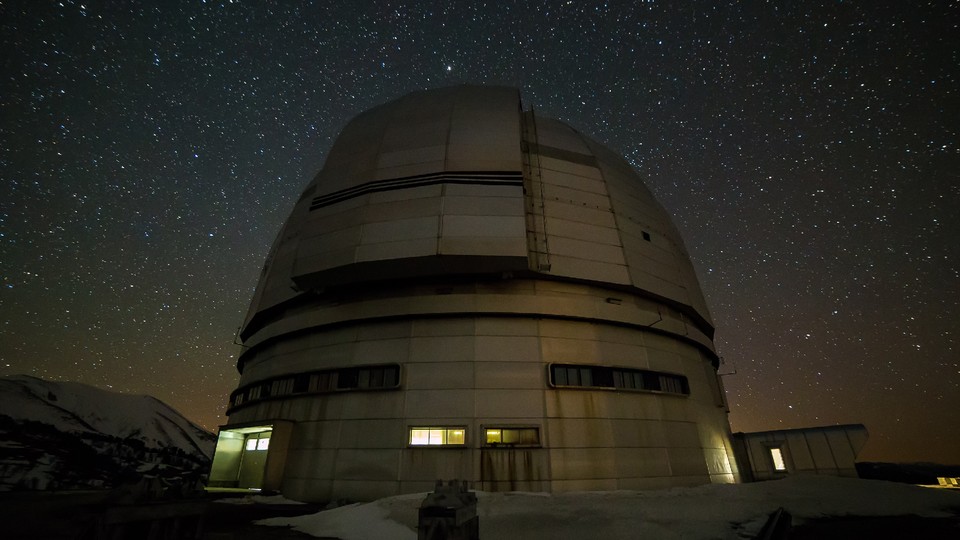
All of us living things have to find out where we are and where we are going. Earth’s first cell had only a dim chemical feel for its immediate liquid surroundings. But it multiplied fruitfully, and the animals that flowed from its lineages are able to navigate whole seas and continents. Birds have developed an inner sense of the Earth that allows them to traverse entire hemispheres. By animal standards, these are impressive feats of orientation, but they are crude compared with those that human beings have achieved. Our most sublime such effort is a global collaboration to build, over the course of decades, a network of more than 30 radio observatories that work together to situate our planet within a mind-bending volume of space.
These radio dishes span the planet, top to bottom. The northernmost one is wedged into an ice field in Svalbard, Norway. On-site staff are required to carry rifles in case of polar-bear attacks. Six other dishes are strung across the islands of the Japanese archipelago. The United States has several within its borders, including one in Hawaii. Russia and Italy have three each. One of China’s two observatories sits in arid Xinjiang. The other towers over a pine forest on Shanghai’s edge. On a rainy morning last August, I visited one of Australia’s five dishes in a sprawling landscape of gold-and-green canola fields 200 miles west of Sydney. The Aussies have another one on the bottom tip of Tasmania. It isn’t even the network’s southernmost dish. That honor belongs to Syowa Station, in Antarctica.
With the help of a complex fiber network, these instruments all voltron together to form the International VLBI Service for Geodesy and Astrometry (IVS). The nested abbreviation VLBI refers to a technique called “very-long-baseline interferometry.” By observing very distant objects in the universe, the networked telescopes are able to furnish us with a constant real-time map of Earth’s position within our galaxy, and a rough sense of the Milky Way’s own movement within tens of billions of other galaxies. Most of these observatories were not purpose-built. They pursue a variety of science goals. The IVS takes only a part of their observing time, but still enough so that at every moment of every day, a subset of the dishes are locked onto quasars in different regions of the deep sky.
Quasars are ultraluminous celestial objects that ignite when a galaxy’s central black hole absorbs enormous amounts of matter. If the ancient Greeks had known about them, quasars would have replaced thunderbolts as the favored weapons of the sky god Zeus. Most of them flared into being about 10 billion years ago, during our universe’s violent childhood, before it expanded to its current proportions. Galaxies were denser then. The black holes at their centers hadn’t yet mellowed into middle age. When gas, dust, and stars avalanched into them, they did not assimilate these materials gently, like a globule of mercury absorbing a droplet. A black hole would instead inflict all kinds of violent and chaotic frictions on the infalling matter, until its accretion disc ignited into a quasar. Huge sums of heat and light would radiate outward from a galaxy’s core. The resulting shock waves and high winds would often disperse its remaining gas clouds, sterilizing the galaxy by bringing star formation within its borders to an end.
Quasars are detectable longer than all other cosmic fireworks, save for the Big Bang. Those that ignited 10 billion years ago burned out long before the Earth even formed, but for a while they shone 1,000 times brighter than a galaxy full of stars, and the radio waves they emitted back then are only now reaching us. The IVS locks its observatories onto these distant, ancient sources of radiation for the same reason that a traveler might fixate on faraway mountains. They appear not to move, making them excellent orienting points.
For the network to work optimally, it must watch each quasar with at least three different dishes. The wave front of the quasar’s radiation will arrive at all three stations, but at slightly different times. Each little ping is time-stamped with an atomic clock so that the differences among them can be discerned and analyzed by seven dedicated supercomputers, also spread across the world. A few years ago, the whole network was upgraded. Now it can not only pinpoint the Earth’s precise position in space, along with the speed of its rotation and orbit around the sun, but also adjust for the solar system’s own 225-million-year orbital movement around the Milky Way.
At times, the quasars seem to wobble, but astronomers know better. Extremely distant objects have no apparent motion. It is the Earth’s crust that is moving: Eppur si muove. By tracking all the quasars’ illusory wobbles carefully, the network can perform an act of magic: Its observatories become like nodes on a motion-capture suit that wraps all the way around our planet’s surface. This spherical suit can pick up vibrations from colliding tectonic plates, and even a continent’s upward bob after a glacier slips off its edge into the sea—an ability that may, sadly, prove useful as our planet continues to warm.
The mere existence of the IVS reveals something else, something profound about what is happening here on the Earth’s surface. However fractious this moment in our history, geopolitical foes can still unite in a common cosmic purpose. Ancient light is pouring in from the far corners of the universe. The peoples of this planet are pooling it together to better understand our shared home, in a newly expansive context. Science has its evil uses, but there are times when it gives us a little glimpse into what a global civilization could be like. This, too, is a kind of orientation. It points a way forward.