An Exoplanet Discovery Akin to Finding an ‘Ostrich Egg in the Chicken Coop’
A very big planet orbiting a tiny star is challenging what scientists know about how planets form.
This article was originally published by The Conversation.
Imagine you’re a farmer searching for eggs in the chicken coop—but instead of a chicken egg, you find an ostrich egg, much larger than anything a chicken could lay.
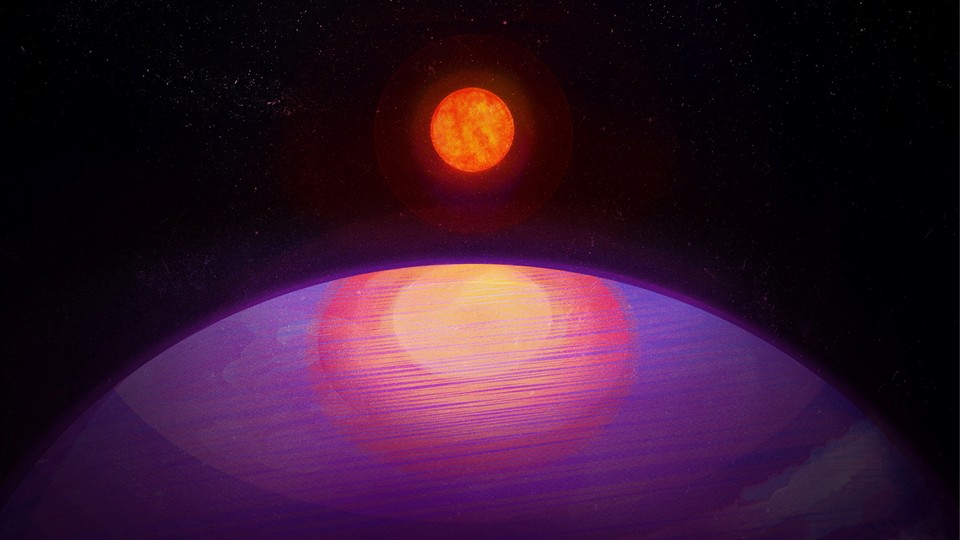
That’s a little like how our team of astronomers felt when we discovered a massive planet, more than 13 times heavier than Earth, orbiting around a cool, dim red star, nine times less massive than Earth’s sun, earlier this year.
The smaller star, called an M-star, is not only smaller than the sun in Earth’s solar system; it’s also 100 times less luminous. Such a star should not have the necessary amount of material in its planet-forming disk to birth such a massive planet.
Over the past decade, our team designed and built a new instrument at Penn State capable of detecting light from these dim, cool stars at wavelengths beyond the sensitivity of the human eye—in the near-infrared, where such cool stars emit most of their light.
Attached to the 10-meter Hobby-Eberly Telescope, in West Texas, our instrument, dubbed the Habitable Zone Planet Finder, can measure the subtle change in a star’s velocity as a planet gravitationally tugs on it. This technique, called the Doppler radial-velocity technique, is great for detecting exoplanets.
Exoplanet is a combination of the words extrasolar and planet, so the term applies to any planet-size body in orbit around a star that isn’t Earth’s sun. Some 30 years ago, Doppler radial-velocity observations enabled the discovery of 51 Pegasi b, the first known exoplanet orbiting a sunlike star. In the ensuing decades, astronomers like us have improved this technique. These more and more precise measurements have an important goal: to enable the discovery of rocky planets in habitable zones, or the regions around stars where liquid water can be sustained on the planetary surface.
The Doppler technique doesn’t yet have the capabilities to discover habitable-zone planets the mass of the Earth around stars the size of the sun. But the cool and dim M-stars show a larger Doppler signature for an Earth-size planet. The lower mass of the star leads to it getting tugged more by the orbiting planet. And the lower luminosity leads to a closer-in habitable zone and a shorter orbit, which also makes the planet easier to detect.
Planets around these smaller stars were the planets our team designed the Habitable Zone Planet Finder to find. Yet our new discovery, published in the journal Science, of a massive planet orbiting closely around the cool, dim M-star LHS 3154—the ostrich egg in the chicken coop—came as a real surprise.
Planets form in disks composed of gas and dust. These disks pull together dust grains that grow into pebbles and eventually combine to form a solid planetary core. Once the core is formed, the planet can gravitationally pull in solid dust as well as surrounding gases, such as hydrogen and helium. But it needs a lot of mass and materials to do this successfully. This way of forming planets is called core accretion.
A star with as low a mass as LHS 3154, nine times less massive than the sun, should have a correspondingly low-mass planet-forming disk. A typical disk around such a low-mass star should simply not have enough solid materials or mass to be able to make a core heavy enough to create such a planet. From computer simulations our team conducted, we concluded that such a planet needs a disk at least 10 times more massive than is typically assumed from direct observations of planet-forming disks.
A different planet-formation theory, gravitational instability—where gas and dust in the disk undergo a direct collapse to form a planet—also struggles to explain the formation of such a planet without a very massive disk. Cool, dim M-stars are the most common stars in our galaxy. In DC Comics lore, Superman’s home world, Krypton, orbited an M-dwarf star.
Astronomers know, from discoveries made with the Habitable Zone Planet Finder and other instruments, that giant planets in close-in orbits around the most massive M-stars are at least 10 times rarer than those around sunlike stars. And we knew of no such massive planets in close orbits around the least-massive M-stars—until the discovery of the planet LHS 3154b.
Understanding how planets form around our coolest neighbors will help us understand both how planets form in general and how rocky worlds around the most numerous types of stars form and evolve. This line of research could also help astronomers understand whether M-stars are capable of supporting life.