'Don't Be That Guy'
Some remaining thoughts from readers on the taboo topic:
One of your readers is quoted as writing, “It’s clear to any sane person that a rapist is completely to blame for a rape.” The problem here is that word “blame”—because for most rapes, there are many, many people who think nobody is to blame, because (they think) there was no rape: The person assaulted wanted to have sex, but changed their mind later, or was ashamed, or was just a lying slut with mysterious motives.
Another reader:
This discussion is hard, because some of the answers are incongruously lofty and nuanced relative to the stark evil of rape. But I think it’s too important and the topic needs to be exhausted.
The distinction between the onus for prevention and criminal responsibility is getting muddled: of course the perpetrator is the only person responsible for the crime, and of course, in a specific instance of rape, it is entirely inappropriate to broach prevention at risk of exacerbating the victim’s tendency to feel ashamed. But speaking generally, the major point is that the onus for prevention cannot be placed on the perpetrator, any more than the onus for defeating ISIS can be placed on ISIS. It’s nonsensical. A rapist is not going to heed a listicle of ten ways to avoid sexually assaulting a person, and a PSA on serial killing will never stymie a future Ted Bundy.
Only a decent society and potential victims can take steps to prevent rape. It’s unfair for any responsibility to fall on potential victims, but we live in a world where systemic solutions are slow-moving and imperfect. We have to consider prevention from the individual point of view. Obviously the most controversial subject of prevention is clothing, and I think nothing short of a gender-concealing robot suit would have any effect. But if we care about prevention more than fairness, we should be willing to study the situations around sexual assault and the minds of sexual deviants from every angle, and consider and share every conclusion.
Any final thoughts? Shoot me an email and I’ll post. Update from a reader, who quotes the one above:
[T]he major point is that the onus for prevention cannot be placed on the perpetrator, any more than the onus for defeating ISIS can be placed on ISIS. It’s nonsensical. A rapist is not going to heed a listicle of ten ways to avoid sexually assaulting a person...
I actually think their point about separating responsibility for prevention vs guilt is reasonable, but the argument I quoted is flawed. A big part of the modern anti-rape movement is the realization that many people sincerely do not realize they’re committing rape—for example, with women who are too drunk or otherwise incapacitated to consent.
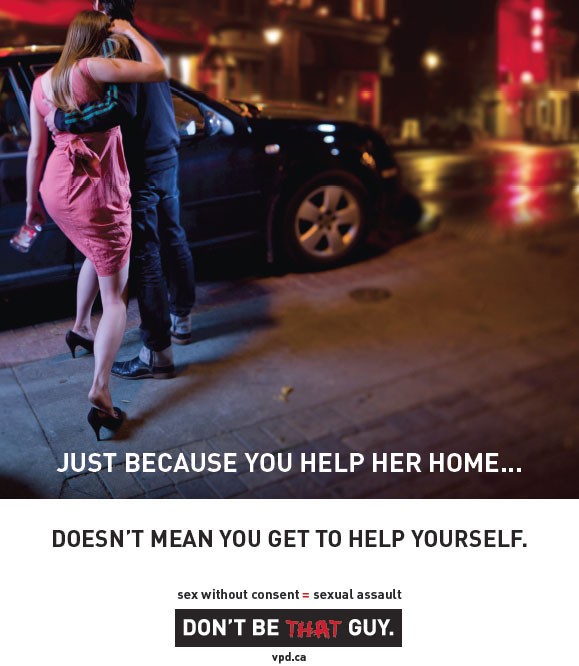
That’s why you have campaigns like “Don’t be that guy [poster seen above],” which are actually trying to address rape prevention from the male perspective. Their effectiveness seems to be inconclusive so far, but the premise doesn’t seem unreasonable on the face of it.
Anyway, thanks for doing this discussion! It’s an interesting one to have.
