The Cirrus Design company, of Duluth MN, brought its first all-new, designed-from scratch small airplane, the SR-20, to the market nearly ten years ago. Through the previous half-century, the other main manufacturers (Cessna, Beechcraft, Piper, Mooney, etc) had offered very, very gradual improvements in their propeller-plane lineup. When I was taking flight lessons a dozen years ago, I used rented Cessnas that had been built in the 1970s and designed in the 1950s.
Cirrus said that instead it would keep up a computer-industry-like pace of new products, making each existing model "obsolete" only because it kept having something better for people to buy. More or less it has lived up to that promise, with a series of improvements in engines, engineering, control systems, plus a recently announced "personal jet." (The story of Cirrus's emergence as a high-tech innovator in a previously dormant industry was part of my 2001 book Free Flight.)
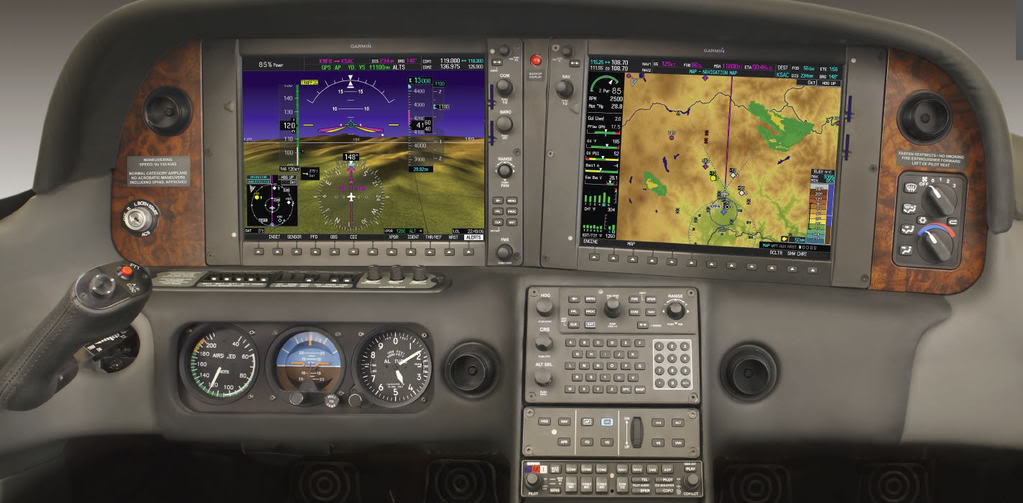
This week Cirrus introduced the third fundamental redesign of its cockpit instrumentation. Its original SR-20 airplane had a then-impressive moving map system from the Arnav company. (I bought an early SR-20 in 2000 and flew it for six years, before selling it when moving to China.) Then it offered a snazzier system from Avidyne, with "Primary Flight Display" that in many ways made it easier to fly the airplane. This week it announced a complete new cockpit panel design, based on a partnership with the leading GPS company Garmin. It looks like this (click for detailed version):
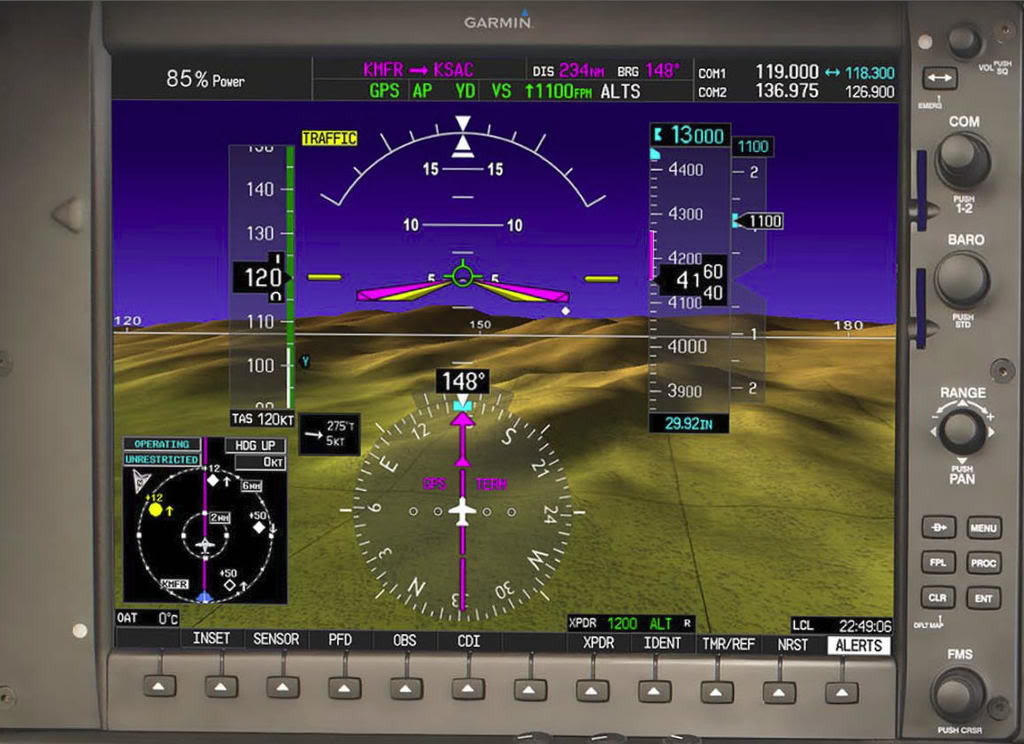
An exhaustive run down of the features and innovations is here, on a blog from "Turbo" Bob Anderson a long-time aviator and owner of several Cirrus models. (These two illustrations are via his blog.) An immediate point to notice is the "synthetic vision" feature on the left-hand panel. The idea here is that even when it's dark, even when it's cloudy, the screen gives an idea of where the runway is, where obstacles and mountains are, etc.
Obviously this not what pilots are supposed to rely on to find their way when they can't see. That's the whole point of instrument flight plans, instrument approaches and departure procedures, and so on. But this kind of easily-understandable graphic display can make a huge difference in "situational awareness," which is the aviation term for the main trait that can keep you alive in difficult circumstances. The features in this cockpit far exceed what's available in most commercial airliners. The new planes will be very expensive. My hope is that they prove so popular that eventually they drift down to a discounted used-plane market, as has happened with previous models from Cirrus.
Update: the editor of AOPA Pilot, Thomas Haines, also has a rundown on the new Cirrus here. He emphasizes a different new feature: the bright blue "LVL" button, that is supposed to return the plane to straight-and-level flight from conditions of extreme pitch and roll (up to 75 degrees of bank and 50 degrees of pitch). Although Haines doesn't put it this way, this button could be applied in JFK Jr-type situations, in which the pilot has lost control of the plane (usually because he can't see the horizon or tell up from down) and needs help before it's too late.