Slouching Toward ‘Accept All Cookies’
When everything we do online is data to be harvested, resignation is easy. But there’s a better way to think about digital privacy.
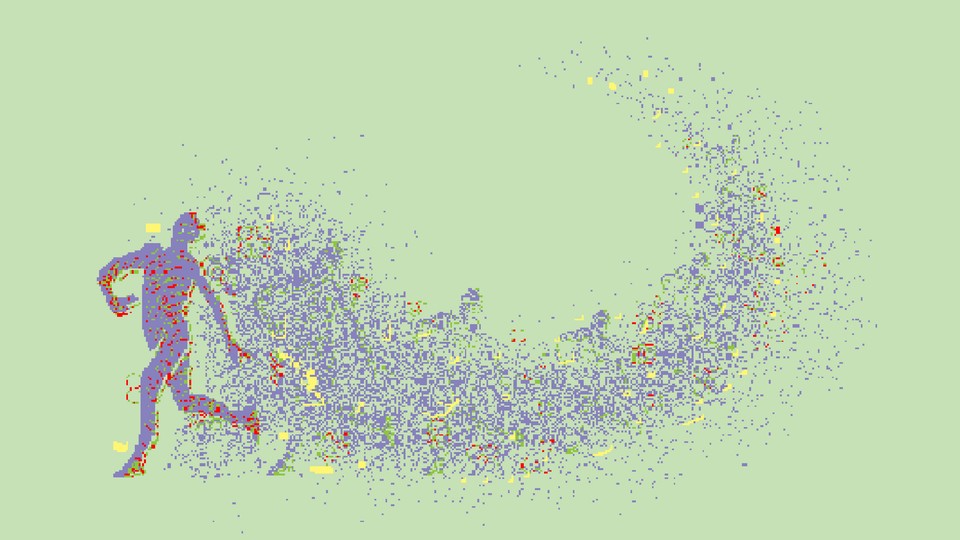

We are all shedding data like skin cells. Almost everything we do with, or simply in proximity to, a connected device generates some small bit of information—about who we are, about the device we’re using and the other devices nearby, about what we did and when and how and for how long. Sometimes doing nothing at all—merely lingering on a webpage—is recorded as a relevant piece of information. Sometimes simply walking past a Wi-Fi router is a data point to be captured and processed. Sometimes the connected device isn’t a phone or a computer, as such; sometimes it’s a traffic light or a toaster or a toilet. If it is our phone, and we have location services enabled—which many people do, so that they can get delivery and Find My Friends and benefit from the convenience of turn-by-turn directions—our precise location data are being constantly collected and transmitted. We pick up our devices and command them to open the world for us, which they do quite well. But they also produce a secondary output too—all those tiny flecks of dead skin floating around us.
Our data are everywhere because our data are useful. Mostly to make people money: When someone opens up their phone’s browser and clicks on a link—to use the most basic example—a whole hidden economy whirs into gear. Tracking pixels and cookies capture their information and feed it to different marketers and companies, which aggregate it with information gleaned from other people and other sites and use it to categorize us into “interest segments.” The more data gathered, the easier it is to predict who we are, what we like, where we live, whom we might vote for, how much money we might have, what we might like to buy with it. Once our information has been collected, it ricochets around a labyrinthine ad-tech ecosystem made up of thousands of companies that offer to make sense of, and serve hyper-targeted ads based on, it.
Our privacy is what the internet eats to live. Participating in some part or another of the ad-tech industry is how most every website and app we use makes money. But ad targeting isn’t the only thing our data are good for. Health-care companies and wearables makers want our medical history and biometric data—when and how we sleep; our respiratory rate, heart rate, steps, mile times; even our sexual habits—to feed us insights via their products. Cameras and sensors, on street corners and on freeways, in schools and in offices, scan faces and license plates in order to make us safer or identify traffic patterns. Monitoring software tracks students taking tests and logs the keystrokes of corporate employees. Even if not all of our information goes toward selling ads, it goes somewhere. It is collected, bought, sold, copied, logged, archived, aggregated, exploited, leaked to reporters, scrutinized by intelligence analysts, stolen by hackers, subjected to any number of hypothetical actions—good and bad, but mostly unknowable. The only certainty is that once our information is out there, we’re not getting it back.
It’s scary and concerning, but mostly it’s overwhelming. In modern life, data are omnipresent. And yet, it is impossible to zoom out and see the entire picture, the full patchwork quilt of our information ecosystem. The philosopher Timothy Morton has a term for elements of our world that behave this way: A hyperobject is a concept so big and complex that it can’t be adequately described. Both our data and the way they are being compromised are hyperobjects.
Climate change is one too: If somebody asks you what the state of climate change is, simply responding that “it is bad” is accurate, but a wild oversimplification. As with climate change, we can all too easily look at the state of our digital privacy, feel absolutely buried in bad news, and become a privacy doomer, wallowing in the realization that we are giving our most intimate information to the largest and most powerful companies on Earth and have been for decades. Just as easy is reading this essay and choosing nihilism, resigning yourself to being the victim of surveillance, so much so that you don’t take precautions.
These are meager options, even if they can feel like the only ones available. Digital privacy isn’t some binary problem we can think of as purely solvable. It is the base condition and the broader context of our connected lives. It is dynamic, meaning that it is a negotiation between ourselves and the world around us. It is something to be protected and preserved, and in a perfect world, we ought to be able to guard or shed it as we see fit. But in this world, the balance of power is tilted out of our reach. Imagine you’re in a new city. You’re downloading an app to buy a ticket for a train that’s fast approaching. Time is of the essence. You hurriedly scroll through a terms-of-service agreement and, without reading, click “Accept.” You’ve technically entered a contractual agreement. Now consider that in such a moment, you might as well be sitting at a conference table. On one side is a team of high-priced corporate lawyers, working diligently to shield their deep-pocketed clients from liability while getting what they need from you. On the other side is you, a person in a train station trying to download an app. Not a fair fight.
So one way to think of privacy is as a series of choices. If you’d like a service to offer you turn-by-turn directions, you choose to give it your location. If you’d like a shopping website to remember what’s in your cart, you choose to allow cookies. But companies have gotten good at exploiting these choices and, in many cases, obscuring the true nature of them. Clicking “Agree” on an app’s terms of service, might mean, in the eyes of an exploitative company, that the app will not only take the information you’re giving up but will sell it to, or share it with, other companies.
Understanding that we give these companies an inch and they take a mile is crucial to demystifying their most common defense: the privacy paradox. That term was first coined in 2001 by an HP researcher named Barry Brown who was trying to explain why early internet users seemed concerned about data collection but were “also willing to lose that privacy for very little gain” in the form of supermarket loyalty-rewards programs. People must not actually care so much about their privacy, the argument goes, because they happily use the tools and services that siphon off their personal data. Maybe you’ve even convinced yourself of this after almost two decades of devoted Facebooking and Googling.
But the privacy paradox is a facile framework for a complex issue. Daniel J. Solove, a professor at George Washington University Law School, argues the paradox does not exist, in part because “managing one’s privacy is a vast, complex, and never-ending project that does not scale.” In a world where we are constantly shedding data and thousands of companies are dedicated to collecting it, “people can’t learn enough about privacy risks to make informed decisions,” he wrote in a 2020 article. And so resignedly and haphazardly managing our personal privacy is all we can do from day to day. We have no alternative.
But that doesn’t mean we don’t care. Even if we don’t place a high value on our personal data privacy, we might have strong concerns about the implications of organizations surveilling us and profiting off the collection of our information. “The value of privacy isn’t based on one’s particular choice in a particular context; privacy’s value involves the right to have choices and protections,” Solove argues. “People can value having the choice even if they choose to trade away their personal data; and people can value others having the right to make the choice for themselves.”
This notion is fundamental to another way to think of privacy: as a civil right. That’s what the scholar Danielle Keats Citron argues in her book The Fight for Privacy. Privacy is freedom, and freedom is necessary for humans to thrive. But protecting that right is difficult, because privacy-related harm is diffuse and can come in many different forms: At its most extreme, it can be physical (violence and doxxing), reputational (the release of embarrassing or incorrect information), or psychological (the emotional distress that comes along with having your intimate information taken from you). But, according to work by Solove and Citron, proving harm that goes beyond concrete economic loss is difficult in legal terms.
Citron argues in her book that we need a new social compact, one that includes civic education about privacy and why it is important. Simply understanding our right to privacy won’t vaporize overly permissive, opt-out data collection. It won’t completely correct the balance of power. But it will begin to give us a language for what is at stake when a new company or service demands our information with few safeguards. This education is not just for children but for everyone: executives, tech employees, lawmakers. It is a way to make the fight a bit fairer.
And how should we think about our data—all that digital dandruff? Scale is part of the problem here: Giving up an individual piece of location data may not feel all that meaningful, but having all of your movements tracked might constitute a violation. Context is also important: A piece of private sexual-health data may be a guarded secret of life-and-death import to the person it originated from; to a health-care conglomerate, that data point may be worth a fraction of a fraction of a cent. But when data are sliced and categorized and placed into profiles and buckets, their value increases. In 2020, Facebook made 97.9 percent of its revenue—nearly $85 billion—off of targeted ads, pinpointed by such data collection. Data, in the aggregate, is an asset class, one that powers innovative technologies and inflates bottom lines.
In a 2019 essay, the technologist Can Duruk discussed an analogy that, he admits, is a bit cliché: Data is the new oil. Extracting it is dirty, and storing it is dangerous. “We are barely recognizing the negative externalities of decades of oil production and consumption now, and it took us almost destroying the planet,” he writes. “We should do a better job for data.”
It’s interesting to imagine a society that would force companies to treat data as an oil-like commodity, something valuable, rather than digital ephemera in inexhaustible supply—where not only would the environmental toll of leaks and spills be remedied but victims could attempt to hold liable those trusted with storage. Maybe we’d demand a sort of supply-chain transparency to trace the flow of the product around the world. Maybe we’d find a way to quantify the externality.
Digital privacy’s climate-change analogy is not perfect, but when it comes to calls to action, the parallel is helpful. No single law or innovation could adequately reshape the world we’ve spent decades building. Quick fixes or sweeping legislative changes may very well have unintended consequences. We cannot totally reverse what we’ve put into motion. But there is always a reason to push for a better future. Last year, the environmentalist, author, and activist Bill McKibben wrote about a climate question he hears frequently: How bad is it? He is unsparing in his assessment but never overly alarmist. “Despair is not an option yet,” he writes. “At least if it’s that kind of despair that leads to inaction. But desperation is an option—indeed, it’s required. We have to move hard and fast.”
When reckoning with a subject as complex and fundamental as our digital privacy, metaphor is appealing—I’ve certainly reached for it throughout this essay. Our information is oil: a pollutant, a liability, a thing that powers the world. It’s skin cells: floating all around us. It’s a hyperobject: impossible to understand in its entirety all at once. If our data are what the internet feeds off of, maybe each piece—every datum, every bit of information from every tiny thing we do—is a calorie: incredibly powerful in the aggregate but invisible and incomprehensible to the naked eye, a sort of hypo-object.
We keep grasping for these metaphors because all are helpful, but none is quite sufficient. The internet as we know it is a glorious, awful, intricate, sprawling series of networks that needs our information in order to function. We cannot go back to a time before this was true—before turn-by-turn directions and eerily well-targeted ads, before we carried little data-collection machines in our pockets all day—and nor would all of us want to. But we can demand much more from the reckless stewards of our information. That starts with understanding what exactly has been taken from us. The fight for our privacy isn’t just about knowing what is collected and where it goes—it is about reimagining what we’re required to sacrifice for our conveniences and for a greater economic system. It is an acknowledgment of the trade-offs of living in a connected world, but focusing on what humans need to flourish. What is at stake is nothing less than our basic right to move through the world on our terms, to define and share ourselves as we desire.
