

98.03.04
Banking on Bright Ideas
What do lost-pet ads, dentist-office ceilings, and in-flight recordings have in common?
98.02.25
ThinkQuest
Techno-savvy kids.
98.02.19
Mapping Cyberspace
Is there a "there" there?
98.02.11
Information-Free
Sometimes the Web can be its own best antidote.
98.02.04
Clintonalia
Investigating rumors of a vast conspiracy.
98.01.28
Eye Candy
Art for the interface's sake.
98.01.22
Alternating Currents
An online exhibit surveys the impact of technology on late-twentieth-century art.
98.01.15
Janeites Unite
Jane Austen's place in cyberspace.
98.01.08
Inquiring Minds
What questions are on our "most complex and sophisticated minds"?
97.12.31
Sites of the Year
A look back at our favorite sites of 1997.
For more, see the complete Web Citations Index.
 "Anybody who would have you believe they have the Internet figured out from a business model standpoint is just kidding themselves."
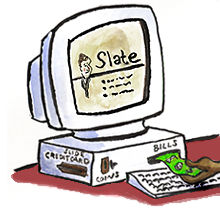
So Rogers Weed, the publisher of Microsoft's online magazine, Slate -- which went on sale this week, bravely charging readers $19.95 for a one-year subscription -- recently told The Wall Street Journal. The deep-pocketed Webzine has been threatening to charge readers since it was launched, with much fanfare, in June, 1996. At that time Slate's editor, Michael Kinsley, wrote:
We want to be self-supporting. Indeed one of Slate's main goals is to demonstrate, if we can, that the economies of cyberspace make it easier for our kind of journalism to pay for itself.... If the Web can make serious journalism more easily self-supporting, that is a great gift from technology to democracy.Slate has managed to put off the day of reckoning for nearly two years. Meanwhile, other Web sites have begun or have announced plans to start charging for access to some or all of their online features. The Wall Street Journal Interactive, The Economist, Money, Business Week, Playboy (and countless other sex-oriented sites), ESPN Sportzone, Entertainment Weekly, and others, are asking readers to ante up. Of course, these titles tell us something -- today, just about the only kinds of "information" proven to sell online consists of sex, sports, or stocks.
 In this context, Weed's desire to keep expectations low is understandable: The Journal quotes him as saying that 20,000 paid subscribers in the first few months would be a good start (compare that to the 150,000 subscribers boasted by The Wall Street Journal Interactive). At $19.95 a head, that won't come close to covering Slate's operating costs -- and it could, by reducing the overall number of visitors to the site, make it harder to sell advertising. Nevertheless, meeting the goal would show that a substantial number of people are willing to pay for serious opinion journalism on the Web.
Because Slate is the first online-only magazine of politics and culture to make the gamble, and because it's owned by Microsoft, it may be tempting for some who follow the industry to pin all the hopes (and fears) attending online journalism on Microsoft's venture -- as though the success of new media, at this stage of the Web's development, could somehow ride on the success or failure of one electronic magazine. Such temptations ought to be resisted.
In the meantime, here's wishing the folks at Slate all the best. Our check is in the mail.
Copyright © 1998 by The Atlantic Monthly Company. All rights reserved.
 |
 |
 |
 |
 |
 |