

98.05.13
6 Billion Human Beings
An online exhibit from the Museum of Natural History in Paris looks at our burgeoning humanity, en masse and one at a time.
98.05.06
Beyond Interface
The state of art on the Net.
98.04.29
Child's Play
The CIA reaches out to a new generation of spies.
98.04.23
Multicultural Lite
A multimedia "essay" has technology serve humanity, and vice versa.
98.04.16
Do-It-Yourself Adventure
"Interactive fiction" moves to the Web.
98.04.08
The "Why?"s Have It
For a nation of strangers, the simplest questions can help bridge the widest distances.
98.04.01
Dances With Words
Experiments in "information choreography."
98.03.25
Non-virtual Communities
Competing visions of post-suburban life give new meaning to the "global village."
For more, see the complete Web Citations Index.
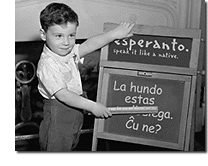 In 1878 the nineteen-year-old Lazar Zamenhof, unsettled
by the enduring antagonisms between his native Poland's various
ethnic groups (Poles, Russians, Germans, Lithuanians, Jews, and others),
decided that much of the problem was linguistic: people who spoke different
languages just didn't seem to get along. Zamenhof therefore resolved to create
from scratch an easy-to-learn language, to be spoken internationally as a
second language; the idea was that people from all backgrounds would be able to
communicate in a culturally neutral context. Nine years later, under the
pseudonym "Doktoro Esperanto," Zamenhof published a textbook outlining the
rudiments of his new language, for which he proposed the name, "Lingva Internacio." (A slowly growing number of converts, though, soon
began to refer to it simply as "Esperanto.") Zamenhof's creation is now the
world's most popular "planned" language, and today Esperantists, optimists at heart,
estimate their population -- large clusters of which can be found in
Eastern Europe, China, Japan, Iran, Brazil, and Cuba -- at some two million.
(At the very least the number is in the hundreds of thousands.)
In 1878 the nineteen-year-old Lazar Zamenhof, unsettled
by the enduring antagonisms between his native Poland's various
ethnic groups (Poles, Russians, Germans, Lithuanians, Jews, and others),
decided that much of the problem was linguistic: people who spoke different
languages just didn't seem to get along. Zamenhof therefore resolved to create
from scratch an easy-to-learn language, to be spoken internationally as a
second language; the idea was that people from all backgrounds would be able to
communicate in a culturally neutral context. Nine years later, under the
pseudonym "Doktoro Esperanto," Zamenhof published a textbook outlining the
rudiments of his new language, for which he proposed the name, "Lingva Internacio." (A slowly growing number of converts, though, soon
began to refer to it simply as "Esperanto.") Zamenhof's creation is now the
world's most popular "planned" language, and today Esperantists, optimists at heart,
estimate their population -- large clusters of which can be found in
Eastern Europe, China, Japan, Iran, Brazil, and Cuba -- at some two million.
(At the very least the number is in the hundreds of thousands.)  These days, however, the largest and most significant concentration of Esperantists is to
be found on the Internet, the vast electronic petri dish in which utopian
dreams of global communication teem and multiply.
Two of the best general introductions to what's available online are Esperanto
Access (in English) and Virtuala Esperanto-Biblioteka (in Esperanto), both of which offer an abundance of links to
Esperanto-related resources online, including historical background,
dictionaries, translators, grammar guides, electronic correspondence courses,
academic departments and publications, Internet associations, e-mail lists,
periodicals, literature, library holdings, and so on -- not to mention a
baffling variety of links to sites maintained by such special-interest groups
as Baha'i Esperantists, gay Esperantists, Esperanto journalists, and,
improbably, the Stomatological Section of the World Medical Esperantist
Association. Even more intriguing are the audio files
of the regular radio broadcasts made around the world in
Esperanto.
These days, however, the largest and most significant concentration of Esperantists is to
be found on the Internet, the vast electronic petri dish in which utopian
dreams of global communication teem and multiply.
Two of the best general introductions to what's available online are Esperanto
Access (in English) and Virtuala Esperanto-Biblioteka (in Esperanto), both of which offer an abundance of links to
Esperanto-related resources online, including historical background,
dictionaries, translators, grammar guides, electronic correspondence courses,
academic departments and publications, Internet associations, e-mail lists,
periodicals, literature, library holdings, and so on -- not to mention a
baffling variety of links to sites maintained by such special-interest groups
as Baha'i Esperantists, gay Esperantists, Esperanto journalists, and,
improbably, the Stomatological Section of the World Medical Esperantist
Association. Even more intriguing are the audio files
of the regular radio broadcasts made around the world in
Esperanto. As recent academic studies with titles like "Creolization and Spontaneous Change in Esperanto" and "What is Colloquial Esperanto?" suggest, Esperanto seems to be taking on a life of its own. This is a good sign, since at many points in its life Esperanto has seemed on the verge of dying out, starved for an interactive community of speakers. Those days may now well be over. The Internet is becoming Esperanto's life-support system.
Copyright © 1998 by The Atlantic Monthly Company. All rights reserved.
 |
 |
 |
 |
 |
 |