

98.07.15
Miles Ahead
An elegant multimedia tribute to the music (and commercial appeal) of Miles Davis.
98.07.08
Eminent Domains
Making sense of the great Internet land grab.
98.07.01
Artists in Lab Coats.
Call it "the work of art in the age of scientific photography."
98.06.24
Armchair Activism.
Those too busy (or lazy) for environmental causes have no more excuses.
98.06.18
Free Truman Burbank!
For some, television's pernicious influence is no joking matter.
98.06.04
Alexandria's Ghosts.
As the Internet makes abundantly clear, the line between an archive and a rubbish heap is a fine one.
98.05.27
I Thee Web
Get me to the church online.
For more, see the complete Web Citations Index.
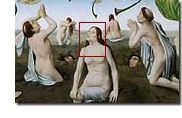 A woman sits -- hair falling down her back, white
shoulders bared -- at the bottom of Last Judgment (c. 1505), a
Renaissance painting by Jan Provoost. A close-up photograph of her bare
torso exposes the faint tracings of a lock of hair falling forward over her
shoulder -- evidence of the artist's earlier intentions. Moving in even
closer, a "microphotograph" reveals the precise brushstrokes. These images,
along with other examples of digital-imaging techniques, are featured in Investigating the
Renaissance, an interactive online exhibit demonstrating the
technologies used by art conservationists and historians.
A woman sits -- hair falling down her back, white
shoulders bared -- at the bottom of Last Judgment (c. 1505), a
Renaissance painting by Jan Provoost. A close-up photograph of her bare
torso exposes the faint tracings of a lock of hair falling forward over her
shoulder -- evidence of the artist's earlier intentions. Moving in even
closer, a "microphotograph" reveals the precise brushstrokes. These images,
along with other examples of digital-imaging techniques, are featured in Investigating the
Renaissance, an interactive online exhibit demonstrating the
technologies used by art conservationists and historians.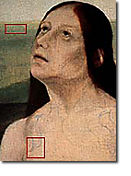 Created by curators from Harvard's Fogg Art Museum, Investigating the
Renaissance is a thoroughly informative introduction to the latest
technology used by art scholars. Digital imaging has enabled scholars to
figure out, for example, the types of paint an artist used, the years a
painting was started and finished, and whether a work is a copy or an
original. The uses of infrared reflectography, X-radiography, and
ultraviolet light, as applied to three early Netherlandish paintings, are
neatly demonstrated on the site through high-resolution images and
Shockwave Plug-ins. The rich, dark-colored (and anonymous) Portrait of a
Man,for instance, can be reduced by a series of mouse clicks down to
its black-and-white "underdrawing" -- the foundation many artists of the
period sketched and then painted over. This technique has enabled scholars
to determine which period and school the artist belonged to.
Created by curators from Harvard's Fogg Art Museum, Investigating the
Renaissance is a thoroughly informative introduction to the latest
technology used by art scholars. Digital imaging has enabled scholars to
figure out, for example, the types of paint an artist used, the years a
painting was started and finished, and whether a work is a copy or an
original. The uses of infrared reflectography, X-radiography, and
ultraviolet light, as applied to three early Netherlandish paintings, are
neatly demonstrated on the site through high-resolution images and
Shockwave Plug-ins. The rich, dark-colored (and anonymous) Portrait of a
Man,for instance, can be reduced by a series of mouse clicks down to
its black-and-white "underdrawing" -- the foundation many artists of the
period sketched and then painted over. This technique has enabled scholars
to determine which period and school the artist belonged to.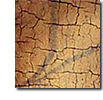 Many of the details about the histories of works of art used to be shrouded
in mystery. But armed with the sorts of sleuthing tools featured in
Investigating the Renaissance, art scholars are now able to ferret out all
sorts of heretofore inaccessible information. Artists, as it turns out, are
going to find it ever more difficult to hide their mistakes and bury their
secrets.
Many of the details about the histories of works of art used to be shrouded
in mystery. But armed with the sorts of sleuthing tools featured in
Investigating the Renaissance, art scholars are now able to ferret out all
sorts of heretofore inaccessible information. Artists, as it turns out, are
going to find it ever more difficult to hide their mistakes and bury their
secrets.
Copyright © 1998 by The Atlantic Monthly Company. All rights reserved.
 |
 |
 |
 |
 |
 |