




Risotto, Pilaf, Fluffy Rice, and Paella
How to Roast Vegetables
Determining Doneness
January 20, 2000
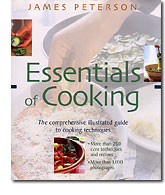 James Peterson is an authoritative teacher who has written definitive and award-winning books like Sauces (1991), Splendid Soups (1993), Fish and Shellfish (1996), and Vegetables (1998). The last two especially show his comprehensive approach to distilling his enormous amount of professional expertise -- acquired as a chef in Paris and Greenwich Village -- into what will be useful to home cooks.
Now he has set his sights both lower and higher, creating a picture book that aims to be a kitchen primer for the beginning cook. In fact Essentials of Cooking is of great interest to experienced cooks too, because Peterson has obsessively documented the preparation and cooking of vegetables, fruit, fish, poultry, and meat as no one has since Jacques Pepin published two large books on technique.
Previously in Corby's Table:
Encyclopedia Gastronomica -- December 22, 1999
Corby Kummer makes his way through The Oxford Companion to Food -- and still finds Room for Dessert.
Italian Soul Food -- October 14, 1999
Corby Kummer serves up selections from Lynne Rossetto Kasper's The Italian Country Table.
Countercultural Cooking -- September 15, 1999
Corby Kummer on Chez Panisse -- the influential Berkeley, California, restaurant that started as a countercultural collective -- and the new Chez Panisse Café Cookbook.
Charmed by Chile -- August 18, 1999
A new collection of home-style recipes reflects the Chilean way of life.
Hail to the Chef -- July 15, 1999
A tribute to Patrick Clark, a chef who was a model for many young African-Americans and an inspiration to other chefs.
Persian Appeal -- June 3, 1999
A look at Najmieh Batmanglij's A Taste of Persia, and the subtle yet persistent spices of Iranian cuisine.
Help! My Child Is a Vegan! -- April 28, 1999
Stephanie Pierson's useful new guide for teenage vegetarians, and those who love them anyway.
Seasons and Seasonings -- March 3, 1999
A seasonal guide to cooking from the garden by Amanda Hesser, a young woman who knows and loves food.
Seductions of Rice -- January 27, 1999
Selections from a new guide to the universal grain's many flavors.
A Passion for Pastry -- December 17, 1998
Two books that will have you dreaming of the perfect holiday dessert.
More by Corby Kummer in Atlantic Unbound
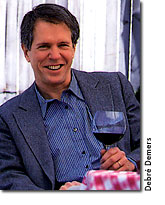 |
| James Peterson |
Like all great teachers, Peterson assumes nothing on the part of his pupils and therefore gives everything, with great economy and concision. This book is relatively short, the chapters relatively few. But it is a lifetime of working and teaching that has enabled Peterson to make his choices.
Most layouts in the book rely, of course, on pictures. But here are two sections that are readily comprehensible in text form: making risotto and pilaf (and the difference between the two) and roasting vegetables -- extremely fashionable right now for the concentrated flavor and silken texture the method gives low-flavor and humdrum vegetables, particularly the root ones available during winter. I also include Peterson's notes on determining the doneness of foods, which appear in the book without photographs, to show how much information Peterson can compress into very little space. Any young cook will welcome Peterson's tips; any experienced cook will be fascinated.
-- Corby Kummer
Excerpts from Essentials of Cooking, by James Peterson
How to Cook Risotto, Pilaf, Fluffy Rice, and Paella
Some rice dishes, such as risotto, emphasize the natural starchiness of rice and are designed to help the rice grains cling together in a natural creamy sauce while other dishes, such as pilaf, keep the grains of rice separate and relatively fluffy. Each of the dishes here uses a different kind of rice and a different technique to underline the desired effect.
To make plain boiled rice so that none of the grains sticks together, use firm, long-grained rice, such as basmati, and boil it in a large pot of boiling water as though cooking pasta.
Rice pilaf is made by first cooking long-grain rice in a small amount of fat to cook the starch before the liquid is added. Flavorful ingredients, usually onions and sometimes garlic, are cooked in the fat along with the rice before the liquid is added.
Risotto is a creamy rice dish made with short-grain Italian rice. The rice, usually vialone nano, carnaroli, or arborio, is gently cooked in butter or olive oil. Liquid, usually broth, is then added a small amount at a time until the rice is cooked and bathed in creamy liquid. Risotto must be stirred almost constantly to release the starch from the rice so the starch thickens the broth, giving the dish its characteristic creamy (sometimes even soupy) consistency. The flavoring in a risotto may be very simple (as for a risotto alla Milanese) or relatively complex.
Paella is made by cooking Spanish medium-grain rice in a flavorful liquid and then nestling in ingredients such as chicken, sausages (chorizos), seafood, and, in some versions, snails. Traditionally, paella is cooked over an open fire, but it can also be cooked on the stove or in the oven.
Risotto alla Milanese
This classic risotto is flavored with chicken broth, saffron, butter, and finely grated Parmigiano-Reggiano (true Italian Parmesan cheese).
1. Rinse short-grained rice in a strainer.
2. Gently stir the rice in butter over low to medium heat until the grains are all lightly coated with butter.
3. Sprinkle over a pinch of saffron threads and stir in a small amount (about 1/2 cup) of chicken broth, or enough to just barely cover the rice. Continue stirring until all the broth has been absorbed.
4. Keep adding broth, just enough to barely cover the rice each time, until the risotto has a creamy consistency and the rice grains are cooked through (bite into one to test) about 25 minutes.
5. Stir in freshly grated Parmigiano-Reggiano and butter. Season to taste with salt and pepper and serve immediately.
Kitchen Notes and Tips
Roasting pulls the water out of vegetables and concentrates their flavor. (Taste a roasted carrot next to a boiled carrot, and you'll see how roasting emphasizes the vegetable's natural sweetness.) Roasting works best for root vegetables, such as carrots, turnips, potatoes, and onions, and for vegetables that contain a great deal of moisture, such as tomatoes and mushrooms. I sometimes coat these softer vegetables with bread crumbs to add texture, as in a gratin.
Sometimes you'll want to roast root vegetables in their skins: russet potatoes because we like to eat the skins, beets because they bleed and dry out once they're peeled, and baby vegetables because their thin skins are entirely edible. But usually we roast vegetables that have been peeled beforehand. Cut the peeled vegetables into sections or wedges, or turn them, and then lightly coat with olive oil or melted butter to prevent them from drying out in the oven.
Vegetables can be roasted alone or in combination. Most of the time, all you need to do to roast vegetables is to slide them into the oven and turn them over from time to time so they brown evenly. A nice touch, however, is to pour a little good meat or chicken broth into the roasting pan about ten minutes before the vegetables are done. The broth quickly reduces in the heat of the oven and glazes the vegetables.
Vegetables being roasted alone are shown here, but they can also surround roasted meats or poultry -- leg of lamb, roast beef, or roast chicken, for example. When you roast them this way, drippings from the roast mingle with and flavor the vegetables.
To Roast Mixed Root Vegetables
1. Same-size vegetables cook evenly: Here, carrots are peeled, sectioned, and cored (for an elegant presentation, they can even be turned). The spring onions are trimmed and left whole (or, if very large, quartered), the turnips are peeled and quartered, and the peeled parsnips are cut the same way as the carrots. Toss the vegetables in the roasting pan with a little extra virgin olive oil or melted butter.
2. Roast the vegetables at 400°F until they start to brown on top, about 20 minutes. Gently stir so they will brown evenly, and continue roasting for about 20 minutes more, until the vegetables are evenly browned and a knife penetrates easily. If desired, add broth and continue roasting until the broth has evaporated and the vegetables are coasted with a shiny glaze.
Roasted Meats
Steak
Braised and Poached Meats
Poultry and Young Rabbit
Fish
Flans, Custards, and Soufflés
Corby Kummer is a senior editor at The Atlantic Monthly and the author of The Joy of Coffee.
More by Corby Kummer in Atlantic Unbound.
Copyright © 2000 by Corby Kummer.
Recipes and links from Essentials of Cooking by James Peterson. Artisan: New York, New York, 1999. Hardcover, 299 pages. ISBN: 1579651208. $TK. Copyright © by James Peterson.
 |
 |
 |
 |
 |
 |