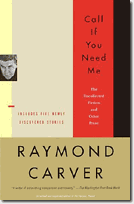
Call If You Need Me:
The Uncollected Fiction and Other Prose
by Raymond Carver
Edited by William L. Stull
Foreword by Tess Gallagher
Vintage
320 pages, $13, paper


|
Call If You Need Me: The Uncollected Fiction and Other Prose by Raymond Carver Edited by William L. Stull Foreword by Tess Gallagher Vintage 320 pages, $13, paper |
Myers called his wife, but she hung up on him. She wouldn't even talk to him, let alone have him anywhere near the house. She had a lawyer and a restraining order. So he took a few things, boarded a bus, and went to live near the ocean in a room in a house owned by a man named Sol who had run an ad in the paper.The Carver approach—giving a first- or third-person voice-track to a wounded protagonist, playing the spare plainspokenness of demotic idioms ("So he took a few things, boarded a bus ...") against our suspicion of deeper grief, trusting implication to build a kind of backdraft behind the seemingly solid presentation—was for a time very influential, showing up in writers like Richard Ford, Thomas McGuane, Tobias Wolff, Denis Johnson, Rick Bass, Russell Banks, John Casey, Andre Dubus, and Robert Stone. Chiefly males, though a possibly kindred stylistic restraint could be seen in Ann Beattie, Joy Williams, Amy Hempel, and others. This is not to argue that any of these writers were taking their cues right from Carver. Not at all. It was more that Carver manifested most purely and obviously a feeling about character and disillusionment that was at large in the culture. This was, historically, the aftermath of Vietnam, the period of counterculture in collapse, governed by a sense of moral bankruptcy of the kind Fitzgerald pointed to in the wake of the twenties. Many of our best writers were doing the barometric thing that artists do. And the prose style that came into favor—though there were notable exceptions—was one at which Carver excelled, a style of lyric suppression.
Sol was wearing jeans and a red T-shirt when he opened the door. It was about ten o'clock at night and Myers had just gotten out of a cab. Under the porch light Myers could see that Sol's right arm was shorter than his other arm, and the hand and fingers were withered. He didn't offer either his good left hand or his withered hand for Myers to shake, and this was fine with Myers. Myers felt plenty rattled as it was.
Our friendship had itself, after twenty years, come to resemble one of the towns in a Van Zorn story: a structure erected, all unknowingly, on a very thin membrane of reality, beneath which lay an enormous slumbering Thing with one yellow eye already open and peering right up at us.restrain myself only with difficulty. But I think the point has been made. The aesthetic of choice these days is the aesthetic of exploratory excess. It sets before the reader a world featured as a swirl of competing energies and stimuli; it searches patterns, connections, instances of psychological complexity. The old gestural muteness won't play in these halls.
Michael Chabon, The Wonder Boys (1995)Explorers would move through a literal forest of numbers, strolling through their woody representations and singling out by sight or sound or smell the significant trees, the hidden arbors.
Richard Powers, Plowing in the Dark (2000)But today, this day of infamy, as the modern Hex completes this circular tour of his childhood, as he completes his prolonged series of delays by sitting on his old narrow cot, with his refusal to face what is in front of him, sleep, unfortunately, is no option.
Rick Moody, Purple America (1997)Were an angel of God to offer me the definitive description of the properties of light (for it was on them and their paradoxical duality, both wave- and particle-like, that my singularity of promise had once largely been focused) I doubt that I'd even hear the cherub out.
Deborah Goldstein, Properties of Light (2000)Or was it conceivable that I only imagined this scenario (the scenario and my perception of it), because I had actually perceived—in ways that I did not understand and could not account for, that evening over pancakes, bacon, and a salad—that Manuel, our Kleinian across the table, was already sleeping with my wife.
Donald Antrim, The Verificationist (1999)The Dean at left, a lean yellowish man whose fixed smile nevertheless has the impermanent quality of something stamped into uncooperative material, is a personality type I've come lately to appreciate, the type who delays need of any response from me by relating my side of the story for me, to me.
David Foster Wallace, Infinite Jest (1996)His fault was not a lack of skill: it is the faultlessness of his skill which makes the paintings embarrassing to watch, so bare do they strip the mind of their creator.
Helen DeWitt, The Last Samurai (2000)