



"Most Multimedia Sucks"
An e-mail interview with Michael Nash
More on Digital Culture
in Atlantic Unbound
Discuss this topic in the Arts & Literature forum of Post & Riposte.
by Ralph Lombreglia
Today, twenty-five years of consumer culture later, you often can't find a decent song on AM or FM.
Some people feel that new art has about as much chance of evolving and flourishing amid the commerce of digital media as it does on commercial radio or television. But when radio and television first appeared they generated a great deal of excitement among certain artists. A number of serious writers and playwrights rushed to create new works (and adapt older works) for those thrilling new electronic media. We know what happened after that. (Some current digital-media executives would like to turn the Internet into nothing more than the television of the future, and if enough consumers are willing to accept only what's "pushed" at them, that plan might succeed. But that's a different subject.)
|
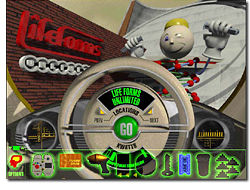
Michael Nash has held industry-shaping positions in digital media almost as long as there has been such a thing. In the late 1980s and early 1990s Nash was the media-arts curator of the Long Beach Museum of Art, where he organized some of the earliest exhibitions devoted to interactive media. He then joined the Voyager Company to oversee its high-end Criterion Collection of interactive laserdisks (working with film directors like Robert Altman, Terry Gilliam, and Louis Malle), but he soon found himself executive producer of one of the most influential early CD-ROMs -- Freak Show (Voyager, 1993), by The Residents, a San Francisco-based group of musicians and media artists.
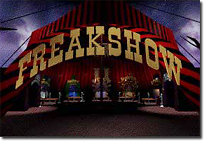 Freak Show is set at a traveling tent show of physically abnormal human beings. The CD-ROM embodies a preoccupation with the "grotesque" that is made unforgettably palpable by the work of animator Jim Ludtke. Freak Show is a tribute to "outcast culture," as the user's manual states explicitly, and its basic point about "freaks" -- captured in the product's epigraph from Fellini ("I don't see freaks. I see people") -- can be overly earnest sometimes. Nonetheless, the disc's combination of macabre (and excellently rendered) graphics and animation, ethereal and funny music, and stories folded into stories was like nothing seen before (and rarely since) in multimedia.
 Michael Nash (and, of course, the artists themselves) quickly grasped that the genre "computer game" was hardly limited to electronic versions of shooting galleries. A well-designed interactive production, they realized, could provide plain old fun -- and thus "commercial potential," to quote the ever-relevant Frank Zappa -- without pandering to commercial taste at all. In fact the game aspect was the reason you didn't have to pander. Once you reached an audience with the intrinsic appeal of a game, you could do just about anything. A game, Nash and company saw, could be a vehicle -- like an AM radio station -- and there was no law that said you had to play bad music on it. Nash went on to found his own company, Inscape (a partnership with Home Box Office and the Warner Music Group), where he guided the development of a number of seminal multimedia works, a few of which I'll discuss briefly here. For his work at Inscape, Entertainment Weekly named him one of "multimedia's ten most influential, forward-thinking" figures.
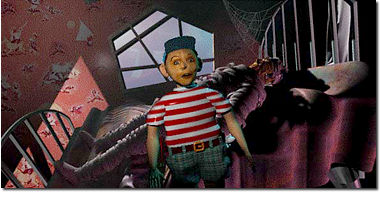
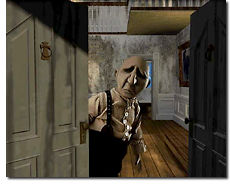
The Residents followed Michael Nash to Inscape for Bad Day on the Midway (1995), which was called "One of the Top Ten Discs of All Time" by CD-ROM Today. A sort of sequel to Freak Show, Bad Day on the Midway echoes and expands upon its predecessor. It too is set at a traveling carnival and uses the animation of Jim Ludtke to bring to life the darker aspects of human existence (to put it mildly). But it offers a deeper immersion into character and story than its predecessor. You begin the game as a wide-eyed boy named Timmy, but you can become nearly any character encountered at the carnival and go on to experience the various attractions from that character's point of view. The disc portrays the psychology of the characters by presenting their thoughts as text at the bottom of the screen -- phrases appearing in sequence and then replaced by other phrases, one at a time, so that most sentences change their meaning as they deteriorate. Some characters can go places that other characters cannot, and the gameplay involves figuring out who can go where, and when. This enables you to unravel a plot that includes a catatonic Nazi (who founded the carnival), a psychopathic killer, and -- most importantly -- all manner of unexpected loves, yearnings, and family-like emotional dependencies among the carnival personnel.
|
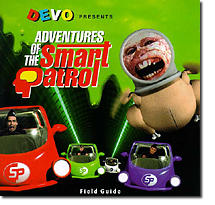 Devo Presents Adventures of the Smart Patrol (Inscape, 1996) is not only my favorite among these titles, it's one of the best pieces of interactive multimedia I've ever seen, period. I confess that I expected it to be silly, lightweight fun. It turned out to be more like the CD-ROM equivalent of Terry Gilliam's remarkable film Brazil, a wickedly funny satire that never misses a trick and never fails to see through any pretension, including its own. Why is it so good? Mostly for old-fashioned reasons: it's wonderfully well-conceived and well-written. A seamless sensibility underlies every aspect of the production; the storyboarding may have been done by committee, but that committee was the band Devo. Sly ironies glow around every detail. In fact, the CD-ROM is like Devo's songs and videos from the 1980s, some of which are on the disc and are deeper, darker, funnier, and more lastingly subversive than I remembered.
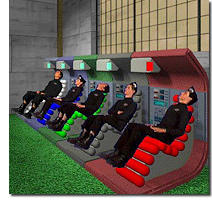
 In Adventures of the Smart Patrol you are a "Spud" -- a special member of the Smart Patrol, which is a group of four men and a woman who are simultaneously 1) a rock band, 2) a force for Good in a futuristic world controlled by a vast corporation called Big Media and plagued by the disease Osso Bucco Myletis (OM), which turns Spuds to jelly, and 3) a parody (in one way or another) of many 1960s television shows and spy movies.
|
Though I admired all the titles discussed here, I had the most "literary" response to Adventures of the Smart Patrol, meaning that the fun of the game involved an encounter with a complex mentality that might also have expressed itself in a book; I cared about the story partly because it was ridiculously funny yet also real and deeply knowing. In fact, I haven't felt as "literarily" engaged by an interactive game since Myst, the venerable piece of magic that has been imitated countless times but never surpassed, maybe never quite equalled. Myst has remained a best-selling CD-ROM for years not because it breaks technical barriers or appeals to low instincts but because it is beautifully designed, springs from an original, unified vision, and turns the limitations of the medium to its advantage. And so it is with Adventures of the Smart Patrol.
Since the release of these titles Inscape has been sold (it's now known as Ignite), and Michael Nash is out on his own, consulting for other producers and publishers. Will his pioneering work in multimedia be seen someday as the equivalent of the high-quality drama that once graced commercial television? Will we look back in nostalgia on such titles as Bad Day on the Midway and Adventures of the Smart Patrol after the world is controlled by Big Media? Is multimedia's artistic heyday already over? Whatever the thrilling and terrifying future may bring, it can never be said that interactive multimedia was somehow inherently unsuitable for serious creative work.
Ralph Lombreglia's e-mail interview with Michael Nash
Copyright © 1997 by The Atlantic Monthly Company. All rights reserved.
 |
 |
 |
 |
 |
 |