



Discuss this topic in the Arts & Literature forum of Post & Riposte.
More on Digital Culture
in Atlantic Unbound

by Ralph Lombreglia
I was talking to a guy recently who said that even though he got on the Internet with a 28.8K modem like most other ordinary citizens, he did not find browsing the Web to be an excruciatingly slow and frustrating experience. In fact he thought the Web was pretty snappy. Unlike me, he wasn't gnashing his teeth over our failure to start wiring the country with fiber-optic cable twenty years ago when the engineers told us to do it. No, this guy was just flying around the Net from site to site, viewing pages almost instantly, getting all kinds of work and research done in no time at all. I told him this didn't sound like any World Wide Web I knew about. Then things got even stranger. We talked about certain sites we'd both visited -- and they didn't seem to be the same sites. He hadn't seen the things I'd seen. "Did you click on such and such?" I'd ask, and he didn't know what I was talking about. Had this guy somehow gotten himself onto a different Internet? Well, as a matter of fact he had.
It turned out he was using the other World Wide Web. The one without pictures. He had "Load Images" turned off in his browser.
While it's true that many useful Net sites could be almost purely textual, it's more true that the explosive growth of the World Wide Web would never have happened without graphics and page layout and the ability to make any component of a page mouse-clickable. The Web revolution isn't simply about electronic publishing, it's about interactive multimedia publishing. When the page becomes electronic it ceases to be merely a repository of "content" and becomes software -- a software application, in fact, with the content assuming the additional role of user interface.
You can use any pictorial material in multimedia, from pencil sketches to photographs, but most Web graphics are computer-generated, and most of those are in some sense 3-D. Interacting with a 2-D screen is inherently alienating, so most digital media try to convey a suggestion of depth. From the ubiquitous "drop shadow" that makes graphics seem to float above their backgrounds, to true "modeled and rendered" 3-D images, to animated VRML "worlds," dimensionality is the thing.
The dominant tendency in computer 3-D is toward photorealism, toward creating graphics that seem "virtually" real. I say "tendency" because it's far from a realized technology. The most "realistic" 3-D looks synthetic; at its best it seems somehow painterly, but most often it resembles a reality wannabe. Few examples of today's 3-D would be mistaken for a photograph of physical reality, never mind for physical reality itself. But every year the engineers come a little bit closer, and as they do the imagery and animations take more time and talent to make. They eat up more disk space and bandwidth, too, because the illusion of "realistic" 3-D requires large amounts of color information.
Not only that, these expensive graphics soon cease to wow you. Computer years are like dog years, except that you multiply by twenty or thirty rather than by seven. Like everything else about computers, 3-D images have minimal shelf life. Much of the graphic content of today's digital media will age badly because its entire artistic agenda was to "look real." It will simply look quaint, if not pathetic, alongside the next generation of imagery.
|
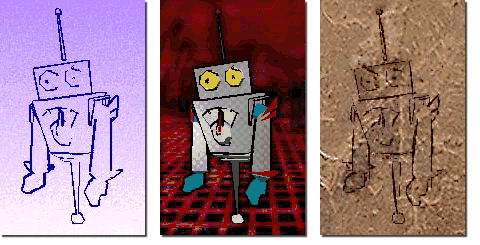
Now a small San Francisco-based startup called ThinkFish Productions has hit upon a contrarian 3-D technology that may bring the spirit of traditional visual art to computer-generated 3-D. It may also help make 3-D more genuinely useful on the Internet despite the info-trickle of today's phone lines. And it may even do for 3-D graphics what Adobe did for fonts -- that is, allow users to purchase interchangeable graphical "styles" that can be applied to objects and scenes at the click of a mouse.
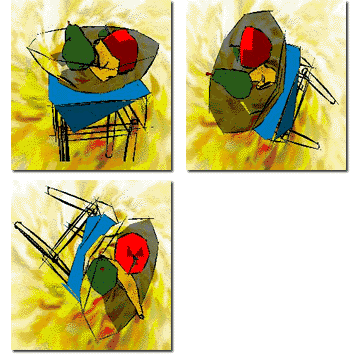
ThinkFish's founder and chief technology officer, Rolf Rando, once a member of MIT's Media Lab, wondered why the fate of computer 3-D should be linked exlusively to the fate of big, expensive photorealism. After all, human beings had been making stylized representations of reality throughout the entire history of pictorial art, from cave paintings to the present. Why couldn't an artist's approach to imagery be applied to 3-D? Such images would be visually interesting, more lasting, and would require vastly fewer resources to render, store, and transmit. What's more, if you could codify the essentials of an artistic style into procedures that dictated how it was applied to 3-D models, you could change the artistic style of objects at will. The rendering "style" of a complex object or scene could be switched, say, from "Cave Painting" to "Picasso" or "Matisse" the way word processors change text from Helvetica to Palatino typefaces.
The result of this thinking is ThinkFish's "LiveStyles" technology: low-fat 3-D with good taste at the touch of a button, and you can still wear it a year from now. It doesn't want to fool you into thinking it's reality. It just wants to be more interesting and less sterile than a failed attempt to look real. And because most of the visual impact of such graphics comes from their idiosyncratic style or personality, they contain far less information than their photorealistic counterparts, making them much smaller to store and quicker to download.
Rolf Rando calls his 3-D idea "artistic rendering," and he says that it represents a genuine paradigm shift relative to photorealistic rendering. Photorealism posits a "virtual camera" that captures virtual light hitting virtual objects. If the light is a certain pink color coming from straight above, and the object is a chromium sphere entwined by blue morning glories, the camera captures the result of all those interactions. Depending on the skill of the artist using the software and the quality of the software's code and mathematics, the resulting image looks more or less realistic.
|
ThinkFish graphics concepts do seem to have a basic philosophical kinship with the way most representational artists portray the world. But most people will not think of LiveStyles imagery as "art," and many traditional lovers of traditional art will no doubt view this whole enterprise with considerable skepticism -- if not horror -- as another commercial co-opting of art, another unleashing of "canned" imagery on the world, another example of the barbarians having crashed the gates. But Rando does not intend his graphics to rival traditional art -- at least not at this point in history. "An artistic rendering system can't rival a Picasso unless it intimately understands the meaning beyond the shapes it is rendering," he says. And that's not today, or anytime soon.
Rather, Rando looks ahead to the day, not so far away, when people on networks are creating their own "personal visual representations" of live information -- for example, the information in a collaborative "story" told in a virtual 3-D space by a number of people on the Internet. What will that story environment and its characters look like to a given user? Rando feels that what he's developing "will ensure that the innate visual language of drawing developed since the stone age" will be carried into the media and applications of the future. In other words he's a conservative, in the best sense of the term.

|
A final interesting note about Rolf Rando. Before founding ThinkFish Productions, Rando worked with interactive 3-D systems at MIT's Media Lab, at VPL Research (the world's first virtual-reality company), and then as CTO of the 3-D entertainment firm Gravity, Inc. I assumed he was solidly in the middle of an impressive engineering career.
He's twenty-three years old.
Copyright © 1997 by The Atlantic Monthly Company. All rights reserved.
 |
 |
 |
 |
 |
 |