


Contributor Profile
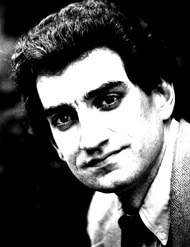 Recently named a distinguished fellow at the fiftieth anniversary of the
Fulbright Foundation, Gregg Easterbrook has a long list of accomplishments. A
graduate of Colorado College in 1976, Easterbrook earned his master's degree in
journalism from Northwestern University in 1977 and quickly gained a national
reputation. Easterbrook received the Investigative Reporters and Editors (IRE)
Award in 1980 for a Washington Monthly story on the national energy
supply. After joining The Atlantic as a staff writer in 1982,
Easterbrook won another IRE Award for an Atlantic story entitled "Divad"
(October 1982) on an Army technology project. He was briefly The
Atlantic's national correspondent in 1986 and then became a contributing
editor to The Atlantic at the end of the year, after receiving the
Livingston Award for excellence by a young print or broadcast journalist.
While Easterbrook's primary contributions to the magazine have focused on
national politics, he has written, often with a rare sense of humor, on a wide
range of topics that include weapons systems, labor negotiations, poverty,
electric power, and the search for extraterrestrial life. His articles
published in The Atlantic include: "The Myth of Oppressive Corporate
Taxes" (June 1982); "Housing: Examining a Media Myth" (October 1983);
"What's Wrong with Congress?" (December 1984); "Making Sense of Agriculture"
(July 1985); "Ideas Move Nations" (January 1986); "Are We Alone?" (August
1988); and "Energy: The Future of Electric Power" (July 1993).
Recently named a distinguished fellow at the fiftieth anniversary of the
Fulbright Foundation, Gregg Easterbrook has a long list of accomplishments. A
graduate of Colorado College in 1976, Easterbrook earned his master's degree in
journalism from Northwestern University in 1977 and quickly gained a national
reputation. Easterbrook received the Investigative Reporters and Editors (IRE)
Award in 1980 for a Washington Monthly story on the national energy
supply. After joining The Atlantic as a staff writer in 1982,
Easterbrook won another IRE Award for an Atlantic story entitled "Divad"
(October 1982) on an Army technology project. He was briefly The
Atlantic's national correspondent in 1986 and then became a contributing
editor to The Atlantic at the end of the year, after receiving the
Livingston Award for excellence by a young print or broadcast journalist.
While Easterbrook's primary contributions to the magazine have focused on
national politics, he has written, often with a rare sense of humor, on a wide
range of topics that include weapons systems, labor negotiations, poverty,
electric power, and the search for extraterrestrial life. His articles
published in The Atlantic include: "The Myth of Oppressive Corporate
Taxes" (June 1982); "Housing: Examining a Media Myth" (October 1983);
"What's Wrong with Congress?" (December 1984); "Making Sense of Agriculture"
(July 1985); "Ideas Move Nations" (January 1986); "Are We Alone?" (August
1988); and "Energy: The Future of Electric Power" (July 1993).
Easterbrook's work has appeared in The New York Times, The Washington Post, The Los Angeles Times, The New Yorker, and The New Republic. He has been a contributing editor to Newsweek and is currently a contributing editor to The Washington Monthly. Easterbrook has published a novel, This Magic Moment (1987), and is noted for his contribution to the ecorealism movement that he made with A Moment on the Earth: The Coming Age of Environmental Optimism (1995), a book that former EPA chief William Reilly called "the most influential book since [Rachel Carson's] Silent Spring." A forthcoming book on religion, Beside Still Waters, is due out in late 1997. Easterbrook currently resides in Brussels with his wife, Nan Kennelly, the U.S. Refugee Officer to the European Union, and their three children.
Copyright © 1996 by The Atlantic Monthly Company. All rights reserved.
 |
 |
 |
 |
 |
 |