
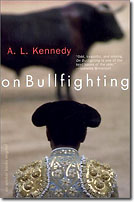
On Bullfighting
by A. L. Kennedy
Anchor Books
165 pages, $8.80

| |
On Bullfighting by A. L. Kennedy Anchor Books 165 pages, $8.80 |
When I began the necessary research, I could have heard that the corrida had been banned throughout the world for ever and ever amen and I would have remained unconcerned. I came to this with entirely selfish motives. I wanted to see if I was still capable of writing anything at all. I wanted to keep my mind occupied, because—left to its own devices—it might very well manage to kill, or at least torment me. And I wanted to discover if the elements which seemed so much a part of the corrida—death, transcendence, immortality, joy, pain, isolation and fear—would come back to me. Because they were part of the process of writing and, good and bad, I miss them.Kennedy persevered, tackling her material with curiosity, intelligence, and wit. She was determined to see and understand this phenomenon which, outside of the Spanish-speaking world, is largely regarded as a barbaric anachronism.
The matador appears to clear a way through the air with his muleta for exactly the path the bull desires to follow. Rather than tricking the bull, Ponce gives the impression that he knows what it wants before it does, that he is here to help. This is the body knowledge of a lover, played out as theater and execution.A. L. Kennedy's work has been highly praised on both sides of the Atlantic. Her first book of short stories, Night Geometry and the Garscadden Trains (1991), appeared when she was twenty-five. Since then there have been four novels—Looking for the Possible Dance (1993), So I Am Glad (1995), Original Bliss (1997), and Everything You Need (1999)—another collection of stories, Now That You're Back (1994), and a nonfiction monograph, The Life and Death of Colonel Blimp (1997). She first reached U.S. readers two years ago with the North American publication of Original Bliss, about the stuttering romance between a lonely housewife searching for her faith and a pop-psychologist with an addiction to pornography. She also writes for the screen and the stage. She lives in Glasgow.
Everytime the bull falters or stalls, Ponce stays with it, closer and closer, the animal's blood slowly painting the front of his traje, no one in the world but them, no one in the world but us, because he has cited us, too, drawn us into the inexorable movement towards his goal, the kill.
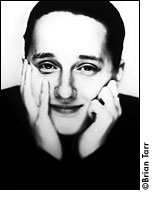 |
| A. L. Kennedy |