
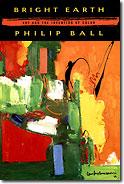
Bright Earth: Art and the Invention of Color
by Philip Ball
Farrar, Straus & Giroux
382 pages, $30.00

| |
Bright Earth: Art and the Invention of Color by Philip Ball Farrar, Straus & Giroux 382 pages, $30.00 |
How is your desire for blue affected if you have just paid more for it than for the equivalent weight in gold? That yellow looks glorious, but what if its traces on your fingertips could poison you at your supper table? This orange tempts like distilled sunlight, but how do you know that it will not have faded to dirty brown by next year?In some cases, the sheer difficulty of creating a particular dye or pigment has given a color an aura of mystique or sacredness. The Virgin Mary, for example, was often depicted wearing a deep blue robe in medieval paintings, not because she was believed to have actually worn such a garment, but because the extremely complex and time-consuming process of deriving ultramarine blue from the rare stone lapis lazuli rendered the color off limits for all but the most precious of subjects. Indeed, the use of ultramarine or gold, Ball explains, "does not simply imply a wish to show piety by lavishing expense but reveals the hope that the supernatural potency of the work will thereby be enhanced."
Where before there were two-dimensional images in gilded frames, there was now a living world. Each picture seemed as though it had just left the artist's workshop or studio, the paint's transition from palette to panel or canvas almost visible in the brush marks. Of course, time, too, has left its mark: paintings often need more decoding than the artist intended, as greens darken to black and reds fade to pink. In the end, learning the language of color is really about learning to see.Philip Ball, who majored in chemistry at Oxford and has a Ph.D. In physics from the University of Bristol, is a writer and editor for Nature. His previous book, published in 2000, is Life's Matrix: A Biography of Water.
 |
| Philip Ball |