
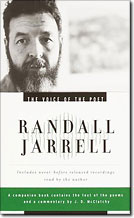
The Voice of the Poet: Randall Jarrell
edited by J. D. McClatchy
Random House
64 pages, 1 cassette, $17.95
| |
The Voice of the Poet: Randall Jarrell edited by J. D. McClatchy Random House 64 pages, 1 cassette, $17.95 |
From my mother's sleep I fell into the State,Audio:
And I hunched in its belly till my wet fur froze.
Six miles from earth, loosed from its dream of life,
I woke to black flack and the nightmare fighters.
When I died they washed me out of the turret with a hose.
 Listen to Randall Jarrell read "The Death of the Ball Turret Gunner" (requires RealPlayer).
The saris go by me from the embassies.Audio:
Cloth from the moon. Cloth from another planet.
They look back at the leopard like the leopard.
And I....
Listen to Randall Jarrell read "The Woman at the Washington Zoo." (Requires RealPlayer.)this print of mine, that has kept its colorWhat may seem a rather startling leap—navy print to grave—to the literal-minded reader, will seem familiar enough to anyone of a more depressive disposition. This is the feeling-path of wounded inwardness. We are but a few lines in and already we have sounded a soul. Her "dull null/ Navy" is the garb of her condition, its banner.
Alive through so many cleanings; this dull null
Navy I wear to work, and wear from work, and so
To my bed, so to my grave ...
small, far-off, shiningIt is hard to read through this passage without thinking of Rilke's famous panther, that utterly self-enclosed creature pacing out its instinct life as if oblivious of its captive state. Jarrell was surely mindful of his predecessor. At moments it seems he is almost annexing some of the power of that perception for himself. But it is to entirely different effect. For it is the distance from us of the creature world—the distance of its unconsciousness—that drives home the insistent power of the idea of death, allowing the poet then to feature that awareness as a cage far more imprisoning than what the zoo animals are forced to inhabit.
In the eyes of animals, these beings trapped
As I am trapped but not, themselves, the trap,
Aging, but without knowledge of their age,
Kept safe here, knowing not of death, for death—
Oh, bars of my own body, open, open!
Vulture,xclamation mark notwithstanding, Jarrell's voice registers the final words unemphatically. This is not a bid for self-renovation but a cry for oblivion. Yes, Jarrell is, as McClatchy wrote, a poet of transformation, but in this case—and in the other poems written in the voices of aging women—it is not the exalting but the despairing transformation that is meant. The vulture, death's ugly factotum, is invited into a strange, sexually morbid embrace—"step to me as man"—and the plea is for the consummation that is the end of suffering. The poem is perfectly hopeless, really. If there is anything exalting, it exists outside the frame—the stringent artistic exaltation of having exacted a look at the worst.
When you come for the white rat that the foxes left,
Take off the red helmet of your head, the black
Wings that have shadowed me, and step to me as man:
The wild brother at whose feet the white wolves fawn,
To whose hand of power the great lioness
Stalks, purring....
You know what I was,
You see what I am: change me, change me!