

97.06.18
And Now ... This?
When TV-network news is translated onto the Web the picture is something completely different.
97.06.11
Group Therapy
For victims of HIV and AIDS, a Web site that offers hope in community.
97.06.04
What's Cooking
The next big thing ... for the kitchen.
97.05.28
Small World
A site where "who you know" is the only thing that matters.
97.05.14
"If you build it they will come..."
Baseball legends live on at RedSox.com's site of dreams.
97.05.07
Journey to the Microwilderness
Slime mold has never looked so beautiful.
97.04.30
A Poem a Day
With National Poetry Month behind us, a new site offers poetry lovers a
daily fix.
For more, see the complete Web Citations Index.

June 25, 1997
Who would have thought so many would be here? They keep appearing all through this disquieting structure, gathered in groups, pacing alone in meditation, or studying the paintings, the books, the exhibits. It seems to be some very extensive museum, a place of many levels, and new wings that generate like living tissue -- though if it all does grow toward some end shape, those who are here inside it can't see it.... Movement among these passages is without friction, skimming and rapid, often headlong, as on perfect roller skates.Writers in the current issue of Pynchon Notes -- a journal dedicated to the reclusive novelist and cult figure Thomas Pynchon -- are falling all over themselves to point out the parallels between Pynchon's writing (maddeningly tangled plots and enormously allusive prose) and the World Wide Web (equally tangled and allusive). One essay, by Brian Stonehill, analyzes "Pynchon's Prophecies of Cyberspace"; another, by Steven Weisenburger, has the title "Hyper-Embedded Narration in Gravity's Rainbow." These sorts of papers, written by scholars in awe of Pynchon's various talents as a writer, researcher, and social diagnostician, inevitably verge on the spoofable. "What happens to Tyrone Slothrop [a main character in Gravity's Rainbow] when he grows faint, vague and eventually invisible altogether," Stonehill writes, "is precisely prophetic of what is now happening to paper in the culture of information. [It is] eerily iconic of the fate of materiality itself in a virtual world."
Thomas Pynchon, Gravity's Rainbow (1973)
 There is something to this, however. Pynchon's fiction has become eerily
iconic of the modern era, and choosing to grapple with the implications of the
information age is a lot like choosing to grapple with a Pynchon novel -- in
both cases links and meanings proliferate almost organically.
Many people simply refuse to take on the challenge, of course, but others revel
in it.
There is something to this, however. Pynchon's fiction has become eerily
iconic of the modern era, and choosing to grapple with the implications of the
information age is a lot like choosing to grapple with a Pynchon novel -- in
both cases links and meanings proliferate almost organically.
Many people simply refuse to take on the challenge, of course, but others revel
in it.It's fitting, then, that Web sites devoted to Pynchon are now multiplying. Of particular interest are the HyperArts Pynchon Pages, the San Narciso College Thomas Pynchon Home Page, and The Libyrinth -- sites that provide all the (scanty) biographical
information there is about Pynchon, along with reviews of his books, commentaries on his work, concordances, glossaries, collected essays by and about Pynchon, photographs, and more.
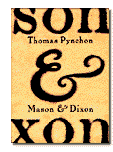
Pynchon's latest book, Mason & Dixon, is a sprawling historical novel set in the eighteenth-century. Despite Mason & Dixon's focus on the past, however, Pynchon fans will surely find in it commentaries on the present and intimations of the future. And, just as surely, they'll post it all on the Web.
Copyright © 1997 by The Atlantic Monthly Company. All rights reserved.
 |
 |
 |
 |
 |
 |