

In the Valley of the Kings
Breaking new ground in Egypt -- and on the Web.
97.09.04
Autumn Tapestry
The traditional art of weaving -- in code.
97.08.27
Bibliocity
What better place for bibliophiles, bibliopoles, bibliotaphs, and bibliomaniacs to congregate?
97.08.20
Car Talk
It's not just on NPR.
97.08.13
The Official Guide to Bedlam
The teeming, chaotic, utterly bizarre world of popular music on the Web -- brought to you by MTV and Yahoo!.
97.08.07
Shakespeare's Theatre
A multimedia tribute to the reopening of the Globe.
97.07.30
Classically Inclined
A refreshingly fundamental approach to classical music.
97.07.23
The Museum of Jurassic Technology
"Um, what exactly is this place?"
97.07.16
Women's Health Online
As soothing as a pastel-painted clinic, as informative and helpful as your favorite clinician.
97.07.09
McSpotlight
Experience an "activist frisson" on the Web.
97.07.02
Hong Kong Diaries
Making history -- and living it -- on a personal scale.
For more, see the complete Web Citations Index.
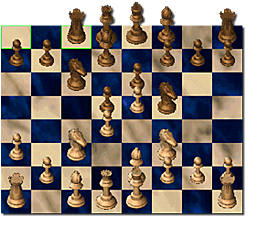 In 1878, when two country gentlemen in Derbyshire,
England played the first-ever game of chess by telephone, they had no idea what
a felicitous combination (chess, phone lines) they had stumbled across. Today
chess on the Internet is booming. Just how popular chess has become online was
apparent during the match this past spring between IBM's Deep Blue and Garry
Kasparov; the New York Times reported that "millions of people signed on
to the Internet to follow the final game live." Although dozens and dozens of
chess sites have sprung up in recent years, one site in particular is emerging
as preeminent: the Internet Chess Club (ICC), an organization with more than
15,000 members from some fifty countries that bills itself as "the oldest,
largest, and greatest place to play chess on the Internet."
In 1878, when two country gentlemen in Derbyshire,
England played the first-ever game of chess by telephone, they had no idea what
a felicitous combination (chess, phone lines) they had stumbled across. Today
chess on the Internet is booming. Just how popular chess has become online was
apparent during the match this past spring between IBM's Deep Blue and Garry
Kasparov; the New York Times reported that "millions of people signed on
to the Internet to follow the final game live." Although dozens and dozens of
chess sites have sprung up in recent years, one site in particular is emerging
as preeminent: the Internet Chess Club (ICC), an organization with more than
15,000 members from some fifty countries that bills itself as "the oldest,
largest, and greatest place to play chess on the Internet."What the ICC has to offer is remarkable -- so much so that its members are willing to pay dues of $50 a year, making the ICC one of the few economically viable subscription-based services on the Internet today.
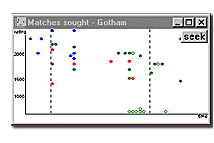 At just about any
time of day or night a member can log on and within minutes be playing someone
of comparable ability. Finding an opponent is made especially easy by what the
ICC calls its "Seek Graph" (see adjacent image); all of the players currently
online and available to play are represented as dots on a grid that indicates
ability and the kind of game sought. Clicking on a dot brings up an image of a
chessboard and sets the two players' clocks running; once play begins, pieces
are moved simply by clicking and dragging. The ICC system checks the legality
of all moves, maintains the clocks, handles draw offers, determines the
outcomes of all games, and adjusts players' ratings; it also stores entire
games (up to sixty of them) in each player's personal library for later review.
Players can converse with each other in a text chat area that appears alongside
the chessboard.
At just about any
time of day or night a member can log on and within minutes be playing someone
of comparable ability. Finding an opponent is made especially easy by what the
ICC calls its "Seek Graph" (see adjacent image); all of the players currently
online and available to play are represented as dots on a grid that indicates
ability and the kind of game sought. Clicking on a dot brings up an image of a
chessboard and sets the two players' clocks running; once play begins, pieces
are moved simply by clicking and dragging. The ICC system checks the legality
of all moves, maintains the clocks, handles draw offers, determines the
outcomes of all games, and adjusts players' ratings; it also stores entire
games (up to sixty of them) in each player's personal library for later review.
Players can converse with each other in a text chat area that appears alongside
the chessboard.There's much more. Members can at any time consult a list of games currently being played and then choose to watch any one of them -- a particularly popular feature when GrandMasters are playing games online. Chess experts appear regularly to deliver lectures, and tournaments from around the world are broadcast live for members to follow and analyze. Those in the audience can chat one-on-one or publicly, and, if granted permission, can even converse with the players themselves. There are some three hundred chat "channels" in all, devoted to upcoming events, registration, specific chess interests, speakers of different languages -- and, most importantly, help.
That help channel is a vital one for online-chess neophytes. The ICC is driven mainly by UNIX-based text commands, and as a result the user interface, although becoming friendlier, is at the outset somewhat daunting. But ICC administrators are available online to answer questions and provide advice, and they promise that more multimedia enhancements are imminent. Their ultimate goal is an extraordinary one, well worth waiting (and paying) for: an online community unfettered by geographical boundaries and linguistic differences, where the only language that needs to be spoken is a visual one of chess moves, not words.
Copyright © 1997 by The Atlantic Monthly Company. All rights reserved.
 |
 |
 |
 |
 |
 |