




New England-Style Lobster Chowder
Lobster & Corn Chowder
Lobster, Tomato, & Mint Salad
Summer Vegetable Slaw
June 4, 1998
Jasper White knows food in the way legendary French chefs do: he fearlessly experiments every day while drawing on terrific technique born of years of experience in restaurant kitchens. Growing up in a family that knew how to cook, with an Italian grandmother who prepared big Sunday lunches, didn't hurt either.
For twelve years White's waterfront restaurant, Jasper's, was the best place in Boston to get fish, even though the menu had some of everything and the place never billed itself as a fish house. No chef in the city put seafood vendors through their paces as rigorously as White, who didn't ever hesitate to order from someone new if one of his suppliers let him down with cod or oysters that were less than pristine.
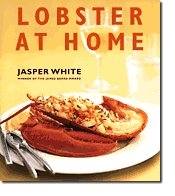
White's foremost love was and is lobster. As executive chef of Legal Sea Foods, Boston's most popular fish restaurant (there are eleven in and around Boston), he has deepened his already extensive knowledge of America's favorite crustacean. His new book, Lobster at Home, tells you truly everything you need to know to buy and cook lobsters. It's full of specific and practical tips, and answers all your questions: how to hold lobsters so their flapping claws can't get to you (put your thumb and forefinger behind the large claws, over the body); what the difference between male and female lobsters is, and whether one tastes better than the other (nah); what that greenish stuff is (tomalley, which works like the liver, and is a strong-flavored delicacy); how to kill a lobster humanely (do it fast, with a knife or by plunging it in boiling water); how live lobsters should be stored (in paper bags, never in fresh stagnant water, which will kill them); and, most importantly, how to eat them.
 How to eat, in my childhood, amounted to this: suck everything. One reason I
so love White's new book is that it conforms to all the advice I was given
during childhood trips to Maine. It's like having a Down Easter by your
side, distilling years of experience and telling you just what to do at the
market and in the kitchen. White has an encouraging, patient, reassuring tone
and is full of good, absolutely practical advice.
How to eat, in my childhood, amounted to this: suck everything. One reason I
so love White's new book is that it conforms to all the advice I was given
during childhood trips to Maine. It's like having a Down Easter by your
side, distilling years of experience and telling you just what to do at the
market and in the kitchen. White has an encouraging, patient, reassuring tone
and is full of good, absolutely practical advice. The recipes are extremely tempting. There's every lobster favorite you could want, from pot pie to thermidor to bisque to Mahattan chowder, and plenty you'll make a part of your summers. Lobster minestrone could be a week's worth of dinners. Lobster pad thai, devised by Gerald Clare, a chef in Portland, Maine, will be a constantly demanded family favorite. I'm very happy to see White's lobster sausage and pan-fried lobster here, even if I'm likelier to make a time-tested classic like lobster rolls -- plain mayonnaise-bound lobster salad in a split buttered hot-dog bun -- or a simple White invention like fettucine with lobster and fresh peas or asparagus.
There's not much I wouldn't make, in fact. Here is White's definitive lobster chowder, and a variation with corn; a simple and fresh-sounding summer salad; and a great summer slaw that typifies White's respectful but original take on the American repertory. Everyone vacationing along the East Coast this summer needs a copy of Lobster at Home beside the rental-house stove.
Previously in Corby's Table:
A rare book that shows Italy unromanticized -- and more appetizing.
New reasons not to get out of bed in the morning.
In Ruth Reichl's new memoir, Tender at the Bone, food is about more than eating.
South America's well-traveled cuisine.
Just in time for the holidays, a look back over the year's best.
A book to help one get wise to the whys of cooking.
More by Corby Kummer in Atlantic Unbound
Excerpts from Lobster at Home, by Jasper White (Scribner)
Techniques for Cooking Lobster
Boiling and Parboiling Lobsters: Boiling is such a popular method that many people do not realize there are other ways to cook lobsters. In fact, whenever I mentioned this book to friends outside of the food profession, they looked at me strangely and said, "It must be a small book. What else do you need to know about lobsters besides how to boil them?" As you can see by glancing through these pages, the preparation of lobster can be very versatile, but boiling is still of the utmost importance, as is parboiling.
Lobster should be boiled in fresh ocean or tidal water. To my way of thinking, the ultimate achievement when preparing seafood is to deliver the fish -- whether oysters, clams, bass, tuna or lobsters -- tasting clean and distinctive, and, most important, tasting of the ocean. It is the briny-sweet taste of the sea, where all life began, that is so intensely satisfying and sensually stimulating. Boiling a lobster in the clean ocean water from whence it came produces this flavor experience better than any other cooking method. When no ocean water is available, heavily salted fresh tap or spring water is fine, but it never fully captures the flavor of the sea. Because of this, when no ocean water is available, I usually recommend steaming, a method that produces a pure lobster flavor with little danger of toughening due to overcooking.
That being said, why recommend boiling at all? Boiling is an essential method for partially cooking food. Water boils at a steady temperature and comes into direct contact with the food, while the intensity with which steam cooks food varies. In addition, boiling is easier and more accurate to time than steaming. Many lobster dishes, such as soups, pastas and sautés, depend on partially cooked lobster meat that is reheated in the final cooking, resulting in meat that is cooked just right, not overcooked. Boiling also cooks the lobster fast and hard, from the outside in. The intense direct heat cooks the outer red part of the meat first; this causes it to shrink away from the shell, making it easier to remove. Lastly, boiling is the easiest method of cooking lobster and thus is great for the first-time lobster cook. Follow my charts, and you are guaranteed success!
The process of boiling, in ocean or homemade salt water, is the same whether the intention is to fully or partially cook a lobster. The three key elements are the pot, the salinity of the water, and the water temperature.
Salt: If using ocean water, no added salt is necessary. If using fresh water, add 1/4 cup of salt for each gallon of water. The water should taste distinctly salty. If any rockweed is available, throw it in. Like putting a little oil in pasta water, it may not be necessary, but it does not hurt and does make some people (like me) feel better.
Temperature: In order to achieve accurate timing, it is crucial to always bring the water to a rolling boil before adding the lobsters. In general, most cookbooks (including my own first book) suggest timing lobsters from the moment the water returns to a boil. After numerous tests, however, I have become convinced that it is actually more accurate to time lobsters from the moment they are put in the water, not from the moment the water reaches a boil again. My logic is that since stoves, depending on their power, can vary in the time they take to bring a pot of lobsters back to boil, and since the difference between boiling and not boiling can be a matter of only a few degrees, the total amount of time in the hot water is more important and is a more accurate measure than the amount of time after the boil.
The boiling procedure is simple: Bring the salted water to a rolling boil. Pick up the lobsters one at a time and, holding the lobster with your hand wrapped around its carapace, drop it in the pot. Leave the pot uncovered while the lobsters cook. Time according to the chart below. Stir the lobsters once, halfway through the cooking. Use a pair of long tongs to remove the lobsters when they are ready. Before removing all the lobsters from the pot, remove one and break it in half where the carapace meets the tail. The tail meat should be creamy white with no translucency, and the roe, if there is any, should be bright red. If not, let the lobsters cook a little longer. Serve with drawn butter or allow them to cool at room temperature. If the meat is to be removed, do it before refrigerating.
Boiling Chart for Fully Cooked Lobster: If you use more water per lobster than recommended, shorten the cooking time by one minute. Conversely, if you crowd the pot, using less water per lobster, add at least one minute to the cooking time per extra lobster.
| 1 pound | 8 minutes |
| 1 1/4 pounds | 9 to 10 minutes |
| 1 1/2 pounds | 11 to 12 minutes |
| 1 3/4 pounds | 12 to 13 minutes |
| 2 pounds | 15 minutes |
| 2 1/2 pounds | 20 minutes |
| 3 pounds | 25 minutes |
| 5 pounds | 35 to 40 minutes |
Boiling Chart for Partially Cooked Lobster: This chart is based on the same lobster-to-water ratio recommended for fully cooked lobsters. Because it is crucial that the lobsters be in contact with the water as close to boiling as possible, and because this is such a quick procedure, there is no reason to crowd the pot. If you need to, you can parboil lobsters in more than one batch. Just be sure that the water returns to a rolling boil before you cook the second batch. Lobsters weighing more than 3 pounds are not suitable for parboiling because the meat does not cook properly during the second cooking. If you are using soft shells, deduct at least one minute from the cooking time. Allow lobsters to cool at room temperature. Remove the meat while still slightly warm -- it is easiest that way. Keep refrigerated until ready to use.
| 1 pound | 3 1/2 minutes |
| 1 1/4 pounds | 4 minutes |
| 1 1/2 pounds | 4 1/2 minutes |
| 1 3/4 pounds | 5 minutes |
| 2 pounds | 5 1/2 minutes |
| 2 1/2 pounds | 6 1/2 to 7 minutes |
| 3 pounds | 7 1/2 to 8 minutes |
Drawn Butter: Lobster and butter are like cheese and wine ... they love each other, they belong together. Although there are many great lobster dishes without butter, there is no denying the perfection of the combination.
Drawn butter is simply melted butter. For some unfathomable reason, many clam shacks and restaurants serve clarified butter (the skimmed clear yellow fat of the butter) as drawn butter. They do not realize that the milk solids which are skimmed from clarified butter are what make drawn butter so tasty. As far as I am concerned, the best butter for dipping is sweet (unsalted) butter seasoned with lemon, salt and pepper. Simply put the butter in a pot near a warm area of the stove and whisk it now and then so that it emulsifies (blends into a creamy liquid where all components are suspended) slightly as it melts. Or put the pot directly on the heat and bring to a boil, stirring often. This is not a sauce, so if it separates after heating, do not worry. By adding your own salt you can determine the exact flavor of the drawn butter. The lemon, while not traditional, adds a freshness to the butter that cannot be beat. I use about a quarter of a lemon for every stick of butter. Figure on using about 2 tablespoons butter per lobster. A great addition to drawn butter is a big spoonful of lobster tomalley. I adore the flavor of tomalley I get with every bite!
New England-Style Lobster Chowder
This traditional chowder is made with lobster, pork (saltpork or bacon), onions and potatoes, but differs from New England church-supper-type recipes in that it is not made with milk. I learned long ago from Chef Bob Redmond at the Copley Plaza Hotel in Boston that the very best New England-style chowders are made with strong stock and cream, which give intensity of flavor and a smoothness in texture that cannot be achieved with milk. This is the new "traditional" chowder, more closely resembling the chowder made with the fattier fresh farm milk of the past. Unlike milk-based chowder, stock-and-cream-based chowder almost never separates (curdles). Although I am certainly no slave to tradition, I have never strayed from the idea of chowder as a one-pot meal, a stew, thick from its ingredients and not from a roux or other starches. The only starch needed is what is released from the potatoes during cooking and the crumbled crackers that Yankees add to it at the table.
| 2 live 1-pound chicken lobsters | 2 medium onions (10 ounces), cut into 3/4-inch dice |
| 4 sprigs fresh thyme | 1 teaspoon Hungarian paprika |
| 1 teaspoon whole black peppercorns | 1 pound Maine or other all-purpose potatoes, peeled and cut into 3/4-inch dice |
| 2 bay leaves | 1 cup heavy cream |
| 4 ounces slab country bacon | freshly ground black pepper |
| kosher or sea salt | about 2 tablespoons chopped fresh chives and/or parsley for garnish |
| 2 tablespoons unsalted butter |
1. Parboil the lobsters. Let stand until cool enough to handle. Remove the meat from the tails, knuckles and claws. Cut into large (3/4- to 1 -inch) pieces and then cover and refrigerate. Split the carcasses in half and discard the head sacs. Remove the roe if there is any, chop it and add it to the lobster meat. Leave about half of the tomalley in the body to flavor the stock. Reserve the rest for Tomalley Toasts or discard. (Too much tomalley will make the broth bitter.) Place the shells and carcasses in a 6-to 8-quart pot and cover with 2 quarts water. Bring to a boil.
2. Meanwhile, pick the leaves off the thyme and add just the stems to the stock. Also add the peppercorns and bay leaves. Trim the rind from the bacon and add the rind to the stock. Cut the bacon into 1/2-inch dice. Turn down the heat and simmer for 1 hour. Lightly salt the stock and taste for strength. Simmer for up to 30 minutes more if needed. Strain the stock. You should have 3 to 4 cups.
3. Fry the bacon in a heavy 4-quart soup pot over medium heat until crisp and browned and most of the fat has been rendered. This will take about 8 minutes. Pour off all but 1 tablespoon fat, leaving the bacon in the pot. Add the butter, onions, and thyme leaves. Cook over medium heat for 8 to 10 minutes until the onions are tender but not browned. Stir in the paprika. Add the potatoes and enough stock to cover them (about 3 1/2 cups, add a little water if you do not have enough stock). Turn up the heat and boil for 15 to 20 minutes until the potatoes are tender. This hard cooking will break up some of the potatoes so that their starch is released and the chowder becomes lightly thickened. Remove the pot from the heat.
4. Add the lobster meat and heavy cream. Season to taste with salt (very little will be needed) and pepper. Let the chowder sit off the heat for 30 minutes to 1 hour. If you let it sit longer than 1 hour, cover and refrigerate it. You can make this a day in advance if desired.
5. Reheat the chowder, check the seasoning, and divide evenly among 4 soup plates. Sprinkle with chives and serve at once.
Variation: While this recipe calls for bacon, the same amount of salt pork (without the rind) may be substituted. Leave the fat in the pot and reduce the amount of butter by half.
Lobster & Corn Chowder
This recipe, one of my signature dishes, has been featured on magazine covers and in many newspapers. I think its enormous appeal lies in that, for locals and visitors alike, it epitomizes summer in New England when up and down the coast summer lobsters and sweet corn are abundant. It is not chowder. It is a Martha's Vineyard, Boothbay Harbor, Point Judith, Gloucester and Block Island vacation in a bowl.
For this recipe I prefer yellow or bicolor varieties of corn, such as earlivee, sugar buns, tuxedo, butter and sugar, clockwork, pilot and double gem -- all are varieties that thrive in New England. They hold up well to the long cooking that this recipe requires and make the soup more colorful. If you cannot find these varieties, do not worry; as long as you use sweet local corn, the chowder will be a success.
| Recipe ingredients for New England-Style Lobster Chowder | 2 large or 3 small ears fresh sweet corn |
1. Follow the recipe for New England-Style Lobster Chowder, making the following two adjustments: Husk the corn and wipe away any silk. Cut the kernels from the cobs -- you should have 1 1/2 cups. Chop the cobs into 3 or 4 pieces. Add to the stock in step 2 and let simmer with the lobster shells the entire time.
2. Add the corn kernels at the same time you add the potatoes in step 3.
Summer Salad of Lobster, Ripe Tomatoes & Mint
Luscious ripe tomatoes are the essential ingredient in this recipe. Without them it is rendered meaningless. You can buy cooked lobster meat for this salad if you do not want to cook lobster on what may be a very hot summer day. This salad is simple and easy to prepare.
| 8 ounces fully cooked lobster meat, or 2 1/2 pounds live lobsters | kosher or sea salt |
| 6 sprigs fresh mint | freshly ground black pepper |
| 1/2 small red onion (2 ounces), thinly sliced | 2 ripe medium tomatoes (8 ounces), red and/or yellow |
| 2 teaspoons balsamic or good red wine vinegar | 1 small head lettuce or 8 ounces mixed lettuces, torn into large bite-sized pieces, rinsed, dried and chilled |
| 2 tablespoons olive oil |
1. If you are using live lobsters, fully cook them by steaming, boiling or microwaving. Let cool at room temperature. Remove the meat from the tail, claws and knuckles. Reserve the carcass for soup. Cover and refrigerate the lobster meat; this will make it easier to slice. Depending on how fancy you want the slices, either make a slit along the top of the tail to remove the intestine or try to remove it with tweezers. Carefully cut the tails into slices about 1/3 inch thick. Remove the cartilage from the claws and do your best to slice them into 2 pieces. Do not worry if you tear the claw when you remove the cartilage. Place the meat in a small mixing bowl, cover and refrigerate.
2. Pick 4 of the most beautiful sprigs of mint and set aside. Remove the remaining mint leaves and coarsely chop: you should have about 3 tablespoons. Combine the mint with the red onion, vinegar and oil. Season lightly with salt and more generously with pepper. Let stand for 5 minutes.
3. Meanwhile, cut the tomatoes into 6 slices each and spread on a large plate. Drizzle the vinaigrette over the tomatoes. Cover and refrigerate for 10 to 15 minutes. Chill your plates if you have not already.
4. When ready to serve the salad, place the lettuce in a bowl and put the bowl of lobster meat next to it. Holding your hand on the sliced tomatoes so that they do not slide, pour a little vinaigrette off the plate onto the lobster and the remaining greens. Toss the greens and divide evenly among the 4 chilled plates. Arrange 3 tomato slices in the center of each plate, leaving a little space in the middle for the lobster. Toss the lobster meat and place the slices in the center. Garnish each plate with a sprig of mint and serve at once.
Summer Vegetable Slaw
This light, refreshing slaw is wonderful with fresh vegetables from your garden or local farmer's market. Think of the recipe as a guideline: The only constant is that half of the mixture should be cabbage, and the onion should always be the some amount. The rest is up to you. Fennel, peas, cucumbers and summer squash work well here. If you like it spicy, throw in a few slivers of fresh hot chilies. This slaw is perfect with chilled lobster and many other summer foods.
| 3 tablespoons white wine or champagne vinegar | 2 small zucchini or other summer squash (8 to 10 ounces) |
| 2 tablespoons granulated sugar | 3 or 4 jalapeno peppers or a lesser amount of a hotter fresh chili seeded and sliced (optional) |
| 1 small or 1/2 large red onion (4 ounces) | 1/4 teaspoon celery seeds |
| 1 ear sweet corn | 1/4 cup peanut or other salad oil |
| 1/2 head green cabbage (1 1/4 to 1 1/2 pounds) | about 2 teaspoons kosher or sea salt |
| 1 red bell or other sweet pepper (5 to 6 ounces) | freshly ground black pepper |
| 1 handful snow peas (2 to 3 ounces) |
1 medium carrot (4 ounces) |
2. Husk the corn and remove the silk. Boil in lightly salted water for about 3 minutes until tender. Let cool. Cut off the kernels with a knife.
3. Scrub, peel and/or clean the vegetables you have selected. Very thinly slice the cabbage and the other vegetables using a mandoline, a kitchen utensil for slicing or shredding, to save time. Otherwise, use a sharp knife.
4. Add the corn, sliced vegetables, celery seeds and oil to the onion. Toss, season with salt and pepper, and toss again. Cover and chill. It is best to make the slaw at least 1 hour before serving to permit the different flavors to mingle. Check the seasonings before serving, adjusting the vinegar, salt and pepper if necessary.
Corby Kummer is a senior editor at The Atlantic Monthly and the author of The Joy of Coffee.
Copyright © 1998 by Corby Kummer.
Recipes from Lobster at Home by Jasper White. Scribner: New York 1998. Hardcover, 241 pages. ISBN: 0684800772. $30.00. Copyright © by Jasper White.
 |
 |
 |
 |
 |
 |