Arts & Entertainment Preview | February 2001 | Sponsored by Chrysler
by Nancy Dalva and John Istel
The League of George
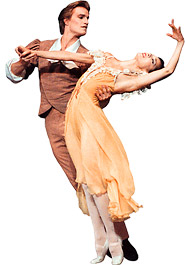
Robert Schumann's "Davidsbündlertänze"
Choreographed by George Balanchine five years before his death, in 1979, Robert Schumann's "Davidsbündlertänze" is named after the eighteen-part piano suite of the same name. Balanchine places the pianist directly onstage during the ballet; in doing so, he plunks the maker right down in the middle of the thing made—in this case, an elegiac and sorrowful ballet that can be read as, among other things, a long good-bye. Ostensibly, the dance concerns the melancholic composer's relationship with his sweetheart (and later wife) Clara Wieck, seen through the prism of four different couples. The music's title translates as "Dances of the League of David," with the latter being an imaginary group Schumann concocted to express different aspects of his personality. Fine and dandy, but one might just as easily interpret the dance as the choreographer (as pianist) set down among his company, propelling the work. Or you might want to think of it as being about a virtual "League of George"—he being at once all four danseurs. (Handy fact: Balanchine had four wives.) Perhaps, though, you might want to consider the four couples simply as artists and muses. But however it strikes you, the ballet is always the same in this way: it is beautiful. And like any great work of art, it unfolds before you teeming with possibility. The dance is the patient, and the audience is the psychiatrist—and vice versa. (New York State Theater, February 3 [matinee], 7, and 8; 212-870-5570.) —N.D.
Radical Revivals
In 1965, two plays—Peter Weiss's Holocaust documentary The Investigation and Edward Bond's savage slice of London working-class life, Saved—opened in Europe within weeks of each other. It was a seismic moment in twentieth-century drama because each work displayed new theatrical vernaculars with which to speak about unspeakable violence. This month, both works receive rare revivals in the United States: Robert Woodruff directs Saved for Theatre for a New Audience, in New York, and Irene Lewis mounts The Investigation for Baltimore's Center Stage. For the latter play, Weiss began with transcripts of the 1964 Frankfurt war crimes trials brought by Auschwitz survivors, carefully edited them into verse lines sans punctuation, and sculpted such scenes as "The Song of Cyklon B" and "The Song of the Fire Ovens." Several weeks after The Investigation opened simultaneously at fifteen theaters, London audiences were confronted with Saved. "I write about violence as naturally as Jane Austen wrote about manners," Bond has said. And indeed his "Oedipal comedy," written in gritty street patois, climaxes with the onstage murder of an infant. The point—that "small" acts of violence result from the systemic violence of capitalism—was lost on the Lord Chamberlain's office, which made Saved a cause célèbre as the last play banned in Britain. Given that neither genocide nor infanticide has disappeared, unfortunately, both plays remain as timely as ever. —J.I.
Spring's Awakening
That marching-band sound you hear in the distance may just be the annual spring migration of big-budget musicals to Broadway. This month, two undergo final tinkering out of town. The most anticipated is the stage adaptation of Mel Brooks's feature film The Producers, in which Nathan Lane and Matthew Broderick costar as a pair of schemers who have the audacity to con theater investors of their money via a musical project unforgettably dubbed Springtime for Hitler. Their show might have succeeded if they also had Susan Stroman (Contact,The Music Man) as their director and choreographer. She gives the musical its final tune-up February 1-25 at the Cadillac Palace, in Chicago. Meanwhile, in Stamford, Connecticut (Palace Theatre, February 20-25), a revival of the Jule Styne-Comden and Green musical Bells Are Ringing makes its final port of call. It stars Faith Prince as Ella Peterson, the role for which Judy Holliday won a Tony Award, in 1956. Director Tina Landau (Floyd Collins) makes her Broadway debut with the classic musical comedy about an irrepressible answering service employee who can't stay out of her clients' lives. It features such stellar Styne compositions as "It's a Perfect Relationship," in which Ella croons about a man she's fallen in love with over the phone: "Can he dance like Fred Astaire?/Is he dark or is he fair?/Pompadour or not a hair?/Well, I don't care!" It's an apt sentiment this time of year for all curious musical-theater obsessives. Both shows open in New York in April. —J.I.
What do you think? Discuss this article in Post & Riposte.
Nancy Dalva's essays appear in the magazine 2wice.
John Istel is the editor-in-chief of Stagebill.
Photograph from Robert Schumann's "Davidsbündlertänze": Paul Kolnik.