Arts & Entertainment Preview | February 2001 | Sponsored by Chrysler
by Ella Taylor
Close Encounters
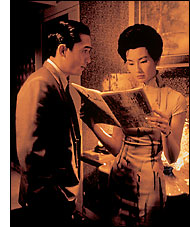
Tony Leung (left) and Maggie Cheung star in In the Mood for Love
On the principle that the best love stories are sustained by unfulfilled or secret desire, the Hong Kong director Wong Kar-wai (best known in the United States for his whimsical 1994 comedy, Chungking Express) has spent a prolific career obsessively revisiting the theme while crafting a dazzling fusion of cinematic styles from both sides of the Pacific. Set in Hong Kong in 1962, his latest film, In the Mood for Love (billed as a sequel to his 1991 film, Days of Being Wild, and boasting the same two romantic leads), turns on two neighbors in a crowded rooming house who, after discovering that their spouses are having an affair—with each other—struggle with their own growing mutual attraction. Coifed to the gills en bouffant and graceful as a swan in a series of to-die-for high-necked, form-fitting shifts, the Hong Kong martial arts star Maggie Cheung is ravishing but droopy as the lonely wife who finds solace with her equally proper neighbor (Hong Kong heartthrob Tony Leung). The aching beauty of the movie's visual style and its impishly anachronistic score are woefully undercut by the flat affect that courses sluggishly between the would-be lovers, on whom Wong Kar-wai's characteristically voyeuristic and claustrophobic camera spies, framing them in doorways and lintels or disappearing around corners. Though not unduly lengthy by current standards, In the Mood for Love feels like one of the longest brief encounters in cinema history—all mood and precious
little encounter.
Eros as Émigré
Raised in rural Cuba in "a roomful of unhappy women"—among them his own mother—the novelist and poet Reinaldo Arenas found sexual and intellectual liberation in the heady, experimental early days of Fidel Castro's revolution. Unrepentantly homosexual and congenitally incapable of toeing anybody's party line, Arenas soon ran afoul of the authorities. Though his work was published abroad to great acclaim, at home his writing was banned and he spent years in prison or in hiding, until he joined the Mariel Harbor boatlift, in 1980, and settled in New York. In more solemn directorial hands than those of the artist Julian Schnabel (Basquiat), such a life might easily be tailored into a glum bio-pic. But Before Night Falls, "interpreted" from Arenas's posthumously published memoir, is a downright buoyant movie, due in large measure to a wonderfully excitable performance by the Spanish actor Javier Bardem. His Arenas is a mercurial man—part provincial naïf, part jaundiced sophisticate, by turns euphoric and despairing, never a natural victim, and always insisting on eros as the truest cultural revolt. The movie is itself a study in contrasts, with a powerfully lyrical juxtaposing of space and color that grasps, through Arenas's struggle, the beauty and horror of Cuban life—without, in the end, pinning the full blame for the writer's predicament on Castro. Even in New York, Arenas never found the unconditional freedom he craved. He died of AIDS, in 1990, attended by his faithful old friend Lázaro Gómez Carriles, who, with Schnabel and Cunningham O'Keefe, cowrote the movie's muscular screenplay.
Nervous Laughter
Recent film adaptations of Edith Wharton's novels—John Madden's Ethan Frome, Martin Scorsese's The Age of Innocence—have foundered on excessive reverence for period accuracy and a funereal way with tone. Oddly enough, it takes a British director—and one like Terence Davies, whose very slow, very English movies have met with only critical success in the United States—to enliven our understanding of Wharton's themes without cheapening them in the process. Though it was shot in Scotland, The House of Mirth does sumptuous justice to its belle epoque New York setting. Yet one feels one is watching not a costume drama but the slow unfurling of a genteel subculture whose brocaded decorum conceals a snake pit peopled with conniving hypocrites. As the urbane yet naïve socialite Lily Bart, who believes that in the absence of wealth, her beauty, wit, and charm will solidify her social standing, Gillian Anderson, a more expansive actress than her role as Agent Dana Scully in The X-Files would suggest, exudes the consumptive radiance of a typical Wharton heroine—a victim of others' malice, but also of her own corruptibility and, ultimately, hard-won moral scruples. Eric Stoltz's tendency to be a bit of a stiff serves him well as Lawrence Selden, the one man Lily might marry purely for love. Davies's screenplay prunes the novel yet remains faithful to Wharton's quiet passion, and he directs with a lush delirium inflected with an elfin humor that offers relief from the story's bleak insistence on the inadequacy of principles in a venal world.