Arts & Entertainment Preview | June 2001 | Sponsored by Chrysler
by Austin Baer
The Pendulum Swings
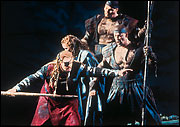
Cast members of Das Rheingold, in The Ring of the Nibelung
A generation or so ago, Seattle was the reactionary Wagnerite's last refuge. Elsewhere, any opera company capable of mounting The Ring of the Nibelung—that four-night epic of universal corruption and redemption—was taking some radical, iconoclastic approach. Only on Puget Sound could you still see the rivers and forests, the dwarfs and giants, the old Norse mythology of Wagner's story. With the arrival of Speight Jenkins as general director of the Seattle Opera in 1983, the company soon swept its drinking horns and bear pelts away in favor of a spiffy postmodern Ring of its own, directed by François Rochaix. (Around the same time, the Metropolitan Opera—alone among world-class institutions—took over the conservative franchise.) Now Seattle is embarked on a new cycle, which reaches completion this summer. The director is Stephen Wadsworth, who has perpetrated a concept or two in his time but now reverts to tradition. "The look of the show is real," he says. "Nature is real. I'm trying to realize the piece in the terms of its creation." Perhaps even more important, Wadsworth's aim is fresh dramatic truth, with every character on the stage thoroughly involved in every scene at every moment. "That kind of specificity," he observes, "is something this material hasn't enjoyed much lately." And it makes all the difference. The bad news: this summer's three cycles (August 5-26) are sold out, and the next reprise isn't until 2005. The good news: there are always returns. Call the box office (206-389-7676), and keep ringing.
Dust to Dust
Ask not for whom the bell tolls. The Michelangelesque choral fresco best known as the "Verdi Requiem" is resounding in churches and concert halls everywhere this year to commemorate the centennial of the death of its composer. In fact, Verdi wrote it in honor of Italy's great nationalist novelist and poet Alessandro Manzoni. But the origins of the work go back further. In 1868, four days after the death of Gioacchino Rossini, composer of The Barber of Seville, Moses, and William Tell (among much else), Verdi proposed a requiem mass for the illustrious deceased consisting of individual movements by Italy's "most eminent" composers. How eminent? Of the dozen recruited (in addition to Verdi himself), contemporary audiences will recognize not one. Yet each did his part, and a two-hour homage to Rossini resulted. For tangled reasons—this was Italy—the planned performances failed to materialize. Verdi was not the only contributor to recycle his part within a larger composition of his own, and his staggering "Libera me" duly made its way into the requiem for Manzoni. But the forgotten patchwork Messa per Rossini only saw the light in 1988, in Parma. On June 22, Helmuth Rilling, the conductor on that occasion, dusts it off as the opening concert of his Oregon Bach Festival, in Eugene, which by no means confines itself to Bach. The event is one bookend in a two-part Verdi tribute that concludes on closing night, July 8, with the immortal work its creator called the Messa da Requiem. (Box office: 541-682-5000.)
A Beauty Awakens
For the past half century, the heroines of Richard Strauss have known no more constant Prince Charming than John Crosby, founder and general director emeritus of the Santa Fe Opera. A privileged half dozen—Salome, Elektra, Ariadne, and Arabella, in the operas that bear their names; the Marschallin, in Der Rosenkavalier; perhaps the Countess of Capriccio—have the run of stages everywhere. But under the blazing dome of the New Mexico sky, the whole sorority has awakened to Crosby's kiss. Several of the incandescent sleepers hail from Greek myth, which Strauss tended to view through a magic, turn-of-the-century prism that bathed antiquity in a golden haze. This year, his Helen of Troy gets her turn with a rare staging of Die Aegyptische Helena (The Egyptian Helen). According to one revisionist tradition, there were two Helens: the true one, who remained chaste, and sat out the Trojan War in Egypt; and a phantom adulteress, who shared her bed with the unsuspecting prince Paris. The opera posits a single Helen, who tries to sell her husband this exact bill of goods once the Greeks have won the war. She succeeds temporarily, and in a voluptuous passage exults at the bliss of her "second wedding night." But eventually, Helen's future happiness must be put on a more truthful footing. At Santa Fe, it is the lustrous soprano Christine Brewer who undertakes this tricky journey, of course under Crosby's baton. (July 21-August 15; 800-280-4654.)