Return to the June A&E Preview cover page.


S P E C I A L   A D V E R T I S I N G   S E C T I O N

Arts & Entertainment Preview | June 2001 | Sponsored by Chrysler


Classical Music

by Bob Blumenthal and Charles M. Young


Leading the Blind


Founding fathers
Fountain, Carter, and Scott

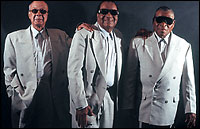
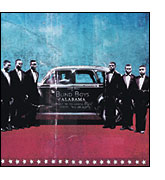
When you've been singing together for sixty-three years, as the Blind Boys of Alabama have been doing since meeting at the Alabama Institute for the Deaf and Blind, in Talladega, in 1939, you need to think in terms of marketing some of that fine old wine in a flashy new bottle. This the Blind Boys have done on Spirit of the Century (Real World Records), the flashy new bottle taking the form of some world-class blues and folk musicians like David Lindley and John Hammond on guitar, Charlie Musselwhite on blues harp, and Danny Thompson on bass. They manage to achieve maximum swing with minimum fuss, hitting the right notes, all the right notes, and nothing but the right notes on twelve songs that range from surprisingly reworked classics ("Amazing Grace" is sung over the chord progression from "House of the Rising Sun") and more contemporary (and ironic?) gospel like "Way Down in the Hole," by Tom Waits, and "Just Wanna See His Face," by the Rolling Stones. The main appeal, though, is first and foremost the Blind Boys, led by Clarence Fountain, who can rasp and roar and carry a melody with formidable authority. If he says Jesus is coming back soon, the matter is settled and that's all there is to it. Atheists will groove on his enthusiasm, agnostics will harmonize with believers, and heathens all over the world will flop on the floor and have Saul-on-the-road-to-Damascus revelations. The final cut, "The Last Time" (which the Stones turned to their purposes in the mid-1960s), is a stunning a cappella reminder that any moment can be your last, so appreciate the moment you have now. —C.M.Y.


Jazz Squared

The switched-on sensibilities of pop-jazz are rarely compatible with the more elevated inventions identified with the music's acoustic mainstream. A few intrepid souls manage to straddle these lines, and Marcus Miller may be the most intrepid of all. Miller, who gained his first notoriety twenty years ago with Miles Davis, has few rivals when it comes to slapping out funky lines on his primary instrument, the electric bass. Few other electric bassists, however, are equally comfortable on such instruments as the bass clarinet, or can create (and play most of the parts on) orchestral settings of their own design. On (Telarc), Miller brings these talents to bear on a program that is eclectic to say the least, as the Raphael Saddiq vocal on the original pop song "Boomerang" follows a meditative reading of John Coltrane's "Lonnie's Lament," and a hard-charging cover of Talking Heads' "Burning Down the House" is succeeded by the Brazilian-flavored "It's Me Again." The album is loaded with guest stars, and saxophonists Kenny Garrett and James Carter almost upstage their host with intrepid cameos; yet Miller remains the focal point. His arrangements are visceral and graceful, with synthesizers and drum programs coexisting alongside woodwinds and cellos, while his theme statements and solos on electric bass display virtuosity without abandoning a strong melodic focus or a deep groove. The disparate moods of are linked by an overriding upbeat attitude that suggests a younger Quincy Jones who can provide his own killer solos. —B.B.


Crisp Notes

The pianist Marilyn Crispell has worked in the realm of free jazz for the past two decades. Her playing is often described as lyrical, and was always less relentless than that of avant-garde avatar Cecil Taylor; but it has only been since Crispell joined forces with bassist Gary Peacock and drummer Paul Motian that the lyrical aspects of her style have fully emerged. Amaryllis (ECM), the second effort by the Crispell/Peacock/Motian trio, is a contemplative program of original compositions and collective improvisations in which the attentiveness of the musicians to each other is almost audible. Peacock and Motian helped lay the foundation for such affinity when they worked as a unit with Bill Evans and then Paul Bley in the 1960s, and they remain expert at making music breathe in natural, if not conventionally symmetrical, cycles. Crispell, to her credit, does not imitate her partners' former partners, finding her own way through the disc with a glowing touch and looping variations that establish their own considered momentum. The tautness inherent in such closely argued music is enhanced by the program's balance of concise written lines and the more floating collages. When the trio does let loose, on "December Greenwings" and "Rounds," Crispell is able to approach the explosive impact of her previous work without raising her voice. —B.B.


Go to Dance & Theater | Classical Music

What do you think? Discuss this article in Post & Riposte.


Bob Blumenthal is a jazz critic for The Boston Globe.
Charles M. Young reviews music for Playboy and other publications and for Allmusic.com.

Photograph of the Blind Boys of Alabama: Todd Radunsky. Blind Boys of Alabama CD cover: Real World Records.

Copyright © 2001 by The Atlantic Monthly Group. All rights reserved.