 |
DECEMBER 1996
THE ARTS & ENTERTAINMENT PREVIEW Dance and Theater | By Austin Baer and Nancy Dalva |
|
|
DECEMBER 1996
THE ARTS & ENTERTAINMENT PREVIEW Dance and Theater | By Austin Baer and Nancy Dalva |
Copyright © 1996 by The Atlantic Monthly Company. All rights reserved.
NOT YOUR TYPICAL TCHAIKOVSKY
Chances are as you read this article there is a production of The Nutcracker somewhere in your vicinity. Choose whatever metaphor you like--warhorse, cash cow, goose that lays golden eggs--this ballet, in all its various guises from the elaborate to the touchingly makeshift, sells tickets. Run The Nutcracker for a few days (or weeks or months), the reasoning goes, and you can afford to present more-esoteric fare come spring. In fact a number of Nuts are themselves esoteric: Nureyev's is creepily psychological, Mark Morris's hilariously contrarian. But to my mind, the very familiarity of the ballet is the draw, although one can certainly sympathize with the stagehands and musicians and performers who, along with certain jaded members of the public, feel like fleeing from the room as the curtain rises yet again. Nonetheless, it is at just that moment, out in the dark of the auditorium, that some of us are settling in our seats, preferably with a little one at our side; this is, after all, an entertainment for families. Ideally one would always go with one's grandmother, and indeed it was with his own granny in mind that Donald Byrd fashioned his newfangled yet old-fashioned The Harlem Nutcracker. (Donald Byrd/The Group: Northrop Auditorium, Minneapolis, December 4-7; Brooklyn Academy of Music, New York City, 11-15; University Musical Society, Ann Arbor, Michigan, 18-21; Wiltern Theater, Los Angeles, 27-29.) And so he has made Clara (the little girl who receives the Nutcracker as a Christmas gift, setting the whole plot in motion) herself a matriarch who recalls her youth during the Harlem Renaissance of the 1920s. Rather than the traditional Tchaikovsky score, Byrd has used Duke Ellington's thirty-five-minute arrangement, amplified by the composer David Berger's gospel interludes and additional Ellington-style material. Another period Nutcracker is my own favorite: Robert Joffrey's exceptionally beautiful Valentine-card vision of Victorian America, circa 1850. Himself an acknowledged "Christmas nut," the late choreographer adored everything about the holiday season. This exquisitely rendered and merry production features local children in charming cameo roles at all of its stops on tour, and local orchestras as well. (The Joffrey Ballet of Chicago: Rosemont Theatre, Chicago, November 25-December 8; Hancher Auditorium, Iowa City, December 9-15; Orange County Center for the Performing Arts, Costa Mesa, December 23-29.) --N.D.
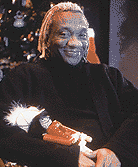
Donald Bryd in the Christmas spirit
Photo: Dan Rest
CLASSIC SHTICK
Farce: it is a funny genre. . . By literary standards, Molière's Scapin is no gem, but as a springboard for clowning, it still has lots of bounce. What's it about? Fathers and children, servants and masters (Scapin is one of the former), marriage plans run amok--if anyone tries to elaborate, run for your life. Know, though, that Bill Irwin has lately taken up the knockabout French classic for an eagerly awaited Broadway revival by the Roundabout Theatre Company (December 4-March 9; 212-869-8400). Irwin, whose loose-limbed antics have won him a MacArthur "genius" award, has in his time toyed with the idea of playing Hamlet. But lots of others are in line for the Dane's inky cloak and suits of solemn black, and so far our true-begotten bozo has found no takers. Which leaves him free for such happy tasks as directing and starring as the scamp who pulls the strings in what promises to be a side-splitting show. --A.B.
Jean Baptiste Poquelin,
a.k.a. Molière
Photo: The Bettmann Archive
A TALE OF INNOCENTS
Film buffs will remember Whistle Down the Wind (1961) as a minor classic that explores the contradictory realities of kids and grown-ups. Three children rescue three kittens from drowning and hide them in their father's barn. Next morning they discover a bearded stranger there, asleep in the hay. In context it does not seem all that far-fetched for them to mistake him for Jesus. (Shortly, in a wondrous touch of magic realism, they are dancing over a hillside to the jaunty soundtrack accompaniment of "We Three Kings.") In fact, though, the man is wanted for murder. The circumstances of his crime are never revealed, nor is he seen to do any harm. When the law catches up with him, he goes gently. Mute and disconsolate, the children witness his capture. Mawkish as the tale may sound in the retelling, on the screen it has a disarming and at times blunt innocence. Perhaps that quality will survive in the new Broadway-bound Andrew Lloyd Webber musical, directed by Harold Prince, which transposes the action from bleak black-and-white Lancashire to a Louisiana backwater; it receives its world premiere this month at the National Theatre, in Washington, D.C. (December 6-February 9; 800-447-7400). --A.B.
Photo: Courtesy of Boneau/Bryan-Brown
Austin Baer is a writer based in New York.
Nancy Dalva is working on a series of essays on Merce CunninghamDiscuss this feature in the Arts & Literature conference of Post & Riposte (First-time users enter here).
| December 1996 Cover Page | Film | Pop and Jazz |