 |
DECEMBER 1996
THE ARTS & ENTERTAINMENT PREVIEW Film | By Ella Taylor |
|
|
DECEMBER 1996
THE ARTS & ENTERTAINMENT PREVIEW Film | By Ella Taylor |
Copyright © 1996 by The Atlantic Monthly Company. All rights reserved.
LIFE'S CONCERTO
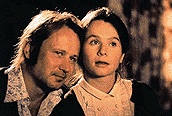
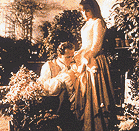
Based on the troubled life of Australian concert pianist David Helfgott, Scott Hicks's playful Shine steers clear of the linear arc of conventional biopics while maintaining a broad accessibility that won the movie top prizes from both the press and the public at the 1996 Toronto Film Festival. The movie darts back and forth in time, mimicking the structure of a concerto as it traces the roots of David's emotionally unstable adulthood to his unhappy youth under the repressive wing of his ambitious father (Armin Mueller-Stahl), a Polish-Jewish refugee whose rigidity is outstripped only by devotion to an abstract idea of family unity that cripples his sensitive son. Escaping England to study under the legendary music teacher Cecil Parkes (John Gielgud), David suffers a complete collapse after a triumphant performance and returns to a life spent in and out of mental institutions in Australia. Brilliant performances by Noah Taylor (The Year My Voice Broke) as the young David and Geoffrey Rush as the adult David convey not only his nerdy pathos but also the hyperkinetic charm that drew so many kind people to him, including the astrologer (Lynn Redgrave) who helped to salvage his life and career. Jan Sardi's screenplay, though witty, presses almost every line of dialogue into the service of a simplistic master narrative--damaged father produces damaged son--that stops this touching, expert, and often wildly funny movie just short of greatness. Still, one is left hungering for a sequel that chronicles the astonishing match between David and his astrologer.
David and his eccentric astrologer
The shining star (r)
Photos: Lisa Tomasetti

MAKING WAVES IN A SMALL TOWN
The extraordinarily imaginative Danish filmmaker Lars Von Trier (Zentropa, The Kingdom) makes his bid for the mainstream with Breaking the Waves, the story of a remarkable marriage between Bess (Emily Watson), an impish woman who dwells just this side of sanity in an austere Calvinist community on the Scottish coast, and Jan (Swedish actor Stellan Skarsgård), a worldly oil-rig worker who falls in love with Bess's trusting innocence. When Jan is brought home paralyzed by terrible injuries from an accident at sea, he persuades his young bride to "aid his recovery" by taking other lovers (and regaling him with the details), in the hope that she will thus lead the normal life he can no longer offer her. The acting is superb (Katrin Cartlidge, last seen in Before the Rain, is especially good as Bess's loving but bossy sister-in-law), and the movie, exquisitely shot with a hand-held camera by the gifted cinematographer Robby Müller, also has a score that will thrill fans of early-seventies pop. Yet before long it becomes clear that all this talent is being poured into kitschy romantic melodrama, for Bess becomes the tiresome child-whore-saint icon that excites the fantasies of all too many male filmmakers. She's Mary Magdalene in hot pants, and after the hundredth shot of her guileless saucer eyes and beatifically parted lips smudged by tarty lipstick, I was overcome by an urge to do the unthinkable--throw popcorn at a saint and head for the exit.
An intense love, strangely altered
Photo: Courtesy of October Films
WHERE WIT REIGNS SUPREME
Although it's set in eighteenth-century Versailles and littered with giant wigs, Patrice Leconte's new movie is in no sense a regulation period picture. Newcomer Charles Berling plays Gregoire Ponceludon de Malavoy, a mildly blue-blooded, idealistic young engineer who arrives on Louis XVI's doorstep to beg for resources to drain the mosquito-infested swamps of his home region and so save his countrymen from disease. Once at court the naive Gregoire gets sucked into the rotting culture of an aristocracy in decline, where neither sincerity nor decency but wit and the ability to ridicule others open doors to the few favors the King has left to bestow. Caught between his love for Mathilde (Judith Godreche), a free-spirited young scientist raised on Rousseau, and the attentions of a conniving courtesan (a majestic Fanny Ardant), Gregoire struggles between means and ends until he realizes he's being used. Leconte's most ambitious work to date, Ridicule is a film of ideas, ripe with the moral passion of good historical drama and speckled with both the precisely placed venom of Restoration comedy and the waggish antics to be expected from the versatile director of The Hairdresser's Husband and Monsieur Hire. By the time Gregoire rises from a final humiliation to tell the court that the Voltaire they quote so liberally is, unlike them, "ridiculously compassionate," you're as primed as France was for the revolution just around the corner.
Charles Berling
and Judith Godreche
Photo: Courtesy of Miramax Zoe
Ella Taylor is a film critic for LA Weekly.Discuss this feature in the Arts & Literature conference of Post & Riposte (First-time users enter here).
| December 1996 Cover Page | Pop and Jazz | Dance and Theater |