

NOVEMBER 1996
Copyright © 1996 by The Atlantic Monthly Company. All rights reserved.
THE DOMINGO EFFECT
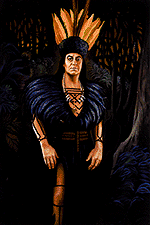
Even by the standards of grand opera, the love duet of Antônio Carlos Gomes's Il Guarany is bizarre. In the wilds of sixteenth-century Brazil a noble Indian chieftain has fallen under the spell of a Portuguese imperialist's daughter whose beauty also attracts scum both European and Native American, landing her in more perils than the proverbial Pauline. In a corker of a plot twist the hero pops slow poison to get even with the cannibals who are about to dress him for dinner. But custom demands that the victim be granted the carnal favors of the queen--this time none other than his ladylove. From our remove the score sounds derivative of early Verdi, with an exotic overlay. In fact, Verdi himself spoke highly of it. Catching up with Il Guarany in 1872, two years after its world premiere, at La Scala (and a year after unveiling his own, incomparably richer, exotic masterpiece Aida), the great Italian declared the Brazilian newcomer a "truly musical genius." After long neglect Gomes has now found a champion in Plácido Domingo, who recorded Il Guarany live in Germany two years ago for Sony Classical. This month, in a stroke of administrative genius, he makes it the opening salvo of his reign as artistic director of the Washington Opera (November 9-December 1; 202-416-7800). Consider: to have unearthed an exciting grand opera with all the trappings, unspoiled by prior acquaintance, with a New World theme, and from the pen of a New World composer to boot. All this plus a juicy title role for Domingo, the tenorissimo everyone in town is dying to hear.
The warrior-chieftain
Photo: Diane Levy
Hear a clip ("Sinfonia" or "Scena e duetto") from Antônio Carlos Gomes's Il Guarany in RealAudio 28.8 format. Or, you may also download "Sinfonia" and "Scena e duetto" in .AU format. (For help, see a note about the audio.)
SHAKESPEARE SINGS
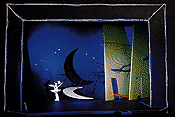
A bright fellow once observed (in these or very similar words) that Shakespeare's plays, being music, cannot be set to music. Perhaps out of some dim understanding that this is so, no composer of any fame has attempted to set Shakespearean drama to music verbatim. One who came close is Benjamin Britten, whose A Midsummer Night's Dream alights at the Metropolitan Opera on November 25, three dozen long years after its world premiere. The adaptation is the handiwork of Britten himself and his lifetime companion and muse, the tenor Peter Pears, and recent scholarship has canvassed their (as it turns out, numerous) deviations from the original in excruciating detail. Still, no other libretto preserves more extensive tracts of genuine Shakespearean text or has been set with an acuter ear. Fashions in bardolatry change, of course. To the Victorians, whose musical Dream image was Mendelssohn's, Shakespeare's fairies were faeries, gossamer sprites at home in the petals of a rose. By mid twentieth century the zeitgeist had recast them as goblins, dark imps of the id, and thus Britten saw them too. His spider and bat-wing aesthetic will scarcely be lost on the production team of Tim Albery and Antony McDonald, deconstructionists new to the Met but not to the up-to-date theatrical styles of the continent. David Atherton, who conducts, knows well how to sail Britten's currents and undertows; and a first-rate cast, dominated by the chimelike soprano of Sylvia McNair and the smoldering male alto of Jochen Kowalski as the squabbling royal couple of fairyland, promises impersonations of rare witchery. (Performances continue through December 21; 212-362-6000.)
Set design by Anthony McDonald
Photo: Courtesy of The Metropolitan Opera
PORTRAIT OF A PEOPLE
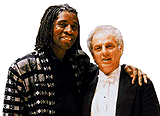
Hannibal Lokumbe's African Portraits, on the Philadelphia Orchestra's calendar this month (November 8-12; 215-893-1999), traverses 400 years of the "African-American experience" in fifty-plus swift minutes. The vignettes run a course from prelapsarian joy in a 16th-century West African village through the atrocities of slavery to a celebration of gospel, spirituals, blues, and jazz. Timeless world music meets historic strains grown on American soil. Masters in each style lend the proceedings authenticity as well as eloquence. Nothing is mainstreamed, yet all is fitted into a narrative carried by that quintessentially European invention, the modern symphony orchestra. The instrumental scene painting (especially in sea episodes) is haunting, and the elegy of a violin solo pierces the heart. Nor are the voices of white men excluded: the auctioneer in the slave-market scene is demonized, but the captain of a slaver plying the Middle Passage stands forth (in his benighted white-supremacist way) as a soul not altogether untouched by godliness and human decency. On a Teldec CD with Daniel Barenboim, the blue-chip Chicago Symphony Orchestra, and a splendid assembly of soloists, African Portraits sings a powerfully ecumenical song. How exactly to classify it, though, is hard to say. "File Under: Classics and Jazz" advises a tiny note on the CD cover. Well, that's a start. Next question: Under what letter? The answer is H--the composer prefers to be known by his first name.
Hannibal and Barenboim
Photo: Courtesy of Teldec
Austin Baer is a writer based in New York.
Go to the November 1996 Film page
Go to the November 1996 Pop and Jazz page
Return to the November 1996 cover page