

NOVEMBER 1996
CASTING A WIDE NET
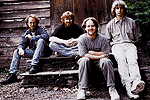
Rock-and-roll being the loud branch of folk art, its practitioners rarely know how to read and write music in any formal sense. The members of Phish do, and even more remarkably, they manage to display their considerable skills with such imagination and taste that you never suspect arrogance (like Frank Zappa's) or bombast (like Emerson, Lake & Palmer's). What they do display is a breathtaking command of odd time signatures, sweet harmonies, and catchy melodies with touches of rock, jazz, bluegrass, classical, folk, whimsical jokes, blues, and avant-garde weirdness. Since forming at the University of Vermont, in 1983, they have trained their Neo-Deadhead audience to expect daring improvisations that might lead to screwups and might lead to moments of true awe and wonder. So the complete Phish experience is most readily consumed in concert--you haven't lived until you've seen 20,000 Phish Heads noodle dance--or on last year's double CD A Live One (Elektra). This year's album, Billy Breathes (Elektra), probably rates as their most successful studio effort. Their sense of humor, which has sometimes crossed the line into cuteness, seems to be in check, and that lets the amazing breadth of music speak for itself. Ranging from the most delicate fingerpicking to great washes of feedback, Trey Anastasio's guitar is on particularly admirable display. You may ask yourself, "What's missing here that every other alternative band has had since 1988?" Alienation. These guys don't whine and they don't snarl. They're just damn thrilled to be making music. --C.M.Y.
Phish: A success in the studio at last
Photo: Danny Clinch
Hear a clip ("Taste" or "Train Song") from Phish's Billy Breathes in RealAudio 28.8 format. Or, you may also download "Taste" and "Train" in .AU format. (For help, see a note about the audio.)
SONNY'S DAYS ARE HERE AGAIN
Twenty-five years have passed since the tenor saxophonist Sonny Rollins emerged from his last sabbatical. Since then, while his reputation as jazz's most galvanic living soloist has grown, his albums have been panned for failing to document the excitement of his live performances. Milestone, his recording company since 1972, intends to shatter the latter perception with Silver City, a two-disc anthology of Rollins's years at the label programmed by the colossus himself.
Photo: Steve Maruta
The results are generally persuasive, especially when Rollins is free-associating at length over strong rhythmic support ("G-Man" and the title track) or looping riffs and outrageous quotations in heated unaccompanied cadenzas ("Autumn Nocturne," "Skylark"). What also emerges clearly is a point stressed in Chip Stern's excellent liner-note interview with Rollins--that the saxophonist has been absorbed in wedding jazz swing to Caribbean and other dance rhythms, rather than simply replaying his hard-bop triumphs of the 1950s and 1960s. Although the choice has its downside (a preference for electric bass), it has also produced such treats as the celebratory "Duke of Iron" and "Harlem Boys."
Rollins and his wife and manager, Lucille, have taken pains with the selections on Silver City, substituting choices late in production to include two tracks from this year's Sonny Rollins +3, his strongest album in a decade. The decision was well advised, because Rollins, at age sixty-six, has been performing with the strength of a newcomer and the imagination of jazz's reigning genius. --B.B.
EXPANDING THE BORDERS OF BEBOP
"Acid jazz" is an elusive concept. The phrase was coined in European dance clubs, where deejays would sample funky instrumentals from the 1960s. Sometimes the term takes in hip-hop variations or rule-breaking avant-garde solo styles; but it always tends to connote a view of jazz that spurns orthodoxy and incorporates alternative elements. Two new albums suggest that acid jazz already has broad horizons.
Medeski, Martin & Wood
Photo: Michael Macioce
Medeski Martin & Wood are all about grooves. John Medeski favors early-generation electric keyboards like the clavinet and the Wurlitzer piano, which he locks into infectious patterns with Billy Martin's drums and Chris Wood's upright bass; then the music unravels. Shack-man (Gramavision), the fourth MM&W collection, brings a new level of concentration and momentum to the concept. Each track begins by stating a seductive basic rhythmic premise and then pulls on a single instrumental strand as drums, bass, or keyboards wander off on warped tangents. Simple on the surface, yet new facets emerge with repeated listening.
A more direct line to funky jazz styles is heard in the music of young San Franciscans such as the eight-string guitarist Charlie Hunter and the tenor saxophonist Dave Ellis. After working in Hunter's trio, Ellis formed his own band, which is heard on Raven (Monarch). The CD contains several modern jazz classics (by the likes of McCoy Tyner and Wayne Shorter) that receive a new, danceable spin. The jazz/pop standard "Always There" and a Beatles tune are also in the mix, which Ellis dominates with his enveloping sound and emphatic attack. Hunter and the fusion drum pioneer Mike Clark make guest appearances that add extra kick to Ellis's populist approach. --B.B.
Bob Blumenthal is a jazz critic for The Boston Globe.
Charles M. Young reviews popular music for Playboy, Musician, and other publications.
Go to the November 1996 Classical page
Go to the November 1996 Film page
Return to the November 1996 cover page