


OCTOBER 1996
TRIUMPHANT RETURNS
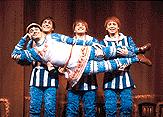
A few hits, and the proverbial Fabulous Invalid that is Broadway stages an astonishing recovery. It happened last season, thanks in large measure to some inspired revivals that lent American classics brilliant new spin and sparkle. Happily, most of the best are running strong, their stars still blazingly on the job. Despite crinolines and the absence of overt sex, Donna Murphy and Lou Diamond Phillips reveal in Rodgers and Hammerstein's The King and I a love story of tigerish intensity. In A Funny Thing Happened on the Way to the Forum, with its merry, wicked Stephen Sondheim score, Nathan Lane, unfairly faulted for failing to be Zero Mostel, dances on a high wire of classic comic convention, twirling quirky shtick all his own. The irreplaceable Zoe Caldwell, who created the role of Maria Callas in Terrence McNally's ingenious Master Class, has passed the torch to Patti LuPone: an Evita for a Medea, and why not? LuPone's diva credentials are in order. Watch her and marvel. Now the new season's hopefuls are chomping at the bit. This month all eyes are on the classy Sigourney Weaver, on furlough from Hollywood for Sex and Longing, the new comedy by Chris Durang (her Yale classmate). Ronald Harwood's Taking Sides, which probes the Nazi links of that titan of the podium Wilhelm Furtwängler, showcases the fine-tuned, sharp intelligence of Ed Harris. The next link in the chain of great revivals could well be the Lincoln Center Theater's The Little Foxes, starring the always enthralling Stockard Channing as Lillian Hellman's cold-blooded, grasping terror Regina. Watch for her this spring. --A.B.
Nathan Lane in A Funny Thing Happened on the Way to the Forum and Patti LuPone in Master Class
Photo: Joan Marcus
UNSETTLING THE AMERICAN WEST
Get out your Gestalt meter. Pina Bausch, Tanztheater Wuppertal's high priestess of angst, anomie, and hard-bitten glamour, is turning her jaded gaze on the American West, where she spent a month last winter. Set to American jazz and pop tunes from the 1940s, 1950s, and 1960s, this new work, called Nur Du (Only You), is said to be about "the breakdown of the American dream," and takes place on a stage set with giant redwood trees. (No surprise to those of us who have taken in her previous mise-en-scènes, which have included leaves, dirt, carnations, dust clouds, collapsing walls, and fish tanks, variously populated by her weirdly glamourous troupe.) This is not the choreographer's first encounter with Americana (from 1958 to 1962 she studied and performed in New York), but hers is a distinctively Germanic point of view. Bausch's four-city tour takes her to Berkeley (October 3-5; 510-642-9988), Los Angeles (October 10-12; 310-825-2101), Tempe (October 17; 602-965-3434), and Austin (October 22; 800-687-6010). --N.D.
A Scene From Nur Du (Only You)
Photo: F. CarboneAfter some thirty-five years of performing and dancing, Trisha Brown retains--gorgeously, improbably, wonderfully--both her potent allure and her rare astringency. Sometimes she has been a hot mind in a cool body, and sometimes the reverse. Her idiosyncratic movement is some of the slipperiest stuff ever seen in dance, described by the art critic Klaus Kertess as "unstable, molecular, and structural." Brown's 1983 masterpiece Set and Reset was "the culmination of that way of working," she says, and so she has included it--with the virtuosic Stephen Petronio returning to perform his original solo--on the first program of her twenty-fifth anniversary season at the Brooklyn Academy of Music, where the Trisha Brown Company is opening the Next Wave Festival (October 1-6; 718-636-4100). Also on that bill: her solos Homemade (1966) and Accumulation (1971), the fabulously fluid Opal Loop (1980), and none other than Mikhail Baryshnikov, performing alongside Brown in a mirror-image duet she calls You can see us (1994). The meditative score was composed by Brown's longtime collaborator Robert Rauschenberg. Highlights of the two other programs include a duet with the master improviser Steve Paxton and a brand-new dance called Twelve Ton Rose. Later this month the company travels (sans guests) to Dartmouth College's Moore Theater (October 11-12; 603-646-2422). --N.D.
A BODY OF WORK
Austin Baer is a writer based in New York.
Nancy Dalva is working on a series of essays on Merce Cunningham.
Copyright © 1996 by The Atlantic Monthly Company. All rights reserved.
