
Return to the November 1997 A&E Preview Cover
|
Arts & Entertainment Preview - November 1997


B Y A U S T I N B A E R

Fallen Soldiers

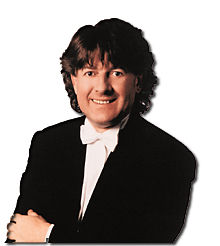 |
Music Director James Judd
|
Of all the concert settings of the mass for the dead, none combines the grim
pomp of public ceremony with the pain of private mourning as does Benjamin
Britten's passionately pacifist War Requiem (1961). To drive home his
point the composer hit on an idea so neat that in less skilled hands it might
have seemed a gimmick. Instead of taking as it stood the familiar Latin text
that served the likes of Mozart and Verdi, Britten interwove the Latin with
plainspoken, quietly tragic poems by Wilfred Owen, himself a casualty of what
the British still call the Great War. The liturgical passages deploy the full
artillery of the modern symphony orchestra and get the grand choral treatment,
punctuated by the impersonal clarion exclamations of a solo soprano. Owen's
poems, accompanied in chamber style, are divided between two soloists, a tenor
and a baritone: voices of the dead. Through these Britten speaks his heart. "I
am the enemy you killed, my friend," sings the baritone, leading into the final
elegy, most eloquent where the music is most still. Underscoring his own
intense personal involvement in the subject matter, Britten dedicated the
War Requiem "in loving memory" to four who fell in the Second World War,
citing each by name and rank. The work's power is not lost in a land at
peace, and in recent seasons it has been making the rounds of American
orchestras. From November 3 to 10 Britten's compatriot James Judd, the
music director of the Florida Philharmonic, leads performances in Miami,
Fort Lauderdale, and West Palm Beach (930-1812 tri-county, or
800-226-1812).
While My Sitar Gently Weeps
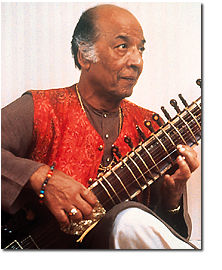 | Ustad Vilayat Khan
|
Subtle yet ecstatic, governed by laws and traditions nothing like our own, the
classical music of India is virgin territory to most of us in the West. Yet the
strains of the subcontinent have cast their spell on professional Western
musicians of many stripes, who in turn have tried to weave Indian strands into
tapestries of their own. The eminent violinist Yehudi Menuhin was instrumental
in turning Western listeners on to the art of Ravi Shankar on the sitar; the
two even shared the stage in some inventive cross-cultural jam sessions. The
Beatles, back from the enlightening East, poured Indian timbres over their next
album like so much patchouli. The French visionary Olivier Messiaen made the
complexities of Hindu metrics an integral element of his own idiosyncratic
musical grammar. In September, in celebration of the fiftieth anniversary of
India's independence, the traveling "Music Festival of India" brought to
Carnegie Hall a dizzying assembly of India's supreme practitioners.
Instrumental luminaries were joined by counterparts in song and dance; for a
Western analogy, picture Cecilia Bartoli, Mikhail Baryshnikov, Van Cliburn,
Plácido Domingo, James Galway, Evelyn Glennie, Itzhak Perlman, Mstislav
Rostropovich, and a few friends sharing a single bill. Is there an irony here?
Indian classical music was originally an art of the court, directed exclusively
to aristocratic connoisseurs immersed in its intricacies. Today those courts
are gone, the gilded cage is sprung, and the birds fly forth, though not often
our way, and never before in so rich a flock. This month the festival continues
at the Paramount Theater in Seattle (November 1; 206-292-ARTS) and the Nob Hill
Masonic Center, in San Francisco (November 7; 415-392-4400). These concerts
focus on three top stars from the gala: Ustad Vilayat Khan and his son Shujaat
Khan, sixth and seventh generations in an unbroken line of sitar masters, and
Shankar's colleague Zakir Hussain on tabla, the intoxicating Indian drum.
An Apple Keeps the Tyrant at Bay
Everyone knows the last three minutes of the William Tell overture,
which leaves roughly three hours and fifty-seven minutes of gorgeous music to
discover (including the overture's opening nine). This month the San Francisco
Opera offers a rare opportunity to do so (November 2-24; 415-864-3330). Adapted
from Schiller's high-minded costume drama, and written for the Paris Opera
under an extraordinary contract with the French government, Rossini's final
opera centers, of course, on the legendary thirteenth-century Swiss freedom
fighter who was handy with his crossbow.
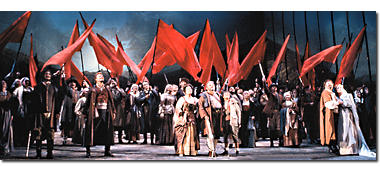
The climax comes right on
schedule when Tell, having refused to kneel to an Austrian tyrant's empty hat,
must shoot an apple off his own son's head--not, however, before delivering
an aria of miraculously poised solemnity that amazed the great Richard Wagner
himself. But individuals are less important in this opera than the grandeur
of nature and the fate of a people oppressed: Guillaume Tell, to use the proper French title, has a sweep and pathos that place it at
the very pinnacle of Romantic operas. Eugène Delacroix -- another Rossini fan -- would have been just the painter to capture its scenes of storm-tossed lake, somber forest, and night-shrouded wilderness.
Austin Baer is a writer based in New York.
Go to ...
 
Copyright © 1997 by The Atlantic Monthly Company. All rights reserved.
|