|


Return to the October 1997 A&E Preview Cover |
Arts & Entertainment Preview - October 1997
   
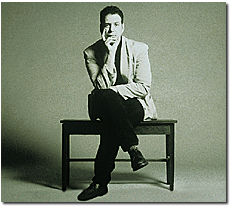
Exquisite snippets of stride piano open and close the album. The nine songs in
which Feldman sings address the usual dysfunctional relationships with unusual
humor and charm, with empathy, and without surrendering his own point of view.
But what really seems to interest him is the subject of time. He likes lots of
time, because he loves to reflect, to let the aesthetics of a situation just
wash over him. Thus he prefers the peace of the suburbs to the tumult of the
city and would rather think than rebel. He knows that ultimately we don't have
much time at all: "You better have fun, 'cause it's over soon," he counsels in
"Always Till Always," a paradoxical reflection on reincarnation.
-- C.M.Y.
"Living It All Wrong," AU, Real Audio 28.8 Copyright 1997, Pure/Mercury Records
There are no young lions among great jazz vocalists. The singer's art requires native talent and years of experience along with a sense of when and how to apply technique. Several young veterans have hit their singing stride recently. Kitty Margolis ranges from African chants to "in-crowd" camp on Straight Up With a Twist (Mad-Kat), and Count Basie alum Dennis Rowland abandons crossover efforts for modern balladry on Now Dig This! (Concord Jazz). Now Dominique Eade has released one of the year's most haunting and accomplished collections.
Much of this music is obscure, and Eade deserves credit for rescuing such
tunes as "When the Wind Was Green" and "The Bad and the Beautiful." With a
talented arranging team, she makes use of ten musicians in unusual small
groupings, often putting guitar or vibes in the place of piano. Flute, bass
clarinet, and frame drum add other dramatic touches. Excellent accompaniment,
especially from Fred Hersch's piano and the tenor sax of the great Benny
Golson, could easily have stolen the scene if not for Eade's commanding vocals.
-- B.B.
"Moonray," AU, Real Audio 28.8 Copyright 1997, RCA Victor
Appearing on The Children's Channel in England -- a necessary credential for any rock-and-roll band coming out of the mother country these days -- the members of Kenickie called the Spice Girls "Tory scum." The band consists of three girls (two on guitar and vocals and one on bass) and one boy (on drums), all twenty or under. They bring the advantages of youth to their album At the Club (Warner Bros.) -- namely, energy, enthusiasm, and attitude, to which they add a forthright desire 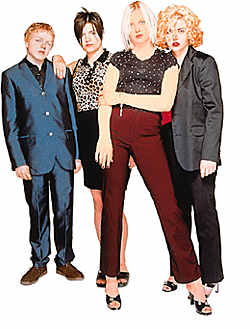 to be looked at and to make a lot of money. Yes,
they really want to be rock stars, so they're in the right business. Should
anyone else pay attention? Yes if your idea of girl rock is the Runaways and
the Go-Go's. No if your idea of girl rock is Joni Mitchell. Kenickie's members
bash away with contagious abandon on riffs worthy of the Ramones, with the
occasional psychedelic interlude. True to the most hallowed tradition of punk
rock, they denounce punk rock for conformity, for clichés, and for being
self-righteous about low production quality -- which makes them more punk than
the punks they denounce in "Punka." Their hit single "In Your Car," which
appears to compare the course of a relationship to the course of hitching a
ride, has a hugely catchy chorus that goes "Yeah yeah yeah yeah yeah yeah
yeah." It would be easy to ridicule such a lyric, as has often been
done in the past, except for two caveats: Songs aren't about linear meaning,
they're about creating a mood. And in the early sixties another band from
England had a cho-rus that went "Yeah yeah yeah," and they are remembered a lot
better now than their many critics. -- C.M.Y. to be looked at and to make a lot of money. Yes,
they really want to be rock stars, so they're in the right business. Should
anyone else pay attention? Yes if your idea of girl rock is the Runaways and
the Go-Go's. No if your idea of girl rock is Joni Mitchell. Kenickie's members
bash away with contagious abandon on riffs worthy of the Ramones, with the
occasional psychedelic interlude. True to the most hallowed tradition of punk
rock, they denounce punk rock for conformity, for clichés, and for being
self-righteous about low production quality -- which makes them more punk than
the punks they denounce in "Punka." Their hit single "In Your Car," which
appears to compare the course of a relationship to the course of hitching a
ride, has a hugely catchy chorus that goes "Yeah yeah yeah yeah yeah yeah
yeah." It would be easy to ridicule such a lyric, as has often been
done in the past, except for two caveats: Songs aren't about linear meaning,
they're about creating a mood. And in the early sixties another band from
England had a cho-rus that went "Yeah yeah yeah," and they are remembered a lot
better now than their many critics. -- C.M.Y.Bob Blumenthal is a jazz critic for The Boston Globe. Charles M. Young reviews popular music for Playboy, Musician, and other publications.  
Copyright © 1997 by The Atlantic Monthly Company. All rights reserved. | ||||||||||||
| |||||||||||||