Tour Information:
Day of Ideas
Philanthropy
The Media
China
Animals
Humor
Military
Religion
Science
American Icons
Education
Politics
Tech & Innovation
Arts & Letters
Idealism & Practicality
Women's Rights
Nature & Environment
Markets & Morals
Civil Rights
Politics & Presidents

The voyager from Europe who lands upon our shores perceives a difference in the sky above his head; the height seems loftier, the zenith more remote, the horizon-wall more steep.... One wishes to be convinced that here the intellectual man inhales a deeper breath, and walks with bolder tread; that philosopher and artist are here more buoyant, more fresh, more fertile; that the human race has here escaped as one bound from the despondency of ages, as from their wrongs.
(From "Americanism in Literature" by Thomas Wentworth Higginson, The Atlantic Monthly, January 1870)
In the mid-nineteenth century, New
England intellectuals became preoccupied by something they called "the American
idea." The United States was less than a hundred years old, but its
philosophers and poets were convinced that the New World was already producing
a new kind of human being. Americans, they believed, were more than just
transplanted Europeans. They were a distinct people, lacking in art galleries
and opera houses but abounding in sheer exuberance and creative thinking. A
nation built on the premise of "life, liberty and the pursuit of happiness"
needed a culture that was vast enough to hold its visions and ideals.
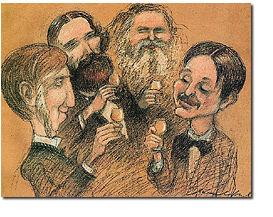 With this lofty aim in mind, a
circle of literary friends with Ralph Waldo Emerson as its lynchpin began
meeting on Saturday afternoons in the early 1850s. Sharing a table at Boston's
Albion Restaurant or Parker House Hotel, these literary luminaries read
original poetry, condemned slavery, and pondered new ways to enlighten the
masses.
With this lofty aim in mind, a
circle of literary friends with Ralph Waldo Emerson as its lynchpin began
meeting on Saturday afternoons in the early 1850s. Sharing a table at Boston's
Albion Restaurant or Parker House Hotel, these literary luminaries read
original poetry, condemned slavery, and pondered new ways to enlighten the
masses.
The Atlantic Monthly was born during such a gathering in the spring of 1857. On
this particular occasion, a prominent local publisher named Moses Dresser
Phillips sat at the head of the table, flanked on either side by Emerson and
Henry Wadsworth Longfellow. Phillips' young assistant, Frank Underwood, was
also at the meeting: an ardent abolitionist, Underwood had been responsible for
persuading his boss to publish a new journal of American politics, art and
literature. Phillips later described the seminal meeting in a letter to his
niece:
Imagine your uncle at the head of such a table, with such guests.... We sat down at 3 p.m. and rose at 8. The time occupied was longer by about four hours and thirty minutes than I am in the habit of consuming in that kind of occupation, but it was the richest time intellectually by all odds that I have ever had. Leaving myself and literary man out of the group, I think you will agree with me that it would be difficult to duplicate that number of such conceded scholarship in the whole country beside.... It was the proudest day of my life.
The first issue of The Atlantic, which appeared in November 1857, featured poems by Emerson, Longfellow, John Greenleaf Whittier and James
Russell Lowell, who served as the magazine's first editor. It would be many
years before the magazine expanded to include writers from the western states
or, for the most part, women. (An 1859 Atlantic article, entitled "Ought Women to Learn the Alphabet?",
answers "yes" to that question only after considering the argument that "Eve's
daughters are in danger of swallowing a whole harvest of forbidden fruit, in
these revolutionary days, unless something be done to cut off the supply.")
Over the next several decades, The
Atlantic's scope expanded to accommodate
the changing "American idea." In 1875, The Atlantic ventured far beyond New England when it printed Mark
Twain's first book, Old Times on the Mississippi (later retitled Life on the Mississippi) in seven installments. That same decade, The Atlantic published Anna Harriette Leonowens' "English Governess at
the Siamese Court," the memoir that would inspire the musical The King &
I. By the early 1900s, John Muir was using
The Atlantic as a platform for
defending his beloved Yosemite forests, and Helen Keller was inspiring readers
to make full use of their senses in "Three Days to See." Martin Luther King
Jr., James Baldwin and Richard Wright were among the African-American authors
who wrote for The Atlantic before and
during the civil rights era.
Today, The Atlantic continues to define and redefine the "American idea." During Bill Clinton's presidency, Robert D. Kaplan's articles "Europe's Third World" (July 1989) and "The Coming Anarchy" (February 1994) had a powerful impact on post-Cold War policy. Around the same time, another Atlantic article, a criminology study by James Q. Wilson and George L. Kelling called "Broken Windows" (March 1982), impacted the way New York City Mayor Rudolph Giuliani approached crime. And in the fall of 2002, William Langewiesche, the only reporter granted access to New York's Ground Zero, offered a profound and unsentimental vision of the "unbuilding" of the World Trade Center in his three-part Atlantic series "American Ground." The series, which became a bestselling book, was instrumental in helping America deal with the trauma of the September 11th attacks.
At a
time when sound bites and headline summaries have become the normal news
digest for so many Americans, The Atlantic takes the time to explore the biggest issues and the smallest
pleasures. It is, as it was in the beginning, a magazine for thinking
people—an ever-evolving conversation on what it means to be American and
what it means to be human.