The two victims suffering from critical and serious injuries from the shooting are expected to make full recoveries, Houston officials said Monday evening.
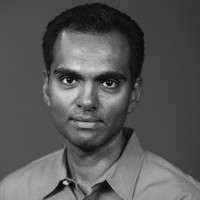
The Houston Police Department would not confirm the identity of the suspect, citing the on-going investigation. Several news organizations, though, have identified the shooter as Nathan DeSai.
Officials did confirm the suspect had two weapons in his possession during the shooting, both of which were purchased legally: a .45 semi-automatic handgun and a Thompson submachine gun, commonly known as a “Tommy Gun.” They added that the suspect had several other weapons at his residence.
Police said the suspect wore “military-style apparel,” but could not confirm if the uniform had a particular affiliation, as previous unconfirmed reports stated he wore a Nazi-style uniform. Police, though, did confirm that Nazi emblems were found on his person and at his residence.
The suspect’s motive has not yet been determined. He is believed to have acted alone.
Multiple news organizations identified the alleged shooter as Nathan DeSai. The Houston Chronicle reports that a .45 pistol was used in the shooting. Investigators, the newspaper added, also found a long gun and ammunition in the shooter’s car.
DeSai’s father, in an interview with the local ABC affiliate, said his son had been having business troubles.
KPRC, the local TV station, cited two unnamed law-enforcement sources as saying the shooter wore a Nazi uniform during this morning’s shooting. That claim has not been independently verified.
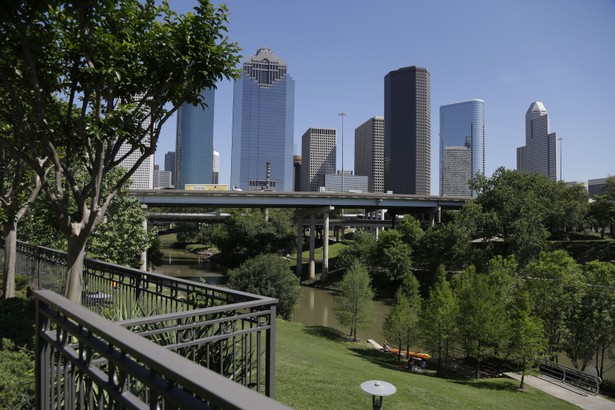
Some witnesses have described the gunman firing dozens of shots at cars passing through a condo complex, which is near the affluent West University Place community. Several cars with bullet holes and shattered windows were at a parking lot near the condo complex.
Eduardo Andrade, 42, was driving his Audi A3 this morning on his way to LA Fitness when he found himself thrust into the middle of an active shooter scene.
"As I was driving by Law Street I suddenly hard a big explosion," said Andrade. "I covered myself, accelerated and tried to get out of there. I did not know if someone was following me or trying to shoot me."
Two bullets struck his vehicle, one came through the windshield and the other the front-passenger window.
"One bullet hit here and the other here," he said, while pointing at the holes. "I felt the hot air."
The father of two who works in the oil and gas industry was on his way to exercise at his gym at about 6:25 a.m. when the shooting happened.
"It's so random, think of it, if I was driving a little faster or a little slower, the bullet would have had a different trajectory," he said.
At a news conference Monday, Martha Montalvo, the Houston police chief, said, in all, nine people were injured: Three of them were treated on the scene and released; six were taken to area hospitals. One person suffered critical injuries, Montalvo said; another had serious injuries. The identities of those shot have not been released.
Montalvo said the suspect was a lawyer, “and there were some issues concerning his law firm.” He lived in the neighborhood, she said, but did not provide further details. The suspect was shot and killed by police, Montalvo said.
The Houston Police Department says the suspect who opened fire near a shopping center early Monday is dead . The location of the shooting is active, but contained, it added.
The motive for the shooting isn’t clear. More information on the shooting will be provided at a news conference later Monday.
Richard Mann, the executive assistant chief of the Houston Fire Department’s Emergency Response Command, told reporters the suspect had been “neutralized.” He did not elaborate whether that meant the suspect was injured or killed by officers responding to the shooting.
Mann also said six people were taken to hospital after the shooting. Their status is not known.
Earlier this month, the IRS finished collecting 2025 taxes, taking in an estimated $5.2 trillion from businesses and households. That’s a lot of cash.
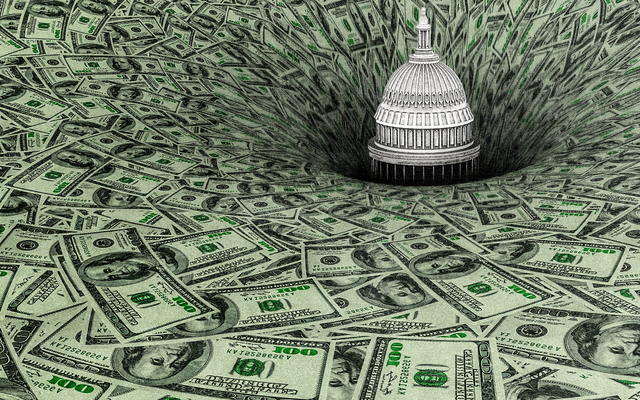
But Congress is spending $7 trillion a year, pumping out as much fiscal stimulus now as it did during the Great Recession. All of those excess dollars are spurring retailers to raise prices and the Federal Reserve to slow down interest-rate cuts. Were the economy to tank—because of, say, a war with Iran—we could end up with a toxic combination of widespread joblessness and rampant inflation. Congress is creating long-term risks too. In the coming years, a smaller share of Americans will work and a larger share will require Social Security payments, Medicare, disability-insurance coverage, and long-term care. More mandatory spending plus less revenue plus soaring interest costs on a hefty preexisting debt load add up to a big problem.
For a brief moment this weekend, the president appeared introspective.
This article was featured in the One Story to Read Today newsletter. Sign up for it here.
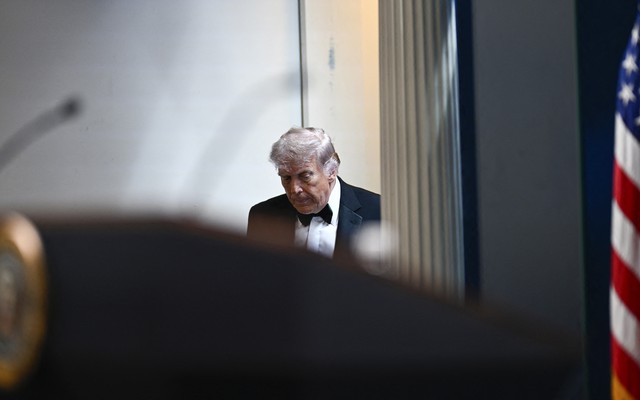
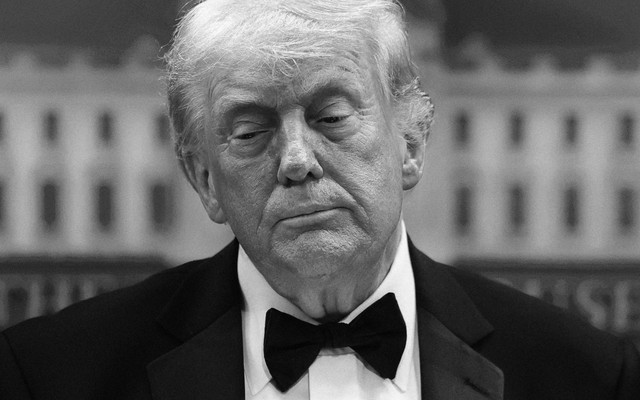
For a guy who had just been rushed out of a ballroom at the sound of gunfire, he seemed remarkably calm. For a president who regularly attacks the press, he seemed unusually gracious. For a fleeting period on Saturday night, Donald Trump appeared introspective, or at least as introspective as he’s capable of being in public.
“It’s always shocking when something like this happens,” he told reporters in the White House briefing room, standing in his tux and appearing to speak without notes. He briefly seemed to consider how familiar he was with threats to his life, and how the shock doesn’t fade: “Happened to me a little bit. And that never changes.”
Vice President Vance is worried that the U.S. is running low on weapons.
In closed-door meetings, J. D. Vance has repeatedly questioned the Defense Department’s depiction of the war in Iran and whether the Pentagon has understated what appears to be the drastic depletion of U.S. missile stockpiles.
Two senior administration officials told us that the vice president has queried the accuracy of the information the Pentagon has provided about the war. He has also expressed his concerns about the availability of certain missile systems in discussions with President Trump, several people familiar with the situation told us. The consequences of a dramatic drawdown in munitions reserves are potentially dire: U.S. forces would need to draw from these same stockpiles to defend Taiwan against China, South Korea against North Korea, and Europe against Russia.
Conservatives want to police how we talk about Trump—while excusing how the president talks about everyone else.
To describe Donald Trump as a corrupt aspiring authoritarian is not to conclude that he should be murdered.
This ought to be a simple point to understand. Yet it is lost on a large swath of the American right, who insist that calling Trump what he is causes at least some of his opponents—among them, the accused shooter Cole Tomas Allen—to believe that violence is justified against the president.
In an interview with CBS following the White House Correspondents’ Association Dinner, Trump blamed the most recent attempt on his life on “the hate speech of the Democrats,” which he called “very dangerous.”
The New York Post asked on Sunday, “Where did Allen get such ideas about Trump and the need to remove him, via murder?” It answered the question like so: “Almost certainly from the left, including from Democrats in positions of power. Barely a day goes by without some Dem calling Trump an autocrat, a king, a dictator, Hitler.”
Could a marriage policy first pursued by the Catholic Church a millennium and a half ago explain what made the industrialized world so powerful—and so peculiar?
This article was featured in the One Story to Read Today newsletter. Sign up for it here.
Around 597 a.d., Pope Gregory I dispatched an expedition to England to convert the Anglo-Saxon king of Kent and his subjects. The leader of the mission, a monk named Augustine, had orders to shoehorn the new Christians into Church-sanctioned marriages. That meant quashing pagan practices such as polygamy, arranged marriages (Christian matrimony was notionally consensual, hence the formula “I do”), and above all, marriages between relatives, which the Church was redefining as incest. Augustine wasn’t sure who counted as a relative, so he wrote to Rome for clarification. A second cousin? A third cousin? Could a man marry his widowed stepmother?
OpenAI is racing to catch up to its greatest rival.
OpenAI does not like to be left out. The week after Anthropic announced Claude Mythos Preview—an AI model that has put governments around the world on edge because of its potential ability to hack into banks, energy grids, and military systems—OpenAI shared a program that is uncannily similar. And just like Anthropic did with its model, OpenAI has, for cybersecurity purposes, restricted access to this new bot, called GPT-5.4-Cyber, to a small group of trusted users.
This sequence has become something of a pattern: First Anthropic will make an announcement, and then OpenAI will follow suit. Last year, Anthropic launched Claude Code, an AI coding tool. A couple of months later, OpenAI came out with its own version, Codex. When Claude Code had a breakout moment in January, OpenAI responded with two major updates to Codex alongside a press blitz for the product. And earlier this month, OpenAI released a version of Codex that allows it to use other apps on your desktop—similar to an existing Anthropic tool called Claude Cowork.
How New York City’s education budget became an untouchable money pit
New York City’s new mayor, Zohran Mamdani, will soon confront an ordeal that might finally knock that trademark smile off his face: balancing the budget. The city is projected to have a $5 billion deficit this year and is required by law to make up for that shortfall by raising revenue, cutting spending, or both. Mamdani has proposed large tax increases paired with modest cuts to city programs. But getting to $5 billion won’t be easy, in part because the biggest portion of the city’s budget is considered untouchable.
I refer not to the police department or the transit system, but to the department of education. It costs about $40 billion a year, making up a third of the city’s gargantuan budget. New York City spends more money per pupil—north of $40,000, according to one recent estimate—than any of the other 100 largest public-school districts in the country, and more than twice as much as the median district. Meanwhile, it generates educational outcomes that are average at best. According to federal data, its per-pupil spending is nearly 50 percent higher than Los Angeles’s and Chicago’s (the second- and fourth-largest districts), and 150 percent higher than Miami’s (the third-largest). Per pupil is the key phrase here. New York City’s public-school system is the largest in the country, but that’s not the problem. The problem, actually, is that the student body is small relative to the resources devoted to it, and shrinking fast—but the city and state governments won’t cut education spending accordingly. As long as that’s the case, the city’s financial situation will grow only harder to manage.
For the richest men on Earth, everything is free and nothing matters.
At the end of Paul Thomas Anderson’s 2007 movie, There Will Be Blood, Daniel Day-Lewis’s oil-baron character, old now and richer than Croesus, beats Paul Dano’s preacher to death with a bowling pin. Dano’s Eli Sunday, a nemesis of Day-Lewis’s Daniel Plainview during his seminal, wealth-building years, has come to sell Plainview the oil-rich land that he once coveted. But Plainview doesn’t need the land anymore, because—as he explains in one of the most famous monologues in modern cinema—he has sucked out all the oil hidden beneath it from an adjoining property, like a milkshake.
Desperate for money, Eli begs for a loan. Instead, Plainview chases him around a bowling alley and murders him with great enthusiasm. Once it’s over, a butler comes to see what all the noise was about. “I’m finished,” Plainview yells.
Many historical disasters would have been prevented if we had one of these in the White House.
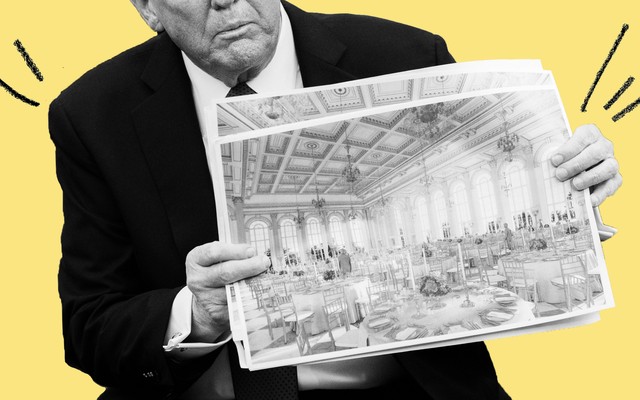
I join my voice to those of Donald J. Trump, Lindsey Graham, John Fetterman, and all the others calling for a secure White House ballroom now. Never mind that the White House Correspondents’ Dinner, held in the Washington Hilton, is not hosted by the White House, so if a White House ballroom did exist, it would have altered nothing about Saturday night’s events. How dare you say such an unpatriotic thing at a time when we most need unity? Unity and a ballroom, the sooner the better! If you look closely enough, every event, not just now but also throughout history, is proof that we need a secure White House ballroom.
The Eruption of Mount Vesuvius, 79 C.E.: Had they been in a ballroom-bunker combo attached to the White House, the ancient Pompeiians might be alive today. The White House is nowhere near Mount Vesuvius.
To understand the significance of someone running a marathon in less than two hours, you also need to understand that, until recently, the notion of this actually happening was truly, utterly absurd. Sure, a physiologist named Michael Joyner had floated the idea that such a feat might be humanly possible in a journal paper way back in 1991. But his peers laughed off the idea, and not much changed over the succeeding decades. In Runner’s World in 2014, I predicted that it would happen in 2075. Frankly, even that forecast seemed overly optimistic to me, but I figured I’d be dead by then, so no one would be able to call me on it.
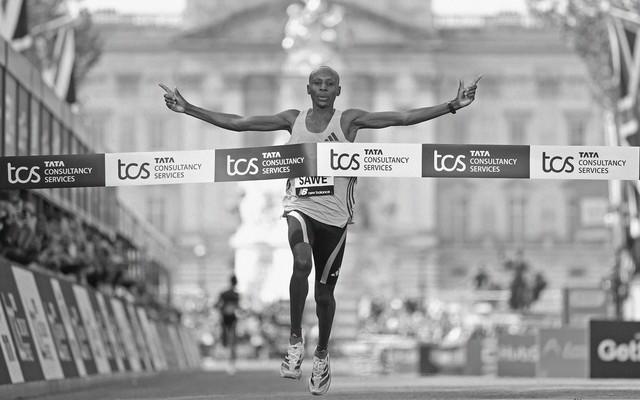
Well, I was wrong. Yesterday morning, the two-hour marathon barrier finally went down. A relatively unheralded 31-year-old Kenyan named Sabastian Sawe won the London Marathon with a time of 1:59:30. That is, for reference, 26.2 miles run at an average of 4:34 a mile—or, put another way, a pace that most recreational runners would struggle to sustain for more than a few seconds, if they could hit it at all. Perhaps even more arresting was the fact that the man who took second place, Ethiopia’s Yomif Kejelcha, also ran under two hours, finishing just 11 seconds behind Sawe.
Sherry Turkle, the Director of the MIT “Initiative on Technology and Self,” discusses the relationship between talking in real life and cultivating empathy.