—Hate crimes against Muslims in the United States rose by 67 percent in 2015, according to an FBI crime report released Monday.
—Gwen Ifill, the American journalist who worked for PBS since 1999, died Monday of cancer. She was 61.
—President Obama kicks off his final major foreign-policy trip tonight, leaving Washington for Athens. He will visit Berlin and Lima later this week, where he’s expected to try to reassure leaders surprised by the unexpected election of Donald Trump.
—We’re live-blogging the news stories of the day below. All updates are in Eastern Standard Time (GMT -5).
A federal judge has ordered Brendan Dassey, one of the two imprisoned Wisconsin men featured in the Netflix documentary “Making a Murderer,” be released from prison.
The judge, William E. Duffin, previously overturned Dassey’s conviction in the 2005 murder and sexual assault of a photographer. Duffin argued Dassey “was mentally unfit, that he had been coerced into a confession he later recanted and that his court-appointed lawyer had been content to cut a deal,” The New York Timesreports.
Dassey’s uncle, Steven Avery, is also serving a life sentence for murder and sexual assault.
Wisconsin Attorney General Brad Shimel has appealed the judge’s ruling. He is also temporarily blocking Dassey’s release from prison.
Dassey’s lawyers said Monday they hoped to get Dassey home by Thanksgiving, adding:
Dassey's family is concentrated in northeastern Wisconsin. There is no indication that he has the inclination much less the means to flee or will otherwise fail to appear as may be legally required.
Dassey has been in prison since he was convicted in 2007.
U.S. Forces Accused of Possible War Crimes in Afghanistan
Lucas Jackson / Reuters
There is “reasonable basis to believe” that U.S. forces and the CIA may have committed war crimes in Afghanistan, the International Criminal Court said Monday.
Fatou Bensouda, the ICC chief prosecutor, signaled in an annual report that the court would open investigations into “war crimes of torture and related ill-treatment” by U.S. forces deployed in Afghanistan in CIA-operated detention facilities between 2003 and 2004. The probe will include investigating the possible use of “torture, cruel treatment, outrages upon personal dignity, and rape.”
Here’s more from the report:
These alleged crimes were not the abuses of a few isolated individuals. Rather, they appear to have been committed as part of approved interrogation techniques in an attempt to extract ‘actionable intelligence’ from detainees. According to information available, the resort to such interrogation techniques was ultimately put to an end by the authorities concerned, hence the limited time-period during which the crimes allegedly occurred.
Though the final decision to launch the investigation has not been announced, Bensouda said she would decide whether to ask the court’s judges for permission “imminently.” If the investigation goes forward, it would mark the first time U.S. forces have been exposed to an ICC probe.
Anti-Muslim Hate Crimes in the U.S. Rose by 67 Percent in 2015
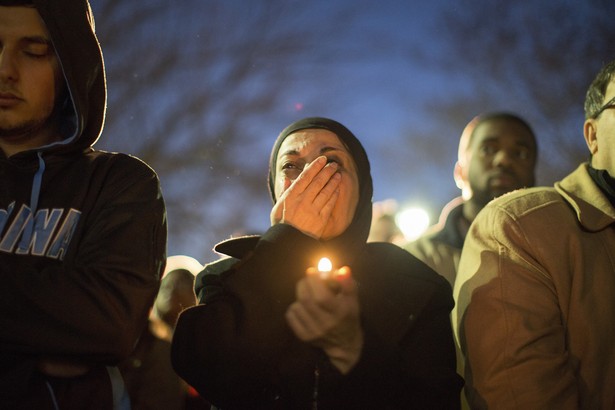
A woman cries at a vigil for three Muslim students killed in Chapel Hill, North Carolina on February 11, 2015. (Chris Keane / Reuters)
Hate crimes against Muslims in the United States rose by 67 percent in 2015, according to an FBI crime report released Monday.
The bureau’s Uniform Crime Report documented a total of 5,850 hate-crime incidents reported in 2015 overall—a 6 percent increase from the 5,479 incidents reported the previous year. Of these incidents, 257 of them were classified as anti-Muslim hate crimes, a significant increase from the 154 incidents reported in 2014. This latest report marks one of the largest increases in anti-Muslim hate crimes in more than a decade, second only to the 481 anti-Muslim hate crimes reported in 2001, according to the Southern Poverty Law Center.
Overall, religion-based incidents made up 21 percent of the hate crimes documented, with more than 50 percent targeting Jews and 22 percent targeting Muslims. Anti-Semitic hate crimes, which remain the largest religious-based hate crimes reported, rose by 9 percent.
Other hate crimes reported were based on sexual orientation, disability, gender, and gender identity.
The FBI’s latest report comes amid an increase in reported hate crimes following last week’s presidential election, including racist, anti-Semitic, and anti-Muslim incidents.
Gwen Ifill, the American journalist who worked for PBS since 1999, died Monday of cancer. She was 61.
“I am very sad to tell you that our dear friend and beloved colleague Gwen Ifill passed away today in hospice care in Washington,” Sharon Percy Rockefeller, the CEO of WETA, Washington D.C.’s public TV and radio stations, wrote in an email to staff on Monday, Politico reports. “I spent an hour with her this morning and she was resting comfortably, surrounded by loving family and friends.”
Ifill went on leave from PBS from early April to mid-May this year to address ongoing health issues, which she did not make public. She took a leave again last week before Election Day.
Ifill served as a co-anchor on PBS “NewsHour” and as moderator of “Washington Week,” the longest-running primetime news program on television. Before joining PBS, Ifill was the chief congressional and political corresponded for NBC News, a White House correspondent for The New York Times, and reporter for The Washington Post.
Ifill and her “NewsHour” co-host Judy Woodruff became the first all-female team to anchor the show in 2013. Ifill acknowledged the significance of her role in particular, tellingThe New York Times:
“When I was a little girl watching programs like this — because that’s the kind of nerdy family we were — I would look up and not see anyone who looked like me in any way. No women. No people of color,” she said.
“I’m very keen about the fact that a little girl now, watching the news, when they see me and Judy sitting side by side, it will occur to them that that’s perfectly normal — that it won’t seem like any big breakthrough at all,” she added.
Ifill covered seven presidential campaigns during her long career in Washington. She moderated the 2004 vice-presidential debate between Dick Cheney and John Edwards, the 2008 vice-presidential debate between John Biden and Sarah Palin, and the final Democratic primary debate last year.
President Obama praised Ifill’s work at the start of a press conference Monday afternoon, and described the veteran journalist as “an especially powerful role model for young women and girls.”
“I always appreciated Gwen's reporting, even when I was at the receiving end of one of her tough and thorough interviews,” Obama said. “Whether she reported from a convention floor or from the field, whether she sat at the debate moderator’s table or at the anchor’s deck, she not only informed today’s citizens but she also inspired tomorrow’s journalists.”
Ifill was named in August as the recipient of the 2016 John Chancellor Award for excellence in journalism and was scheduled to receive the award this week in New York.
Archaeologists in Egypt have discovered an ancient mummy bound in linen inside a colorful sarcophagus that has remained in very good condition, according to Egypt's antiquities ministry.
Spanish archeologists announced their discovery Sunday, saying they believed the mummy is that of a nobleman named Amenrenef, a servant to the royal household of King Thutmose II. The burial site is located near a temple for the king on the west bank of the Nile, 435 miles south of Cairo near Luxor, a city of about 500,000 people and the site of many ancient tombs.
The mummy was adorned with religious symbols and gods, like Isis, Nephtys, and the sons of Horus, and he sarcophagus was brightly colored. The practice of mummification dates back to 4500 BC, although this tomb is believed to be more recent; archaeologists put it somewhere between 1075 BC and 664 BC.
Qienabh Tappii, center, wins the Miss Transgender Indonesia pageant in Jakarta on November 11, 2016. (Dita Alangkara / AP)
Hundreds of transgender activists crowned the winner of a transgender beauty pageant in Indonesia over the weekend in an event that was kept almost entirely secret, the Associated Press reports.
Qienabh Tappii, a 28-year-old representing the Indonesian capital, defeated more than 30 other contestants Friday for the title of Miss Waria, the Indonesian word for transgender. Tappii, who will represent Indonesia at the Miss International Queen pageant in Thailand next year, told the AP, “I want waria to be accepted, appreciated, and understood in our society, and to be equal with other Indonesians. I will work really hard to achieve it.”
The pageant’s organizers said they kept the event in Jakarta secret because they feared the country’s Islamic hardliners would try to shut it down. Organizers told only a few journalists about when and where the event would be held.
“If the public knew in advance that there will be such an event, those who use religion as their mask could attack us,” Nancy Iskandar, one of the pageant’s organizers, said. “That's why we kept it secret until the last minute.”
Indonesia’s religious culture is considered more moderate compared to other Muslim-majority countries. But the nation has increasingly drawn criticism from human-rights organizations for its treatment of its LGBT community. This year, some Indonesian lawmakers have called for measures banning LGBT students from university campuses and instituting “healing programs” to cure sexual orientation.
The United States and Australia reached a deal Sunday to resettle asylum seekers held in detention centers in Papua New Guinea and Nauru that were stopped while trying to reach Australia by boat.
Under a one-time deal, the U.S. has agreed to accept individuals who have already received refugee status from the United Nations. Officials have not said how many refugees will be transported, or exactly when and where. Australian Prime Minister Malcolm Turnbull said the deal will prioritize “women, children, and families.” He said the transfer would likely begin after President-elect Donald Trump took office in January.
The detention camps hold about 1,200 men, women, and children who are mostly from Iran, Afghanistan, Vietnam, and Malaysia.
The deal, which has been in the works for months, comes after Papua New Guinea’s supreme court ruled this spring that it was unconstitutional for the island to host Australia’s migrants.
The facilities have attracted controversy since they opened about 15 years ago, in part because many migrants wait about three years for the government to process their applications while living in mostly poor conditions. In the early 2000s, Australia began a policy of detaining migrants in offshore processing centers, essentially renting out some of its migration processing duties to Nauru and Papua New Guinea. The centers are favored among Australian conservatives, but were closed briefly in 2008 after the progressive Labor Party took power.
Iraqi soldiers fighting to reclaim Mosul from the Islamic State have nearly surrounded the city and will begin a collective push toward downtown in the coming days. The operation is nearing the end of its fourth week, and over the weekend the fighting mostly slowed to allow forces to regroup and to minimize civilian deaths.
So far only the elite Iraqi special forces entering from the east have breached ISIS’s front lines in Mosul, the country’s second-largest city and a key stronghold for ISIS in Iraq. But Kurdish peshmerga and Iraqi forces in the north, as well as the Shia Popular Mobilization Force in the southwest, have advanced slowly toward the city center as they recapture towns along the outskirts. On Sunday, to the north of Mosul, Iraqi forces nearly reached the Habda neighborhood. Their arrival would mark the first time security forces reached the city limits from this direction.
“The enemy is collapsing and losing control, and we are now taking only two days to seize a neighborhood where we planned to be fighting for four days,” Maan al Saadi, a commander with Iraqi special forces, told The Wall Street Journal.
More than 1 million people live in Mosul and about 54,000 people have been displaced as fighting intensified. ISIS has moved residents to the city’s center and used them as human shields against bombing attacks. The Telegraphreported Monday that injured children have overwhelmed hospitals in the area, seeking treatment for gunshots, burns, and shrapnel from bombs, which militants have placed in roadways to slow the advance of Iraqi forces.
About 1,000 Tourists Stranded After New Zealand Earthquake
Landslides block a highway near Kaikoura on the upper east coast of New Zealand's South Island on November 14, 2016. (Sam Shepherd / Royal New Zealand Defence Force/ Reuters)
Tsunami warnings have been canceled in New Zealand a day after a 7.8-magnitude earthquake struck the country, triggering dangerous waves and dozens of aftershocks that were felt for hours.
Two people were killed in the quake, Radio New Zealand reported Monday night local time. One person died in a house in Mount Lyford, a ski resort located north of Christchurch, and another died in a collapsed house in Kaikoura, a coastal town to the country’s east.
The quake caused major landslides in Kaikoura, blocking roads and stranding about 1,000 tourists and hundreds of residents. New Zealand officials say they will send in helicopters, which could each pick up about 18 people at a time, the AP reports. A ship from Auckland is also on its way. But the rescue operation could take several days.
"From all directions, Kaikoura has essentially been isolated," Air Commodore Darryn Webb, the head of New Zealand's Joint Forces, told the AP.
Prime Minister John Key estimated the damage of the quake to be in the billions of dollars, according to the AP. “It’s just utter devastation,” said Key, who flew over Kaikoura by helicopter to survey the landslides.
Small aftershocks were still being recorded as recently as Tuesday morning, according to GeoNet, which monitors seismic activity in the country.
The city of Christchurch is still recovering from a 2011 earthquake that killed 185 people and destroyed scores of buildings.
Vice President Vance is worried that the U.S. is running low on weapons.
In closed-door meetings, J. D. Vance has repeatedly questioned the Defense Department’s depiction of the war in Iran and whether the Pentagon has understated what appears to be the drastic depletion of U.S. missile stockpiles.
Two senior administration officials told us that the vice president has queried the accuracy of the information the Pentagon has provided about the war. He has also expressed his concerns about the availability of certain missile systems in discussions with President Trump, several people familiar with the situation told us. The consequences of a dramatic drawdown in munitions reserves are potentially dire: U.S. forces would need to draw from these same stockpiles to defend Taiwan against China, South Korea against North Korea, and Europe against Russia.
For a brief moment this weekend, the president appeared introspective.
This article was featured in the One Story to Read Today newsletter. Sign up for it here.
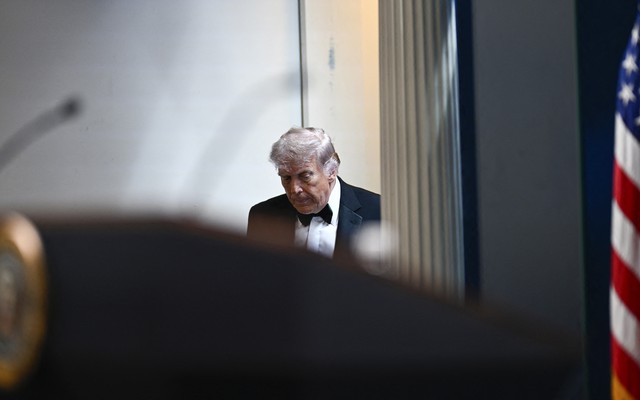
For a guy who had just been rushed out of a ballroom at the sound of gunfire, he seemed remarkably calm. For a president who regularly attacks the press, he seemed unusually gracious. For a fleeting period on Saturday night, Donald Trump appeared introspective, or at least as introspective as he’s capable of being in public.
“It’s always shocking when something like this happens,” he told reporters in the White House briefing room, standing in his tux and appearing to speak without notes. He briefly seemed to consider how familiar he was with threats to his life, and how the shock doesn’t fade: “Happened to me a little bit. And that never changes.”
For the richest men on Earth, everything is free and nothing matters.
At the end of Paul Thomas Anderson’s 2007 movie, There Will Be Blood, Daniel Day-Lewis’s oil-baron character, old now and richer than Croesus, beats Paul Dano’s preacher to death with a bowling pin. Dano’s Eli Sunday, a nemesis of Day-Lewis’s Daniel Plainview during his seminal, wealth-building years, has come to sell Plainview the oil-rich land that he once coveted. But Plainview doesn’t need the land anymore, because—as he explains in one of the most famous monologues in modern cinema—he has sucked out all the oil hidden beneath it from an adjoining property, like a milkshake.
Desperate for money, Eli begs for a loan. Instead, Plainview chases him around a bowling alley and murders him with great enthusiasm. Once it’s over, a butler comes to see what all the noise was about. “I’m finished,” Plainview yells.
The legal right spent decades empowering the presidency. Now it must reckon with the system it helped create.
Julius Caesar styled himself as a servant of the republic, claiming to speak for the people even as he disregarded laws and norms to govern by caprice. The Roman republic did not survive him.
The second Trump administration has revealed American Caesarism in nearly full bloom. Despite ambitions to fundamentally change the course of the country, this administration has no real legislative agenda. Instead, the president governs by executive orders, emergency decrees, and extortionate transactions, using his power to reward his friends and punish his enemies. He’s launched foreign military adventures and full-blown wars seemingly based on personal whim, and has made the military a political prop and a tool for domestic law enforcement. With Congress sidelined and the courts reluctant to check Donald Trump’s excesses, America has been left with what some legal scholars have described as an “executive unbound”—and with a president who threatens to supplant the republic in all but name.
To understand the significance of someone running a marathon in less than two hours, you also need to understand that, until recently, the notion of this actually happening was truly, utterly absurd. Sure, a physiologist named Michael Joyner had floated the idea that such a feat might be humanly possible in a journal paper way back in 1991. But his peers laughed off the idea, and not much changed over the succeeding decades. In Runner’s World in 2014, I predicted that it would happen in 2075. Frankly, even that forecast seemed overly optimistic to me, but I figured I’d be dead by then, so no one would be able to call me on it.
Well, I was wrong. Yesterday morning, the two-hour marathon barrier finally went down. A relatively unheralded 31-year-old Kenyan named Sabastian Sawe won the London Marathon with a time of 1:59:30. That is, for reference, 26.2 miles run at an average of 4:34 a mile—or, put another way, a pace that most recreational runners would struggle to sustain for more than a few seconds, if they could hit it at all. Perhaps even more arresting was the fact that the man who took second place, Ethiopia’s Yomif Kejelcha, also ran under two hours, finishing just 11 seconds behind Sawe.
The shooting at the Correspondents’ Dinner made clear who gets saved first.
This article was featured in the One Story to Read Today newsletter. Sign up for it here.
On one level, the system worked. The perimeter held. A would-be assassin was tackled in the hallway outside the White House Correspondents’ Association’s annual dinner. The one bullet that found a human target—a U.S. Secret Service agent—was halted, in part, by the officer’s phone and bulletproof vest, according to a law-enforcement summary report that we reviewed. A counterassault team promptly swarmed the stage with assault rifles and night-vision equipment in case the lights were cut. The government’s top leaders—president, vice president, Cabinet officials, speaker of the House—were ushered to secure locations in a matter of minutes. No one died in the attack.
The administration could exert much greater control over the industry—but just how far would it go?
AI companies are beginning to entertain the possibility that they could cease to exist. This notion was, until recently, more theoretical: A couple of years ago, an ex-OpenAI employee named Leopold Aschenbrenner wrote a lengthy memo speculating that the U.S. government might soon take control of the industry. By 2026 or 2027, Aschenbrenner wrote, an “obvious question” will be circling through the Pentagon and Congress: Do we need a government-led program for artificial general intelligence—an AGI Manhattan Project? He predicted that Washington would decide to go all in on such an effort.
Aschenbrenner may have been prescient. Earlier this year, at the height of the Pentagon’s ugly contract dispute with Anthropic, Secretary of Defense Pete Hegseth warned that he could invoke the Defense Production Act (DPA), a Cold War–era law that he reportedly suggested would allow him to force the AI company to hand over its technology on whatever terms the Pentagon desired. The act is one of numerous levers the Trump administration can pull to direct, or even commandeer, AI companies. And the companies have been giving the administration plenty of reason to consider doing so.
The pontiff has proved unwilling to subordinate his faith to politics, or to adjust his commitment to the Gospel in exchange for access to power.
American presidents and popes have clashed before, but the battle of words and wills between Donald Trump and Pope Leo XIV is unprecedented.
The distinctiveness of their clash is not due mainly to the fact that Robert Francis Prevost is the first American-born pope, though that is significant. After all, Leo can’t be dismissed as a foreigner who is speaking about a country and culture he doesn’t understand. When he is critical of America, on matters ranging from war to mass deportation to those who “manipulate religions and the very name of God,” it comes from a place of love and devotion.
Nor does it have to do solely with the nature of the disagreements, most specifically the war waged by Trump against Iran. Past popes have criticized past presidents for going to war.
What makes the Trump-Leo collision most unusual is the manner of the disagreement, not on the part of the pope—whose criticisms have been direct but restrained—but on the part of the president.
Instead of a crackdown on his enemies, Trump wants his ballroom.
When an assassin murdered Charlie Kirk in September 2025, the MAGA movement seized the moment to demand a campaign of repression. Vice President Vance called for an ambitious program to “go after the NGO network that foments, facilitates, and engages in violence.” He named the Ford Foundation, Open Society Foundations, and The Nation magazine as examples of candidates for the retaliation he had in mind. The people who faced consequences after the killing almost universally did so for things they had written or said, not for acts of violence. In November, Reuters counted some 600 cases of people who were fired, suspended, or otherwise disciplined for their speech about Kirk’s life and death.
Now another gunman has attacked political targets. At the White House Correspondents’ Association Dinner, a man discharged a firearm in the vicinity of hundreds of people from the worlds of politics, media, and business—among them, the president and vice president of the United States. Although much about the event remains unclear, the available evidence suggests that the gunman was motivated by an anti-Trump agenda. Yet this time, MAGA’s immediate response to political violence has been much less aggressive. At his press conference after yesterday’s attempted shooting, President Trump cited the attack as proof of the need for his wished-for White House ballroom. Social-media accounts that take their cues from the White House promptly echoed the message.
The people we were died at the exact moment our child did.
This article was featured in the One Story to Read Today newsletter. Sign up for it here.
My husband, David, hates Valentine’s Day. He once called it “New Year’s Eve with nuclear weapons.” I pretend not to care. Still, when the day passes entirely unremarked on, a woman can’t help but feel overlooked.
On Valentine’s Day 2024, David found a way out. He booked a speech on February 14 that required traveling from our home in Washington, D.C., to Toronto. I couldn’t object—he was getting paid. Anyway, I had my own plans: an “anti–Valentine’s Day” dinner hosted by one of the foreign embassies.
As I got ready, I called our oldest daughter, Miranda. She answered from her Brooklyn bathroom, getting ready for her own party. She propped her phone up beside her sink and laughed when I told her about her father’s strategic Valentine’s Day escape.