The Department of Homeland Security says it has suspended any actions to implement Trump’s travel ban, and the Louvre in Paris reopens after Egypt identifies the man who attacked soldiers with a machete.
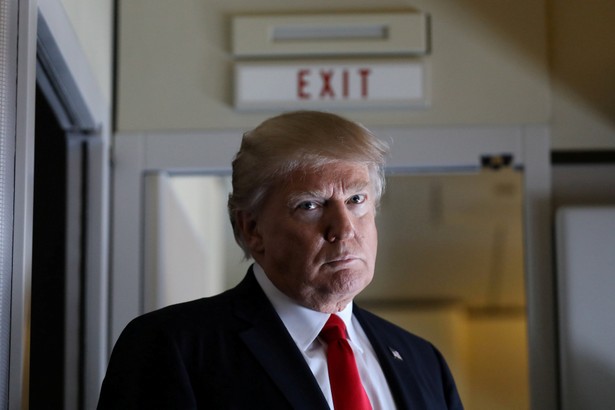
President Trump pauses as he talks to journalists.
Carlos Barria / Reuters
—The Department of Homeland Security said it has suspended all actions to enforce President Donald Trump’s travel ban on seven majority-Muslim countries.
—Egypt identifies the man who attacked soldiers outside the Louvre Museum in Paris.
—We’re tracking the news stories of the day below. All updates are in Eastern Standard Time (GMT -5).
The Justice Department Appeals the Federal Court Stay on Trump's Travel Ban
Jonathan Ernst / Reuters
The U.S. Justice Department (DOJ) appealed a decision on Saturday night by a federal judge in Seattle that temporarily halted President Donald Trump’s travel ban. The judge’s ruling was made Friday night, and by the next morning the Department of Homeland Security and the State Department both said they would quit enforcing the ban that stopped people in seven majority-Muslim countries from coming to the U.S. The move by the DOJ takes the case to the Ninth Circuit Court of Appeals, where it could go before three judges, one appointed by former-President George W. Bush, another by Jimmy Carter, and the third by Barack Obama. As POLITICO reported, a potential hurdle for Trump’s ban is that “temporary restraining orders” like those issued by the federal judge in Seattle “are not ordinarily appealable. Usually a party who wants to appeal has to wait until the next stage in the process, a preliminary injunction.” If the Ninth Circuit Court refuses to hear the appeal then it could go to the Supreme Court.
The judge opens up our country to potential terrorists and others that do not have our best interests at heart. Bad people are very happy!
Romanian Prime Minister Rescinds Decree that Legalized Corruption
Stoyan Nenov / Reuters
The prime minister of Romania, Sorin Grindeanu, bowed to massive protests on Saturday against a decree that would have protected politicians from prosecution for corruption. The decree decriminalized some offences of graft and bribery of up to $48,000. It was pitched as a way to relieve pressure on the prison system, although it mainly would have protected dozens of government officials. Protesters had taken to the streets for five days, with as many as 330,000 showing up in 70 different cities—140,000 of whom were in a plaza near the prime minister’s office building. The decree would have especially helped Social Democrat leader Liviu Dragnea, who was convicted of electoral fraud and was accused of using his political influence to get state salaries for two people. The conviction barred Dragnea from serving in political office. He is viewed as the power behind the prime minister, who took office last month.
Egypt Identifies the Man Who Attacked Guards at the Louvre
Christian Hartmann / Reuters
An Egyptian Interior Ministry official said on Saturday that the man who attacked soldiers at the Louvre Museum in Paris was 28-year-old Abdullah Reda Refaie al-Hamahmy, a man with no history of political activism or criminal activity, the Associated Press reported. Al-Hamahmy came to Paris on a tourist visa and bought two military machetes at a gun store in the city. Then, while trying to enter the Louvre’s underground shopping center, he rushed at French guards. The guards shot al-Hamahmy four times, and he is recovering from those wounds, which are no longer listed as life-threatening. Al-Hamahmy is Egyptian, although he is believed to have been living in the United Arab Emirates. He came to Paris last week and sent his family a photo of himself with the Eiffel Tower. During the attack, al-Hamahmy yelled "Allahu akbar!" and French President Francois Hollande has said there is “no doubt” this was a terror attack. Al-Hamahmy’s father denied to reporters that his son was radicalized or involved in any militant group. The Louvre, which houses countless masterpieces of art, reopened Saturday morning.
The Department of Homeland Security and the State Department Suspend Trump's Travel Ban
Brian Snyder / Reuters
The U.S. Department of Homeland Security (DHS) said Saturday it would suspend all actions to implement President Donald Trump’s travel ban on seven majority-Muslim countries, and the State Department said it would allow visa holders from those countries to to enter the U.S. Both announcements came after a federal judge in Seattle ruled to temporarily block Trump’s executive order, a ruling that derived from a lawsuit filed by the state of Washington, and joined by Minnesota. “This decision shuts down the executive order immediately,” Washington Attorney General Bob Ferguson said Friday night after the ruling was made. “That relief is immediate, happens right now.” In accordance with that ruling, the State Department said it would allow people with visas from the previously banned countries to enter the U.S., and in a separate statement DHS said it would stop enforcing Trump’s order, effectively returning to the standards prior to the ban. In its statement, DHS said it had “suspended any and all actions implementing the affected sections of the Executive Order entitled, 'Protecting the Nation from Foreign Terrorist Entry into the United States.'” Trump denounced the judge’s decision via Twitter, saying:
The opinion of this so-called judge, which essentially takes law-enforcement away from our country, is ridiculous and will be overturned!
The shooting at the correspondents’ dinner made clear who gets saved first.
This article was featured in the One Story to Read Today newsletter. Sign up for it here.
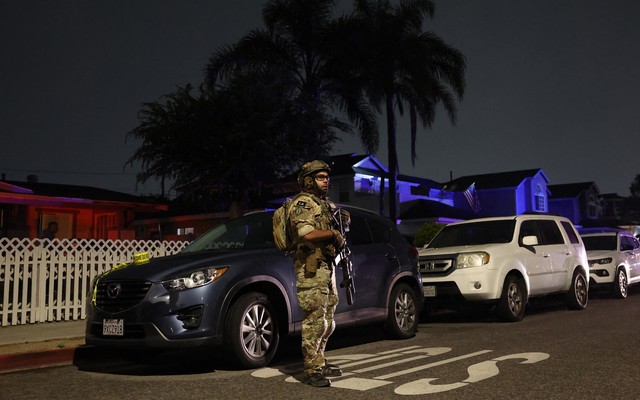
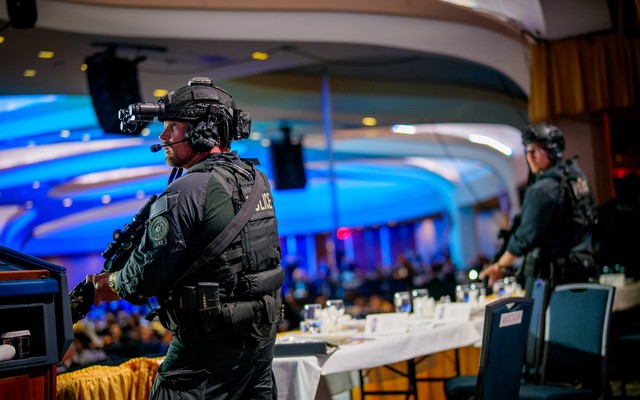
On one level, the system worked. The perimeter held. A would-be assassin was tackled in the hallway outside the White House Correspondents’ Association’s annual dinner. The one bullet that found a human target—a U.S. Secret Service agent—was halted, in part, by the officer’s phone and bulletproof vest, according to a law-enforcement summary report that we reviewed. A counterassault team promptly swarmed the stage with assault rifles and night-vision equipment in case the lights were cut. The government’s top leaders—president, vice president, Cabinet officials, speaker of the House—were ushered to secure locations in a matter of minutes. No one died in the attack.
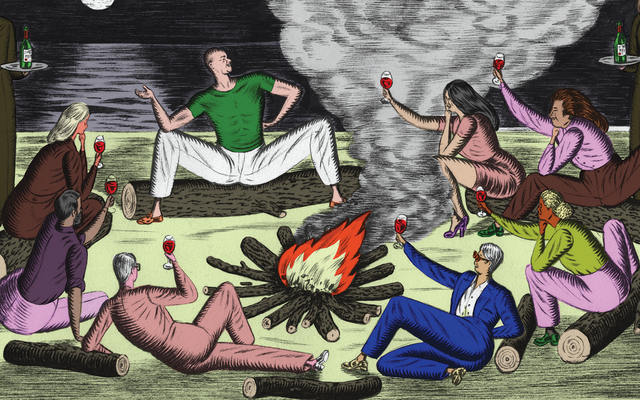
For the richest men on Earth, everything is free and nothing matters.
At the end of Paul Thomas Anderson’s 2007 movie, There Will Be Blood, Daniel Day-Lewis’s oil-baron character, old now and richer than Croesus, beats Paul Dano’s preacher to death with a bowling pin. Dano’s Eli Sunday, a nemesis of Day-Lewis’s Daniel Plainview during his seminal, wealth-building years, has come to sell Plainview the oil-rich land that he once coveted. But Plainview doesn’t need the land anymore, because—as he explains in one of the most famous monologues in modern cinema—he has sucked out all the oil hidden beneath it from an adjoining property, like a milkshake.
Desperate for money, Eli begs for a loan. Instead, Plainview chases him around a bowling alley and murders him with great enthusiasm. Once it’s over, a butler comes to see what all the noise was about. “I’m finished,” Plainview yells.
Instead of a crackdown on his enemies, Trump wants his ballroom.
When an assassin murdered Charlie Kirk in September 2025, the MAGA movement seized the moment to demand a campaign of repression. Vice President Vance called for an ambitious program to “go after the NGO network that foments, facilitates, and engages in violence.” He named the Ford Foundation, Open Society Foundations, and The Nation magazine as examples of candidates for the retaliation he had in mind. The people who faced consequences after the killing almost universally did so for things they had written or said, not for acts of violence. In November, Reuters counted some 600 cases of people who were fired, suspended, or otherwise disciplined for their speech about Kirk’s life and death.
Now another gunman has attacked political targets. At the White House Correspondents’ Association dinner, a man discharged a firearm in the vicinity of hundreds of people from the worlds of politics, media, and business—among them, the president and vice president of the United States. Although much about the event remains unclear, the available evidence suggests that the gunman was motivated by an anti-Trump agenda. Yet this time, MAGA’s immediate response to political violence has been much less aggressive. At his press conference after yesterday’s attempted shooting, President Trump cited the attack as proof of the need for his wished-for White House ballroom. Social-media accounts that take their cues from the White House promptly echoed the message.
A manifesto-like email allegedly sent by the dinner shooter suggests a murderous obsession with Trump’s politics.
The line “I experience rage thinking about everything this administration has done” could probably have been written in an email to friends by any number of the attendees at last night’s White House Correspondents’ Association dinner. But the line was apparently written by a man who showed up with a shotgun and pistol and was ready to kill “most everyone” there to get to Donald Trump and assassinate him and his Cabinet. In a manifesto-like email that he reportedly sent to family minutes before allegedly shooting, Cole Tomas Allen wrote that the assembled journalists and machers “chose to attend a speech by a pedophile, rapist, and traitor, and are thus complicit.” Allen never came near the president or the gala floor. A Secret Service agent was shot in the vest before Allen was tackled and arrested.
This weekend’s failed attack highlighted a risk that often goes unspoken.
In the chaotic swirl of events after President John F. Kennedy’s assassination, doctors feared that Vice President Lyndon B. Johnson had suffered a heart attack upon arrival at Parkland Memorial Hospital in Dallas. The signs were ominous: Johnson’s face was ashen, and he was clutching his chest. “There was the real possibility that the No. 3 in the line of succession would become president,” the historian Michael Beschloss told me. Johnson was reportedly examined and a heart attack ruled out—but not before then–House Speaker John McCormack was told that he might be the next president. The declaration prompted a severe bout of vertigo in the 71-year-old.
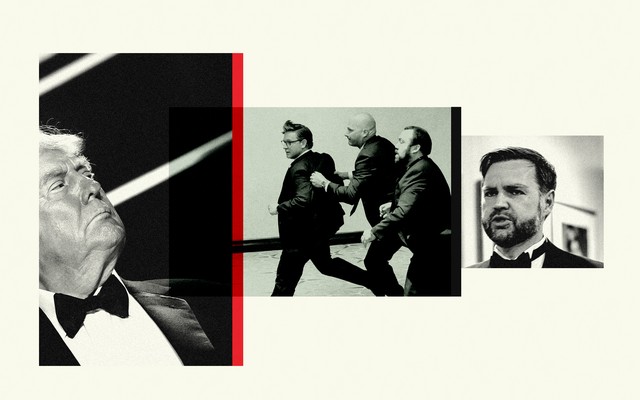
Few moments in history have so starkly exposed the vulnerabilities of the presidential line of succession—or the lack of clarity about how it is protected. Last night provided another illustration of them. If events at the White House Correspondents’ Association Dinner had gone differently, a gunman who breached security at the Washington Hilton could have reached a ballroom containing an unusually dense cluster of American power. The president and the vice president were seated a few feet apart. Congressional leadership and many Cabinet secretaries were also on hand. In other words, much of the presidential line of succession was in the same spot—and subject to the same vulnerabilities.
Tragedy was averted at a Washington hotel, but such moments will happen again.
Except for what appears—thank God—to be only a minor injury to a Secret Service officer who was shot near a security checkpoint, no one was hurt at the White House Correspondents’ Association dinner last night. News reports are reassembling the mosaic of the attacker’s movements; he apparently took a train and transported some weapons with him, checked into the hotel, and then made his run at the event.
These are the basic contours of all that we know, and it will take time for more credible information to emerge. In the meantime, the vacuum of facts has been filled by a certain amount of hysteria and the usual conspiracy theories, as well as understandable demands to make changes so that such a thing can never happen again.
Priests and theologians want to shape the future of AI. Big Tech is listening.
In 1633, Galileo Galilei stood in the convent of the Santa Maria sopra Minerva church in Rome, where a tribunal of Catholic authorities forced him to “abjure, curse, and detest” his belief that the sun—not Earth—was the center of the universe.
Almost four centuries later, in 2016, the Vatican invited a group of the world’s most prominent technologists to the same church to discuss AI ethics. That was the start of the Minerva Dialogues, annual closed-door conferences in Rome that have become the centerpiece of a decade-long exchange between Silicon Valley and the Catholic Church.
The Valley and the Vatican seem like strange bedfellows: The oldest institution in the world meets secular upstarts bent on creating godlike technology. When the venture capitalist Reid Hoffman first attended the dialogues, he told me he was struck by the portraits lining the walls that depicted Catholic inquisitors like those who persecuted Galileo. “It feels a little bit weird to be walking in voluntarily past these,” he remembers thinking.
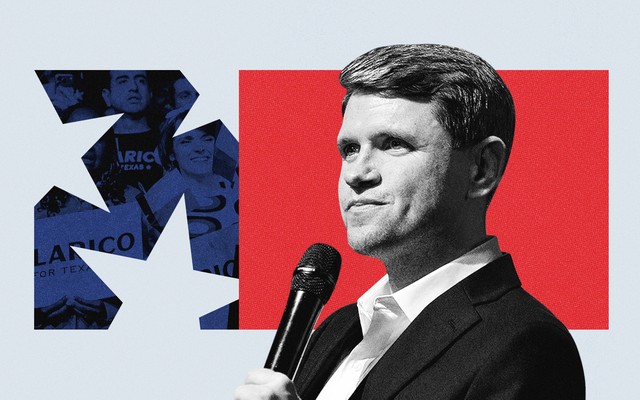
James Talarico is trying to sell a novel brand of Christian politics in a deep-red state.
Updatedat 11:25 a.m. ET on April 24, 2026
While some might pray for hope or peace in such dark times, others are praying for the death of Texas Democrat James Talarico, who is running for the U.S. Senate. During a recent episode of the right-wing Protestant podcast Reformation Red Pill, host Joshua Haymes told the pastor Brooks Potteiger that he prays that “God kills” Talarico, given that the politician seems to be possessed by demons. Potteiger agreed, offering that Talarico should be “crucified with Christ.” Both Haymes and Potteiger later insisted that their remarks were not sincere expressions of violent intent, but rather metaphorical calls for Talarico, a Presbyterian seminarian, to find salvation in their brand of Christianity. Talarico shrewdly responded by offering forgiveness: “You may pray for my death, Pastor, but I still love you. I love you more than you could ever hate me.”
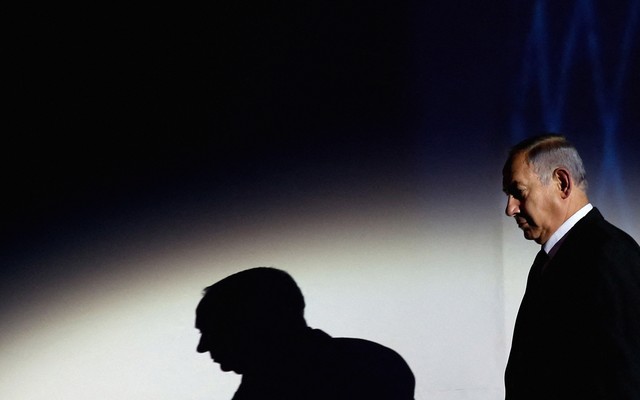
The Israeli prime minister’s focus is, as always, on himself and his near-term political needs. The plight of American Jews is simply not his concern.
The relationship between the United States and Israel is in crisis. Six in 10 Americans have a negative view of Israel, and a majority of those under 50 in both major parties view Israel as well as its prime minister, Benjamin Netanyahu, negatively. After the brutal Gaza war, a large percentage of liberal-leaning Generation Z considers Israel a pariah state. Democratic candidates are scrambling to distance themselves from Israel and its controversial leader; earlier this month, 40 of the 47 Democratic senators voted against a military aid package for the country. And hostility toward Israel is spilling over into hostility toward Jews. Liberal influencers, activists, podcasters, and even politicians are invoking age-old anti-Semitic tropes with frightening regularity.
A New York Times podcast hosted Hasan Piker and a New Yorker staff writer for a discussion of lawbreaking, which they both endorsed as resistance to tyranny.
The late political scientist James C. Scott endorsed what he called “anarchist calisthenics”—the regular practice of small acts of lawbreaking and disobedience. Jaywalk at an empty intersection. Have a beer in the park. Smuggle a pudding cup past the TSA agents. The point, Scott said, was to keep the civic muscles strong. Without constant reinforcement, these muscles will atrophy, and when real tyranny arrives, the flabby citizen will be powerless to resist. Scott particularly enjoyed telling Germans to get their reps in, because their grandparents had not.
On Wednesday a New York Times podcast hosted the Twitch streamer Hasan Piker and the New Yorker staff writer Jia Tolentino for a discussion of lawbreaking, which they both endorsed not as a habit of mind but as resistance to actual tyranny, today. They agreed that shoplifting from grocery stores such as Whole Foods is laudable, because (as Tolentino says, without evidence) “every major grocery chain” steals from workers and customers. Streaming services—they specifically name Spotify, which carries the Times podcast—are bad for creators and, they say, worthy of being ripped off. Piker said he would steal cars, “if I could get away with it.” Channeling Abbie Hoffman, Tolentino encourages people to steal from her own employer, The New Yorker, but does not explain which high crimes David Remnick has committed to earn this comeuppance.