President Donald Trump and Japanese Prime Minister Shinzo Abe held a joint news conference on Saturday night at Mar-a-Lago, responding to North Korea’s launch of a ballistic missile.
“North Korea’s most recent missile launch is absolutely intolerable,” Abe said, speaking through an interpreter. “North Korea must fully comply with the relevant UN Security Council resolutions.” He pointed to Trump’s presence at the impromptu news conference as evidence of the new president’s commitment to the strength of the alliance.
Then Trump stepped forward to speak. “I just want everyone to understand and fully know that the United States of America stands behind Japan, its great ally, 100 percent,” he said. “Thank you.”
The statements were somewhat more measured than the words of South Korea’s acting president, Hwang Kyo-Ahn. “Our government, in tandem with the international community, is doing its best to ensure a corresponding response to punish the North,” he said earlier.
The missile was launched hours earlier over the Korean peninsula, flying some 300 miles into the Sea of Japan. It was unclear whether this was a test of a shorter-range missile, a successful flight of the mid-range Musadan missile, or a test of one or more stages of the intercontinental ballistic missile that North Korea is attempting to develop.
North Korean weapons development programs, including its nuclear arsenal, have challenged successive American administrations, and now present an early test to the Trump administration.
Yale Changes the Name of Calhoun College Over Ties to Racism
AP
Yale University announced Saturday that it would rename its residential college that bore the name of John C. Calhoun, a Yale graduate, U.S. vice president, white supremacist and advocate of slavery. The college will now be named after Grace Murray Hopper, a mathematician who graduated from the university in 1934 and left a teaching role to enlist in the Navy during World War II. The name change is a reversal of a decision made last spring, when Yale’s president, Peter Salovey, said he would not remove Calhoun’s name, because he thought it better to confront history, not to erase it. In that same spirit, Calhoun’s name will not be removed from the college, but will appear alongside Hopper’s, although the college will only be referred to by the latter. Hopper left her teaching job at Vassar and joined the Navy to help defeat Fascism, and she remained in service most of her life. But she is much better known for her work on early computers, developing code and language that allowed non-specialists to use them. The protest and petition over the college’s namesake began not long after a white supremacist in South Carolina shot and killed nine black worshipper at a church. The backlash led South Carolina to take down the Confederate flag that flew above the state capitol, as well as petitions for other colleges to remove names or images of historical figures who were pro-slavery or white supremacists.
A 6.7 magnitude earthquake hit the the Philippines late Friday, killing at least six people and injuring more than 100. The city of Surigao, in the country’s southern Mindanao region, was worst hit and the quake shut off power, destroyed homes, and took down a bridge. Since the initial quake, more than 100 aftershocks have been felt. The government set up evacuation centers, but they have struggled to accommodate everyone. More than a thousand people spent the night outside the provincial capitol building, and by morning emergency crews were passing out food and other supplies. Rescue workers are now going through the rubble of toppled buildings, pulling out some trapped survivors. Seismologists say the epicenter struck along the Philippine fault zone, which last moved in 1879.
Hundreds of Whales Die in New Zealand After They Beached Themselves
Reuters
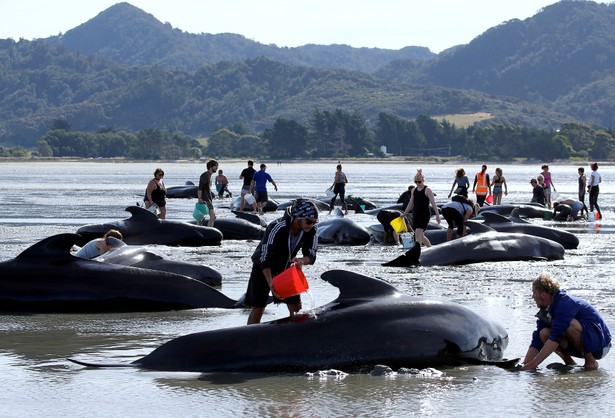
More than 650 pilot whales have beached themselves in the past two days along a stretch of New Zealand coastline called Farewell Spit, and about 330 have died so far. Dozens of volunteers from around the country worked to keep the whales cool, bucketing water on their bodies, and they managed to push about 100 back to the ocean. But early Saturday morning another pod of 240 swam onto the beach. The rescuers are waiting until the next high tide, which comes Sunday morning, until they can save this new pod. It’s not clear why whales beach themselves. Bite marks from a shark were found on at least one of the whales, so they may have driven themselves onto land looking for safety. Another possibility is that when one whale swims too far onto the coast it becomes confused and sends out a distress call. When other whales come to save it they also become beached. This area in New Zealand, on the South Island, has seen large pods of whales beach themselves before, but never this bad.
The shooting at the correspondents’ dinner made clear who gets saved first.
This article was featured in the One Story to Read Today newsletter. Sign up for it here.
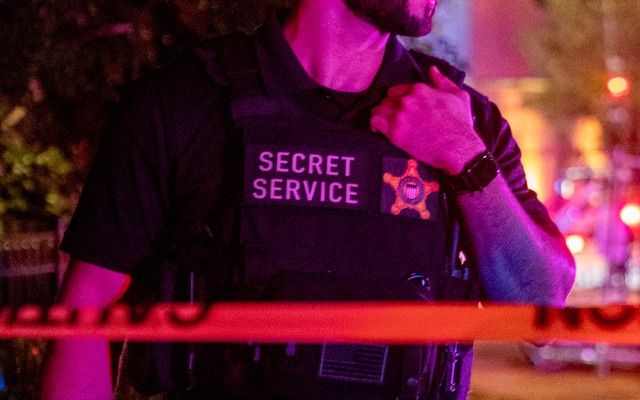
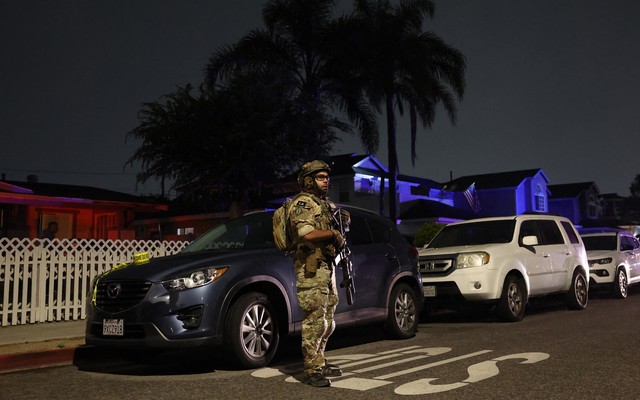
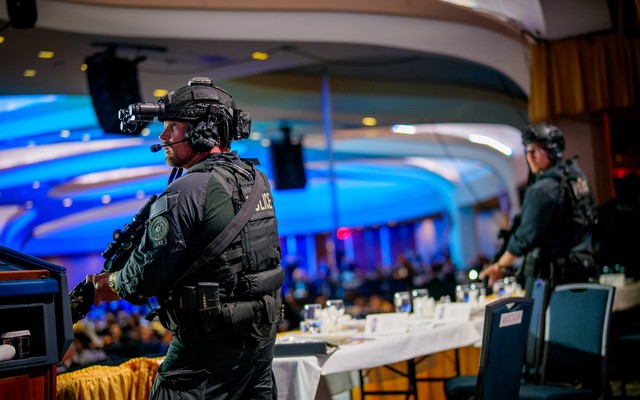
On one level, the system worked. The perimeter held. A would-be assassin was tackled in the hallway outside the White House Correspondents’ Association’s annual dinner. The one bullet that found a human target—a U.S. Secret Service agent—was halted, in part, by the officer’s phone and bulletproof vest, according to a law-enforcement summary report that we reviewed. A counterassault team promptly swarmed the stage with assault rifles and night-vision equipment in case the lights were cut. The government’s top leaders—president, vice president, Cabinet officials, speaker of the House—were ushered to secure locations in a matter of minutes. No one died in the attack.
Instead of a crackdown on his enemies, Trump wants his ballroom.
When an assassin murdered Charlie Kirk in September 2025, the MAGA movement seized the moment to demand a campaign of repression. Vice President Vance called for an ambitious program to “go after the NGO network that foments, facilitates, and engages in violence.” He named the Ford Foundation, Open Society Foundations, and The Nation magazine as examples of candidates for the retaliation he had in mind. The people who faced consequences after the killing almost universally did so for things they had written or said, not for acts of violence. In November, Reuters counted some 600 cases of people who were fired, suspended, or otherwise disciplined for their speech about Kirk’s life and death.
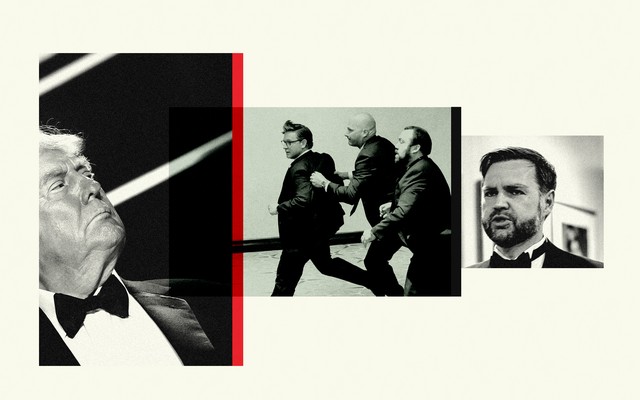
Now another gunman has attacked political targets. At the White House Correspondents’ Association dinner, a man discharged a firearm in the vicinity of hundreds of people from the worlds of politics, media, and business—among them, the president and vice president of the United States. Although much about the event remains unclear, the available evidence suggests that the gunman was motivated by an anti-Trump agenda. Yet this time, MAGA’s immediate response to political violence has been much less aggressive. At his press conference after yesterday’s attempted shooting, President Trump cited the attack as proof of the need for his wished-for White House ballroom. Social-media accounts that take their cues from the White House promptly echoed the message.
For the richest men on Earth, everything is free and nothing matters.
At the end of Paul Thomas Anderson’s 2007 movie, There Will Be Blood, Daniel Day-Lewis’s oil-baron character, old now and richer than Croesus, beats Paul Dano’s preacher to death with a bowling pin. Dano’s Eli Sunday, a nemesis of Day-Lewis’s Daniel Plainview during his seminal, wealth-building years, has come to sell Plainview the oil-rich land that he once coveted. But Plainview doesn’t need the land anymore, because—as he explains in one of the most famous monologues in modern cinema—he has sucked out all the oil hidden beneath it from an adjoining property, like a milkshake.
Desperate for money, Eli begs for a loan. Instead, Plainview chases him around a bowling alley and murders him with great enthusiasm. Once it’s over, a butler comes to see what all the noise was about. “I’m finished,” Plainview yells.
A manifesto-like email allegedly sent by the dinner shooter suggests a murderous obsession with Trump’s politics.
The line “I experience rage thinking about everything this administration has done” could probably have been written in an email to friends by any number of the attendees at last night’s White House Correspondents’ Association dinner. But the line was apparently written by a man who showed up with a shotgun and pistol and was ready to kill “most everyone” there to get to Donald Trump and assassinate him and his Cabinet. In a manifesto-like email that he reportedly sent to family minutes before allegedly shooting, Cole Tomas Allen wrote that the assembled journalists and machers “chose to attend a speech by a pedophile, rapist, and traitor, and are thus complicit.” Allen never came near the president or the gala floor. A Secret Service agent was shot in the vest before Allen was tackled and arrested.
Priests and theologians want to shape the future of AI. Big Tech is listening.
In 1633, Galileo Galilei stood in the convent of the Santa Maria sopra Minerva church in Rome, where a tribunal of Catholic authorities forced him to “abjure, curse, and detest” his belief that the sun—not Earth—was the center of the universe.
Almost four centuries later, in 2016, the Vatican invited a group of the world’s most prominent technologists to the same church to discuss AI ethics. That was the start of the Minerva Dialogues, annual closed-door conferences in Rome that have become the centerpiece of a decade-long exchange between Silicon Valley and the Catholic Church.
The Valley and the Vatican seem like strange bedfellows: The oldest institution in the world meets secular upstarts bent on creating godlike technology. When the venture capitalist Reid Hoffman first attended the dialogues, he told me he was struck by the portraits lining the walls that depicted Catholic inquisitors like those who persecuted Galileo. “It feels a little bit weird to be walking in voluntarily past these,” he remembers thinking.
A good marriage is no guarantee against infidelity.
This article was featured in One Story to Read Today, a newsletter in which our editors recommend a single must-read from The Atlantic, Monday through Friday. Sign up for it here.
“Most descriptions of troubled marriages don’t seem to fit my situation,” Priya insists. “Colin and I have a wonderful relationship. Great kids, no financial stresses, careers we love, great friends. He is a phenom at work, fucking handsome, attentive lover, fit, and generous to everyone, including my parents. My life is good.” Yet Priya is having an affair. “Not someone I would ever date—ever, ever, ever. He drives a truck and has tattoos. It’s so clichéd, it pains me to say it out loud. It could ruin everything I’ve built.”
This weekend’s failed attack highlighted a risk that often goes unspoken.
In the chaotic swirl of events after President John F. Kennedy’s assassination, doctors feared that Vice President Lyndon B. Johnson had suffered a heart attack upon arrival at Parkland Memorial Hospital in Dallas. The signs were ominous: Johnson’s face was ashen, and he was clutching his chest. “There was the real possibility that the No. 3 in the line of succession would become president,” the historian Michael Beschloss told me. Johnson was reportedly examined and a heart attack ruled out—but not before then–House Speaker John McCormack was told that he might be the next president. The declaration prompted a severe bout of vertigo in the 71-year-old.
Few moments in history have so starkly exposed the vulnerabilities of the presidential line of succession—or the lack of clarity about how it is protected. Last night provided another illustration of them. If events at the White House Correspondents’ Association Dinner had gone differently, a gunman who breached security at the Washington Hilton could have reached a ballroom containing an unusually dense cluster of American power. The president and the vice president were seated a few feet apart. Congressional leadership and many Cabinet secretaries were also on hand. In other words, much of the presidential line of succession was in the same spot—and subject to the same vulnerabilities.
The Israeli prime minister’s focus is, as always, on himself and his near-term political needs. The plight of American Jews is simply not his concern.
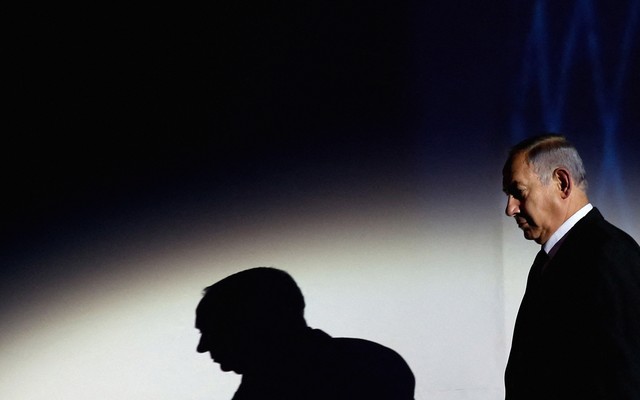
The relationship between the United States and Israel is in crisis. Six in 10 Americans have a negative view of Israel, and a majority of those under 50 in both major parties view Israel as well as its prime minister, Benjamin Netanyahu, negatively. After the brutal Gaza war, a large percentage of liberal-leaning Generation Z considers Israel a pariah state. Democratic candidates are scrambling to distance themselves from Israel and its controversial leader; earlier this month, 40 of the 47 Democratic senators voted against a military aid package for the country. And hostility toward Israel is spilling over into hostility toward Jews. Liberal influencers, activists, podcasters, and even politicians are invoking age-old anti-Semitic tropes with frightening regularity.
Kash Patel has alarmed colleagues with episodes of excessive drinking and unexplained absences.
This article was featured in the One Story to Read Today newsletter. Sign up for it here.
On Friday, April 10, as FBI Director Kash Patel was preparing to leave work for the weekend, he struggled to log on to an internal computer system. He quickly became convinced that he had been locked out, and he panicked, frantically calling aides and allies to announce that he had been fired by the White House, according to nine people familiar with his outreach. Two of these people described his behavior as a “freak-out.”
Patel oversees an agency that employs roughly 38,000 people, including many who are trained to investigate and verify information that can be presented under oath in a court of law. News of his emotional outburst ricocheted through the bureau, prompting chatter among officials and, in some corners of the building, expressions of relief. The White House fielded calls from the bureau and from members of Congress asking who was now in charge of the FBI.
Tragedy was averted at a Washington hotel, but such moments will happen again.
Except for what appears—thank God—to be only a minor injury to a Secret Service officer who was shot near a security checkpoint, no one was hurt at the White House Correspondents’ Association dinner last night. News reports are reassembling the mosaic of the attacker’s movements; he apparently took a train and transported some weapons with him, checked into the hotel, and then made his run at the event.
These are the basic contours of all that we know, and it will take time for more credible information to emerge. In the meantime, the vacuum of facts has been filled by a certain amount of hysteria and the usual conspiracy theories, as well as understandable demands to make changes so that such a thing can never happen again.