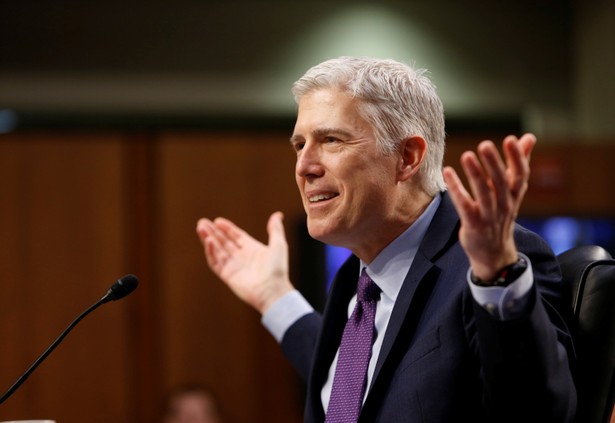
—The Senate Judiciary Committee begins deliberations today on the nomination of Judge Neil Gorsuch to the U.S. Supreme Court. Republicans need five more Democratic votes to overcome a filibuster that Democrats have vowed to mount on the nomination.
—We’re tracking the news stories of the day below. All updates are in Eastern Daylight Time (GMT -4).
Trump Donates His First-Quarter Paycheck to the National Park Service
Carlos Barria / Reuters
President Trump donated his first three months of salary to the National Park Service (NPS) on Monday. The total comes to $78,333.32, which Sean Spicer, the White House spokesman, handed in the form of a check to an NPS employee. During his election campaign, Trump promised to donate his $400,000 annual salary if elected, even asking for the press corps’s help in deciding where to send it. The NPS is overseen by the Department of Interior, which said the money would go toward maintaining historic battlefield sites. At these areas alone, the NPS faces a $229 million budget shortfall. Interior Secretary Ryan Zinke has said the NPS faces an overall maintenance shortfall of $12 billion, and he’s made this one of his top priorities. But it’s unclear how that shortfall will be made up because Trump’s “skinny” budget calls for a 12 percent cut to the Interior Department.
UPDATE: Democrats Have Enough Votes to Filibuster Gorsuch's Nomination; GOP Vows to Press Ahead
(Joshua Roberts / Reuters)
The Senate Judiciary Committee voted 11-9 along party lines Monday to move the nomination of Judge Neil Gorsuch to a full Senate vote. The move comes after Senate Democrats said they have the 41 votes needed to filibuster Gorsuch’s nomination, likely forcing Republicans to use the so-called “nuclear option” and put the Supreme Court nominee’s appointment to a full vote. Gorsuch, President Trump’s nominee to fill the vacancy created by the death last year of Judge Antonin Scalia, has the support of all 52 Republicans in the Senate, as well as of at least three Democrats—Joe Manchin of West Virginia, Heidi Heitkamp of North Dakota, and Joe Donnelly of Indiana—from conservative states that went to Trump. He needed 60 votes—a supermajority—for his nomination to be approved. The “nuclear option” would allow Gorsuch’s nomination to be approved by a simple majority of senators rather than the 60-vote supermajority. Democrats, who are still angry over the Republican refusal to hold hearings for Judge Merrick Garland, whom President Obama nominated to fill Scalia’s spot on the court, insist that if Republicans don’t have 60 votes for Gorsuch, Trump should nominate a judge who can win the support of a supermajority of lawmakers. Despite their opposition, however, Gorsuch is expected to be confirmed.
President Trump meets Egyptian President Abdel Fattah al-Sisi in the Oval Office on April 3, 2017. (Kevin Lamarque / Reuters)
President Trump welcomed Egyptian President Abdel Fattah al-Sisi to the White House Monday, marking the Arab leader’s first visit to Washington since he assumed power following former President Mohamed Morsi’s ouster in 2013. “I just want to let everybody know, in case there was any doubt, that we are very much behind President al-Sisi,” Trump told reporters at the meeting. “He’s done a fantastic job in a very difficult situation. We are very much behind Egypt and the people of Egypt.” Though Egypt has been a longstanding U.S. ally—receiving approximately $1.3 billion in U.S. military aid annually—Sisi was never afforded an invitation to the White House under the Obama administration. Indeed, Obama froze aid to the country for two years after Sisi, then Egypt’s defense minister, led a popular uprising against Morsi’s Muslim Brotherhood-led government, which was elected the previous year. The U.S.-Egyptian relationship was further strained by alleged human-rights abuses by the Sisi government, including mass arrests, enforced disappearances, and extrajudicial executions. Though Trump noted that both countries “have a few things” they do not agree upon, he said the two countries will work together “to fight terrorism and other things.”
Ecuador's New Socialist President Is Good News for Julian Assange
Mariana Bazo / Reuters
Socialist candidate Lenín Moreno narrowly won Ecuador’s presidential election Sunday night, though his opponent has demanded a recount and protesters from both sides took to the streets. Moreno’s win bucked a trend of center-right victories in South America, and was also good news for Julian Assange, whose fate as an asylee in Ecuador’s embassy in London was predicated on the win. Moreno, a former vice president, won 51 percent of the vote over his opponent, Guillermo Lasso. Lasso was a former banker who offered voters a change from leftist economic policies he blamed for the country’s sagging economy. He also promised to kick Assange out of the embassy within 30 days of taking office. At least one respected exit poll had put Lasso ahead Sunday night, so when news of Moreno’s win came later that evening, Lasso denounced it as fraudulent, saying, “We won’t let them cheat us!” His supporters stormed the country’s election headquarters and battled riot police. As oil prices and exports have fallen in the region, countries like Argentina, Peru, and Brazil have turned to center-right leaders who’ve promised fiscal reforms. But by selecting Moreno, Ecuador remains in the company of Socialist-led Bolivia and Venezuela.
Blast Reported at Metro Station in St. Petersburg, Russia
A general view of St. Petersburg, Russia (Maxim Zmeyev / Reuters)
Updated at 9 a.m.
Russian news reports say an explosion in the St. Petersburg metro system has killed at least people. The blast reportedly occurred at the Sennaya Square metro station.
The shooting at the correspondents’ dinner made clear who gets saved first.
This article was featured in the One Story to Read Today newsletter. Sign up for it here.
On one level, the system worked. The perimeter held. A would-be assassin was tackled in the hallway outside the White House Correspondents’ Association’s annual dinner. The one bullet that found a human target—a U.S. Secret Service agent—was halted, in part, by the officer’s phone and bulletproof vest, according to a law-enforcement summary report that we reviewed. A counterassault team promptly swarmed the stage with assault rifles and night-vision equipment in case the lights were cut. The government’s top leaders—president, vice president, Cabinet officials, speaker of the House—were ushered to secure locations in a matter of minutes. No one died in the attack.
Instead of a crackdown on his enemies, Trump wants his ballroom.
When an assassin murdered Charlie Kirk in September 2025, the MAGA movement seized the moment to demand a campaign of repression. Vice President Vance called for an ambitious program to “go after the NGO network that foments, facilitates, and engages in violence.” He named the Ford Foundation, Open Society Foundations, and The Nation magazine as examples of candidates for the retaliation he had in mind. The people who faced consequences after the killing almost universally did so for things they had written or said, not for acts of violence. In November, Reuters counted some 600 cases of people who were fired, suspended, or otherwise disciplined for their speech about Kirk’s life and death.
Now another gunman has attacked political targets. At the White House Correspondents’ Association dinner, a man discharged a firearm in the vicinity of hundreds of people from the worlds of politics, media, and business—among them, the president and vice president of the United States. Although much about the event remains unclear, the available evidence suggests that the gunman was motivated by an anti-Trump agenda. Yet this time, MAGA’s immediate response to political violence has been much less aggressive. At his press conference after yesterday’s attempted shooting, President Trump cited the attack as proof of the need for his wished-for White House ballroom. Social-media accounts that take their cues from the White House promptly echoed the message.
The Israeli prime minister’s focus is, as always, on himself and his near-term political needs. The plight of American Jews is simply not his concern.
The relationship between the United States and Israel is in crisis. Six in 10 Americans have a negative view of Israel, and a majority of those under 50 in both major parties view Israel as well as its prime minister, Benjamin Netanyahu, negatively. After the brutal Gaza war, a large percentage of liberal-leaning Generation Z considers Israel a pariah state. Democratic candidates are scrambling to distance themselves from Israel and its controversial leader; earlier this month, 40 of the 47 Democratic senators voted against a military aid package for the country. And hostility toward Israel is spilling over into hostility toward Jews. Liberal influencers, activists, podcasters, and even politicians are invoking age-old anti-Semitic tropes with frightening regularity.
For the richest men on Earth, everything is free and nothing matters.
At the end of Paul Thomas Anderson’s 2007 movie, There Will Be Blood, Daniel Day-Lewis’s oil-baron character, old now and richer than Croesus, beats Paul Dano’s preacher to death with a bowling pin. Dano’s Eli Sunday, a nemesis of Day-Lewis’s Daniel Plainview during his seminal, wealth-building years, has come to sell Plainview the oil-rich land that he once coveted. But Plainview doesn’t need the land anymore, because—as he explains in one of the most famous monologues in modern cinema—he has sucked out all the oil hidden beneath it from an adjoining property, like a milkshake.
Desperate for money, Eli begs for a loan. Instead, Plainview chases him around a bowling alley and murders him with great enthusiasm. Once it’s over, a butler comes to see what all the noise was about. “I’m finished,” Plainview yells.
A New York Times podcast hosted Hasan Piker and a New Yorker staff writer for a discussion of lawbreaking, which they both endorsed as resistance to tyranny.
The late political scientist James C. Scott endorsed what he called “anarchist calisthenics”—the regular practice of small acts of lawbreaking and disobedience. Jaywalk at an empty intersection. Have a beer in the park. Smuggle a pudding cup past the TSA agents. The point, Scott said, was to keep the civic muscles strong. Without constant reinforcement, these muscles will atrophy, and when real tyranny arrives, the flabby citizen will be powerless to resist. Scott particularly enjoyed telling Germans to get their reps in, because their grandparents had not.
On Wednesday a New York Times podcast hosted the Twitch streamer Hasan Piker and the New Yorker staff writer Jia Tolentino for a discussion of lawbreaking, which they both endorsed not as a habit of mind but as resistance to actual tyranny, today. They agreed that shoplifting from grocery stores such as Whole Foods is laudable, because (as Tolentino says, without evidence) “every major grocery chain” steals from workers and customers. Streaming services—they specifically name Spotify, which carries the Times podcast—are bad for creators and, they say, worthy of being ripped off. Piker said he would steal cars, “if I could get away with it.” Channeling Abbie Hoffman, Tolentino encourages people to steal from her own employer, The New Yorker, but does not explain which high crimes David Remnick has committed to earn this comeuppance.
The president is safe after chaos at the Washington Hilton, and a suspect is reportedly in custody.
Updated at 1:29 a.m. ET on Sunday, April 26, 2026
We were under the table before we knew what was happening. One moment, a military band was parading out of the Washington Hilton’s cavernous ballroom; hundreds of government officials, diplomats, and journalists, including more than a dozen of us from The Atlantic, dressed in our best or borrowed black tie, had turned to our spring-pea-and-burrata salads.
The next moment, armed agents—maybe Secret Service, maybe police, maybe hotel guards; it was hard to tell from where we were huddled under a tablecloth—were pushing their way through mounds of people, climbing over chairs, rushing to the stage, where President Trump and First Lady Melania Trump had shortly before been seated.
Requiring schools to endorse biblical laws is both unconstitutional and counterproductive.
When you were in elementary school, did your mind occasionally rise above the smell of pencil shavings and the sound of squeaking desk chairs to contemplate whether you ought to commit murder? Did you ponder what it would mean to covet your neighbor’s wife? Ordinarily those aren’t questions addressed in grade-school classrooms, but according to legislators in Alabama, Louisiana, Texas, and Arkansas, they ought to be.
In those districts, state Republicans are rallying behind laws that would mandate posting the Ten Commandments in public-school classrooms and common areas, such as cafeterias and libraries. This fad began in 2024, when Louisiana Governor Jeff Landry signed such a bill, reviving a debate long silenced by the Supreme Court’s 1980 decision in Stone v. Graham to strike down a similar Kentucky law.Other states followed suit: Arkansas and Texas last year, and Alabama just this month. Although these laws pose a threat to the First Amendment rights of students and teachers, the trend is spreading, so far unchecked by courts. Opponents of Texas’s law suffered a defeat last week when an appellate court decided in the state’s favor. The ACLU and other organizations representing the plaintiffs—a multifaith group of Texas families—are expected to appeal this decision to the Supreme Court.
James Talarico is trying to sell a novel brand of Christian politics in a deep-red state.
Updatedat 11:25 a.m. ET on April 24, 2026
While some might pray for hope or peace in such dark times, others are praying for the death of Texas Democrat James Talarico, who is running for the U.S. Senate. During a recent episode of the right-wing Protestant podcast Reformation Red Pill, host Joshua Haymes told the pastor Brooks Potteiger that he prays that “God kills” Talarico, given that the politician seems to be possessed by demons. Potteiger agreed, offering that Talarico should be “crucified with Christ.” Both Haymes and Potteiger later insisted that their remarks were not sincere expressions of violent intent, but rather metaphorical calls for Talarico, a Presbyterian seminarian, to find salvation in their brand of Christianity. Talarico shrewdly responded by offering forgiveness: “You may pray for my death, Pastor, but I still love you. I love you more than you could ever hate me.”
Silicon Valley venture capitalists are wining and dining 18-year-olds.
This article was featured in the One Story to Read Today newsletter. Sign up for it here.Updated at 8:22 a.m. ET on April 25, 2026.
When I was a freshman at Stanford University, I learned to shotgun a beer from a guy in a frat. Soon after, he dropped out and started an AI company. Six months later, it was valued at more than $1 billion.
For most students, Stanford is a normal competitive school, where people go to class and coffee shops and fall in love and freak out over finals. But a select few attend something else: a Stanford inside Stanford, where venture capitalists pursue 18- and 19-year-olds, handing out mentorships and money and invites to yacht parties in an attempt to convert promise into profit.
Priests and theologians want to shape the future of AI. Big Tech is listening.
In 1633, Galileo Galilei stood in the convent of the Santa Maria sopra Minerva church in Rome, where a tribunal of Catholic authorities forced him to “abjure, curse, and detest” his belief that the sun—not Earth—was the center of the universe.
Almost four centuries later, in 2016, the Vatican invited a group of the world’s most prominent technologists to the same church to discuss AI ethics. That was the start of the Minerva Dialogues, annual closed-door conferences in Rome that have become the centerpiece of a decade-long exchange between Silicon Valley and the Catholic Church.
The Valley and the Vatican seem like strange bedfellows: The oldest institution in the world meets secular upstarts bent on creating godlike technology. When the venture capitalist Reid Hoffman first attended the dialogues, he told me he was struck by the portraits lining the walls that depicted Catholic inquisitors like those who persecuted Galileo. “It feels a little bit weird to be walking in voluntarily past these,” he remembers thinking.