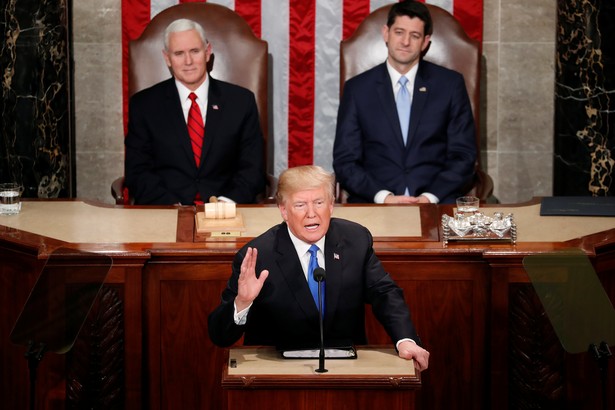
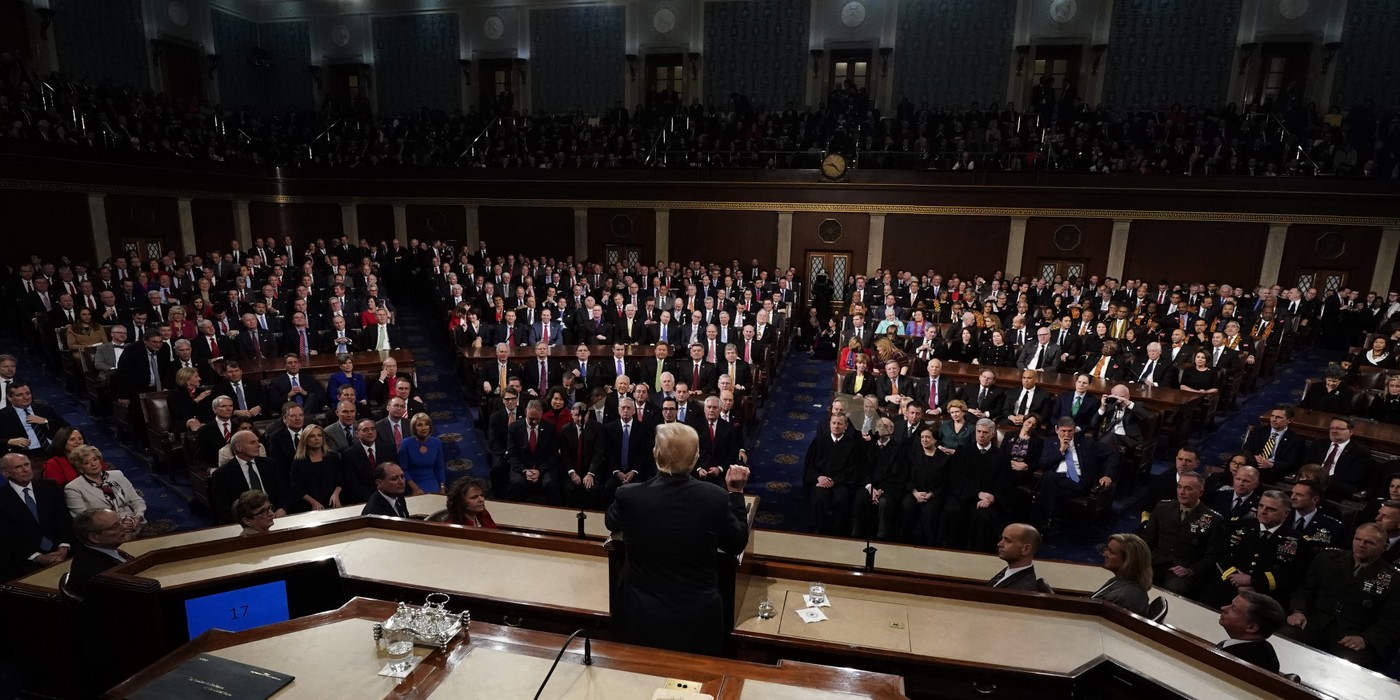
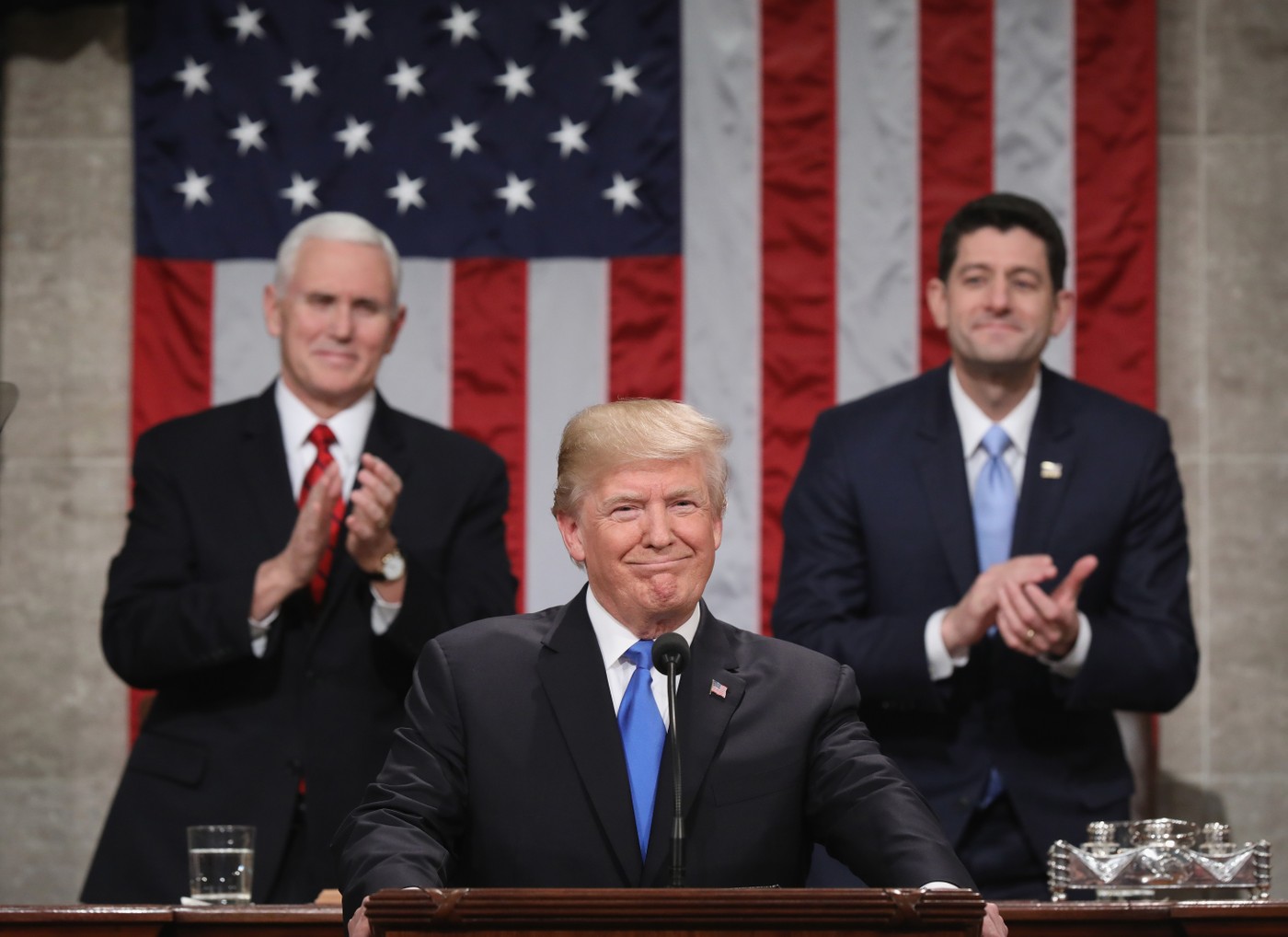
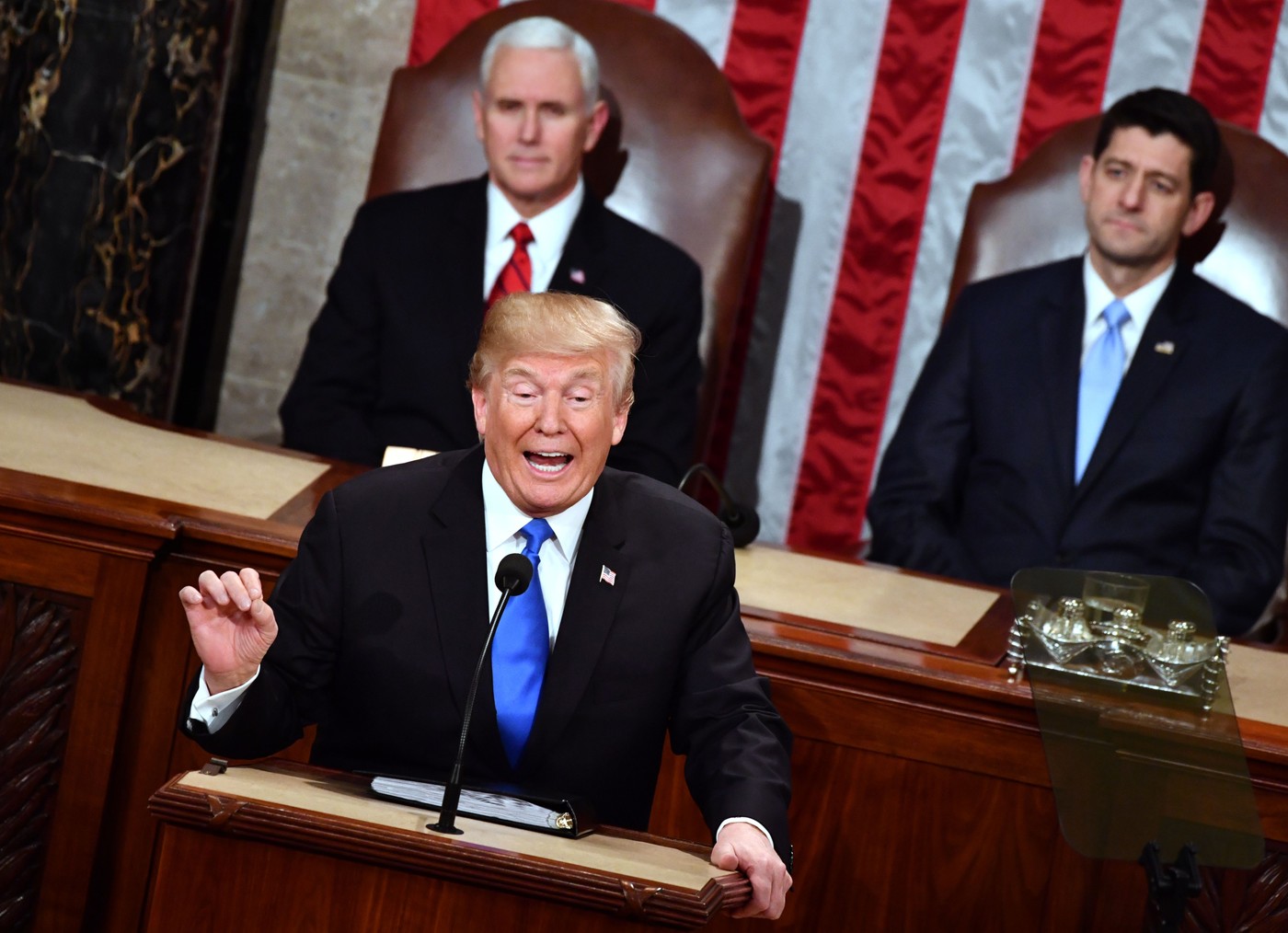
President Trump delivered his first State of the Union before a joint session of Congress on Tuesday night. These addresses are typically opportunities for American presidents to highlight their achievements and provide a vision for the country going forward. To that end, Trump pitched a framework for immigration reform that was released by the White House last week and touted his recent record on trade, infrastructure, and the economy.
But the night was atypical in other ways. For one, Trump delivered the address under the shadow of the Russian investigation, and amid tensions over his administration’s relationship with the intelligence community—not to mention its relationship with Congress.
Follow along for live updates on the evening’s events. Also see our continuing coverage:
President Trump ended his speech with an homage not to any of his predecessors, but to none other than former British Prime Minister Winston Churchill. “As long as we are proud of who we are, and what we are fighting for, there is nothing we cannot achieve,” Trump said. “As long as we have confidence in our values, faith in our citizens, and trust in our God, we will never fail.”
Those lines seemed to deliberately echo Churchill’s famed “Masters of Our Fate” speech, which, like the State of the Union, was delivered to a joint session of Congress. “As long as we have faith in our cause and an unconquerable willpower, salvation will not be denied us,” Churchill told lawmakers in December 1941. “In the words of the Psalmist, ‘He shall not be afraid of evil tidings; his heart is fixed, trusting in the Lord.’”
There have been interesting parallels drawn between the two men. After viewing the film Darkest Hour, former Arkansas Governor Mike Huckabee said that the movie’s portrayal of Churchill reminded him deeply of Trump, a characterization that many criticized as blunting Churchill’s persona and legacy. But, as illustrated in his State of the Union address, Trump does resemble the late leader in a certain light. Churchill infamously agitated against immigration, and clearly extolled racist and imperialist values, often denigrating the citizens of developing nations. And as his “Masters” speech showed, Churchill’s main allure was authoritarian and martial, qualities that appealed to both Great Britain and the United States in the middle of World War II. In fighting his culture war and stoking fears against terrorism and immigrants, Trump seems to want to harness those same energies.
Well, it's over. President Trump loves setting records, and he nearly set one tonight—for length. His speech topped out at 1 hour and 20 minutes. That's longer than any of the eight addresses Barack Obama delivered to Congress, and just eight minutes shy of the State of the Union record Bill Clinton set during his final appearance in the Capitol in 2000, according to records kept by the American Presidency Project at the University of California, Santa Barbara. But the duration of Trump's speech was due almost entirely to the president's unhurried delivery and his decision to milk the seemingly endless interruptions for applause (mainly from Republicans). Trump rarely deviated from his prepared remarks, which amounted to 5,190 words. Clinton's 2000 address lasted eight minutes longer but contained nearly twice as many words: 9,086. Trump’s full speech, as delivered, can be found here.
Trump Describes an Imminent and Immense Threat From North Korea
Chip Somodevilla / Getty
Donald Trump just made clear how pivotal a year 2018 will be for the crisis over North Korea’s nuclear-weapons program. “North Korea's reckless pursuit of nuclear missiles could very soon threaten our homeland” and the “depraved” North Korean regime “threatens our world,” he said. Trump administration officials like to say that their predecessors kicked the can down the road on North Korea and that we’re now all out of road. It’s more accurate to say we’re fast-approaching a fork in the road.
The Trump administration is currently engaged in an international campaign to severely sanction North Korea in hopes of extracting concessions from Kim Jong Un and draining his government of the funds it needs to develop its nuclear arsenal. And there are signs that this effort is starting to succeed. The North’s winter military exercises, for example, haven’t been as robust as usual.
Yet there’s a fundamental time mismatch with the administration’s North Korea policy. Sanctions often take a while—sometimes years—to achieve results. And according to Trump’s CIA director, North Korea is only months away from achieving something administration officials have described as unacceptable: acquiring the capacity to place a nuclear warhead on an intercontinental ballistic missile that can reach the United States. If North Korea conducts additional missile or nuclear tests that demonstrate its long-range nuclear capabilities, the Trump administration will find itself at a crossroads: Does it back down and focus on deterring North Korea from using its weapons? Does it buy time for the sanctions to work by modifying its definition of what North Korean actions are unacceptable? Or does it take more drastic action—like limited military strikes to intimidate Kim or all-out war to take out the North’s nuclear weapons? Just before Trump’s State of the Union address, news broke that the administration’s plans to nominate an ambassador to South Korea had fallen apart. The candidate, Victor Cha, explained that he had argued against taking preventive military action against North Korea. This view apparently proved disqualifying.
Trump Follows Through on His Guantanamo Campaign Pledge
Joe Skipper / Reuters
A decade ago, both presidential nominees, Barack Obama and John McCain, pledged to close the military detention center at Guantanamo Bay, Cuba. During his two terms in office, Obama was never able to do so; Congress continually blocked his efforts over concerns that suspected terrorists would be brought to domestic soil. On Tuesday night, Trump confirmed that he would follow through on his own, opposite campaign pledge: He announced that he had signed an executive order officially keeping Gitmo open and directing Defense Secretary James Mattis to review the nation's terrorist-detention policies. "We must be clear," he said. "Terrorists are not merely criminals. They are unlawful enemy combatants. And when captured overseas, they should be treated like the terrorists they are."
President Trump renewed his pledge to combat the ongoing opioid crisis, committing the White House to "fighting the drug epidemic and helping get treatment for those in need." But he used much more punitive language tonight than he has in the past. In an October speech on drugs, he characterized the nation as a "national family" and seemed to present the crisis—at least in part—as a public-health issue. By contrast, this was his main opioid-related sound bite tonight: "We must get much tougher on drug dealers and pushers if we are going to succeed in stopping this scourge."
Trump Has Made Big Gains Against ISIS—but at a Cost
Jonathan Ernst / Reuters
The Trump administration has, as the president boasted, presided over the retaking of nearly all ISIS territory in Syria and Iraq, including the Islamic State’s former strongholds of Raqqa and Mosul. A U.S.-led air and ground coalition has made remarkable progress in wiping out a globe-spanning terrorist group that just a few years ago looked unstoppable. Just this week, the head of U.S. Central Command said the “military defeat of ISIS” is just weeks away.
But there are some critical caveats to keep in mind. First, as Trump himself noted, the effort to “extinguish ISIS from the face of the earth” is far from over; ISIS’s inspirational power remains potent and ISIS affiliates remain active from Niger to Afghanistan. Second, the Trump administration has largely stuck with and built on the military campaign that the Obama administration began. And third, while the crippling of ISIS has saved countless lives, it has also come at a steep human cost. In part because the fight against ISIS accelerated and moved to urban centers, in part because Trump loosened Barack Obama’s rules of military engagement, civilian casualties in Iraq and Syria have soared. Roughly three-fourths of acknowledgedcivilian deaths during the anti-ISIS military campaign have occurred since Trump took office.
But the Trump administration can nevertheless claim credit for seeing this fight through, and for the success it has achieved.
Can Trump Take Credit for America's Energy Economy?
Donald Trump attends a coal-mining roundtable as a candidate in August 2016. (Eric Thayer / Reuters)
“In our drive to make Washington accountable, we have eliminated more regulations in our first year than any administration in the history of our country,” President Trump said. “We have ended the war on American energy—and we have ended the war on beautiful clean coal. We are now very proudly an exporter of energy to the world.”
This is one of the few nods in the speech to the Trump administration’s expansive regulatory agenda. Repealing regulations—or making them more friendly to business and energy interests—has united the Trump administration and congressional Republicans like almost nothing else. His administration has withdrawn or slow-rolled dozens of regulations at the Environmental Protection Agency and elsewhere across the federal government. Most prominently, it’s repealed the Clean Power Plan, a trademark Obama rule that would have reduced carbon-dioxide pollution from the power sector. The Department of Interior has slashed the size of Bears Ears National Monument, making some of it open to uranium mining. Trump claims his agenda has cut the private costs of regulation by $8.1 billion—though most of those savings came through the cancellation of a single rule governing federal contractors.
It makes sense that Trump will link this to the new U.S. energy economy. America is energy dominant now in ways that it has never been before. In 2016, for instance, U.S. oil companies defied an OPEC attempt to raise global oil prices. Within the next few years, the United States may even export more energy than it imports.
But little of that supremacy is due to Trump. Decades of innovation and exploratory policy—going back to the Carter administration—got the U.S. to this point. The fracking boom changed the U.S. electricity sector. And America exports oil now thanks to the bipartisan repeal of a longstanding oil-export ban in 2015. Those forces are what’s making America energy dominant—and ironically, they’re also putting the domestic coal industry out of business.
How Can We Really Lift Citizens 'From Welfare to Work?'
“We can lift our citizens from welfare to work, from dependence to independence, and from poverty to prosperity.” President Trump didn’t spare too many words for his ideas on welfare and welfare reform tonight, but it’s likely those reforms will be major policy issues in the upcoming year, with the White House sending signals to states that it will advance a conservative reform agenda on anti-poverty programs. That includes revisions to the federal food-stamp program (SNAP) and to Medicaid, the federal health-insurance program for low-income people.
With respect to SNAP, USDA chief Sonny Perdue—who happens to be tonight’s designated survivor—recently stated that the next Farm Bill should “support work as the pathway to self-sufficiency,” which likely signals support for a strong work requirement in the program. The Department of Health and Human Services has already moved in this direction with Medicaid, with the Centers for Medicare and Medicaid services approving for the first time state waivers for requirements that some recipients work in order to receive benefits.
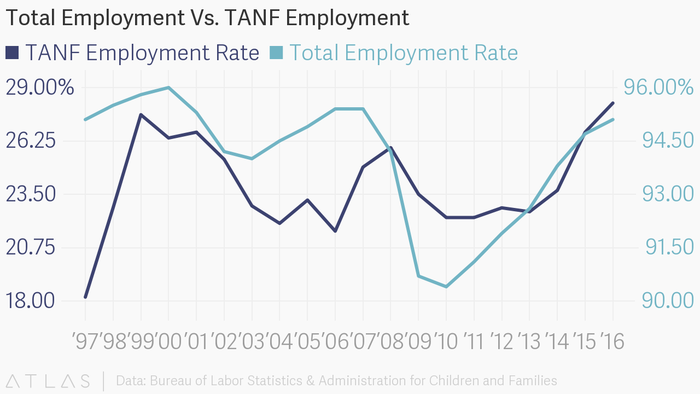
It’s unclear if that rationale will have measurable effects other than simply moving people off federal programs, though. The example often touted as the model for these work requirements is the TANF program, which was created out of Bill Clinton’s 1996 welfare reform and required many people receiving cash benefits to work. But over its two decades of full implementation, the program has likely done most of its work not by ensuring that people on welfare work, but by kicking off those who don’t. Employment for people on TANF is still well below the national average, and follows unemployment closely.
President Trump just called for more vocational schools, “so our future workers can learn a craft and realize their full potential.” But in his proposed budget for 2018, he sent a different message: The president requested cuts to career and technical education, including $166 million in cuts to grants that fund those programs. While the proposed grant reductions are relatively small, amounting to 15 percent of current levels, advocates say they’d significantly undermine efforts to expand vocational opportunities despite ever-growing demand.
"Americans are dreamers, too." With those four words, Trump summed up his worldview on immigration and his "America First" slogan. Seeking to reframe the debate over young undocumented immigrants at risk for deportation, the president said his "greatest compassion" was for American citizens, and he spotlighted ICE agents and victims of crimes by the MS-13 gang he so frequently targets. Then Trump segued into his four-part immigration plan, which would provide a path to citizenship for 1.8 million “Dreamers” brought illegally to the U.S. by their parents. In exchange, Trump wants $25 billion for border security, including his signature wall, an end to the diversity visa lottery, and significant reductions to longterm legal immigration through family sponsorship. That's too much for Democrats, and even many Republicans have blanched at the proposed cuts to immigrant entries over the next few decades. His call to end "chain migration" even drew a few boos in the House chamber.
It’s odd to cite open borders as the cause of gangs taking over our communities, as President Trump just did, when gang violence has fallen across the United States; when the unusual cities that remain high-crime are not that way because of immigrant gangs; and when our border is far from “open.” Claims of this sort might have been plausible in 1995. Today, they are a decade or two out of date, as a matter of substance. Unfortunately, they retain effectiveness as political rhetoric out of all proportion to their rootedness in reality.
One year into his tenure, the president's ambitions for a long-delayed infrastructure program have expanded. Last year, he called for a $1 trillion bill; this year, it's 50 percent higher. "Tonight," Trump said, "I am calling on the Congress to produce a bill that generates at least $1.5 trillion for the new infrastructure investment we need."
But the price tag is misleading. Democrats would love legislation that invests that much money into rebuilding the nation's roads, bridges, and railways. Barack Obama called for it repeatedly. But Trump isn't proposing to spend that amount, only to "generate" that much investment. His proposal relies on states, cities, and private companies to shoulder the bulk of the cost—and that's where his plan has already run into stiff opposition in Congress.
Although, as my colleague Russell Berman wrote below, Trump has not detailed further plans for health-care policy from the White House for the upcoming year, it is clear that the repeal of the individual mandate will have large enough effects on health-care costs and coverage in 2018 to be considered as a stand-alone policy regime in its own regard.
The Trump administration branch has done everything within its power to weaken Obamacare’s provisions and to slough more Americans off coverage, including by slashing open-enrollment times and budgets. While it’s unclear just how deeply those actions have affected health care, a Gallup poll suggests 2017 was the first time since the Affordable Care Act was passed that the rate of the uninsured went up, with about 3 million more Americans lacking insurance.
Repealing the individual mandate will likely make 2018 the second straight year of an increased uninsured rate. While the Congressional Budget Office has recently said it will reduce its prediction of the impact of a repeal on uninsured rates (down from its initial estimate of 15 million more uninsured people in 10 years), it still expects an increase of some magnitude. In all, millions more Americans are projected to lack affordable health care at the end of 2018 than did at the start of Trump’s term.
How Democrats Responded to Trump's National Anthem Comment
President Trump’s tribute to the flag and the national anthem presented a tricky choice for Democrats in the House chamber, who largely supported the NFL players who chose to protest police brutality and systemic racism by not standing for the anthem during games. They appeared to be split. A number of them, including House Minority Leader Nancy Pelosi, joined Republicans who rose in a standing ovation. But the majority of them stayed seated, including the second-ranking House Democrat, Steny Hoyer.
Trump's Fight With Colin Kaepernick Still Isn't Over
It's really remarkable that a year and a half after he first attacked former 49ers quarterback Colin Kaepernick for his decision to kneel during the national anthem in protest of police violence, Trump is still—in a sense—campaigning on the same issue. He just made reference to standing for the anthem in his speech.
The football season is almost over now. Kaepernick hasn't played in a year. Mass protests from players in solidarity seem to have receded from public view. Yet the president, apparently, still sees in the issue an easy way to get his base riled up and to draw clear lines in the sand in an ongoing culture war—one that sees him on the side of unquestioning loyalty to law enforcement, and sees anyone else as anti-American.
Tump’s disdain for America’s trade agreements have been evident since the campaign. That sentiment was on display during Trump’s speech. “The era of economic surrender is over,” the president said. “From now on, we expect trading relationships to be fair and to be reciprocal.”
During his first year in office he pulled the country out of the Trans-Pacific Partnership (which he says he would be willing to renegotiate if terms are more favorable to the U.S.) and criticized NAFTA. Just last week, Trump offered a somewhat confusing message about the country’s place in a globalized world. At the World Economic Forum in Davos, Trump said, “America is open for business.” He also said that he “will always put America first,” then adding “America first does not mean America alone. When the U.S grows, so does the world.” All in all, Trump’s actual strategy on how America fits into the global economy—and whether or not that strategy will hurt or help the economy—remains murky.
On Tuesday night, Trump’s speech offered little additional detail on how he might actually alter trade positions. “We will protect American workers and American intellectual property, through strong enforcement of our trade rules,” the president said. But notably, he did not single out any nations, or name any specific agreements he wishes to revise.
Trump Addresses High Prescription Drug Prices, a Democratic Priority—to a Lukewarm Response
Trump devoted a large chunk in the middle of the speech to tackling the high price of prescription drugs, calling it "one of my greatest priorities." This is a topic he has talked about repeatedly, but so far done little to address. And it's one that has the potential for bipartisanship, since it's been a top priority for many Democrats for years. Acknowledging this, Trump actually gestured to their side of the aisle after urging Congress to take action, as if to encourage their applause. The response was mixed, however, in an indication of how little trust exists between the president and the opposition party.
President Trump’s rhetoric about America as “one team” with “one destiny” is vexing. That’s partly because of the divisiveness that he deliberately stokes many days on Twitter, but also because a core part of what makes America great is that it accommodates people with very different notions of what their destiny holds. It’s been that way from the start, when the country’s unprecedented guarantees of religious freedom and a separation of church and state allowed people with deep differences on the biggest questions to coexist in relative peace and attain theretofore unknown prosperity.
That isn’t to say that Americans share nothing in common with one another, or that no project at all ought to unite them. Indeed, at a polarized moment, an effective leader would certainly work to help Americans achieve common projects in spite of their differences. But Trump is not up to that task, so he simply speaks as if the divisions do not exist, as if he represents the consensus voice of a country where a majority of people disapprove of the job that he is doing.
Trump Says He 'Ended the War' on Clean Coal—but He Repeatedly Tried to Slash Its Funding
Trump shakes the hand of Michael Nelson, a coal miner, in February 2017. (Carlos Barria / Reuters)
On Tuesday night, President Trump announced he had “ended the war on beautiful, clean coal.” It’s an odd claim, given that his administration has repeatedly tried to cut the federal programs that support clean coal.
The truth of the president’s claim partly depends on what he means by “clean coal.” If he means just, you know, regular coal, he has a leg to stand on. The Trump administration has withdrawn the Clean Power Plan, an Obama-era rule meant to fight climate change that would have led to more coal plant closings through 2030. It also proposed a plan that would have forced electricity customers to directly subsidize coal mining—though that plan has since been nixed.
But that’s not “clean coal.” If the president is referring to what energy scientists, economists, and executives mean by “clean coal”—that is, new coal power plants with reduced emissions of greenhouse gasses and conventional pollution—then he’s been the warlike one. The Trump administration has repeatedlyproposed slashing the budget of the Department of Energy’s Office of Fossil Research, which studies clean coal. Rick Perry’s most recent budget proposal bumped the clean-coal budget from more than $200 million to $35 million. This funding proposal, if adopted by Congress, would be well below Obama administration levels.
Meanwhile, one of the few operational clean-coal plants failed last year. And for all the president’s lip service, the coal industry added only about 500 jobs in 2017. That’s because cheap natural gas—and not federal policies—have driven coal’s decade-long decline.
Trump's claim that in his first year as president the economy added around 2.4 million jobs is correct. And unemployment has tipped down, hovering around 4 percent, which is low by any standard. Unemployment for black Americans has also hit a record low of 6.8 percent—a fact Trump has touted again and again in recent weeks.
But as he touts these numbers, Trump is leaving some information out. That 2.4 million is actually a decrease from annual job growth during the final term of the Obama presidency. Black Americans’ unemployment rate is still nearly double that of white Americans. Wages have begun to tick up, but not nearly as fast as economists say would be healthy for an economy that is so strong.
While Trump has claimed credit for the strong job market, the performance is largely the result of policies enacted by the Federal Reserve and its current chair Janet Yellen—who Trump declined to reappoint.
“Our massive tax cuts provide tremendous relief for the middle class and small businesses, to lower tax rates for hard-working Americans,” Trump said. The president’s claims about which Americans will benefit from his new tax policies have been almost universally rejected by independent analysts. Experts at the Tax Policy Center who examined several Republican tax plans found that the cuts implemented by the Trump administration benefit America’s wealthiest families and companies the most—with companies benefitting from trillions of dollars in tax relief.
The president’s references to the 3 million Americans who have gotten benefits from tax cuts includes a wave of employees who were offered bonuses at the end of 2017, after Republicans successfully passed their $1.5 billion tax cut plan. Companies including AT&T, Boeing, Washington Federal, Wells Fargo, Fifth Third Bancorp, and Comcast pledged to give workers holiday-season bonuses due to the tax cuts. Other companies said that the tax cuts would result in new jobs, business expansion, higher pay. But as my colleague Annie Lowrey wrote, many of those bonuses and pay increases were likely already in the works—the results of an economy that has been steadily improving now for several years. The choice to try to tether these bonuses to the tax plan is in many ways an attempt to sell the American public on the idea that tax cuts and increasing profits for the wealthy will trickle down to the masses, a strategy that has failed many times before.
Why Trump Isn't Calling for Obamacare Repeal Anymore
Nicholas Kamm / AFP / Getty
Congress and President Trump failed at their first and biggest legislative task last year: fully repealing and replacing the Affordable Care Act, as lawmakers promised voters they would do for seven years. But in a brief reference to health care, Trump seized on a partial victory Republicans scored in their tax bill, which eliminated the ACA’s penalty for people who do not buy health insurance. "We repealed the core of disastrous Obamacare—the individual mandate is now gone," the president said, drawing a rapturous ovation from Republicans and silence from Democrats. Notably, however, Trump did not renew his pledge to fully scrap Obamacare—a nod to the fact that Republicans have neither the votes nor the political will to do so.
President Trump says “the state of our union is strong because our people are strong.” But that isn’t right. Americans are not magically stronger than the people of other countries. Our advantage, insofar as we thrive, is rooted in our liberty, our institutions, and the ideas that animate them.
And how is the "State of the Union"—the question at the ostensible center of this annual speech? In his official assessment to Congress, Trump says: "So let us begin tonight by recognizing that the state of our Union is strong because our people are strong."
'We Have Made Great Progress and Achieved Extraordinary Success'
Reuters
“Over the last year, we have made great progress and achieved extraordinary success.” President Trump is now live, delivering his first State of the Union address in front of a packed House chamber. The president’s remarks will span important news events and policy decisions over his first year in office, but he started with a nod to the natural disasters that often dominated the front pages in 2017, from Hurricane Harvey’s devastation on the Gulf Coast to the wildfires in California.
Following the lead of Hollywood actresses at the Golden Globes, many Democratic women in the House and Senate on Tuesday are wearing black in a show of solidarity with the #MeToo and Times Up movements. African American members of the caucus are also wearing a button in honor of Recy Taylor, whose rape at the hands of six white men in 1944 was an early spark for the civil-rights movement. Taylor died late last year at the age of 98.
The display of black was easily noticeable as cameras panned over the Democratic side of the House chamber. And it provided a stark contrast to the fashion choice Democratic women made during Trump’s speech to Congress last year, when many of them wore white as a tribute to Hillary Clinton and the suffragettes. This year, it is First Lady Melania Trump who is wearing an all-white pantsuit.
As in Hollywood, accusations of sexual harassment have swept across the Capitol, forcing the resignations and retirements of several members of both parties in recent months. Lawmakers have introduced bipartisan legislation to overhaul the process of investigating harassment claims against members of Congress; among other changes, it would force lawmakers to pay any settlements themselves, instead of using taxpayer dollars as they currently can do.
President Trump’s critics often accuse him of destroying norms, and whether that is true or not, his presidency has ended one notable long-running State of the Union tradition. Every year for 28 years, Representative Eliot Engel, a Democrat who represents the Bronx, has famously staked out the entrance route into the House to make sure that he can get a handshake from the commander-in-chief. Engel’s Cal Ripken-esque eagerness became a stock trope for reporters covering of the speech, but not this year: He decided that due to his dissatisfaction with Trump, he would not camp out for a prime spot. Actually, Engel sat out last year too, but since that wasn’t technically a State of the Union, it’s 2018 that breaks the streak.
A Republican Congressman Wants 'Dreamer' SOTU Guests Arrested
Darren Ornitz / Reuters
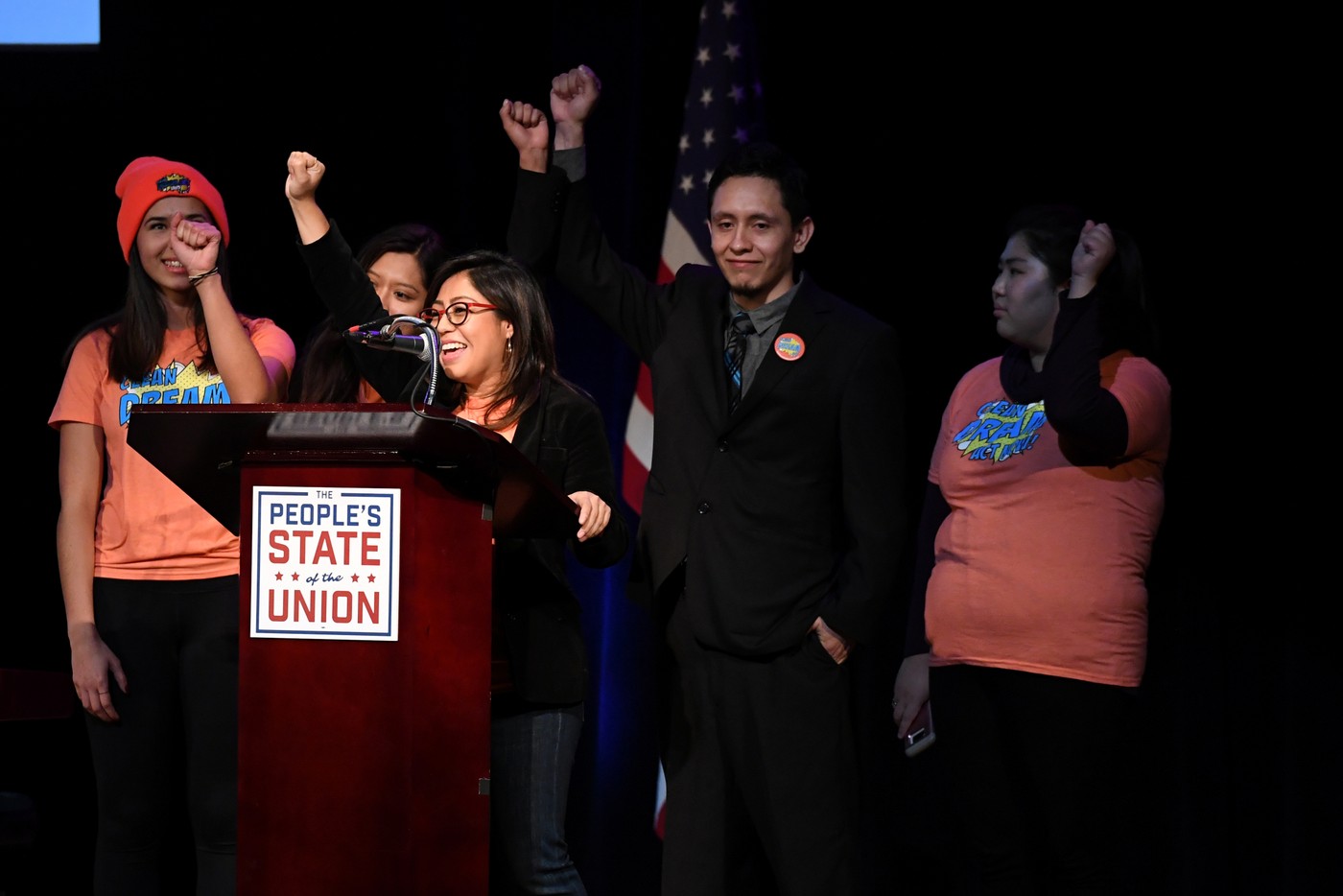
Dozens of Democrats are bringing young immigrants known as “Dreamers” as their guests to the State of the Union, hoping to highlight the urgency of extending special deportation protections under the Deferred Action for Childhood Arrivals program that President Trump plans to end in March.
That caught the attention of one of the House’s most conservative immigration hawks, Republican Representative Paul Gosar of Arizona, who suggested on Twitter that federal authorities should check the IDs of those entering the Capitol Tuesday night and arrest any who are in the country illegally.
Today, Congressman Paul Gosar contacted the U.S. Capitol Police, as well as Attorney General Jeff Sessions, asking they consider checking identification of all attending the State of the Union address and arresting any illegal aliens in attendance.
“Of all the places where the Rule of Law needs to be enforced, it should be in the hallowed halls of Congress. Any illegal aliens attempting to go through security, under any pretext of invitation or otherwise, should be arrested and deported," said Congressman Gosar.
Since Trump took office, agents with Immigration and Customs Enforcement have been aggressive about detaining undocumented immigrants, making arrests outside churches, schools, and inside courthouses where people have attended hearings unrelated to their immigration status. But the administration has said DACA recipients are not a priority for deportation as long as they don’t pose a criminal threat, and Republican leaders—including Trump—have voiced support for granting them permanent legal status and a path to citizenship.
A spokeswoman for House Speaker Paul Ryan quickly shot down the idea. “The speaker clearly does not agree,” spokeswoman AshLee Strong told CNN. Nonetheless, Gosar’s suggestion may have had one desired effect: The congressman was invited to appear on Fox News during its coverage of the lead-up to Trump’s speech.
Designated Survivor: It’s not just a Kiefer Sutherland vehicle. It’s also a real assignment for a Cabinet member, someone who skips attending the State of the Union. Sort of like the sergeant-at-arms’s introduction, it feels like a bit of a vestigial ceremony, but it comes from the sobering possibility that a disaster could wipe out the rest of the government, vaulting an often-obscure public official to the presidency. Tonight’s designated survivor is Sonny Perdue, the secretary of agriculture. (If the worst happened, he’d the first president from Georgia since Jimmy Carter.) NBC News talked to a few designated survivors from past years, who described an evening of high-quality steak in a mystery location, paired with watching the speech on TV. "You kind of drill it and role-play ahead of time," said Jim Nicholson, George W. Bush’s veterans-affairs secretary. "They call you ‘Mr. President.’" Perdue’s experience is likely to be similar, and highly controlled—there’s little to no chance that he can ask to hit the mall instead.
The president is on a losing streak, and even some of his aides are dismayed by his choices.
This article was featured in the One Story to Read Today newsletter. Sign up for it here.
You’ve heard the joke: The White House is going to start talking about the Epstein files to distract from how badly the Iran war is going.
Except that this reverse “Wag the dog” is based on bizarre truth: First Lady Melania Trump did bring the disgraced financier up, unprompted, late last week in an effort to distance herself from the scandal (in a move that, predictably, only shifted it back into the spotlight once again). Meanwhile, as negotiations with Iran stumble forward, the Strait of Hormuz is still in Tehran’s hands and now President Trump has authorized a risky naval blockade that will likely send prices soaring further. Moreover, Trump’s poll numbers have continued to fall, Republicans worry that both houses of Congress could be lost in November, and the president threw away a remarkable amount of geopolitical capital trying to support his now-defeated illiberal buddy Viktor Orbán of Hungary. Oh, and Trump deeply offended adherents of the world’s two largest religions in one week’s time.
The car industry says it has an answer for drivers wary of going electric.
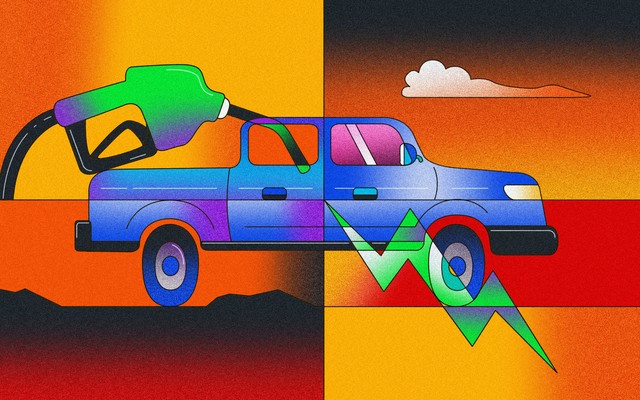
Two hours into a road trip in my Tesla, I start to get twitchy. By that point, the battery in my 2019 Model 3 has dipped to an uncomfortably low percentage. If I can’t reach the next plug, I’m in trouble. This is the kind of problem that Ram’s electric pickup truck—the first of a new breed of EV to arrive in the United States—is intended to solve. When the range starts to dwindle, the truck automatically fires up a hidden gas engine that refills the giant battery. The “electric” vehicle keeps on chugging down the highway, hour after hour; pit stops are once again decided by the need for bathroom breaks rather than battery range.
The Ram 1500 REV, set to debut later this year, is what’s called an “extended-range electric vehicle,” or EREV. In essence, it is an electric vehicle that burns gas. There’s nothing revolutionary about a half-gas, half-electric car, of course. Hybrids have been a mainstay in the United States since the Toyota Prius broke through two decades ago, and automakers have released more efficient plug-in hybrids—allowing drivers to charge up for about 30 miles of electric driving, just enough to accomplish daily errands without fossil fuels. An extended-range EV is a different kind of beast. The engine burns gasoline for the sole purpose of replenishing the battery—it never actually pushes the wheels. In the Ram, the battery can run for about 150 miles of electric driving, and the whole setup delivers enough range to travel nearly 700 miles between stops.
A minimally speaking autistic man just wrote a best-selling book. Or did he?
On a recent morning at Rockefeller Center, NBC employees strolled through the crowd with copies of Upward Bound, the latest book-club pick from the Today show co-host Jenna Bush Hager. “It’s deeply heartfelt and moving,” Hager said, after holding up the debut novel from the 28-year-old Woody Brown, “and the reason it’s so authentic is that the author understands autism firsthand.”
That understanding is indeed profound. Brown’s autism is such that he can barely speak, and he communicates mostly by pointing to letters, one by one, on a laminated board. This is also how his novel, which is already a New York Times best seller, came to be. In the recorded interview that followed Hager’s introduction, Brown’s mother, Mary, sat beside him, holding the letter board and reading his tapped-out messages.
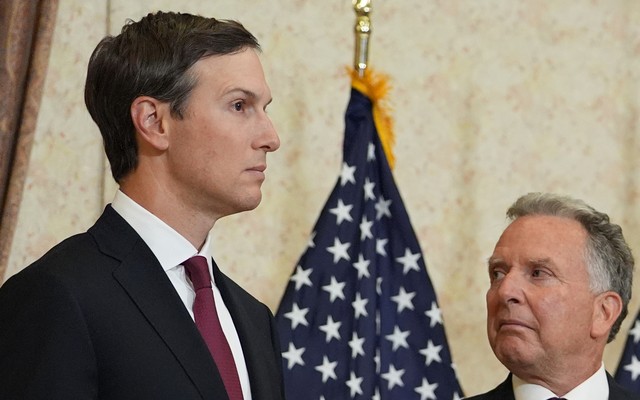
Is the president’s son-in-law carrying out the public’s business or pursuing his own private interests?
In 2021, shortly after he left his role as a senior White House adviser, Jared Kushner let it be known that he had loved his job but disliked the scrutiny and disclosure that came with being a top U.S. government official. He set up a private-equity firm and took a $2 billion investment from a Saudi fund led by Crown Prince Mohammed bin Salman. He proclaimed that he was embracing private life. “I’m an investor now,” Kushner said in a 2024 interview. If President Trump “calls you on November whatever and says, ‘I’d like you to come back to D.C.,’ you say, ‘Thanks, but I’m good’?” the interviewer, Dan Primack of Axios, pressed. “Yes,” Kushner responded.
But Kushner did come back. Two days before the United States and Israel attacked Iran this past February, he was in Geneva in a negotiation of the highest possible stakes. Over the weekend, he traveled with Vice President Vance to Islamabad to participate in failed peace talks with Iran. Without title or remit or any kind of official designation—only “presidential son-in-law”—Kushner has in the first 14 months of the second Trump administration sat down with world leaders including Vladimir Putin, Benjamin Netanyahu, and Volodymyr Zelensky, along with Saudis and multiple other actors from the Middle East.
Thirteen thousand miles. Infinite contenders. One beautiful loaf.
This article was featured in the One Story to Read Today newsletter. Sign up for it here.
Here is the promise you and I must cling to across the thousands of words that follow: At some point within this text, I will reveal to you what—after 555 responses, 13,000 miles of travel, and months of monomaniacal research—I have determined to be the best free restaurant bread in America. I will not attempt to slither to the moral high ground, arguing that best is a meaningless measure, or insisting that all bread is dear in its own way. Even if you attempt to betray me—for instance, by merely scanning the text that follows for the phrase Here it is: the best free restaurant bread in America—I will uphold my end of the bargain.
The president’s attempts to interfere with the midterms demand vigilance, but a recent flimsy gambit is an argument against despair.
This is an edition of The Atlantic Daily, a newsletter that guides you through the biggest stories of the day, helps you discover new ideas, and recommends the best in culture. Sign up for it here.
Anxiety among election officials and experts had been building for months before Donald Trump issued his latest executive order purporting to ensure election integrity late last month. When the actual text emerged, the reaction wasn’t relief exactly—but a definite sense that things could have been much worse.
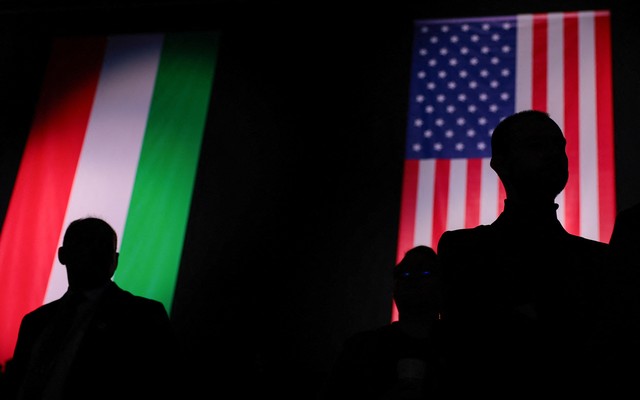
Americans have many reasons to be worried about whether the midterm elections will be free and fair. As I laid out in a cover story last fall, the president’s plan to subvert the 2026 election is multifaceted and already in swing. But last month’s order and the dismissive reaction it’s received from experts—along with this weekend’s decisive defeat of Hungarian Prime Minister Viktor Orbán, which shows how the competitive-authoritarian playbook that Trump has imitated can be beaten—also point to the reasons to resist doomerism.
Hungary offers lessons in defeating right-wing populists.
To the outside world, Hungarian Prime Minister Viktor Orbán began his rule as a pariah—an obstreperous, often lone dissenter from European Union policies, especially over migration. Then he became a prophet to new-style “national conservatives”—the anti-immigration, anti-elite right-wing movement that has reshaped the politics of the West. After resoundingly losing national elections held on April 12, Orbán has become a parable for how populism can be defeated.
His political demise was hardly inevitable. It had to be shrewdly engineered by politicians and voters who put aside their ideological differences to defeat him. In politics, there is no natural law of self-correction.
From 2010 until now, Orbán and his Fidesz party transformed Hungary into a new kind of state, which he proudly proclaimed as an “illiberal democracy.” He and his allies rewrote the constitution to entrench his power, centralizing control over civil society and countervailing institutions such as courts and universities. Péter Magyar, the presumptive next prime minister, triumphed against a tilted electoral system—gerrymandered districts, government influence over traditional media and even over the country’s billboards—designed to keep Fidesz in power. Magyar understood that such a regime does not simply collapse under the weight of its own contradictions and mismanagement.
Former U.S. Deputy National Security Adviser Matt Pottinger on the U.S.-Iran cease-fire, Trump’s Hormuz blockade, and China’s reaction to the Iran war. Plus: A seismic election in Hungary, and Labyrinths, by Jorge Luis Borges.
In this week’s episode of The David Frum Show, The Atlantic’s David Frum opens with his reaction to the recent election in Hungary and the defeat of Viktor Orbán. David counters Orbán defenders who claim that this loss proves Orbán was never a threat. Antidemocratic leaders often face institutional constraints, and it was those institutional constraints that compelled Orbán to accept a defeat after years of abuse of power.
Then, David is joined by former U.S. Deputy National Security Adviser Matt Pottinger to discuss the current state of President Trump’s war in Iran. David and Pottinger talk about the recent failed negotiations between the two sides in Pakistan, the blockade of the Strait of Hormuz, and what could happen next. They also discuss how the Iran war is viewed in China and how it has been a financial gain for Russia.
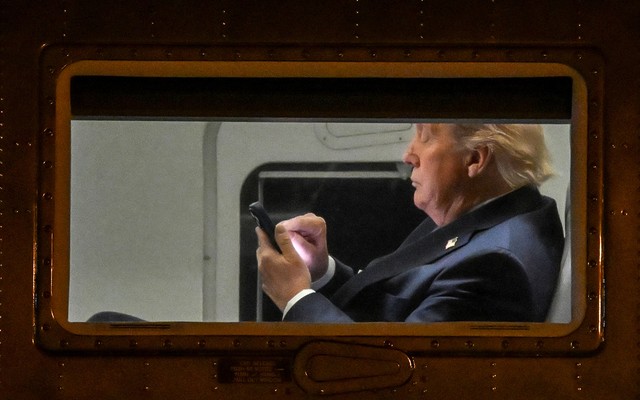
On many recent nights, Donald Trump has been posting obsessively on his Truth Social site into the wee hours. The president, of course, has never been one for a solid night’s sleep—or restrained and temperate commentary on social media—but his emotional state seems to be fraying: This weekend, he attacked Pope Leo XIV, presented himself as Jesus Christ, and then jabbed at his phone until dawn.
Judging from those posts, the commander in chief is in distress. No one can say for sure what is causing the president’s bizarre behavior. Perhaps Trump’s narcissistic insistence that he is always successful in everything he undertakes is feeling the sting and strain of multiple public failures, including the collapse of his campaign to dislodge the Iranian regime, plummeting approval ratings, the decline of the U.S. economy, and, on Sunday, the crushing defeat of one of his favorite fellow authoritarians, Hungary’s Viktor Orbán.
If you are anything like me, you have spent a lot of time over the past few weeks opening letters, finding receipts, requesting PDFs, scanning documents, and going through your credit-card statements line by line. It’s tax season. And in the United States, taxes are a DIY affair.
This is the case even though Washington could probably do your taxes for you. If you earn a salary or an hourly wage, the Internal Revenue Service already knows how much money you make. It likely knows how much you owe or how big your refund should be too. Nine in 10 households take the standard deduction, making their liability easy to glean from payroll and banking data.
Yet Uncle Sam demands that Americans fire up TurboTax, head to a storefront preparer, hire an accountant, or sit down with a sharp pencil and a strong cup of coffee to get their taxes done each spring. The average filer spends 13 hours on their 1040—a time tax that many of our wealthy peer countries have reduced to a couple of minutes, if that. Prepopulated documents and return-free systems are common everywhere but here. Sweden lets residents file by text. Canada prefills paperwork. Japan sends households a document summarizing their tax contributions. If everything looks copacetic, many workers get to do a blissful nothing. Denmark, Estonia, Spain, and Norway have similarly simple processes.