English Folk-Songs
IN a remarkable and famous passage in Religio Medici, Sir Thomas Browne says, “ There is a music wherever there is a harmony, order, or proportion ; and thus far we may maintain the ‘music of the spheres’ : for those well-ordered motions and regular paces, though they give no sound unto the ear, yet to the understanding they strike a note most full of harmony. Whatsoever is harmonically composed delights in harmony, which makes me much distrust tlie symmetry of those heads which disclaim against all church-music. For myself, not only from my obedience but from my particular genius, I do embrace it ; for even that vulgar and tavern - music, which makes one man merry, another mad, strikes in me a deep fit of devotion, and a profound contemplation of the first composer. There is something in it of Divinity more than the ear discovers : it is an hieroglyphical and shadowed lesson of the whole world, and creatures of God, — such a melody to the ear as the whole world, well understood, would afford the understanding.” (Sec. IX. Part II.)
Entered according to Act of Congress, in the year 1873, by JAMES R, OSGOOD & Co., in the Office of the Librarian of Congress, at Washington.
Through the cleft rock, and chiming as they fall
Upon loose pebbles, lose themselves at length
In matted grass, that with a livelier green
Betrays the secret of their silent course.”
The Saxons not only had different musical instruments, — among which they specially delighted in the harp, — and their “ gleemen,” or professed poets and musicians, venerated and courted by all ranks and conditions, but they enjoyed also some generally diffused musical culture, as we learn from the venerable Bede, to whom Strutt refers as stating “ that, as early as the seventh century, it was customary at convivial meetings to hand a harp from one person to another, and every one who partook of the festivity played upon it in his turn, singing a song to the music for merriment’s sake.” Bede relates that, on one occasion, the poet Cædmon, when he saw the harp passing round, arose and went home ; and King Alfred adds that the poet departed for shame that he was not able to sing and play with the others. The Saxons have left illustrations of their fondness for music in certain curious illuminations used as frontispieces to copies of the Psalms, in which David — his dignity intimated by a stature much larger than that of the other figures— is depicted seated upon his throne playing on a harp, and surrounded by indubitable Saxon “gleemen” performing on various instruments, and even dancing and executing feats of agility or magic. The honest illuminators were no more conscious of incongruity than the old preachers who delighted to riot in the parable of the Prodigal Son, and to depict the splendors that celebrated his return, when his father “ fitted him with boots or Venetian slippers and provided music of violins and English cornets.” Saxon England was by no means a stranger to minstrelsy and its wandering votaries. But after the Conquest, under the rule of the Normans, many minstrels came over from France, where especially they abounded ; their example and the favor extended to them probably excited the emulation of the English, and the kingdom swarmed with itinerant musicians and singers. They were favored with many immunities and privileges, were sacred in time of war, were welcomed in crowds at the houses of the great, and could enter even the royal presence without leave or introduction. Not only monarchs but the great barons and earls supported minstrels munificently, both as to numbers and as to pay and clothing, and took them in their train when they travelled. Minstrels were distinguished by a peculiar dress, and seem in some places to have been united into guilds or similar organizations. Their ample rewards made them prosperous, and some were even distinguished for their wealth. But as it is with nations, so with trades, professions, and individuals ; there is nothing so hard to turn to good account as prosperity, and it becomes shortly the most invincible of all ills. The minstrels became greedy, and ready with many tricks and cunning devices. They displayed their rich presents wherever they performed, so as to excite the generosity of others ; and they artfully celebrated in their songs the rewards given to minstrels, which they knew well how to invent munificently. Strutt quotes from the metrical romance of Ipomedon, where the poet speaks of the knight’s marriage,—
To minstrelles five hundred pound.”
Finally, they became so inflated and outrageous that, uninvited, they beset opulent houses in great numbers and claimed to fix for themselves the amount of their pay, which they did according to their notions of the wealth and goodnature of their patron. They became flatterers and parasites ; their success attracted large numbers to the profession, and among them many of the idle and dissolute ; the more as the minstrels unhappily had always united the offices of dancing-master, jester, mountebank, and sorcerer to their instrumental or vocal music, and these tricks could be assumed by pretenders and knaves.
This grievous abuse of minstrelsy at last attracted the attention of the law; in the reign of Edward II. a law was passed to restrain vagrants from intruding, under pretence of minstrelsy, into the houses of the wealthy and exacting, not only meat and drink, but clothes or other gifts ; and it was enacted that none but true professed minstrels should resort to the great houses, nor of these more than three or four in a day ; and that they should not go unasked to the dwelling of any person below the rank of a baron, nor, when invited, presume to ask for anything, but simply take what might be offered them. After another century, similar abuses again excited complaint, and from this time minstrelsy rapidly declined both in favor and character. The invention of printing hastened its downfall, not merely because of the greater diffusion of knowledge and the more scientific cultivation of music and poetry by the learned, but because of the competition of the ballad-singers, a new order of men, who sang their songs gratuitously and sold printed copies for a penny. The minstrels sank into utter contempt. By way of contrast to their former wealth and prosperity, Chappell mentions the case of Richard Sheale. This minstrel, to whom we owe the preservation of the heroic ballad of “ Chevy Chace,” — which Ben Jonson declared he would rather have written than all his works, and of which Sir Philip Sydney said that he never heard it without finding his “ heart moved more than with a trumpet,” — was robbed on Dunsmore Heath of sixty pounds ; but he could get no sympathy because he could not persuade the incredulous people that he had ever possessed sixty pounds. He thus bewails his calamity: —
For to lose about threescore pounds at a clap.
The loss of my money did not grieve me so sore.
But the talk of the people did grieve me much more.
Some said I was not robbed, I was but a lying knave,
It was not possible for a minstrel so much money to have.”
In the thirty-ninth year of Elizabeth an act was passed to restrain vagrants ; and among these, “ minstrels wandering abroad ” were enumerated, were held to be “ rogues, vagabonds, and sturdy beggars,” and were to be apprehended and punished as such. This decree seems to have given the final blow to minstrelsy. Puttenham, in his “Arte of English Poesie,” A. D. 1589, writes concerning both ballad-singers and minstrels contemptuously: “The over-busy and too speedy return of one manner of tune doth too much annoy and, as it were, glut the ear, unless it be in small and popular musicks sung by these cantabanqui upon benches and barrels’ heads, when they have none other audience than boys or country fellows that pass by them in the street ; or else by blind harpers or such like tavern minstrels, that give a fit of mirth for a groat ; and their matter being for the most part stories of old time, as the Tale of Sir Topas, Bevis of Southampton, Guy of Warwick, Adam Bell, and Clym of the Clough, and such other old romances or historical rhymes, made purposely for the recreation of the common people at Christmas dinners and brideales, and in taverns and alehouses, and such other places of base resort.” Ritson cites the following lines by one Dr. Bull, probably the same whose fame as a musician preceded him all over Europe : —
(Whose danghter was about to die,)
He turned the minstrels out of doors
Among the rascal company :
Beggars they are with one consent, —
And rogues by act of Parliament.”
The melancholy end of minstrelsy, however, does not count at all against the love of music and proficiency in the art, which, as I have said, distinguished England from the Saxon period until recent times. St. Aldhelm, who died in 709, gained the attention of his semibarbarous countrymen to his serious teachings by mingling these with minstrel ballads which he sung and recited on the bridges and highways ; and a harp, which was the common and favorite instrument with the Saxons and other Northern nations, was held in high esteem and was even a sign of rank. “ By the laws of Wales,” says Chappell, “ a harp was one of the three things that were necessary to constitute a gentleman or a freeman ; and none could pretend to that character who had not one of these favorite instruments or could not play upon it. To prevent slaves from pretending to be gentlemen, it was expressly forbidden to teach or to permit them to play upon the harp ; and none but the king, the king’s musicians, and gentlemen were allowed to have harps in their possession. A gentleman’s harp was not liable to be seized for debt; because the want of it would have reduced him from his rank to that of a slave.” In 1185 Giraldus Cambrensis writes of the part-singing among the Welsh and Northern Britons, as performed with much ease and grace, and practised even by the children. King Alfred, who, as writes Sir John Spelman (quoted by Chappell), “provided himself of musicians, not common, or such as knew but the practic part, but men skilful in the art itself,” according to many testimonies, established a school of music at Oxford. Down to a comparatively late period, music was the only science for the study of which degrees were conferred, and, till very lately, if not now, they were conferred in England alone. The old poets of the English tongue surpass all others in their constant and enthusiastic mention of music, and Chappell remarks that Chaucer’s poems form almost a complete treatise upon the English music of his day. His “ yonge squier,” who was “ A lover, and a lusty bacheler, .... Of twenty yere of age,.... And grete of strengthe, .... Singing he was or floyting (fluting) alle the day,” and “ He coude songes make and well indite.” His nun, “Ful wel she sange the service divine, Entuned in her nose ful swetely.” The Frere, who understood the virtue of wealthy acquaintance and was an “ esy man to give penance, .... Certainly he hadde a merry note, .... Well coude he singe and plaien on a rote ” ;
His eyen twinkeled in his hed aright,
As don the sterres in a frosty night.”
The five-times-married wife of Bath, who certainly may be supposed to know how, chiefly, a woman might be attractive, says that she is often valued, “ for she can other sing or dance,” and mentions, among her own charms, “ coude I dance to an harpe small, And sing yevis as any nightingale ” : and of the carpenter’s wife it is said, “hire song, it was as loud and yerne (fresh), As any Swalow sitting on a berne.” The “ gentil Pardonere,” —
The Sompnour bare to him a stiff burdoun
Was never trompe of half so great a soun ” :
which stentorian “ burdoun,” or dronebass, probably, after the manner of a bagpipe, calls to mind the testimony of Hentzner, writing near the end of the sixteenth century, that “ the English excell in dancing and music,” and “ are vastly fond of great noises that fill the ear, such as the firing of cannon, beating of drums, and the ringing of bells ” (Strutt),2 and reminds us of a certain hale, hearty, bluff character and strongly marked rhythm pervading the old English music. We learn from Chaucer, says Chappell, “ that country squires in the fourteenth century could pass the day in singing or playing the flute, and that some could ‘ songes well make and indite ’; that the most attractive accomplishment in a young lady was to be able to sing well, and that it afforded the best chance of her obtaining an eligible husband [perhaps a little too strongly stated for Chaucer’s language] ; also that the cultivation of music extended to every class.” According to Goodwin’s “Life of Chaucer,” “ Church music was one of the studies most assiduously pursued in the colleges of this period ;.... and no accomplishment led with greater certainty to the most eminent stations in the church. The Gospels, the Epistles, and almost every part of the service, were, in these times, set to music, and performed by rules of art. Dancing, as well as music, appears also to have constituted a part of the service of the church.” To this may be appended the close of Chaucer’s description of the before - mentioned seller of indulgences, the “gentil Pardonere,” who knew how to estimate his song from a business point of view, —
But alderbest he sang an offertorie :
For wel he wiste, whan that song was songe,
He muste preche, and wel afile his tonge,
To winne silver, as he right wel coude :
Therfore he sang the merier and loude.”
The following is a charming picture, from the “ Knight’s Tale,” of English life, as ruddy and buxom as the “ morwe ” when “ Arcite had romed all his fill, And songen all the roundel lustily,” with a dash of a hale love of nature in his lay ; for the delight in natural beauties of meadow, hill, and grove which warbles deliciously through German popular song is not altogether absent from English folk-lore : —
Saleweth in hire song the morwe gray ;
And firy Phebus riseth up so bright.
That all the orient laugheth of the sight,
And with his stremes drieth in the greves
And Arcite, that is in the court real
With Theseus the squier principal,
Is risen and looketh on the mery day.
And for to don his observance to May,
Remembring on the poiut of his desire,
He on his courser, sterling as the fire,
Is ridden to the feldes him to pley,
Out of the court, were it a mile or twey.
And to the grove of which that I you told,
By aventure his way he gan to hold,
To maken him a gerlond of the greves,
Were it of woodbine or of hawthorn leves,
And loud he song agen the sonne shene.
O Maye, with all thy floures and thy grene,
Right welcome be thou faire freshe May ;
I hope that I some grene here getten may.”
As it is my purpose to give specimens of the English folk-music, that their quality may speak to the reader for itself, it will be well from this point to take up in order the periods into which the history of English song naturally divides itself. For this arrangement, as well as for all the melodies presented, I am obliged to Chappell’s “ Music of the Olden Time.” These valuable and learned volumes constitute, so far as I am aware, the only ample work upon her folk-songs which England can boast ; unlike Germany, whose scholars have dwelt with most loving attention upon their rich store of beautiful melodies binding together for many generations the common sympathies of the people, and have celebrated them in countless collections and editions. The English music cannot, indeed, be compared for beauty with the German ; but it has a beauty and strength of its own, which we ought to love as the Germans do theirs ; and it would be well for us if England (and this country) rang now with a people’s music as good, and merry, and hale withal, and as well - beloved, as of yore.
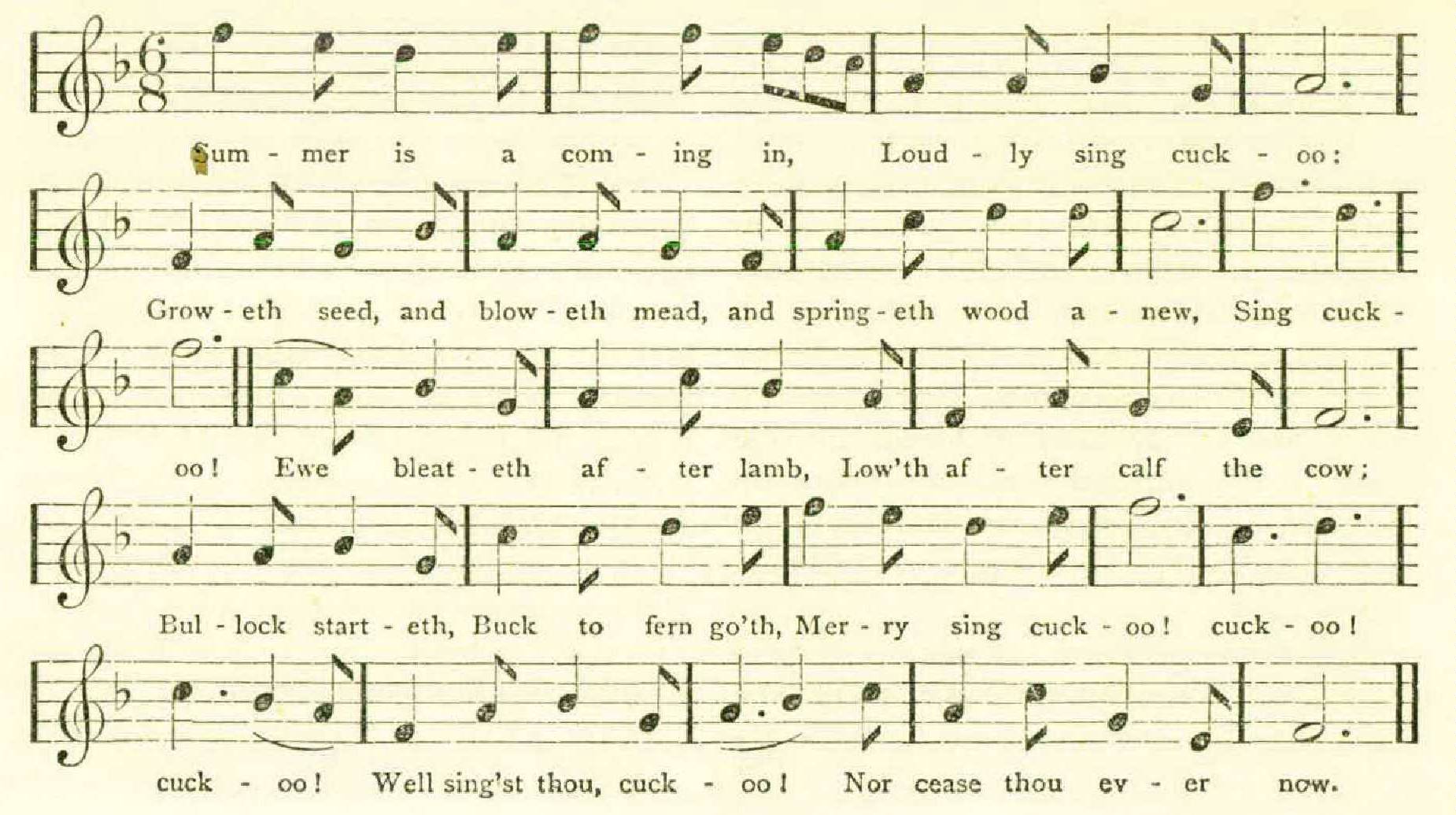
Before the time of Henry VIII., Chappell has found but four pieces of music preserved, three songs and a dance-tune, bridging over about two hundred years from the middle of the thirteenth century. The earliest of these, which here follows, I have previously referred to, as being the earliest example of secular music in parts which has been found in any country. The words form one of the most antique examples of English song to be met with ; and the music precedes by one century, if not two, any similar composition found elsewhere. Chappell is of opinion that there is a notable “ airy and pastoral correspondence between the words and music,” and believes this “superiority to be owing to its having been a national song and tune, according to the custom of the time, as a basis of harmony, and that it is not entirely a scholastic composition.” The most eminent authorities concur in referring this song, which I give in modern spelling and melody, to about 1250 : —
From Henry VII. to Elizabeth, between thirty and forty melodies have been preserved. This interval was very far from inactive in musical cultivation. Henry VIII. was himself no mean composer for the day, and, according to Hollinshed, “exercised himself daily in shooting, singing, dancing, wrestling, casting of the bar, playing at the recorders, flute, virginals, in setting of songs and making of ballads.” Erasmus writes of the English that they can claim, as their peculiar distinctions, beauty, music, and well-furnished tables: “ and it is certain,” says Chappell, “ that the beginning of the sixteenth century produced in England a race of musicians equal to the best in foreign countries, and in point of secular music decidedly in advance of them.” “To sing at sight was so usual an accomplishment of gentlemen in those days, that to be deficient in that respect was considered a serious drawback to success in life. Skelton, in his ‘ Bowge at Court,’ introduces Harvey Hafter as one who cannot sing ‘on the booke,’ but he thus expresses his desire to learn,—
A balade boke before me for to laye,
And lerne me for to synge re, mi, fa, sol,
And when I fayle, bobbe me on the noli.' “
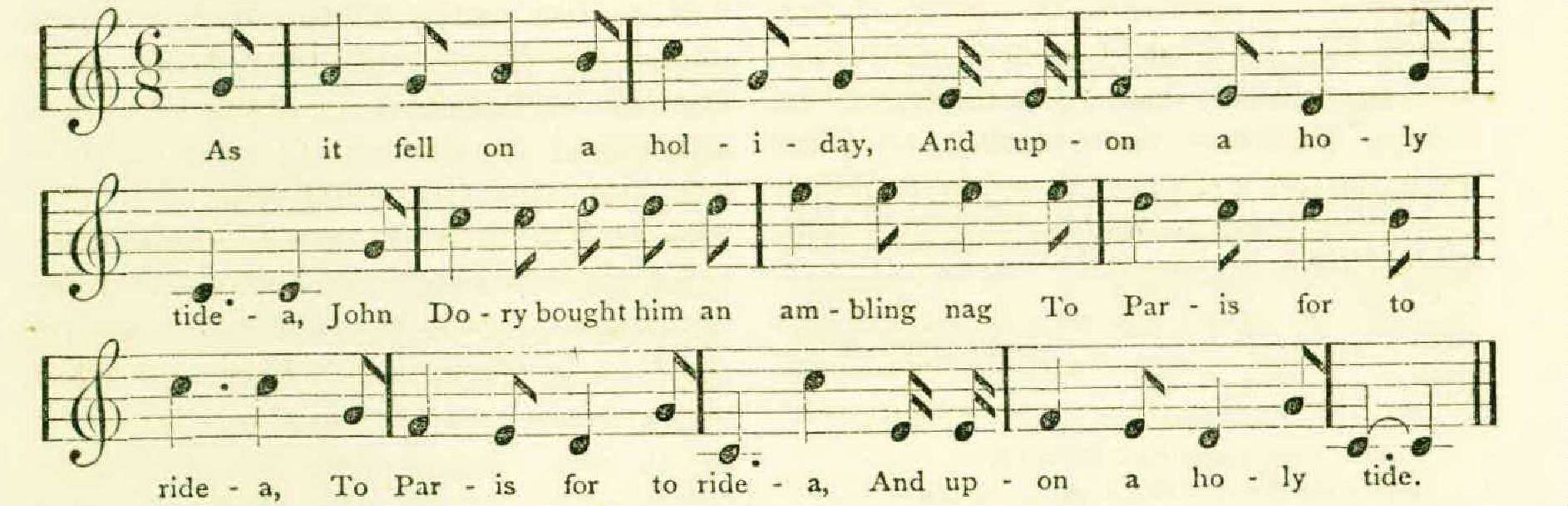
I subjoin two of the songs in favor at this period. The first is the famous “John Dory,” which, without any especial merit to recommend it, held its place in popular esteem for nearly or quite two centuries. It is mentioned in a play printed in 1575, and Dryden refers to it as hackneyed in his time : —
When fiddlers sing at feasts.”
Ritson says “‘John Dory’ was the constant companion of the minstrels ; he stuck to them to the last, and may be said indeed to have died in their service.” As the words have no particular interest, I give only one stanza : —
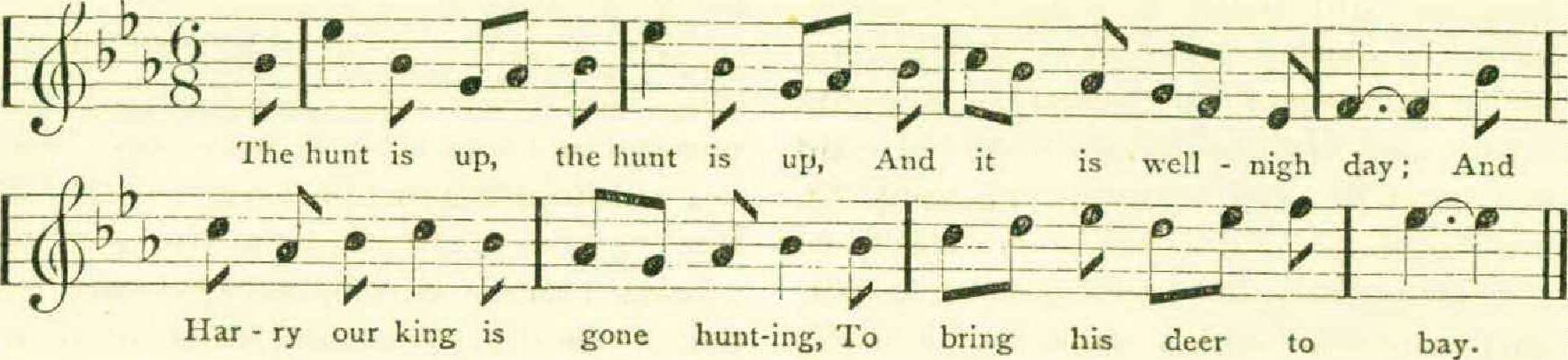
The other song referred to is the equally celebrated and much more beautiful “Hunt’s-up.”This is a matin song, intended to arouse and cheer in the morning. Any song with this purpose was formerly called a “ hunt’s-up.” In the exquisite parting between Romeo and Juliet (Act III. sc. 5), Juliet figures the lark as having changed voices with the toad, and “hunting” her love “ hence, with hunt’s-up to the day.” In old English weddings, which were much gayer than now, the rite was begun with a hunt’s-up in the morning to awake the bride ; and the same compliment was very commonly paid also to young girls on their birthdays. This was one of the many songs parodied by the Puritans for their own purposes. The following is the first of the seventeen stanzas of one of these parodies : —
Loe ! it is allmost daye;
For Christ our Kyng is cum a huntyng,
And browght his deare to stay.”
Ritson cites the first stanza of a similar Scotch parody, —
It is now perfite day ;
Jesus our king is gane ‘a’ hunting,
Quha likes to speed they may.”
The following is the melody with words which Chappell thinks may be those written by one Gray, — mentioned by Puttenham as growing into good estimation with “King Henry (VIII.) and afterwards with the Duke of Somerset, Protectour, for making certain merry ballades, whereof one chiefly was, ‘The hunte is up, the hunte is up’”: —
And darkness it is fled,
And the merie horne wakes up the morne
To leave his idle bed.
Are glowing all around,
The grasse is greene, and so are the treene,
All laughing at the sound.
The dogges are running free,
The woodes rejoyce at the mery noise
Of hey tantara tee ree !
All in our lustie greene,
And smiles in the skye as he riseth hye,
To see and to be seene.
Be mery as you maye,
For Harry our Kinge is gone hunting,
To bring his deere to baye.”
I subjoin, as being chaste and pretty, an example of the morning greeting of the hunt’s-up used as a love-song, taken from the same manuscript with the preceeding: —
Awake, my lady free,
The sun hath risen, from out his prison,
Beneath the glistering sea.
Awake, my lady bright,
The morning lark is high, to mark
The coming of daylight.
Awake, my lady fair,
The kine and sheep, but now asleep,
Browse in the morning air.
Awake, my lady gay.
The stars are fled to the ocean bed,
And it is now broad day.
Awake, my lady sheen.
The hills look out, and the woods about
Are drest in lovely green.
Awake, my lady dear, A morn in spring is the sweetest thing,
Cometh in all the year.
Awake, my lady sweet,
I come to thy bower, at this loved hour,
My own true love to greet.”
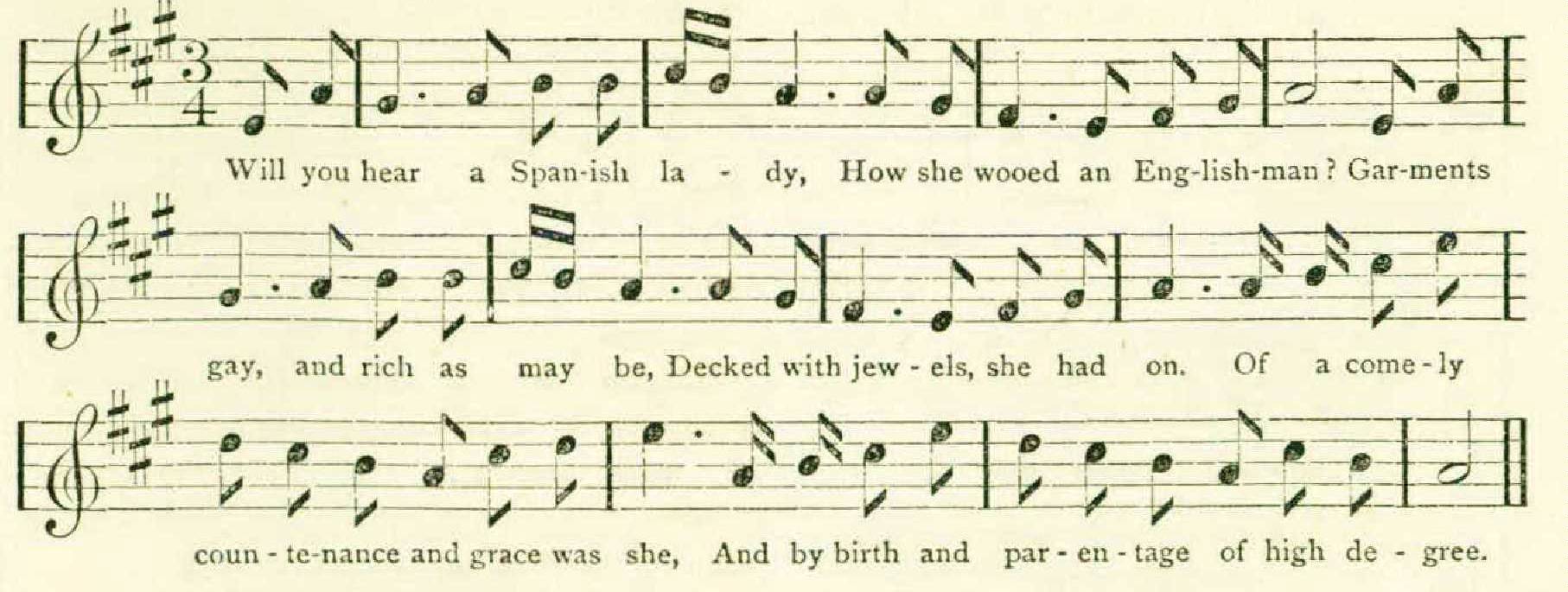
I pass to the reign of Elizabeth, which, though exhibiting no marked division or break in the stream of song flowing from the preceding reigns, deserves to be counted a special era, as it were, because of the universal esteem in which music was held and the cultivation of it by all classes. “ Not only,” says Chappell, “ was it a necessary qualification for ladies and gentlemen, but even the city of London advertised the musical abilities of boys educated in Bridewell and Christ’s Hospital, as a mode of recommending them as servants, apprentices, or husbandmen. In Deloney’s ‘ History of the Gentle Craft,’ 1598, one who tried to pass for a shoemaker was detected as an imposter, because he could neither ‘ sing, sound the trumpet, play upon the flute, nor reckon up his tools in rhyme.’ Tinkers sang catches ; milkmaids sang ballads ; carters whistled ; each trade and even the beggars had their special songs ; the bass-viol hung in the drawing-room for the amusement of waiting visitors [and it was not an uncommon instrument for women to play upon during or near this period]: and the lute, cittern, and virginals for the amusement of waiting customers were the necessary furniture of the barber’s shop. [“Now,” remarks Strutt, and it is emblematic of the change which has come over society, “ the newspaper is substituted for the instrument of music.”] They had music at dinner, music at supper, music at weddings, music at funerals, music at night, music at dawn, music at work, and music at play.” Morley, in his dialogue entitled “ Introduction to Practical Musick,” 1597, makes the pupil say, “ Supper being ended, and music-books, according to custom, being brought to the table, the mistress of the house presented me with a part, earnestly requesting me to sing ; but when, after many excuses, I protested unfeignedly that I could not., every one began to wonder ; yea, some whispered to others, demanding how I was brought up, so that upon shame of mine ignorance, I go now to seek out mine old friend, Master Gnorinus, to make myself his scholar.” Peacham requires his “ Compleat Gentleman ” (1622) to be able “to sing his part sure and at first sight, and withal to play the same on a viol or lute ” ; and declares, “ I am verily persuaded that they [who love not music] are by nature very ill-disposed, and of such a brutish stupidity that scarce anything else that is good and savoureth of virtue is to be found in them.” It was essential to a gentlewoman’s education that she should play and read music at sight ; and lute-strings were very commonly offered as gifts to ladies at the New-Year’s season. England not only overflowed with musicians, but supplied other countries and foreign courts with many of their best, in high repute and demand. “ We are indebted,” says Chappell, “ to foreign countries for the preservation of many of the works of our best musicians of this age. Dr. Bull’s music is chiefly to be found in foreign manuscripts.” Concerning this Dr. Bull, the same probably who wrote the lampoon on the vagrant minstrels before quoted, the story is told that while travelling incognito, a continental musician showed him a vocal work in forty parts, and boasted that it would be found impossible to add so much as one more part; whereupon the English composer, taking the score, speedily added forty more parts, eliciting from the astonished musician the opinion that “he that added those forty parts must either be the Devil or Dr. John Bull.” In the reign of Elizabeth, indeed, scholastic vocal compositions, madrigals, motets, etc., reached their height in England, and thereafter began their decline, while instrumental music took their place. Of the popular or folk songs of the day, I will give two specimens, omitting the melodies which specially illustrate Shakespeare as not being, on the whole, so attractive, although there are some beautiful and plaintive minor melodies among them. Minor keys are very common throughout English folk-music, and there is much of it that is exceedingly tender and plaintive, although the bold, courageous, and hearty predominates. The following delicate little melody is set to the ballad of the “ Spanish Lady.” I give but one stanza, the beautiful and well-known poem being easily accessible in Percy’s “ Reliques ” : —
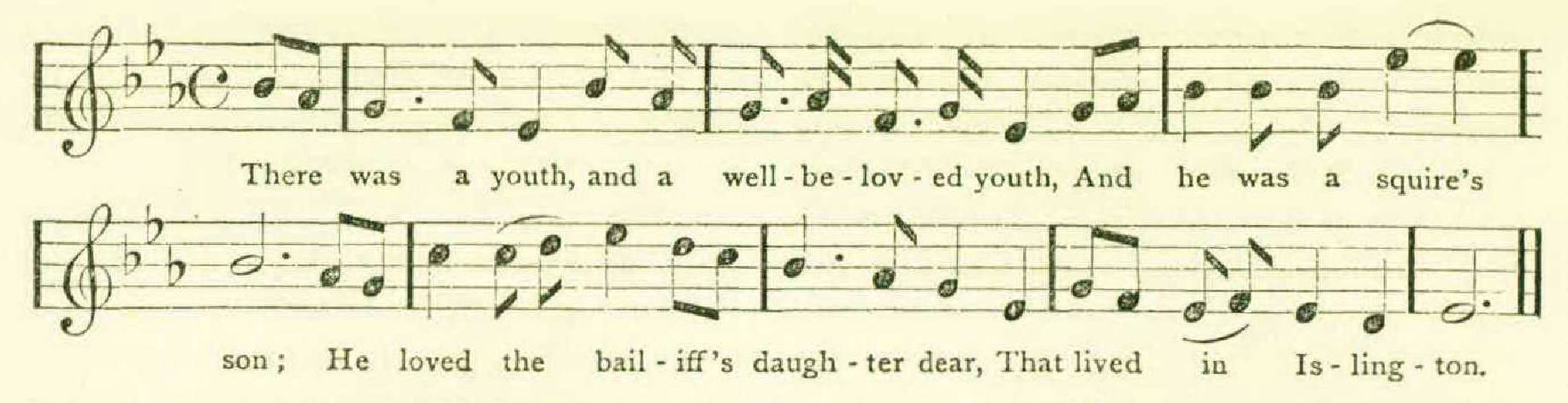
The “ Bailiff’s Daughter of Islington,” a simple and pretty ballad also to be found in Percy, is set to the following pleasing melody : —
From Elizabeth to the Commonwealth, instrumental music, as I have said, obtained the ascendency ; but music in general was still in very high esteem and cultivation. Early in this period “ ballads were first collected into little miscellanies, called Garlands, whose names, e. g., ‘ Garland of Good-Will,’ ‘Crown Garland of Golden Roses,’ etc., remind us of the painful ingenuity in the matter of titles displayed by the makers of our Sundayschool music-books ; and it may be said in passing that the excellent reform which we are now witnessing in the style of pictures made for children, should be forthwith extended to the music they are made to sing, which is at present, for the most part, the laborious patch-work of ‘lack-lustre’ composers, and vapid beyond what, otherwise, it had entered into the mind of man to conceive. I might safely engage to compile the best two or three books of music for children that ever were made ; because the fruitful sources of English and German folk-songs, and those of other countries, replete with the warmth and color of the fresh national genius, and simple as they are beautiful through absence of all scholastic interference, have been neglected to make room for spiritless and dilute effusions with little inspiration save the need of making a living,
“ Musicians in the service of noblemen and gentlemen seem to have held a prescriptive right to go and perform to the friends and acquaintances of their masters, whenever they wanted money: such visits were received as compliments, and the musicians were rewarded in proportion to the rank of their masters. Innumerable instances of this will be found in early books of household expenses.” But in course of time, this privilege was abused, like the corresponding concessions to the old minstrels, and in the reign of King James I. the unwarrantable intrusion of musicians into all companies became a constant subject of rebuke.
I give three examples of the popular songs of this period. The following melody was very popular in its early days, and is “still current,” says Chappell ; “for in the summer of 1855, Mr. Jennings, organist of All Saints’ Church, Maidstone, noted it down from the wandering hop-pickers singing a song to it, on their entrance into that town ” : —
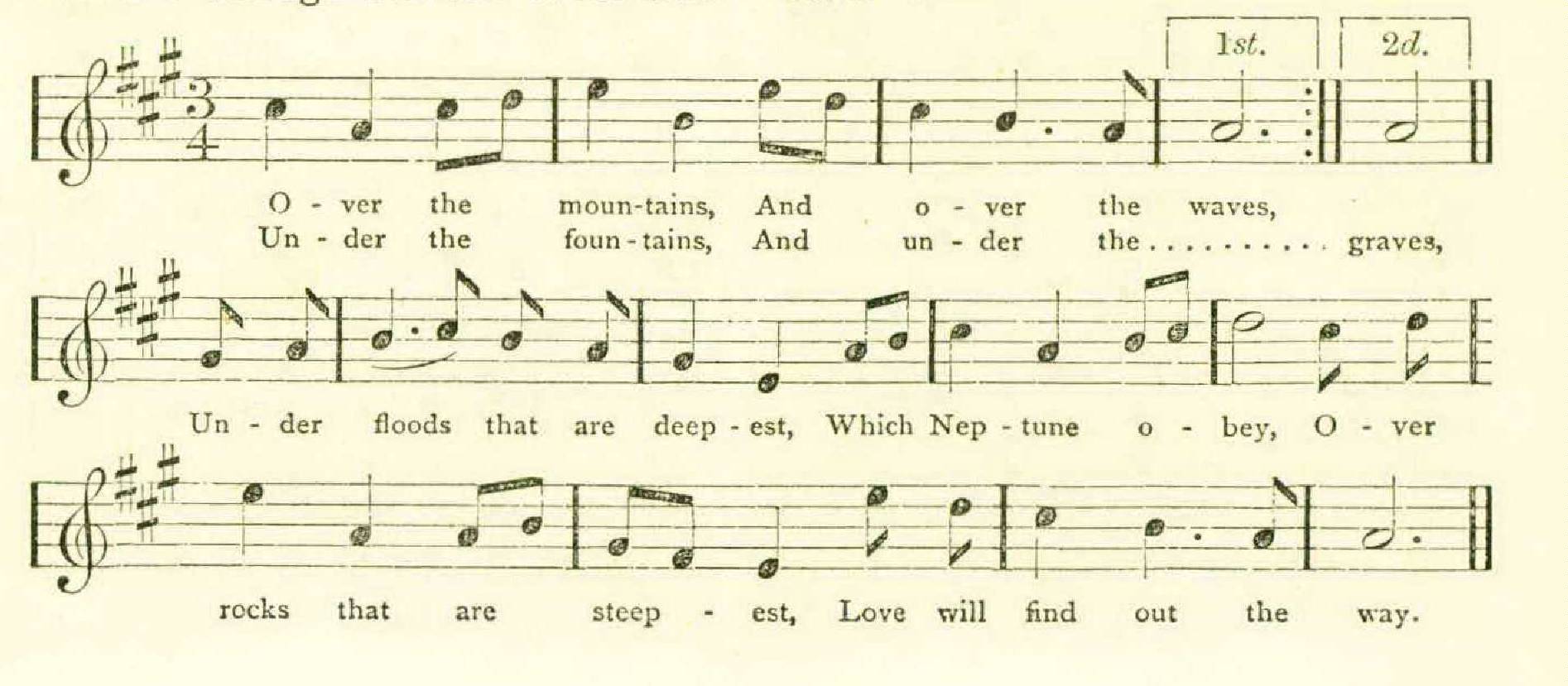
For the glow-worm to lie ;
Where there is no space
For the receipt of a fly;
Where the midge dares not venture
Lest herself fast she lay;
If Love come, he will enter,
And soon find out his way,
A child for his might;
Or you may deem him
A coward from his flight :
But if she, whom Love doth honor,
Be concealed from the day,
Set a thousand guards upon her,
Love will find out the way.
By having him confined ;
And some do suppose him.
Poor thing, to be blind :
But if ne'er so close ye wall him,
Do the best that you may,
Blind Love, if so ye call him,
Soon will find out his way,
To stoop to your fist;
Or you may inveigle
The phœnix of the East;
The lioness, ye may move her
To give o’er her prey :
But you ’ll ne’er stop a lover;
He will find out his way.”
The following is a lively and graceful melody which was sung to many different ballads : —

Pan, leave pip-ing. The gods have done feast-ing, There’s nev-er a god-dess a hunt-ing to-day ; The Mor-tals marvel at Cor - idon’s jest-ing, That gives them assistance to en - ter-tain May.

lads and the lasses, With scarves on their faces, So live - ly time pass-es, Trip over the downs; Much mirth and sport they make, Running at Barley-break, Good lack, what pains they take For a green gown.
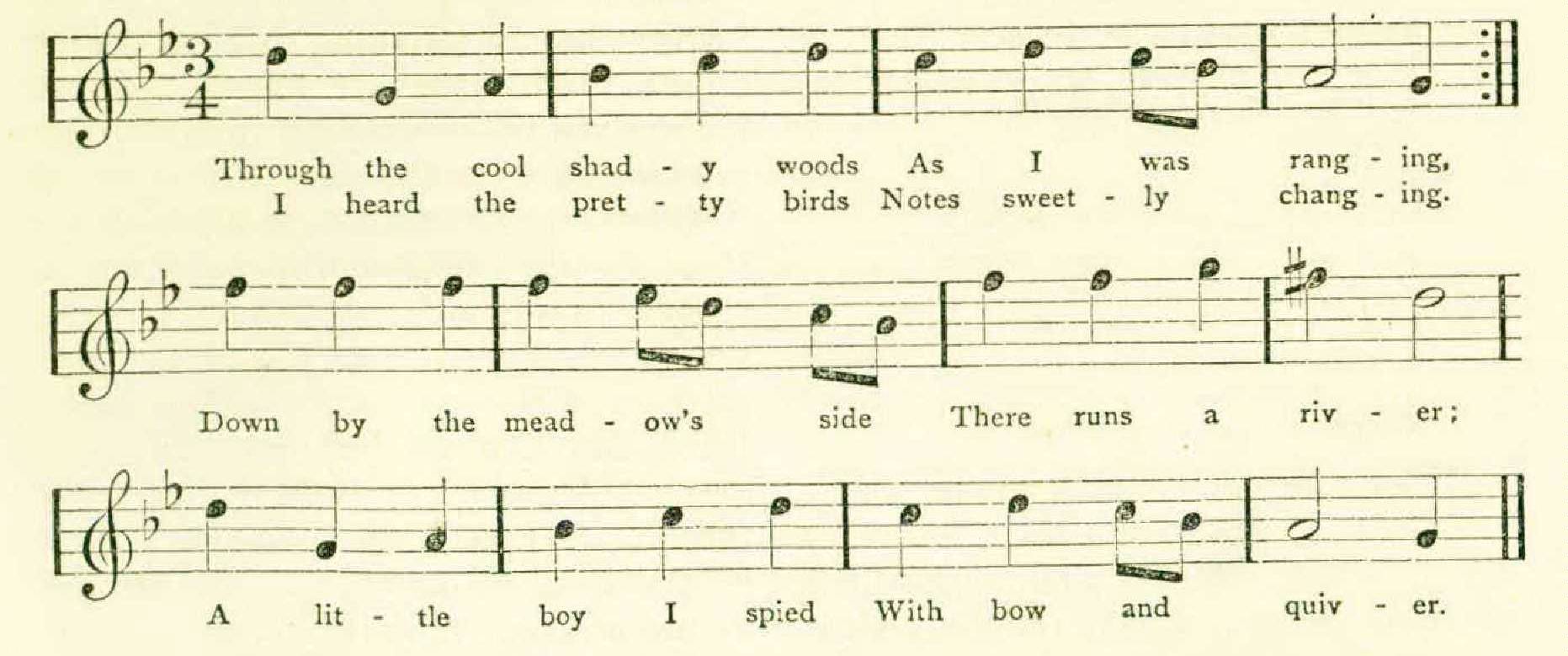
One of the most delightful melodies I have ever met in any folk-music, and indeed worthy of any country or any composer, is the following minor piece, entitled “ Cupid’s Courtesie ; or, The young Gallant foiled at his own Weapon. To a most pleasant Northern Tune.” The words, save the first stanza, have not much claim to merit; they are in Collier’s “ Roxburghe Ballads ” : —
The following, called “ The Country Lass,” is comely and vigorous, both in words and melody. It is the melody to which “ Sally in our Alley ” is now sung with slight variation, the old ballad-tune having entirely superseded the melody which the author of the latter song composed for it and which was used in the balladoperas. The burden, “ derry, derry down,” is very common in old English song.
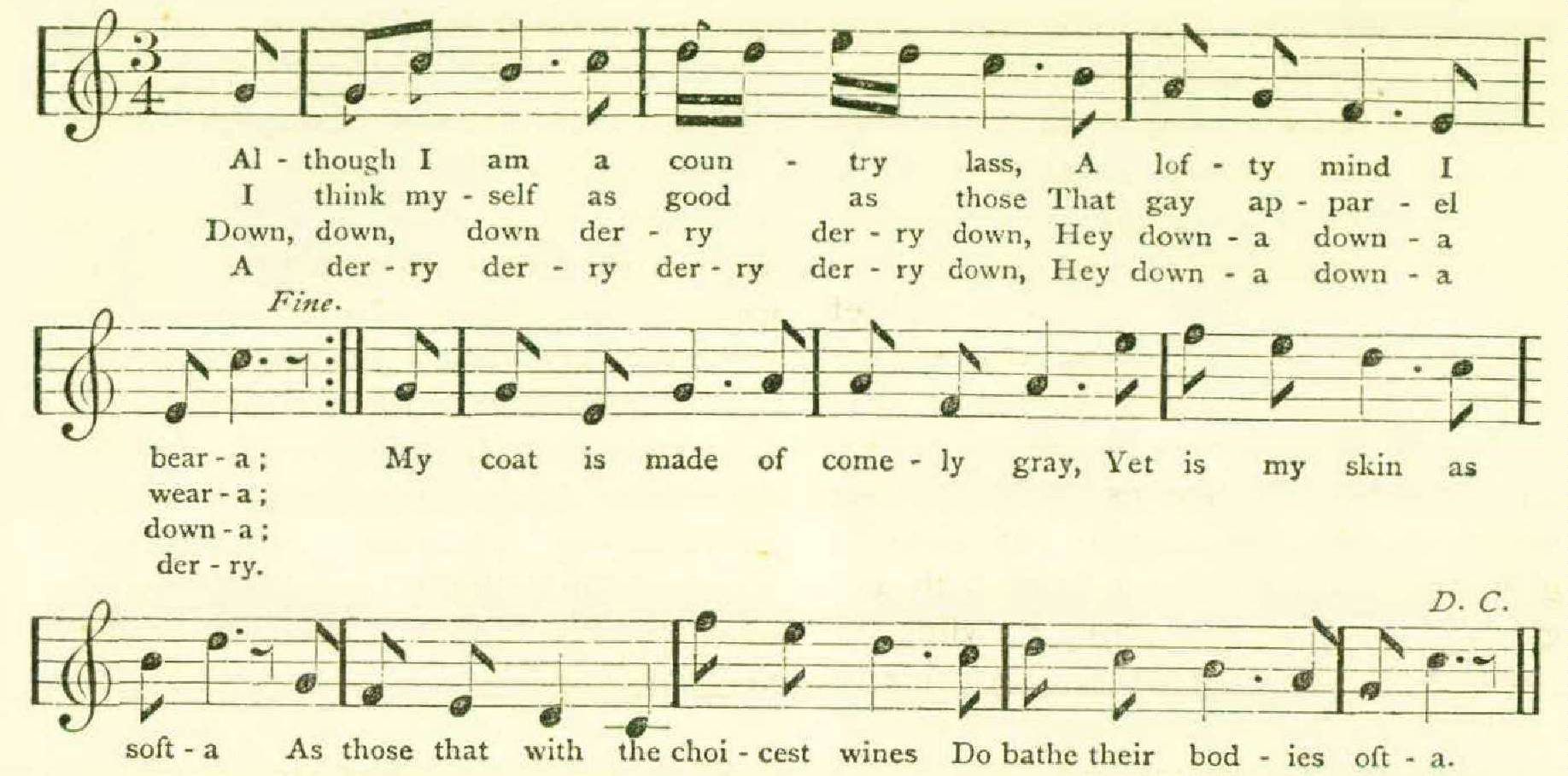
A thing that must be done-a,
A garland of the fairest flowers
Shall shroud me from the sun-a ;
And when I see them feeding by.
Where grass and flowers spring-a,
Close by a crystal fountain side
I sit me down and sing-a.
Surpassing court or city,
We pleasures take from morn to night,
In sports and pastimes pretty:
Your city dames in coaches ride
Abroad for recreation,
We country lasses hate their pride,
And keep the country fashion.
When Titan’s heat reflecteth ;
A homely hat is all I ask
Which well my face protecteth ;
Yet am I, in my country guise,
Esteemed a lass as pretty,
As those that every day devise
New shapes in court or city.
Though she go plain and meanly ;
Who takes a country wench to wife
(That goeth neat and cleanly)
Is better sped than if he wed
A fine one from the city,
For there they are so nicely bred,
They must not work for pity.”
The history of English music under the Commonwealth, and as affected by the influence which culminated in the Puritan uprising, would require almost an ample monograph for its adequate treatment. It is most certain that for a long time the Puritan element exercised a most pernicious and depressing effect upon music; and the hostility of the zealots finally concentrated itself in a virulent fanaticism, which treated music, and especially churchmusic, as an invention of the Devil. In a “Declaration and Petition to the House of Commons,” 1644, Sir Edward Dering averred that “ one single groan in the spirit is worth the diapason of all the church-music in the world.” In 1648, an officer was appointed “with power to seize upon all ballad-singers,” from which Chappell thinks “ we may safely assume that no more ballads were written in their (the Puritans’) favor, and that the majority, at least, had long been against them.” But the honest zealots in general detested music for its own sake, as by its very nature savoring of popery and all other uncleanness. They exercised themselves in destroying the churchorgans in many towns, which they “brake down,” and “taking two or three hundred pipes with them, in a most scornful and contemptuous manner went up and down the street piping with them.” Chappell quotes from Philip Stubbes, who printed an “ Anatomy of Abuses” in 1583, which went through four editions in twelve years ; in the chapter devoted to music, the author says that by reason of “ a certain kind of smooth sweetness in it, it is like unto honey, alluring the auditory to effeminacy, pusillanimity, and loathsomeness of life..... And right as good edges are not sharpened, but obtused, by being whetted upon soft stones, so good wits, by hearing of soft music, are rather dulled than sharpened, and made apt to all wantonness and sin ” ; and “ through the sweet harmony and smooth melody thereof, it estrangeth the mind, stirreth up lust, womanisheth the mind, and ravisheth the heart.” In a pamphlet entitled “ A Request of all true Christians to the Honorable House of Parliament,” 1586, it is requested “that all cathedral churches may be put down, where the service of God is grievously abused by piping with organs, singing, ringing, and trowling of Psalms, from one side of the choir to another, with the squeaking of chanting choristers, disguised (as are all the rest) in white surplices ; some in corner caps and filthy copes, imitating the fashion and manner of Antechrist the Pope, that Man of Sin and Child of Perdition, with his other Rabble of Miscreants and Shavelings.” This choice and handsome language was so effective, that in 1644 were published two ordinances of Parliament “ for the speedy demolishing of all organs, etc.” But alas ! there were no organs to demolish ; they were already destroyed ; and “as said by a writer of the time, —
Nor anthems, — why ? nay, ask of them, not me ;
There’s new church-music found instead of those.
The women’s sighs tuned to the preacher’s nose.’ ”
But, on the other hand, there must have been often a savor, not merely of fanaticism, but of rudeness and vulgarity in all this tirade ; for Cromwell himself was exceedingly fond of music, attracted musicians about him, and had his daughters instructed in the art. Oxford “seems to have been a place of almost peaceable retirement for musicians during the Protectorate,” rejoicing even in weekly music parties. Though churchmusic seemed to bereave a Puritan of his senses, yet Shakespeare speaks of them as singing Psalms to hornpipes ; and “in 1642, ballads respecting ‘the great deeds of Oliver Cromwell at Worcester and Edgehill' were gravely proposed to Parliament to be sung at Christmas in place of Christmas-carols.” I append two specimens of the popular songs of this period. All the pieces recorded by Chappell are either of a general character or are cavalier ballads. If the Puritans had any music besides their Psalms sung to hornpipes, it has not survived. The following, says the historian, “may be termed the ‘ God save the King ‘ " of the period : —
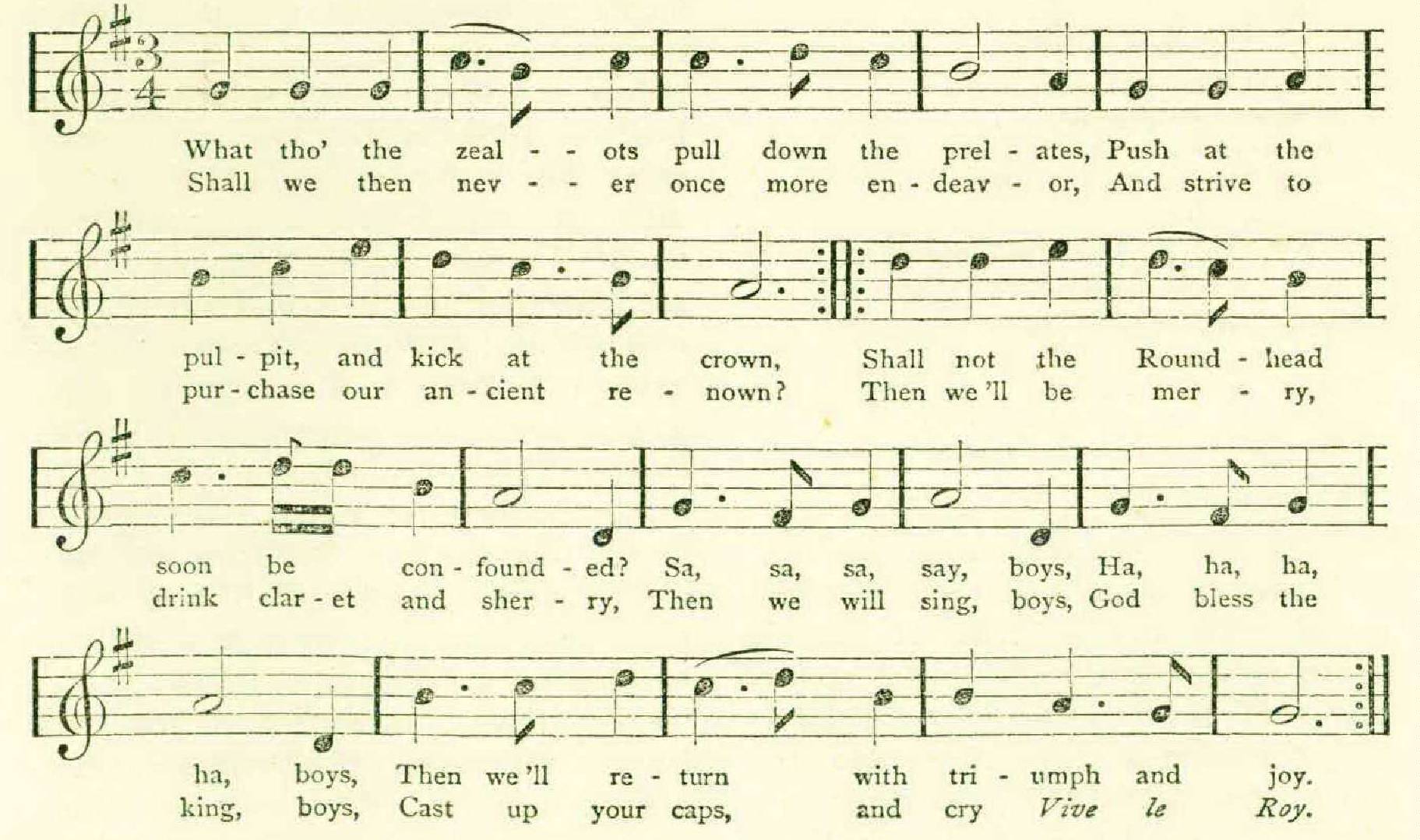
The “ Devil’s Progress " is the name of the following. “It was no doubt this ballad which suggested to Southey his ‘ Devil’s Walk ‘ " : —
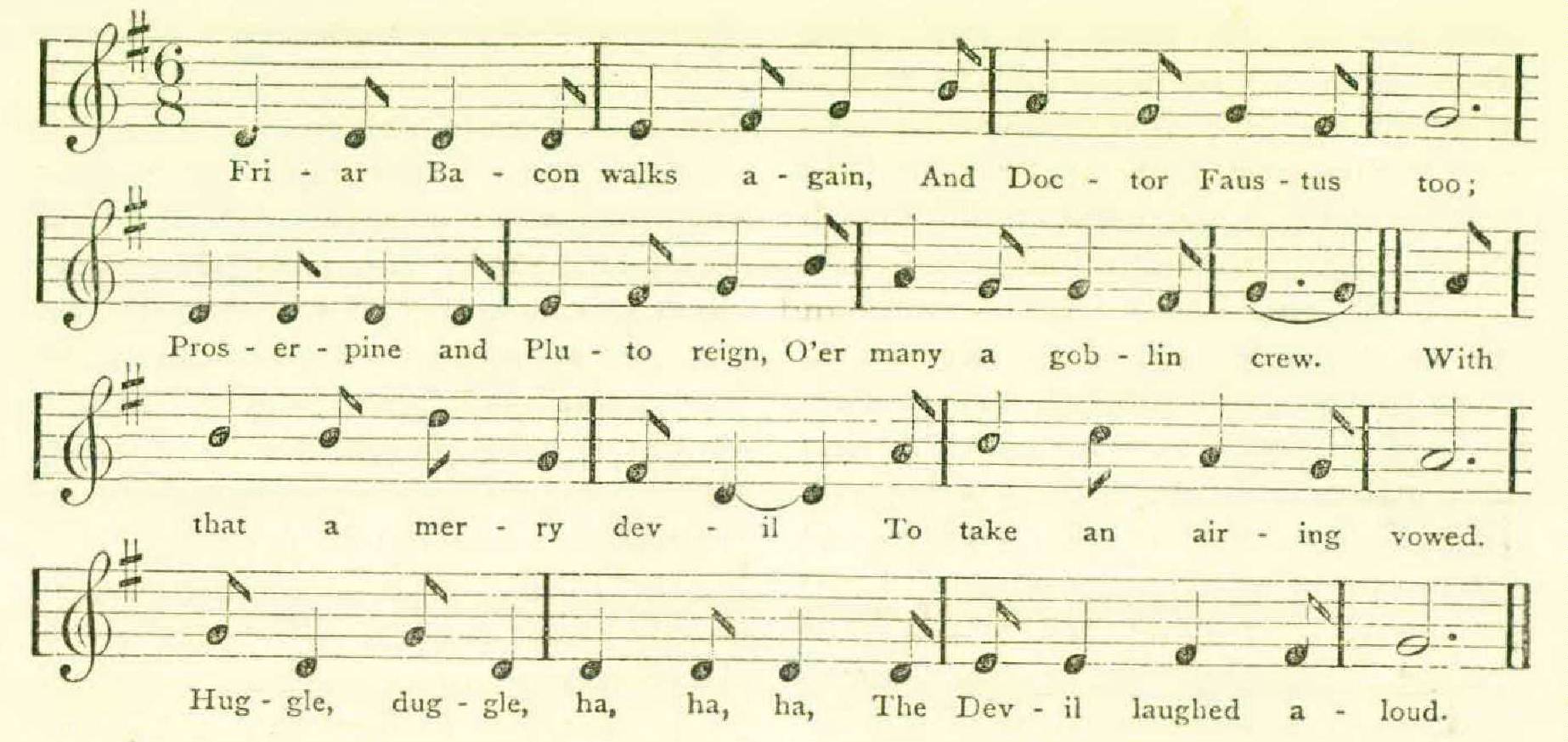
Forsooth he came from court ;
And there, amongst the gallants.
Had spied such pretty sport ;
There was such cunning juggling.
And ladies grown so proud, —
Huggle, duggle, etc.
Away the Devil went,
To view the merchants’ dealings
It was his full intent ;
And there, along the brave Exchange,
He crept into the crowd, —
Huggle, duggle, etc.
To see all there was well ;
Their scales were false, their weights were light,
Their conscience fit for hell ;
And ‘ bad men ’ chosen Magistrates,
And Puritans allowed, —
Huggle, duggle, etc.
Away the Devil goeth,
For there is all plain-dealing,
And that the Devil knoweth :
But the rich man reaps the gains,
For which the poor man ploughed, —
Huggle, duggle, etc.
Took post away to hell,
And told his fellow-furies
That all on earth was well :
That falsehood there did flourish,
Plain-dealing was in a cloud, —
Huggle, duggle, ha, ha, ha,
The devils laughed aloud.”
According to one authority, “ from the restoration of Charles II. may be dated an entire change in the style of music till then cultivated in England.” The “learned counterpoint” and elaborate working-up which distinguished English composition, both vocal and instrumental, gave way to a more flowing and melodious style, and to a concurrent taste for foreign songs, which had become fashionable even in the reign of Charles I. After the invention of recitative, English musicians were willing to concede the superiority of the Italians in vocal music ; but it seems to have been as generally conceded that the English bore the palm in instrumental composition. There were not wanting some protests against the prevailing taste for Italian songs among cultivated people. “This present generation is so sated with what ’s native.” wrote Henry Lawes, in 1633 (the friend of Milton and composer of the music to Comus), “that nothing takes the ear but what’s sung in a language which, commonly, they understand as little as they do the music. And to make them a little sensible of this ridiculous humor, I took a table or index of old Italian songs, and this index, which read together made a strange medley of nonsense, I set to a varied air, and gave out that it came from Italy, whereby it passed for a rare Italian song. This very song have I here printed.” Pepys, who could sing at sight, play on the lute, the viol, the violin, and the flageolet, and compose music, wrote in his diary, on hearing a celebrated Italian piece, “ Fine it was indeed, and too fine for me to judge of”; and again, of a lady’s singing, “ Indeed, she sings mightily well and just after the Italian manner, but yet do not please me like one of Mrs. Knipp’s songs, to a good English tune, the manner of their ayre not pleasing me so well as the fashion of our own, nor so natural.” The dramatists of the day “ commonly attribute to the servants in their plays the ability to sing at ‘ first sight ’ ” ; and Pepys with his wife and her maid and his own waiting-boy used to sit in his garden “singing and fiddling” till midnight, “with mighty pleasure to ourselves and neighbors by their casements opening,” and a great joy it is to see me master of so much pleasure in my house.” Of the many popular songs of this period, the following is a sprightly and original melody ; the words are from a balladopera called “ The Jovial Crew ” : —

There was a maid went to the mill, Sing trol-ly, lol - ly, lol - ly, lol - ly lo, The

mill turned round, but the maid stood still, Oh, oh, ho ! Oh, oh, ho! Oh, oh, ho ! did she so?
Sing trolly, lolly, lolly lo ;
The maid was well pleased, and the miller content,
Oh, ho ! Oh, ho ! Oh, ho ! was it so ?
“ He danced and he sung, while the mill went clack,
Sing trolly, lolly, lolly lo ;
And he cherished his heart with a cup of old sack.
Oh, ho ! Oh, ho ! Oh, ho ! did he so?”
The following beautiful melody was a favorite with the makers of the balladoperas ; but as the songs in these productions have little interest apart from the dramas, Chappell has “ adapted an old lullaby ” to the music : —
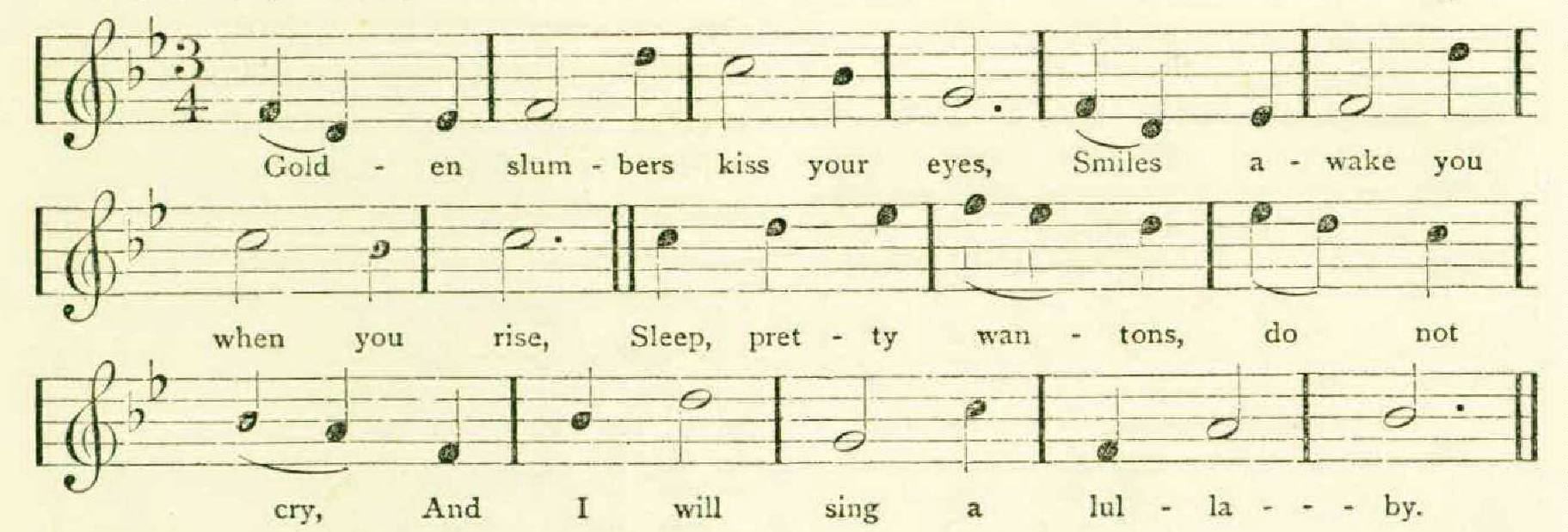
While I o’er you watch do keep ;
Sleep, pretty darlings, do not cry. And I will sing a lullaby.”
From the time of Charles II., music has steadily declined in cultivation. The decline began in Charles’s reign, among gentlemen ; among ladies it declined more slowly, and they still frequently performed upon the bassviol. But the old melodies enjoyed a revival after 1727, through the success of the ballad-operas, incorporating the folk-music of “the olden time.” “The Beggars’ Opera” was the first, produced at the Theatre Royal in January, 1728. It was received with great applause two successive seasons in London, and spread into all the great towns of England, and into Ireland, Scotland, and Wales ; it banished for the time the Italian opera, which had been the height of fashion for ten years ; and it was followed by a host of similar works, ballad-operas being written even for “ booths in Bartholomew Fair.” Chappell records a story of Rich, the manager, “ who, when the customary music [before the play] was called for by the audience at the first performance of ‘ The Beggars’ Opera,’ came forward and said, ‘ Ladies and gentlemen, there is no music to an opera,’ (setting the house in a roar of laughter), ‘ I mean, ladies and gentlemen, an opera is all music.’ ” I will end this article with two selections from popular songs since A. D. 1700. The following excellent minor melody, of the beginning of the last century, celebrates an article of dress then as now apparently much in esteem : —
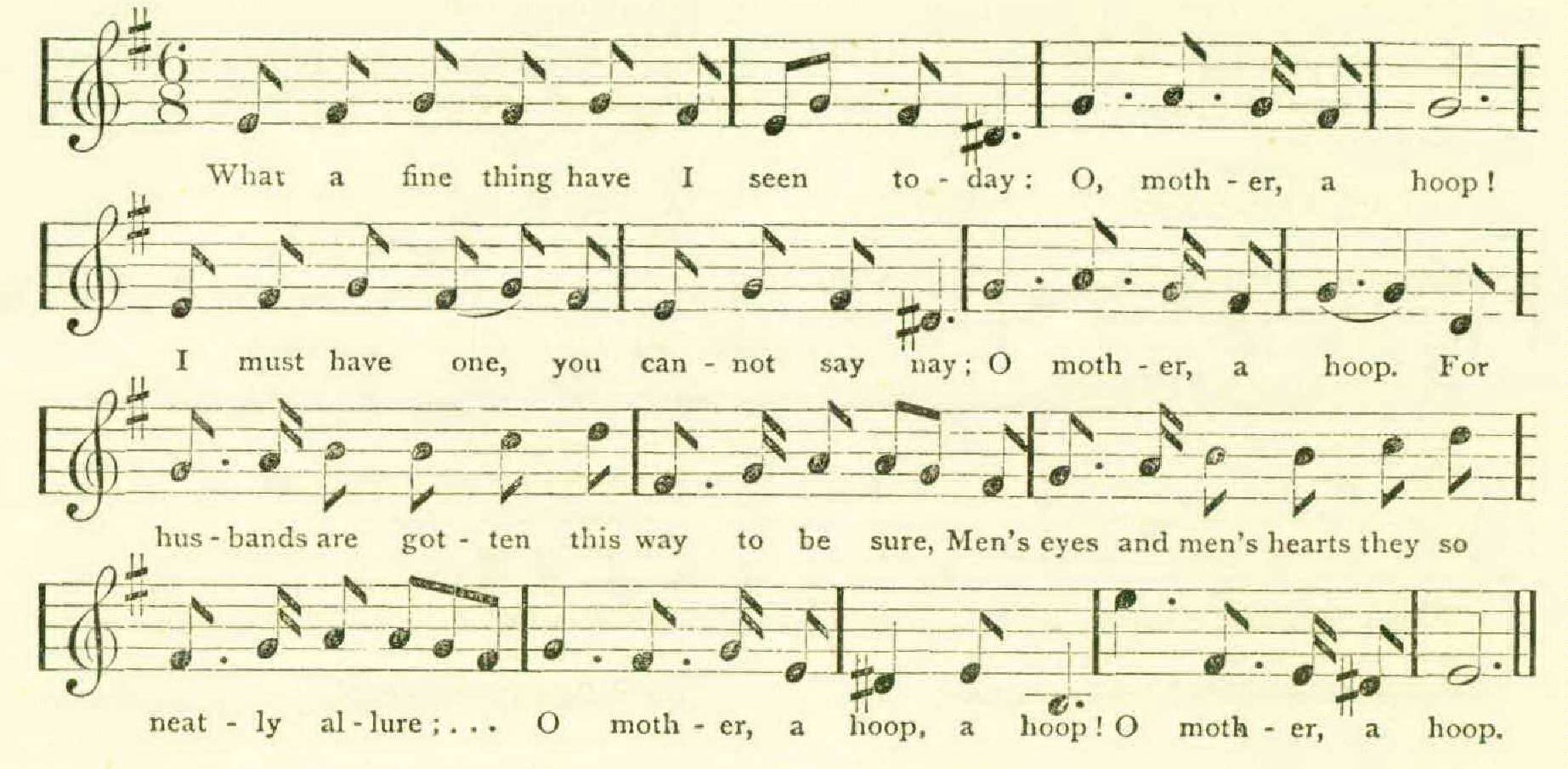
The following stanza from another song on the same subject has a view of the matter not unfamiliar to our own ears ; —
taught, -
Nine men and nine women o’erset in a boat,
The men were all drowned, but the women did float,
And by help of their hoops they all safely got out;
O mother, a hoop ! ”
The following song of “ The Farmer’s Son,” which was exceedingly popular at the beginning of the last century, is still held in high esteem. It is “ regularly printed in Yorkshire,” and “ no song is more in favor with the small farmers and the peasantry.” The melody is original, pleasing, and exceedingly well adapted to the words ; —
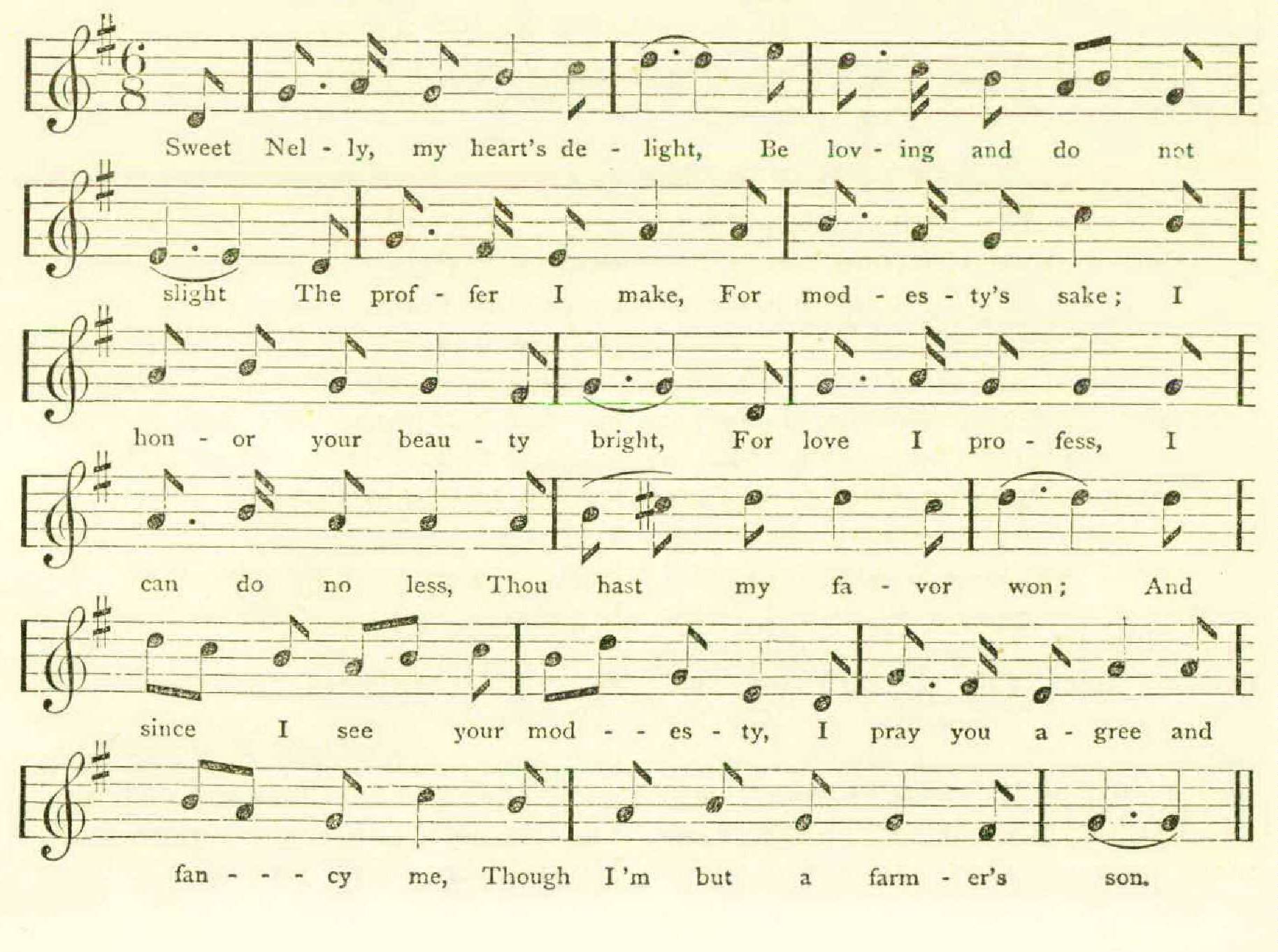
It is very well known I may
Have men of renown
In country or town ;
So, Roger, without delay,
Court Bridget or Sue,
Kate, Nancy, or Prue,
Their loves will soon be won ;
But don’t you dare
To speak me fair
As if I were
At my last prayer
To marry a farmer’s son.
Two hundred a year, and more ;
Besides sheep and cows,
Carts, harrows, and ploughs ;
His age is above threescore ;
And when he does die,
Then merrily I
Shall have what he has won.
Both land and kine,
All shall be thine,
If thou ’lt incline
And wilt be mine,
And marry a farmer’s son.
Your proffered love I scorn.
'T is known very well
My name it is Nell,
And you ’re but a bumpkin born.
Away I will go.
And I hope no harm is done.
Farewell ! Adieu !
I hope to woo
As good as you
And win her too.
Though I ’m but a farmer’s son.
Perhaps we may still agree ;
For, man, I protest
I was but in jest :
Come, prythee, sit down by me :
For thou art the man
That verily can
Win me, if e’er I'm won.
Therefore I shall
Be at your call,
To marry a farmer’s son.”
- “ This music crept by me upon the waters, Allaying both their fury and my passion With its sweet air,” The Tempest.↩
- Sir Toby..... But shall we make the welkin dance indeed ? Shall we rouse the night-owl in a catch, that will draw three souls out of one weaver ? Shall we do that ?↩
- Sir And. An you love me, let’s do’t: I am a dog at a catch. — Twelfth Night, Act II. sc. 3.↩