The Battles About Atlanta
II.
I. GRAND FLANK MOVEMENT UPON HOOD’S COMMUNICATIONS.
WE now come to the final movement before the fall of Atlanta. It will be noticed that Sherman kept withdrawing his forces from the general left and gaining ground to the right, both by the transfer and by thinning and extending the lines of two corps, the fourth (Stanley’s) and the twentieth (Williams’s). We hugged the works of the enemy closely, and by sudden movements endeavored to circumvent Hood’s left flank and strike the railroads to his rear, but he was too wary and active to allow us to do this. He extended as rapidly as we did, dug the same sort of ditches, completed batteries, made épaulements revetted with logs, had good flank covers, and the “ Johnnies ” rivaled the “Yanks ” even in the size and arrangement of the top logs for protection. We were having all the exhausting labor and worry of a regular siege without being able to first invest this forest city. Failing in these safer attempts, Sherman, more fertile than any other man in expedients and being now aware that Stoneman’s cavalry had failed to make any decided impression in its imid upon Hood’s communications (which raid, it will be remembered, resulted in the discomfiture and capture of General Stoneman himself), determined to move his army in a body across Hood’s lines of supply, leaving behind only a detachment of Thomas’s army — Williams’s corps — safely intrenched beyond the Chattahoochee.
The manner in which this movement was effected was somewhat like that of a battalion of three divisions changing front, faced to the rear on the right division. General Schofield, being near Atlanta at the West point railroad, turned his command like the pivot division and faced east. My army was drawn out and marched on the outer circuit to Renfrew’s place. General Thomas swung the fourteenth and the fourth corps into position midway between Atlanta and Renfrew. Kilpatrick with his division of cavalry reported to me during this march, and Watched my front and right flank while moving.
August 16th, General Sherman issued his Special Field Order, No. 57, the substance of which appears in the following extracts:—
“I. . . . First move: General Kilpatrick’s cavalry will move to Camp Creek; General Schofield will cover the Campbellton road, and General Thomas will move one corps (General Williams’s) to the Chattahoochee bridge, with orders to hold it; Paice’s Ferry bridge, and a pontoon bridge (Captain Kossack’s) at Turner’s Ferry, ready to be laid down if necessary. The other corps, General Stanley’s, will move south of Proctor’s Creek to near the Utoy, behind the right centre of the army of the Tennessee, prepared to cover the Bell’s Ferry road. General Garrard’s cavalry will fall behind Peachtree Creek, and act against the enemy should he sally against General Williams’s or General Stanley’s corps during the movement.
“ Second move: the army of the Tennessee will withdraw, cross Utoy Creek, and move by the most direct road toward Fairburn, going as far as Camp Creek. General Thomas will mass his two corps, Generals Stanley’s and Johnson’s, below Utoy Creek, and General Garrard’s cavalry will join General Thomas by the most direct road, or by way of Sandtown bridge, and act with him during the rest of the move. General Schofield will advance abreast of, and in communication with, the army of the Tennessee, as far as Camp Creek.
“ Third move: the armies of the Ohio and Tennessee will move direct for the West Point road, aiming to strike it between Red Oak and Fairburn; General Thomas will follow, well closed up in two columns, the trains between. General Kilpatrick will act as the advance, and General Garrard will cover the rear under direction of General Thomas. The bridge at Sandtown will be kept and protected by a detachment of cavalry detailed by General Elliott, with a section of guns or four-gun battery.
“II. . . . During the movement, and until the army returns to the river, the utmost care will be taken to expose as little as possible the trains of cars and wagons. The depots at the bridge, at Allatoona and Marietta, will be held against any attack, and communication kept up with the army as far as possible by way of Sandtown. On reaching any railroad the troops will at once be disposed for defense, and at least one third put to work to tear up track and destroy iron, ties, and all railroad materials.”
General Sherman suspended this order when he learned that Hood had sent off his cavalry upon a raid, but it was subsequently put into execution, with such modification from time to time as the actual march necessitated.
General Thomas began on the night of the 25th, as directed. By his marchings toward the rear and toward our right, the rear movement being much the more exposed, Hood was completely deceived. Having myself already prepared a new left flank to guard against a sally from Atlanta after Thomas’s withdrawal, I had my command in readiness to begin the withdrawal in two columns as soon as it was dark on the night of the 26th. In perfect silence, twentyfive thousand men were wakened. Each column started quietly, following its guide, who had familiarized himself with the road that he was to take. Regiment followed regiment, brigade followed brigade, till the whole ground was cleared. Even the ordinary rattle of the wheels of batteries and wagons had been obviated by various contrivances. Of a sudden, as the rear of our column was just clearing the old camping-ground, the enemy appeared to suspect what we were attempting to do, and opened fire with artillery. The cannon sounded louder than ever in the stillness of the night, and we feared that the suddenness and terrific nature of this firing, the round shot breaking branches and lopping trees in close proximity to the dim pathway, might throw some of our troops into confusion and create an extensive panic in the command. Nothing in the way of confusion and horror can exceed a panic in the woods and at night, for an army with loaded muskets in hand. I recall one, near the Chain Bridge in Virginia, when every man was alarmed by a sudden firing supposed to come from an enemy. Men sprang to their feet, brigades were broken, regiments dispersed, some ran and some lay down, but all fired in wild panic. There was talking in a high key, cursing, pleading, moaning. Many were killed and hundreds wounded during that fearful night while Sedgwick’s division was marching from Vienna to the Chain Bridge, after the second Bull Run disaster. But, providentially, at Atlanta the enemy’s random fire effected comparatively little damage. One man was killed, and only one man was reported wounded. He had a leg broken by a round shot. By the break of day we were far on our way. Kilpatrick, who was in the van, kept the road pretty well cleared of the enemy. Wheeler, his enterprising antagonist, had some of his cavalry in our front. At every favorable ground, for example at the crossing of creeks large enough to bridge, Wheeler would cross over, burn or otherwise destroy the bridge, make a rail obstruction across the road and on the sides in the timber, and fire upon Kilpatrick’s advance. This was done with carbines and rifles, and sometimes with two pieces of artillery. When the opposition was too strong, the cavalry would be massed, off to the right and left of the road, and a battery be brought forward at a trot, supported by infantry. This expedient generally put the enemy quickly to flight. In some cases these positions had to be turned by infantry soldiers working around their flank, before the enemy would abandon the shelter and leave. I never could quite get accustomed to the use of cavalry. Small numbers of horsemen always took up much space. It was difficult to manœuvre them in a country as broken and rough as that in Central Georgia, and when in camp it always appeared as if it would take too long for them to get ready for action. In case of surprise, it seemed perilous to sleep in a cavalry camp, owing to so very many articles of equipment, as saddles, bridles, blankets, halters, holsters, sabres, carbines, and so on, being scattered around, and not easily to be put into orderly condition except upon the cavalrymen themselves when mounted, and upon their horses. My instinctive apprehension in the presence of cavalry camps and cavalry movements, I think, made me admire the successful cavalry officer the more. About Kilpatrick, in camp, I often found all the ease and apparent or necessary irregularity to which I have referred; but he was quick to saddle, quick to mount, and, as I discovered during this march, very systematic in massing, deploying, and otherwise using his cavalry. In Kilpatrick’s case the apparent recklessness was only in the seeming, for his watches were well out, and his own ears always open. I spoke of two columns. Logan headed one, which marched via Utoy to Camp Creek; Blair, followed by Ransom, took the other, by Lickskillet, to the same point. These men, wagons, and horses filling the roads, well closed up, made their silent night-march and went into camp at daylight at the place indicated in General Sherman’s orders. Kilpatrick had encamped for the night not far away, on a road to the right of us. Quite early, near dawn of the 27th, he drew out and cleared our road of the enemy’s cavalry and scouts as far as the West Point railroad. Here he had quite a successful little cavalry combat, which suited his spirit. The enemy vainly attempted to drive him from the railway.
After a couple of hours’ rest I moved on; Blair and Logan marching in parallel columns. Logan cut a new road for most of the way. This was done to enable a quick concentration of force, if needed, at the front. By noon my three corps were securely intrenching at the railroad, not far from Fairburn. Logan took the right, Blair the left, and Ransom was held in reserve, while Kilpatrick pushed his cavalry well out on the different roads approaching the position. With wonderful quickness the different regiments in position along the front and toward any possible approaches threw up embankments or took advantage of any favorable railroad cuts at hand. Then the work of railway destruction begins. For this purpose, the men arrange themselves, often five hundred at a time, by the side of a road-bed, seize together a set of rails, and lift till the rails and ties are separated. Some pile the ties together in heaps and lay the rails across them, while others throw into the heaps dry stuff enough to quicken the ignition, quickly setting them on fire. As the fire burns, the rails are heated and the ends begin to droop; four or more men, two or three at each end, will catch an iron rail and run quickly in opposite directions around a tree or telegraph post, thus locking the rail and making it troublesome to straighten it. A sort of handspike with a short hook at the fulcrum is sometimes used. The men hitch one on at each end of a rail and turn twice in opposite ways, and then bend the rail like the twist in a cruller, thus leaving it beyond the hope of rectification.
Schofield had made the partial wheel at the pivot. Thomas had come in between Schofield and me at Red Oak station. Our picket lines were reunited. The remainder of the 27th and all of the 28th of August were spent in this destruction of railroad property. My notes say, “ The work was remarkably well done throughout, the rails bent double or broken, the ties burned, and in front of the fifteenth and seventeenth corps cuts filled up with rocks, earth, trunks of trees, and other rubbish.”
Bright and early on the 30th we were on the march. Logan, followed by the trains, took the inner road; Ransom, followed by Blair, the outer or southern road leading toward Jonesboro’. (Jonesboro’ is a railway station and hamlet on a ridge of land near the Macon and Atlanta railroad.) Kilpatrick pushed on under my orders to clear the way. Nothing but some skirmishing on the front and flanks, which did not disturb the use of the soldier’s short clay-pipe and the usual happy chats en route, — nothing of moment occurred till Logan and Ransom’s roads came together before crossing Shoal Creek. Here the enemy with artillery and sharp musketry firing brought everything to a standstill. Kilpatrick was supported by two regiments from Ransom, while Logan sent Hazen’s column to pass his flank. This had the desired effect. The temporary barricades were quickly deserted, and the enemy’s artillery went off with speed. The hindrances were now more frequent; quite a delay intervened at the creek, of precisely the same nature as that just described. Worried with this irritating backing-and - filling sort of work, lasting all day, which the enemy’s enterprising cavalry had caused us, we were glad to reach at night the destination appointed, the right of our “ general line,” named in General Sherman’s special instructions for the day’s march. But here several things pressed themselves upon my attention. Sherman had said in conversation, “ Get hold of the railroad as soon as you can, Howard.”I knew this to be the principal object of the large circuit we had taken. We had been hearing all day the noise of the engines and cars coming and going between Atlanta and Jonesboro’, and knew that this meant Hood’s or Hardee’s infantry and artillery in front of us. The Flint River was five or six miles ahead, and between us and Jonesboro’. Now, though weary and isolated and without written permission to go on, as soon as I learned, furthermore, that there was no water to refresh the men and animals, I made up my mind to attempt getting beyond the Flint that night. I sent for Kilpatrick and said, “Have you an officer, general, who with a small body of cavalry can keep the rebels in motion, and not allow them to create delay between this Renfrew place and the river? ”
“ Just the man, sir,” he replied; and he called to him Captain Estes of his staff.
He placed a squadron of horse under Estes, who quickly led the way. Wheeler, if our enemy was he, had supposed us through with moving for the day, and had made no more rail - piles and hindrances. He had just time to spring into the saddle and be off, as Estes came upon him. Then there was a race for the river. Infantry followed closely. I went ahead with the cavalry, to get all the observation I could before it should grow entirely dark. The enemy made a stand at the bridge on the opposite bank, up and down, and commenced firing. Those of the enemy’s cavalry who could not get over, fled down the river. The bridge was on fire. Estes deployed his men, some of whom dismounted, and with Spencer rifles (seven-shooters) in hand, rushed for the river’s bank and commenced their perpetual din of firing, while others made for the burning bridge, stamped out the kindled flame, crossed, and drove their foe from the other bank. Our infantry skirmishers were soon on hand. Just as they crossed the Flint, I went over with some of my staff (one of them was Lieutenant-Colonel H. M. Stimson, who was severely wounded at Pickett’s Mill, near Dallas, by a bullet passing quite through his body. He was partially recovered, and back again by my side). The Confederates fired from the woods which seemed at the foot of a steep slope in our front — fired a volley. Nobody was hit, for in their hurry they had overshot us. My eye was resting on Stimson in the dim twilight, when at the crash I saw him spring in his saddle, and I feared he was wounded again. I said, “ Harry, are you hurt? ” He said, “No, sir; the suddenness made me jump.’' The shock, however, was too much for him. That night the old wound in his lung reopened and bled considerably, and he was again obliged to leave us. He never fully recovered, but died in Florida after the war, in consequence of this wound. The skirmish-lines, as soon as deployed, made a dash for the woods and farther slope. The enemy’s outer line fell back. By my orders General Logan secured the crest of this ridge beyond the Flint, worked a part of his men all night, even tired as they already were, to intrench, and was ready in the morning for Hardee (for it was his corps and part of S. D. Lee’s that had been brought from Atlanta to head us off).
Kilpatrick pushed out to the right until he came upon the enemy’s infantry in a cornfield, where with much skirmishing he held the foe back till the infantry was well in position. Ransom prolonged Logan’s right. Blair, near at hand, crossed Wood’s division and got it into position in the morning, and extended Logan’s left. Then the cavalry was withdrawn and sent down the Flint to Anthony’s bridge, to effect another crossing below and prevent the possibility of surprise from that quarter. This completed my work of preparation for the last struggle for Atlanta. Schofield and Thomas had carried forard their part and were already upon their ground, the Renfrew place and Atlanta line, on the evening of the 30th.
II. BATTLE OF JONESBORO’.
The army of the Tennessee, by its energy, patience, and rapid work, had secured a position on the railroad ridge. The railroad could be reached Avith artillery and even with musketry, so that the trains of cars could not pass up and down. Logan was well intrenched, holding the ridge; Hazen to the left of the road, Harrow on the right, and Osterhaus mostly in reserve. The latter, a division - commander, had taken great pains to locate a battery, well supported by infantry, somewhat in advance of the general line, facing the railroad and not more than seven or eight hundred yards from it in a direct line. Other batteries were equally well placed under the cover of the woods, for there were woods everywhere. Ransom’s corps, to the right of Logan (Corse’s division on the front line), had built a practicable bridge behind him across the Flint. Reserve wagons of all kinds, not forgetting ambulances, were well parked on the west side. Kilpatrick’s bridge (Anthony’s) was a mile and a half down-stream. At first Kilpatrick pushed a small force across the bridge, went to the railroad by the shortest route, and took up a threatening position. The enemy, fearing that his flank might be turned by a larger force, attacked Kilpatrick with infantry, and forced him, with some loss, to haul off and recross the Flint, following up our cavalry. General Blair sent Giles A. Smith’s division, still in reserve, to check this move. Combating with the cavalry on the right, skirmishing and
sance; but just before the hour set for it, the enemy, as early as three in the afternoon, came on with the same old ringing, tumultuous cry, but opened fire before getting very close. Our men had been for some time all ready, and the fire was returned with the utmost spirit. Two or three times Hardee’s men renewed the charge, but each time the cry was less vigorous and the charge amounted to
battery-firing along the line, were goingon all the time while we and the enemy were getting ready for our next trial of strength. Hardee seemed slow to strike. We expected a blow at daybreak and all the forenoon; but as he delayed, I prepared to make a break after the manner of our Chattanooga battle, on a smaller scale. I ordered a reconnois-little in results. General Logan says: “ The most determined part of the assault was sustained by General Hazen. It raged fiercely in front of Harrow and Osterhaus, the enemy approaching to an average distance of fifty to one hundred paces.” Wood’s division, at the left, had ground more open. The enemy’s heavy loss in front of Colonel Bryant’s brigade indicated a sharp contest there. The charge on Ransom’s front was of much the same description. But everywhere the Confederates were met and resolutely driven back disheartened. My estimate of Hardee’s loss was recorded at the time “ in killed, wounded, and prisoners as not far from six thousand.”
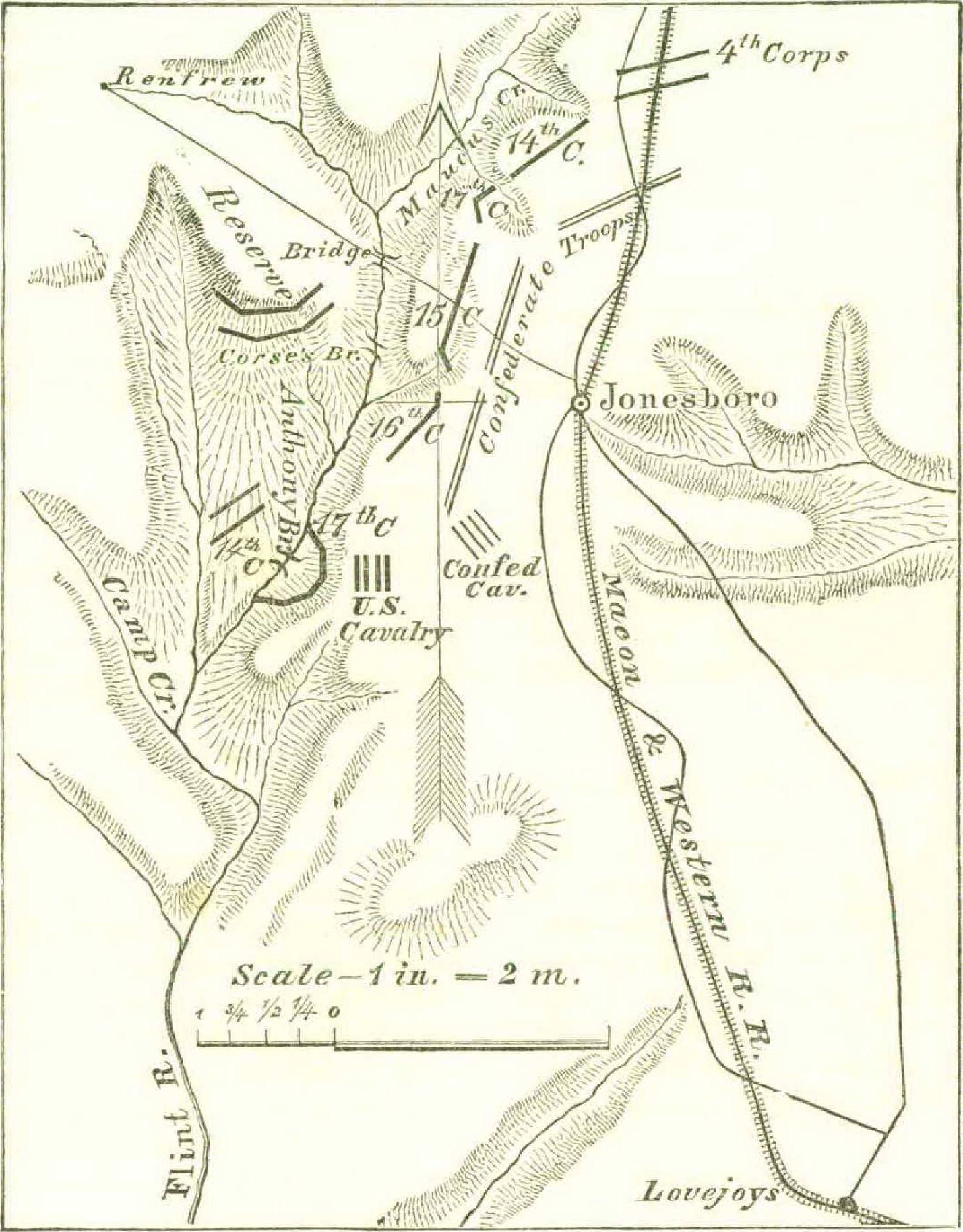
A bold commander will throw in his reserves after such a repulse of his adversary, but from experience I had learned caution. Hardee might have a trap for us like that of Kenesaw Mountain, or of Hooker’s discomfiture after Chattanooga, at Taylor’s Ridge. It was near night, and Thomas was not far off, for Carlin’s division, fourteenth corps, that had been sent ahead, was already supporting Giles A. Smith’s movement at Anthony’s bridge.
A messenger from General Sherman brought word that Schofield and Thomas had already struck the railroad at several points between myself and Atlanta. This seemed to put a complete barrier between Hood there and Hardee in my front. I could then wait for Thomas to push Jeff. C. Davis’s and Stanley’s corps upon Hardee’s exposed right flank. Hence I decided to run no risk by a hasty advance. General Sherman, who in his Memoirs gives an interesting and graphic account of these movements, remained for a time with General Thomas. He was at Renfrew’s place when my battle closed, and came up the next morning. General Thomas soon appeared, with his men in the best of spirits. Jeff. C. Davis’s corps, Carlin’s division being recalled from the right, was placed on my immediate left, and Stanley ordered to hasten his march. General Sherman says, “I also dispatched orders after orders to hurry forward Stanley so as to lap around Jonesboro’ on the east, hoping thus to capture the whole of Hardee’s corps.” Without waiting for Stanley, Davis sent a brigade to reconnoitre. Pressing back the enemy’s skirmishers to a point beyond a small creek in his front, occupied by the enemy in force, he seemed to expose the enemy’s flank. General Davis formed his troops for the assault in his usual complete manner. I was with Generals Thomas and Sherman and saw the movement commence, before passing to my right to execute my part of the programme, namely, to keep the enemy in my front employed and send a force to endeavor to turn his left. Van Horne, in his recent history, gives an excellent detailed account of this assault, in which he lets Generals Carlin, Morgan, and Baird, commanding divisions, each successfully perform his part, and mentions the distinguished conduct of their subordinates, Colonels Edie, Este, Mitchell, Dilworth, Moore, and Grower, as well as the work of Prescott’s and Gardiner’s batteries preceding the assault.
I heard the sound of battle, but could see nothing till I followed up Davis’s lead, for Blair’s command had not time to make the long circuit ordered around the left flank, before this forward movement was completed.
General Sherman summarized it in a few words as follows: “General Davis formed his division in line about four P. M., swept forward over some old cotton-fields in full view, and went over the rebel parapet handsomely, capturing the whole of Govan’s brigade, with two field batteries of ten guns.”This was the time, just before sun-down, when General Thomas was said for the first time to have set his horse into a gallop, so anxious was he to push forward the fourth corps to the east of Jonesboro’. (Thomas was fleshy and very heavy, and it took a pretty good-sized horse to carry him, even at a walk or trot.) He went, as I said, to press Stanley’s command (it had previously been set to destroy the railroad, working toward us), and for some reason, probably because not up with us, did not seem to catch the spirit of the occasion. Van Horne says, comparing the movements of the fourteenth and fourth corps, “Equal success on the part of the fourth corps might have resulted in the capture of Hardee’s command,” but adds, in extenuation of Stanley, that “ Kimball’s and Newton’s divisions were so delayed by the thick undergrowth and the enemy’s skirmishers that they did not get before his main lines before five P. M.” Newton did at last arrive at the point which General Sherman’s orders directed, but it was too late, too dark, to gain much except to aid in the capture of prisoners, who from the situation could hardly escape falling into our hands during Hardee’s night march in withdrawing. Blair promptly withdrew as Davis relieved his troops by his forward movement, and marched back across the Flint and down the river bank to Anthony’s bridge, as far as Kilpatrick’sformer battle-ground. The officer sent to guide General Blair had been there before, but took him by a circuitous route which consumed much time, so that Blair succeeded only in crossing the river and pressing back the enemy sufficiently to gain a good foothold for further work at daylight. Of course Hardee did not neglect this approach to his rear, so that Blair was stoutly resisted.
The next morning (September 2d), the enemy was already at Lovejoy’s Station, having retired from our front during the night. Hood’s dispatches of the 3d intimate that the failure of Hardee on the 31st to dislodge my force caused him to evacuate Atlanta. A Confederate paper said: “ Yankee Howard stole a march on Hardee at Jonesboro'.”
Hood with Stewart’s corps and the rest of his command left Atlanta, went around by the way of McDonough, and joined Hardee and S. D. Lee at Lovejoy. Had we known his intention in season, this reunion of forces would doubtless have been prevented by battle. General Slocum, at the Chattahoochee bridge (Slocum had joined the twentieth corps and taken command after the flank movements began), had heard the sounds of explosions at Atlanta during the night. They had been heard by all of us who were awake, even at Jonesboro’. We surmised, but could not be certain what had happened. General Sherman says he called up a farmer near his bivouac, and questioned him concerning the reverberations. He said they were in the direction of Atlanta and sounded like a battle. (He had probably heard such sounds often within the past two months.) Slocum’s note dated at Atlanta reached us after our arrival at Lovejoy’s Station, for, of course, we promptly followed Hardee thither during the morning of the 2d of September. Slocum had moved his corps up to occupy the city. Ihe rousing cheers that greeted the news told how our men felt. General Mower used to say at every new success, “ Fait accompli!” Sherman pithily puts it, “ Atlanta is ours, and fairly won.”
The great joy and thanksgiving at Washington and at City Point, Virginia, are shown in the well-known letters of September 3d and 4th, of President Lincoln and General Grant.
Besides the battles which were simply named in the article preceding this, there were several cavalry raids and engagements of more or less magnitude under Stoneman, Garrard, Kilpatrick, and Rousseau. These have passed into history, and I cannot give any new facts concerning them. I knew all these leaders. General Stoneman was a brave and loyal cavalry officer, but judging from his misfortunes which resulted in capture and confinement in the South (a judgment I own that may be a very unfair one), I should now say that it would have been better that he should have had an infantry command. It requires, to manage a cavalry corps, unusual enterprise, good, sound health, sleepless activity, and the ability to organize and direct operations on a very large scale. Stoneman had sufficient natural talent, but he suffered excruciatingly from a sad physical disability, aggravated by the extraordinary exertions devolved upon him in the cavalry service.
Garrard was well fitted for the steadiness and regularity of infantry or artillery movements. He was a man of high tone, pure truth, and great fidelity, but had not the dash of Sheridan and J. H. Wilson.
Kilpatrick was found to have the temper that suited General Sherman: he never could believe himself defeated. He was of sanguine temperament, had good powers of endurance, would undertake any enterprise, however difficult, and his reports were always spirited. If the enemy surprised him in camp, he rather liked it, provided he could recover himself and snatch victory from apparent defeat. There was a pleasant humor not only in Kilpatrick’s talk, but in his deeds of hardihood as he ran tilts against his “ friend Wheeler,” who became celebrated for his ubiquitous appearance upon our front and flanks.
Again, besides the cavalry work, our very possession of Atlanta was disputed by a raid of Hood in force around our right flank, endeavoring to “ tow ” us back to the place of beginning, even to Chattanooga. This caused the most vigorous and trying campaign we had. It was in this campaign that General Corse and Colonel Tourtelotte distinguished themselves at Allatoona. This is where General Sherman sent his message from Kenesaw, at least sixteen miles in a straight line, by the signal flags, and received Corse’s well-known reply, declaring that wounds, loss of blood, and his inferior force could not make him surrender. That beautiful hymn, “ Hold the fort for I am coming,” sprang from this incident.
The youthful Ransom’s death was caused by this campaign. He rode his horse night and day till very weak, then rode in an ambulance till his strength was gone beyond recovery. And then — bless his patriotic soul!—he had himself carried on an army-stretcher, by four strong men, at the head of his command. He succumbed after Hood had been finally driven beyond the Blue Ridge, and died while en route from Gaylesville, Alabama, to Rome, Georgia. While this eventful supplementary campaign was in progress, my corps was held steadily at Atlanta, and Atlanta, which was fairly won, was also fairly kept.
O. 0. Howard.