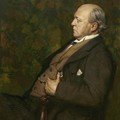
The Aspern Papers: In Three Parts. Part First
I.
I HAD taken Mrs. Prest into my confidence ; in truth without her I should have made but little advance, for the fruitful idea, in the whole business, dropped from her friendly lips. It was she who invented the short cut, who severed the Gordian knot. It is not supposed to bhe the nature of women to rise, as a general thing, to the largest and most liberal view — I mean of a practical scheme; but it has struck me that they sometimes throw off a bold conception — such as a man would n’t have risen to — with singular serenity. “ Simply ask them to take you in on the footing of a lodger ” — I don’t think that, unaided, I should have risen to that. I was beating about the bush, trying to be ingenious, wondering by what combination of arts I might become an acquaintance, when she offered this happy suggestion that the way to become an acquaintance was first to become an inmate. Her actual knowledge of the Misses Bordereau was scarcely larger than mine, and indeed I had brought with me from England some definite facts which were new to her. Their name had been mixed up, ages before, with one of the greatest names of the century, and they lived now in Venice, in obscurity, on very small means, unvisited, unapproachable, in a dilapidated old palace on an out-of-the-way canal: this was the substance of my friend’s impression of them. She herself had been established in Venice for fifteen years, and had done a great deal of good there ; but the circle of her benevolence did not include the two shy, mysterious, and, as it was somehow supposed, scarcely respectable Americans (they were believed to have lost, in their long exile, all national quality, besides having had, as their name implied, some French strain in their origin), who asked no favors and desired no attention. In the early years of her residence she had made an attempt to see them, but this had been successful only as regards the little one, as Mrs. Prest called the niece; though in reality, as I afterwards learned, she was considerably the bigger of the two. She had heard Miss Bordereau was ill, and had a suspicion that she was in want; and she had gone to the house to offer assistance, so that if there were suffering (and American suffering), she should at least not have it on her conscience. The “little one ” received her in the great, cold, tarnished Venetian sala, the central hall of the house, paved with marble and roofed with dim crossbeams, and did n’t even ask her to sit down. This was not encouraging for me, who wished to sit so fast, and I remarked as much to Mrs. Prest, who, however, replied with profundity, “ Ah, but there ’s all the difference : I went to confer a favor, and you will go to ask one. If they are proud, you will be on the right side.” And she offered to show me their house, to begin with — to row me thither in her gondola. I let her know that I had already been to look at it, half a dozen times ; but I accepted her invitation, for it charmed me to hover about the place. I had made my way to it the day after my arrival in Venice (it had been described to me, in advance, by the friend, in England, to whom I owed definite information as to their possession of the papers), and I had revolved about it while I considered my plan of campaign. Jeffrey Aspern had never been in it that I knew of; but some note of his voice seemed to abide there, by a roundabout implication, an attenuated reverberation.
Mrs. Prest knew nothing about the papers, but she was interested in my curiosity, as she was always interested in the joys and sorrows of her friends. As we went, however, in her gondola, gliding there, under the sociable hood, with the bright Venetian picture framed, on either side, by the movable window, I could see that she was amused by my infatuation, the way my interest in the papers had become a fixed idea. “ One would think you expected to find in them the answer to the riddle of the universe,” she said ; and I denied the impeachment only by replying that if I had to choose between that precious solution and a bundle of Jeffrey Aspern’s letters, I knew indeed which would appear to me the greater boon. She pretended to make light of his genius, and I took no pains to defend him. One does n’t defend one’s god : one’s god is in himself a defense. Besides, to-day, after his long comparative obscuration, he hangs high in the heaven of our literature, for all the world to see; he is part of the light by which we walk. The most I said was that he was, no doubt, not a woman’s poet ; to which she rejoined, aptly enough, that he had been at least Miss Bordereau’s. The strange thing had been for me to discover, in England, that she was still alive : it was as if I had been told Mrs. Siddons was, or Queen Caroline, or the famous Lady Hamilton, for it seemed to me that it was to that generation she belonged. “ Why, she must be tremendously old — at least a hundred,” I had said ; but on coming to consider dates, I saw that it was not strictly necessary that she should have exceeded by very much the common span. None the less she was very far advanced in life, and her relations with Jeffrey Aspern had occurred in her early womanhood.
“That is her excuse,” said Mrs. Prest, half sententiously, and yet also somewhat as if she were ashamed of making a speech so little in the real tone of Venice. As if a woman needed an excuse for having loved the divine poet! He had been not only one of the most brilliant minds of his day (and in those years, when the century was young, there were, as every one knows, many), but one of the most genial men, and one of the handsomest.
The niece, according to Mrs. Prest, was not so old, and she risked the conjecture that she was only a grand-niece. This was possible ; I had nothing but my share in the very limited knowledge of my English fellow-worshiper, John Cumnor, who had never seen the couple. The world, as I say, had recognized Jeffrey Aspern, but Cumnor and I had recognized him most. The multitude, to-day, flocked to his temple, but of that temple he and I regarded ourselves as the priests. We held, justly, as I think, that we had done more for his memory than any one else, and we had done it by opening lights into his life. He had nothing to fear from us, because he had nothing to fear from the truth, which alone, at such a distance of time, we could be interested in establishing. His early death had been the only dark spot in his life, unless the papers in Miss Bordereau’s hands should perversely bring out others. There had been an impression, about 1825, that he had “ treated her badly,” just as there had been an impression that he had “served,” as the London populace says, several other women in the same way. Each of these cases Cumnor and I had been able to investigate, and we had never failed to acquit him, conscientiously, of disloyalty. I judged him, perhaps, more indulgently than my friend ; certainly, at any rate, it appeared to me that no man could have behaved better in the given circumstances. These were almost always awkward. Half the women of his time, to speak liberally, had flung themselves at his head, and out of this pernicious fashion many complications, some of them grave, had not failed to arise. He was not a woman’s poet, as I had said to Mrs. Prest, in the modern phase of his reputation ; but the situation had been different when the man’s own voice was mingled with his song. That voice, by every testimony, was one of the sweetest ever heard. “ Orpheus and the Maenads ! ” was the exclamation that rose to my lips when I first turned over his correspondence. Almost all the Maenads were unreasonable and many of them insupportable ; it struck me, in short, that he was kinder, more considerate, than, in his place (if I could imagine myself in such a place !), I should have been.
It was certainly strange beyond all strangeness, and I shall not take up space with attempting to explain it, that whereas in all these other lines of research we had to deal with phantoms and dust, the mere echoes of echoes, the one living source of information that had lingered on into our time had been unheeded by us. Every one of Aspern’s contemporaries had, according to our belief, passed away; we had not been able to look into a single pair of eyes into which his had looked, or to feel a transmitted contact in any aged hand that his had touched. Most dead of all did poor Miss Bordereau appear, and yet she alone had survived. We exhausted, in the course of months, our wonder that we had not found her out sooner, and the substance of our explanation was that she had kept so quiet. The poor lady, on the whole, had had reason for doing so. But it was a revelation to us that it was possible to keep so quiet as that, in the latter half of the nineteenth century — the age of newspapers and telegrams and photographs and interviewers. And she had taken no great trouble about it, either: she had not hidden herself away in an undiscoverable hole ; she had boldly settled down in a city of exhibition. The only secret of her safety that we could perceive was that Venice contained so many curiosities that were greater than she. And then accident had somehow favored her, as was shown, for example, in the fact that Mrs. Prest had never happened to mention her to me, though I had spent three weeks in Venice—under her nose, as it were — five years before. Mrs. Prest had not mentioned this much to any one; she appeared almost to have forgotten she was there. Of course she had not the responsibilities of an editor. It was no explanation of the old woman’s having eluded us to say that she lived abroad, for our researches had again and again taken us (not only by correspondence, but by personal inquiry), to France, to Germany, to Italy, in which countries, not counting his important stay in England, so many of the too few years of Aspern’s career were spent. We were glad to think, at least, that in all our publishings (some people consider, I believe, that we have overdone them), we had only touched, in passing and in the most discreet manner, on Miss Bordereau’s connection. Oddly enough, even if we had had the material (and we often wondered what had become of it), it would have been the most difficult episode to handle.
The gondola stopped, and the old palace was there : it was a house of the class which, in Venice, carries even in extreme dilapidation the dignified name. “ How charming! It’s gray and pink ! ” my companion exclaimed; and that is the most comprehensive description of it. It was not particularly old, only two or three centuries; and it had an air not so much of decay as of quiet discouragement, as if it had rather missed its career. But its wide front, with a stone balcony from end to end of the piano nobile, or most important floor, was architectural enough, with the aid of various pilasters and arches ; and the stucco with which, in the intervals, it had long ago been endued was rosy in the April afternoon. It overlooked a clean, melancholy, unfrequented canal, which had a narrow riva, or convenient footway, on either side. “ I don’t know why — there are no brick gables,” said Mrs. Prest, “ but this corner has seemed to me before more Dutch than Italian, more like Amsterdam than like Venice. It’s perversely clean, for reasons of its own ; and though you can pass on foot, scarcely any one ever thinks of doing so. It has the air of a Protestant Sunday. Perhaps the people are afraid of the Misses Bordereau. I dare say they have the reputation of witches.” I forget what answer I made to this — I was given up to two other reflections. The first of these was, that if the old lady lived in such a big, imposing house she could n’t be in any sort of misery, and therefore would n’t be tempted by a chance to let a couple of rooms. I expressed this idea to Mrs. Prest, who gave me a very logical reply. “ If she did n’t live in a big house, how could it be a question of her having rooms to spare ? If she were not amply lodged herself, you would lack ground to approach her. Besides, a big house here, and especially in this quartier perdu, proves nothing at all; it is perfectly compatible with a state of penury. Dilapidated old palazzi, if you will go out of the way for them, are to be had for five shillings a year. And as for the people who live in them — no, until you have explored Venice socially as much as I have, you can form no idea of their domestic desolation. They live on nothing, for they have nothing to live on.” The other idea that had come into my head was connected with a high, blank wall which appeared to confine an expanse of ground on one side of the house. Blank I call it. but it was figured over with the patches that please a painter, repaired breaches, crumblings of plaster, extrusions of brick that had turned pink with time; and a few thin trees, with the poles of certain rickety trellises, were visible over the top. The place was a garden, and apparently it belonged to the house. It suddenly occurred to me that if it did belong to the house I had my pretext.
I sat looking out on all this, with Mrs. Prest (it was covered with the golden glow of Venice), from the shade of our felze, and she asked me if I would go in then, while she waited for me, or come back another time. At first I couldn’t decide—it was doubtless very weak of me. I wanted still to think I might get a footing, and I was afraid to meet failure, for it would leave me, as I remarked to my companion, without another arrow for my bow. “ Why not another ? ” she inquired, as I sat there hesitating and thinking it over ; and she wished to know why, even now, and before taking the trouble of becoming an inmate (which might be wretchedly uncomfortable, after all, even if it succeeded), I hadn’t the resource of simply offering them a sum of money down. In that way I might obtain the documents without bad nights.
“ Dearest lady,” I exclaimed, “ excuse the impatience of my tone when I suggest that you must have forgotten the very fact (surely I communicated it to you) which pushed me to throw myself upon your ingenuity. The old woman won’t have the documents spoken of; they are personal, delicate, intimate, and she has n’t modern notions, God bless her! If I should sound that note first I should certainly spoil the game. I can arrive at the papers only by putting her off her guard, and I can put her off her guard only by ingratiating diplomatic practices. Hypocrisy, duplicity, are my only chance. I am sorry for it, but for Jeffrey Aspern’s sake I would do worse still. First I must take tea with her; then tackle the main job.” And I told over what had happened to John Cumnor, when he wrote to her. No notice whatever had been taken of his first letter, and the second had been answered very sharply, in six lines, by the niece: “ Miss Bordereau requested her to say that she could n’t imagine what he meant by troubling them. They had none of Mr. Aspern’s papers and, if they had, should never think of showing them to any one, on any account whatever. She did n’t know what he was talking about and begged he would let her alone.” I certainly did n’t want to be met that way.
“ Well,” said Mrs. Prest, after a moment, provokingly, “ perhaps, after all, they have n’t any of his things. If they deny it flat, how are you sure ? ”
“ John Cumnor is sure, and it would take me long to tell you how his conviction, or his very strong presumption — strong enough to stand against the old lady’s not unnatural fib — has built itself up. Besides, he makes much of the internal evidence of the niece’s letter.”
ity implies the possession of mementoes, of relics. I can’t tell you how that ‘ Mr.’ touches me — how it bridges over the gulf of time, and brings our hero near to me — nor what an edge it gives to my desire to see Juliana. You don’t say ‘ Mr.’ Shakespeare.”
“ Would I, any more, if I had a box full of his letters ? ”
“ Yes, if he had been your lover, and some one wanted them ! ” And I added that John Cumnor was so convinced, and so all the more convinced by Miss Bordereau’s tone, that he would have come himself to Venice on the business, were it not that for him there was the obstacle that it would be difficult to disprove his identity with the person who had written to them, which the old ladies would be sure to suspect, in spite of dissimulation and a change of name. If they were to ask him point-blank if he were not their correspondent, it would be too awkward for him to lie ; whereas I was fortunately not tied in that way. I was a fresh hand, and could say no without lying.
“ But you will have to change your name,”said Mrs. Prest. “Juliana lives out of the world as much as it is possible to live, but none the less she has probably heard of Mr. Aspern’s editors ; she perhaps possesses what you have published.”
“I have thought of that,” I returned ; and I drew out of my pocket-book a visiting-card, neatly engraved with a name that was not my own.
“You are very extravagant; you might have written it,” said my companion.
“This looks more genuine.”
“Certainly, you are prepared to go far ! But it will be awkward about your letters ; they won’t come to you in that mask.”
“My banker will take them in, and I will go every day to fetch them. It will give me a little walk.”
“Shall you only depend upon that ? ” asked Mrs. Prest. “ Are n’t you coming to see me ? ”
“ Oh, you will have left Venice, for the hot months, long before there are any results. I am prepared to roast all summer — as well as hereafter, perhaps you 'll say ! Meanwhile, John Cumnor will bombard me with letters addressed, in my feigned name, to the care of the padrona.”
“She will recognize his hand,” my companion suggested.
“ On the envelope he can disguise it.”
“ Well, you ’re a precious pair! Does n’t it occur to you that even if you are able to say you are not Mr. Cumnor in person, they may still suspect you of being his emissary ? ”
“Certainly, and I see only one way to parry that.”
“ And what may that be ?”
I hesitated a moment, “To make love to the niece.”
“ Ah,” cried Mrs. Prest, “ wait till you see her! ”
II.
“I must work the garden — I must work the garden,” I said to myself, five minutes later, as I waited, up-stairs, in the long dusky sala, where the bare scagliola floor gleamed, vaguely, in a chink of the closed shutters. The place was impressive, but it looked cold and cautious. Mrs. Prest had floated away, giving me a rendezvous, at the end of half an hour, at some neighboring watersteps ; and I had been let into the house, after pulling the rusty bell-wire, by a little red-headed, white-faced maid-servant, who was very young and not ugly, and wore clicking pattens and a shawl in the fashion of a hood. She had not contented herself with opening the door from above, by the usual arrangement of a creaking pulley, though she had looked down at me first from an upper window, dropping the inevitable challenge which, in Italy, precedes the hospitable act. As a general thing I was irritated by this survival of mediaeval manners, though as I liked the old I suppose I ought to have liked it; but I was so determined to be genial that I took my false card out of my pocket and held it up to her, smiling, as if it were a magic token. It had the effect of one, indeed, for it brought her, as I say, all the way down. I begged her to hand it to her mistress, having first written on it, in Italian, the words, “Could you very kindly see a gentleman, an American, for a moment?” The little maid was not hostile, and I reflected that even that was perhaps something gained. She colored, she smiled, and looked both frightened and pleased. I could see that my arrival was an event, that visits were rare in that house and that she was a person who would have liked a sociable place. When she pushed forward the heavy door behind me, I felt that I had a foot in the citadel. She pattered across the damp, stony lower hall, and I followed her up the high staircase — stonier still, as it seemed — without an invitation. I think she had meant I should wait for her below, but such was not my idea, and I took up my station in the sala. She flitted, at the far end of it, into impenetrable regions, and I looked at the place in a sort of suspense. It was gloomy and stately, but it owed its character almost entirely to its noble shape and to the fine architectural doors — as high as the doors of houses — which, leading into the various rooms, repeated themselves, on either side, at intervals. They were surmounted with old faded, painted escutcheons, and here and there, in the spaces between them, brown pictures, which I perceived to be bad, in battered frames, were suspended. With the exception of several straw-bottomed chairs, with their backs to the wall, the grand, obscure vista contained nothing else to minister to effect. It was evidently never used, save as a passage, and little, even, as that. I may add that by the time the door opened again, through which the maid-servant had escaped, my eyes had grown used to the want of light.
I had not meant, by my private ejaculation, that I must myself cultivate the soil of the tangled enclosure which lay beneath the windows, but the lady who came toward me from the distance, over the hard, shining floor, might have supposed as much from the way in which, as I went rapidly to meet her, I exclaimed, taking care to speak Italian, “The garden, the garden—do me the pleasure to tell me if it ’s yours ! ”
She stopped short, looking at me with wonder; and then, “ Nothing here is mine,” she answered, in English, coldly and sadly.
“ Oh, you are English; how delightful! ” I remarked, ingenuously. “But surely the garden belongs to the house ? ” “ Yes, but the house does n’t belong to me.” She was a long, lean, pale person, habited apparently in a dullcolored dressing-gown, and she spoke with a kind of mild literalness. She did n’t ask me to sit down, any more than years before (if she were the niece), she had asked Mrs. Prest, and we stood face to face in the empty, pompous hall.
“ Well, then, would you kindly tell me to whom I must address myself ? I’m afraid you ’ll think me odiously intrusive, but, you know, I must have a garden — upon my honor I must! ”
Her face was not young, but it was simple ; it was not fresh, but it was mild. She had large eyes, which were not bright, and a great deal of hair, which was not “ dressed,” and long fine hands, which were — possibly — not clean. She clasped these members almost convulsively as, with a confused, alarmed look, she broke out, “ Oh, don’t take it away from us; we like it ourselves ! ”
“ You have the use of it, then ? ” I asked.
“ Oh, yes. If it was n’t for that! ” And she gave a shy, melancholy smile.
“ Is n’t it a luxury, precisely ? That’s why, intending to be in Venice some weeks, possibly all summer, and having some literary work, some reading and writing, to do, so that I must be quiet, and yet, if possible, a great deal in the open air — that’s why I have felt that a garden is really indispensable. I appeal to your own experience,” I went on, smiling. “ Now can’t I look at yours ? ” “I don’t know, I don’t understand,” the poor woman murmured, planted there and letting her embarrassed eyes wander all over my strangeness.
“ I mean only from one of those windows — such grand ones as you have here — if you will let me open the shutters.” And I walked, myself, toward the back of the house. When I had advanced half-way I stopped and waited, as if I took it for granted she would accompany me. I had been of necessity very abrupt, but I strove at the same time to give her the impression of extreme courtesy. “ I have been looking at furnished rooms all over the place, and it seems impossible to find any with a garden attached. Naturally, in a place like Venice gardens are rare. It’s absurd, if you like, for a man, but I can’t live without flowers.”
“ There are none to speak of down there.” She came nearer to me, as if, though she mistrusted me, I had drawn her by an invisible thread. I went on again, and she continued, as she followed me: “We have a few, but they are very common. It costs too much to cultivate them ; one has to have a man.”
“ Why should n’t I be the man ? ” I asked. “ I ’ll work without wages ; or rather, I ’ll put in a gardener. You shall have the sweetest flowers in Venice.”
She protested at this, with a queer little sigh, which might also have been a gush of rapture at the picture I presented. Then she observed, “ We don’t know you — we don’t know you.”
“ You know me as much as I know you ; that is, much more, because you know my name. And if you are English I am almost a countryman.”
“ We are not English,” said my companion, watching me helplessly while I threw open the shutters of one of the divisions of the wide, high window.
“ You speak the language so beautifully ; might I ask what you are ? ” Seen from above, the garden was certainly shabby ; but I perceived at a glance that it had great capabilities. She made no rejoinder, she was so lost in staring at me, and I exclaimed, “ You don’t mean to say you are also, by chance, American ? ”
“ I don’t know ; we used to be.”
“ Used to be ? Surely you have n’t changed ? ”
“ It’s so many years ago — we are nothing.”
“ So many years that you have been living here ? Well. I don’t wonder at that; it’s a grand old house. I suppose you all use the garden,” I went on, “ but I assure you I should n’t be in your way. I would be very quiet, and stay in one corner.”
“ We all use it ? ” she repeated after me, vaguely, not coming close to the window, and looking at my shoes. She appeared to think me capable of throwing her out.
“ I mean all your family, as many as you are.”
“There is only one other : she is very old — she never goes down.”
“ Only one other, in all this great house! ” I feigned to be not only amazed, but almost scandalized. “Dear lady, you must have space, then, to spare! ”
“ To spare ? ” she repeated, in the same dazed way.
“ Why, you surely don’t live (two quiet women — I see you are quiet, at any rate), in fifty rooms ! ” Then, with a burst of hope and cheer, I demanded, “ Could n’t you let me two or three ? That would set me up ! ”
I had now struck the note that translated my purpose, and I need n’t reproduce the whole of the tune I played on this occasion. I ended by making my interlocutress believe that I was an honorable person, though of course I did n’t even attempt to persuade her that I was not an eccentric one. I repeated that I had studies to pursue ; that I wanted quiet; that I delighted in a garden, and had vainly sought one up and down the city ; that I would undertake that before another month was over the dear old house should be smothered in flowers. I think it was the flowers that won my suit, and I afterwards found that Miss Tita (for such the name of this high, tremulous spinster proved, somewhat incongruously, to be), had an insatiable appetite for them. When I speak of my suit as won, I mean that before I left her she had promised that she would refer the question to her aunt. I inquired who her aunt might be, and she answered, “Why, Miss Bordereau ! ” with an air of surprise, as if I might have been expected to know. There were contradictions like this in Tita Bordereau, which, as I observed later, contributed to make her an odd and affecting person. It was the study of the two ladies to live so that the world should n’t touch them, and yet they had never altogether accepted the idea that it did n’t hear of them. In Tita, at any rate, a grateful susceptibility to human contact had not died out, and contact, of a limited order, there would be, if I should come to live in the house.
“We have never done anything of the sort; we have never had a lodger, or any kind of inmate.” So much as this she made a point of saying to me. “ We are very poor, we live very badly. The rooms are bare — that you might take ; they have nothing in them. I don’t know how you would sleep, how you would eat.”
“ With your permission, I could easily put in a bed, and a few tables and chairs. C’est la moindre des choses, and the affair of an hour or two. I know a little man from whom I can hire what I should want for a few months, for a trifle, and my gondolier can bring the things round in his boat. Of course, in this great house, you must have a second kitchen, and my servant, who is a wonderfully handy fellow ” (this personage was an evocation of the moment), “ can easily cook me a chop there. My tastes and habits are of the simplest; I live on flowers ! ” And then I ventured to add that if they were very poor, it was all the more reason they should let their rooms. They were bad economists. I had never heard of such a waste of material.
I saw in a moment that the good lady had never before been spoken to in that way, with a kind of humorous firmness which did n’t exclude sympathy, but was, on the contrary, founded on it. She might easily have told me that my sympathy was impertinent, but this, by good fortune, did n’t occur to her. I left her with the understanding that she would consider the matter with her aunt, and that I might come back the next day for their decision.
“The aunt will refuse ; she will think the whole proceeding very louche ! ” Mrs. Prest declared, shortly after this, when I had resumed my place in her gondola. She had put the idea into my head, and now (so little are women to be counted on), she appeared to take a despondent view of it. Her pessimism provoked me, and I pretended to have the best hopes ; I went so far as to say that I had a distinct presentiment that I should succeed. Upon this Mrs. Prest broke out, “Oh, I see what’s in your head ! You fancy you have made such an impression, in a quarter of an hour, that she is dying for you to come, and can be depended upon to bring the old one round. If you do get in, you ’ll count it as a triumph.”
I did count it as a triumph, but only for the editor (in the last analysis), not for the man, who had not the tradition of personal conquest. When I went back on the morrow, the little maid-servant conducted me straight through the long sala (it opened there, as before, in perfect perspective, and was lighter now, which I thought a good omen) into the apartment from which the recipient of my former visit had emerged on that occasion. It was a large, shabby parlor, with a fine old painted ceiling, and a strange figure sitting alone at one of the windows. They come back to me now almost with the palpitation they caused, the successive feelings that accompanied my consciousness that, as the door of the room closed behind me, I was really face to face with the Juliana of some of Aspern’s most exquisite lyrics. I grew used to her afterwards, though never completely ; but as she sat there before me my heart beat as fast as if the miracle of resurrection had taken place for my benefit. Her presence seemed somehow to contain his, and I felt nearer to him at that first moment of seeing her than I ever had been before, or ever have been since. Yes, I remember my emotions in their order, even including a curious little tremor that took me when I saw that the niece was not there. With her, the day before, I had become sufficiently familiar, but it almost exceeded my courage (much as I had longed for the event), to be left alone with such a terrible relic as the aunt. She was too strange, too literally resurgent. Then came a check, with the perception that we were not really face to face, inasmuch as she had over her eyes a horrible green shade, which, for her, served almost as a mask. I believed, for the instant, that she had put it on expressly, so that from underneath it she might scrutinize me without being scrutinized herself. At the same time it increased the presumption that there was a ghastly death’s-head lurking behind it. The divine Juliana as a grinning skull — the vision hung there until it passed. Then it came to me that she was tremendously old — so old that death might take her at any moment, before I had time to get what I wanted from her. The next thought was a correction to that; it lighted up the situation. She would die next week, she would die tomorrow, and then I could seize her papers. Meanwhile, she sat there, neither moving nor speaking. She was very small and shrunken, bent forward, with her hands in her lap. She was dressed in black, and her head was wrapped in a piece of old black lace, which showed no hair.
My emotion keeping me silent, she spoke first, and the remark she made was exactly the most unexpected.
III.
“Our house is very far from the centre, but the little canal is very comme il faut!”
“It’s the sweetest corner of Venice, and I can imagine nothing more charming,” I hastened to reply. The old lady’s voice was very thin and weak, but it had an agreeable, cultivated murmur, and there was wonder in the thought that that individual note had been in Jeffrey Aspern’s ear.
“ Please to sit down there. I hear very well,” she said, quietly, as if perhaps I had been shouting at her; and the chair she pointed to was at a certain distance. I took possession of it, telling her that I was perfectly aware that I had intruded, that I had not been properly introduced, and could only throw myself upon her indulgence. Perhaps the other lady, the one I had had the honor of seeing the day before, would have explained to her about the garden. That was literally what had given me courage to take a step so unconventional. I had fallen in love at sight with the whole place (she herself, probably, was so used to it that she did n’t know the impression it was capable of making on a stranger), and I had felt it was really a case to risk something. Was her own kindness in receiving me a sign that I was not wholly out of my calculation ? It would render me extremely happy to think so. I could give her my word of honor that I was a most respectable, inoffensive person, and that as an inmate they would be barely conscious of my existence. I would conform to any regulations, any restrictions, if they would only let me enjoy the garden. Moreover, I should be delighted to give her references, guarantees ; they would be of the very best, both in Venice and in England, as well as in America.
She listened to me in perfect stillness, and I felt that she was looking at me with great attention, though I could see only the lower part of her shriveled white face. Independently of the refining process of old age, it had a delicacy which once must have been great. She had been very fair ; she had had a wonderful complexion. She was silent a little after I had ceased speaking ; then she remarked, “ If you are so fond of a garden, why don’t you go to terra firma, where there are so many far better than this ? ”
“ Oh, it’s the combination ! ” I answered, smiling; and then, with rather a flight of fancy, “ It’s the idea of a garden in the middle of the sea.”
“ It’s not in the middle of the sea ; you can’t see the water.”
I stared a moment, wondering whether she wished to convict me of fraud. " Can’t see the water ? Why, dear madam, I can come up to the very gate in my boat.”
She appeared inconsequent, for she said, vaguely, in reply to this, “ Yes, if you have got a boat. I have n’t any ; it’s many years since I have been in one of the gondolas.” She uttered these words as if the gondolas were a curious, far-away craft, which she knew of only by hearsay.
“ Let me assure you of the pleasure with which I would put mine at your service ! ” I exclaimed. I had scarcely said this, however, before I became conscious that the speech was in questionable taste, and might also do me the injury of making me appear too eager, too possessed of a hidden motive. But the old woman remained inscrutable, and her attitude bothered me by suggesting that she had a fuller vision of me than I had of her. She gave me no thanks for my somewhat extravagant offer, but remarked that the lady I had seen the day before was her niece ; she would presently come in. She had asked her to stay away a little on purpose, because she herself wished to see me at first alone. She relapsed into silence, and I asked myself why she had judged this necessary, and what was coming yet; also whether I might venture on some judicious remark in praise of her companion. I went so far as to say that I should be delighted to see her again: she had been so very courteous to me, considering how odd she must have thought me — a declaration which drew from Miss Bordereau another of her incongruities.
“ She has very good manners ; I bred her up myself! ” I was on the point of saying that that accounted for the easy grace of the niece; but I arrested myself in time, and the next moment the old woman went on : “ I don’t care who you may be — I don’t want to know; it signifies very little to-day.” This had all the air of being a formula of dismissal, as if her next words would be that I might take myself off, now that she had had the amusement of looking on the face of such a monster of indiscretion. Therefore I was all the more surprised when she added, with her soft, venerable quaver, “You may have as many rooms as you like, if you will pay a good deal of money.”
I hesitated but for a single instant, long enough to ask myself what she meant, in particular, by this condition. First it struck me that she must have really a large sum in her mind; then I reasoned, quickly, that her idea of a large sum would probably not correspond to my own. My deliberation, I think, was not so visible as to diminish the promptitude with which I replied, “I will pay with pleasure, and of course in advance, whatever you may think it proper to ask me.”
“ Well, then, a thousand francs a month,” she rejoined, instantly, while her baffling green shade continued to cover her attitude.
The figure, as they say, was startling, and my logic had been at fault. The sum she had mentioned was, by the Venetian measure of such matters, exceedingly large ; there was many an old palace, in an out-of-the-way corner, that I might, on such terms, have enjoyed by the year. But so far as my small means allowed I was prepared to spend money, and my decision was quickly taken. I would pay her, with a smiling face, what she asked, but in that case I would give myself the compensation of extracting the papers from her for nothing. Moreover, if she had asked five times as much, I should have risen to the occasion ; so odious would it have appeared to me to stand chaffering with Aspern’s Juliana. It was queer enough to have a question of money with her at all. I assured her that her views perfectly met my own, and that on the morrow I should have the pleasure of putting three months’ rent into her hand. She received this announcement with serenity, and with no apparent sense that, after all, it would be becoming of her to say that I ought to see the rooms first. This did n’t occur to her, and indeed her serenity was mainly what I wanted. Our little bargain was just concluded when the door opened and the younger lady appeared on the threshold. As soon as Miss Bordereau saw her niece she cried out, almost gayly, “ He will give three thousand — three thousand tomorrow ! ”
Miss Tita stood still, with her patient eyes turning from one of us to the other ; then she inquired, scarcely above her breath, “ Do you mean francs ? ”
“ Did you mean francs or dollars ? ” the old woman asked of me, at this.
“ I think francs were what you said,” I answered, smiling.
“ That is very good,” said Miss Tita, as if she had become conscious that her own question might have looked overreaching.
“ What do you know? You are ignorant,” Miss Bordereau remarked ; not with acerbity, but with a strange, soft coldness.
“ Yes, of money — certainly of money! " Miss Tita hastened to exclaim.
“ I am sure you have your own branches of knowledge,” I took the liberty of saying, genially. There was something painful to me, somehow, in the turn the conversation had taken, in the discussion of the rent.
“ She had a very good education when she was young. I looked into that myself,” said Miss Bordereau. Then she added, “ But she has learned nothing since.”
“ I have always been with you,” Miss Tita rejoined, very mildly, and evidently with no intention of making an epigram.
“ Yes, but for that! ” her aunt declared, with more satirical force. She evidently meant that but for this her niece would never have got on at all, the point of the observation, however, being lost on Miss Tita, though she blushed at hearing her history revealed to a stranger. Miss Bordereau went on, addressing herself to me : “ And what time will you come, to-morrow, with the money ? ”
“ The sooner the better. If it suits you, I will come at noon.”
“I am always here, but I have my hours,” said the old woman, as if her convenience were not to be taken for granted.
“ You mean the times when you receive ? ”
“I never receive. But I will see you at noon, when you come with the money.”
“Very good, I shall be punctual;” and I added, “ May I shake hands with you, on our contract ? ” I thought there ought to be some little form; it would make me really feel easier, and I foresaw that there would be no other. Besides, though Miss Bordereau could not to-day be called personally attractive, and there was something even in her wasted antiquity that bade one stand at one’s distance, I felt an irresistible desire to hold in my own for a moment the hand that Jeffrey Aspern had pressed.
For a minute she made no answer, and I saw that my proposal failed to meet with her approbation. She indulged in no movement of withdrawal, which I half expected ; she only said, coldly, “ I belong to a time when that was not the custom.”
I felt rather snubbed, but I exclaimed, good-humoredly, to Miss Tita, “ Oh, you will do as well! ” and shook hands with her, while she replied, with a small flutter, “ Yes, yes, to show it’s all arranged ! ”
“ Shall you bring the money in gold ? ” Miss Bordereau demanded, as I was turning to the door.
I looked at her a moment. “ Are n’t you a little afraid, after all, of keeping such a sum as that in the house ? ” It was not that I was annoyed at her avidity, but I was really struck with the disparity between such a treasure and such scanty means of guarding it.
“ Whom should I be afraid of, if I am not afraid of you ? ” she asked with a sort of shrunken grimness.
“Ah, well,” said I, laughing, “ I shall be, in point of fact, a protector, and I will bring gold, if you prefer.”
“Thank you,” the old woman returned, with dignity, and with an inclination of her head which evidently signified that I might depart. I passed out of the room, reflecting that it would n’t be easy to circumvent her. As I stood in the sala again I saw that Miss Tita had followed me, and I supposed that, as her aunt had neglected to suggest that I should take a look at my quarters, it was her purpose to repair the omission. But she made no such suggestion ; she only stood there, with a dim, though not a languid, smile, and with an effect of irresponsible, incompetent youth which was almost comically at variance with the faded facts of her person. She was not infirm, like her aunt, but she struck me as still more helpless, because her inefficiency was spiritual, which was not the case with Miss Bordereau’s. I waited to see if she would n’t offer to show me the rest of the house, but I did n’t precipitate the question, inasmuch as my plan was, from this moment, to spend as much of my time as possible in her society. I only observed, at the end of a minute —
“ I have had better fortune than I hoped. It was very kind of her to see me. Perhaps you said a good word for me.”
“ It was the idea of the money,” said Miss Tita.
“ And did you suggest that ? ”
“I told her that you would perhaps give a good deal.”
“ What made you think that ? ”
“ I told her I thought you were rich.”
“ And what put that idea into your head?”
“I don’t know ; the way you talked.”
“ Dear me, I must talk differently now,” I declared. “ I’m sorry to say it’s not the case.”
“ Well,” said Miss Tita, “I think that in Venice the forestieri, in general, often give a great deal for something that after all is n’t much.” She appeared to make this remark with a comforting intention, to wish to remind me that if I had been extravagant, I was not, really, foolishly singular. We walked together along the sala, and, as I took its magnificent measure, I said to her that I was afraid it would n’t form apart of my quartière. Were my rooms, by chance, to be among those that opened into it ? “ Not if you go above, on the second floor,” she answered. with a little startled air, as if she had rather taken for granted I would know my proper place.
“ And I infer that that’s where your aunt would like me to be.”
“ She said your apartments ought to be very distinct.”
“That certainly would be best.” And I listened with respect while she told me that up above I was free to take whatever I liked; that there was another staircase, but only from the floor on which we stood, and that to pass from it to the garden-story, or to come up to my lodging, I should have, in effect, to cross the great hall. This was an immense point gained ; I foresaw that it would constitute my whole leverage in my relations with the two ladies. When I asked Miss Tita how I was to manage, at present, to find my way up, she replied with an access of that sociable shyness which constantly marked her manner —
“ Perhaps you can’t. I don’t see — unless I should go with you.” She evidently had n’t thought of this before.
We ascended to the upper floor and visited a long succession of empty rooms. The best of them looked over the garden ; some of the others had a view of the blue lagoon, above the opposite rough-tiled housetops. They were all dusty, and even a little disfigured, with long neglect, but I saw that by spending a few hundred francs I should be able to convert three or four of them into a convenient habitation. My experiment was turning out costly ; yet now that I had all but taken possession I ceased to allow this to trouble me. I mentioned to my companion a few of the things that I should put in, but she replied, rather more precipitately than usual, that I might do exactly what I liked; she seemed to wish to notify me that the Misses Bordereau would take no overt interest in my proceedings. I guessed that her aunt had instructed her to adopt this tone ; and I may as well say now that I came afterwards to distinguish perfectly (as I believed) between the speeches she made on her own responsibility and those the old lady imposed upon her. She took no notice of the unswept condition of the rooms, and indulged in no explanations nor apologies. I said to myself that this was a sign that Juliana and her niece (disenchanting idea!) were untidy persons, with a low Italian standard ; but I afterwards recognized that a lodger who had forced an entrance had no authority as a critic. We looked out of a good many windows, for there was nothing within the rooms to look at, and still I wanted to linger. I asked her what several different objects, in the prospect, might be ; but in no ease did she appear to know. She was evidently not familiar with the view — it was as if she had not looked at it for years — and I presently saw that she was too preoccupied with something else to pretend to care for it. Suddenly she said — the remark was not suggested —
“ I don’t know whether it will make any difference to you, but the money is for me.”
“ The money ? ”
“ The money you are going to bring.”
“Why, you ’ll make me wish to stay here two or three years.” I spoke as benevolently as possible, though it had begun to act on my nerves that, with these women so associated with Aspern, the pecuniary question should constantly come back.
“That would be very good for me,” she replied, smiling.
“ You put me on my honor! ”
She looked as if she did n’t understand this, but went on : “ She wants me to have more. She thinks she is going to die.”
“ Ah, not soon, I hope ! ” I exclaimed, with genuine feeling. I had perfectly considered the possibility that she would destroy her papers on the day she should feel her end really approach. I believed that she would cling to them till then, and I think I had an idea that she read Aspern’s letters over every night, or at least pressed them to her withered lips. I would have given a good deal to have a glimpse of the latter spectacle. I asked Miss Tita if the old lady were seriously ill, and she replied that she was only very tired — she had lived so long. That was what she said herself — she wanted to die, for a change. Bosides, all her friends were dead, long ago; either they ought to have remained, or she ought to have gone. That was another thing her aunt often said — she was n’t at all content.
“But people don’t die when they like, do they ? ” Miss Tita inquired. I took the liberty of asking why, if there was actually enough money to maintain both of them, there would not be more than enough in case of her being left alone. She considered this difficult problem a moment, and then she said, “Oh, well, you know, she takes care of me. She thinks that when I’m alone I shall be a great fool, I sha’n’t know how to manage.”
“I should have supposed rather that you took care of her. I’m afraid she is very proud.”
“Why, have you discovered that already ? ” Miss Tita cried, with something like an illumination in her face.
“ I was shut up with her there for a considerable time, and she struck me, she interested me, extremely. It did n’t take me long to make my discovery. She won’t have much to say to me while I’m here.”
“No, I don’t think she will,” my companion averred.
“ Do you suppose she has some suspicion of me ? ”
Miss Tita’s honest eyes gave me no sign that I had touched a mark. “ I should n’t think so — letting you in, after all, so easily.”
“ Oh, so easily ! she has covered her risk. But where is it that one could take an advantage of her ? ”
“ I ought n’t to tell you if I knew, ought I ? ” And Miss Tita added, before I had time to reply to this, smiling dolefully, “ Do you think we have any weak points?”
“ That’s exactly what I’m asking. You would only have to mention them for me to respect them religiously.”
She looked at me, at this, with that air of timid but candid and even gratified curiosity with which she had confronted me from the first; and then she said. “There is nothing to tell. We are terribly quiet. I don’t know how the days pass. We have no life.”
“ I wish I might think that I should bring you a little.”
“ Oh, we know what we want,” she went on. “ It’s all right.”
There were various things I wanted to ask her: how in the world they did live ; whether they had any friends or visitors, any relations in America or in other countries. But I judged such an inquiry would be premature; I must leave it to a later chance. “ Well, don’t you be proud,” I contented myself with saying. “ Don’t hide from me altogether.”
“ Oh, I must stay with my aunt,” she returned, without looking at me. And at the same moment, abruptly, without any ceremony of parting, she quitted me and disappeared, leaving me to make my own way down-stairs. I remained a while longer, wandering about the bright desert (the sun was pouring in) of the old house, thinking the situation over on the spot. Not even the pattering little serva came to look after me, and I reflected that, after all, this sort of treatment showed confidence.
IV.
Perhaps it did, but all the same, six weeks later, towards the middle of June, the moment when Mrs. Prest undertook her annual migration, I had made no measurable advance. I was obliged to confess to her that I had no results to speak of. My first step had been unexpectedly rapid, but there was no appearance that it would be followed by a second. I was a thousand miles from taking tea with my hostesses — that privilege of which, as I reminded Mrs. Prest, we had both had a vision. She reproached me with wanting boldness, and I answered that even to be bold you must have an opportunity: you may push on through a breach, but you can’t batter down a dead wall. She answered that the breach I had already made was big enough to admit an army, and accused me of wasting precious hours in whimpering in her salon, when I ought to have been carrying on the struggle in the field. It is true that I went to see her very often, on the theory that it would console me (I freely expressed my discouragement) for my want of success on my own premises. But I began to perceive that, it did n’t console me to be perpetually chaffed for my scruples, especially when I was really so vigilant; and I was rather glad when my incisive friend closed her house for the summer. She had expected to have amusement from the drama of my relations with the Misses Bordereau, and she was disappointed that the relations, and consequently the drama, had n’t come off. “ They ’ll lead you on to your ruin,” she said, before she left Venice. “ They ’ll get all your money without showing you a scrap.” I think I settled down to my business with more concentration after she had gone away.
It was a fact that up to that time I had not, save on a single brief occasion, had even a moment’s contact with the Misses Bordereau. The exception had occurred when I carried them, according to my promise, the terrible three thousand francs. Then I found Miss Tita waiting for me in the hall, and she took the money from my hand, so that I did n’t see her aunt. The old lady had promised to receive me, but she thought nothing, apparently, of breaking that vow. The money was contained in a bag of chamois leather, of respectable dimensions, which my banker had given me, and Miss Tita had to make a big fist to receive it. This she did with extreme solemnity, though I tried to treat the affair a little as a joke. It was in no jocular strain, yet it was with simplicity, that she inquired, weighing the money in her two palms, “Don’t you think it’s too much ? ” To which I replied that that would depend upon the amount of pleasure I should get for it. Hereupon she turned away from me quickly, as she had done the day before, and murmured, in a tone different from any she had used hitherto, ” Oh, pleasure, pleasure — there ’s no pleasure in this house ! ”
After this, for a long time, I never saw her, and I wondered that the common chances of the day should not have helped us to meet. It could only be evident that she was immensely on her guard against them ; and in addition to this, the house was so big that, for each other, we were lost in it. I used to look out for her hopefully, as I crossed the sala, in my comings and goings, but I was not rewarded with a glimpse of the tail of her dress. It was as if she never peeped out of her aunt’s apartment. I used to wonder what she did there, week after week and year after year. I had never encountered such a violent partipris of seclusion ; it was more than keeping quiet — it was like holding their breath. The two ladies appeared to have no visitors whatever, and no sort of contact with the world. I judged, at least, that people could n’t have come to the house, and that Miss Tita could n’t have gone out, without my having some observation of it. I did what I disliked myself for doing (reflecting that it was only once in a way) : I questioned my servant about their habits, and let him divine that I should be interested in any information he could pick up. But he picked up amazingly little, for a knowing Venetian: it must be added that where there is a perpetual fast there are very few crumbs. His cleverness in other ways was sufficient, if it was not quite all that I had attributed to him on the occasion of my first interview with Miss Tita. He had helped my gondolier to bring me round a boatload of furniture ; and when these articles had been carried to the top of the palace, and distributed according to our associated wisdom, he organized my household with such promptitude as was consistent with the fact that it was composed exclusively of himself. He made me, in short, as comfortable as I could be, with my indifferent prospects. I should have been glad if he had fallen in love with Miss Bordereau’s maid, or, failing this, had taken her in aversion ; either event might have brought about some kind of catastrophe, and a catastrophe might have led to some parley. It was my idea that she would have been sociable, and I myself, on various occasions, saw her flit to and fro on domestic errands, so that I was sure she was accessible. But I tasted of no gossip from that fountain, and I afterwards learned that Pasquale’s affections were fixed upon an object that made him heedless of other women. This was a young lady with a powdered face, a yellow cotton gown, and much leisure, who used often to come to see him. She practiced, at her convenience, the art of a stringer of beads (these ornaments are made in Venice, in profusion ; she had her pocket full of them, and I used to find them on the floor of my apartment), and kept an eye on the maiden in the house. It was not for me, of course, to make the domestics tattle, and I never said a word to Miss Bordereau’s cook.
It seemed to me a proof of the old lady’s determination to have nothing to do with me that she should never have sent me a receipt for my three months’ rent. For some days I looked out for it, and then, when I had given it up, I wasted a good deal of time in wondering what her reason had been for neglecting so indispensable and familiar a form. At first I was tempted to send her a reminder, and then I relinquished the idea (against my judgment as to what was right in the particular case), on the general ground of wishing to keep quiet. If Miss Bordereau suspected me of ulterior aims, she would suspect me less if I should be business-like, and yet I consented not to be so. It was possible she intended her omission as an impertinence, a visible irony ; to show how she could overreach people who attempted to overreach her. On that hypothesis, it was well to let her see that one did n’t notice her little tricks. The real reading of the matter, I afterwards perceived, was simply the poor old woman’s desire to emphasize the fact that I was in the enjoyment of a favor as rigidly limited as it had been unmistakably bestowed. She had given me part of her house, and now she would n’t give me even a morsel of paper with her name on it. Let me say that even at first this did n’t make me too miserable, for the whole episode was essentially delightful to me. I foresaw that I should have a summer after my own literary heart, and the sense of holding my opportunity was much greater than the sense of losing it. There could be no Venetian business without patience, and since I adored the place I was much more in the spirit of it for having laid in a large provision. That spirit kept me perpetual company, and seemed to look out at me from the revived, immortal face — in which all his genius shone — of the great poet who was my prompter. I had invoked him, and he had come ; he hovered before me half the time; it was as if his bright ghost had returned to earth, to tell me that he regarded the affair as his own no less than mine, and that we should see it, fraternally, cheerfully, to a conclusion. It was as if he had said, “ Poor dear, be easy with her; she has some natural prejudices ; only give her time. Strange as it may appear to you, she was very attractive in 1820. Meanwhile, are n’t we in Venice together, and what better place is there for the meeting of dear friends ? See how it glows with the advancing summer ; how the sky, and the sea, and the rosy air, and the marble of the palaces all shimmer and melt together.” My eccentric private errand became a part of the general romance and the general glory. I felt even a mystic companionship, a moral fraternity, with all those who, in the past, had been in the service of art. They had worked for beauty, for a devotion ; and what else was I doing ? That element was in everything that Jeffrey Aspern had written, and I was only bringing it to the light.
I lingered in the sala, when I went to and fro ; I used to watch — so long as I thought decent — the door that led to Miss Bordereau’s part of the house. A person observing me might have supposed I was trying to cast a spell upon it, or attempting some odd experiment in hypnotism. But I was only praying it would open, or thinking what treasure probably lurked behind it. I hold it singular, as I look back, that I should never have doubted for a moment that the sacred relics were there ; never have failed to feel a certain joy at being under the same roof with them. After all, they were under my hand — they had not escaped me yet; and they made my life continuous, in a fashion, with the illustrious life they had touched at the other end. I lost myself in this satisfaction to the point of assuming — in my quiet extravagance — that poor Miss Tita also went back, went back, as I used to phrase it. She did indeed, the gentle spinster, but not quite so far as Jeffrey Aspern, who was simple hearsay to her, quite as he was to me. Only she had lived for years with Juliana, she had seen and handled the papers, and (even though she was stupid) some esoteric knowledge had rubbed off on her. That was what the old woman represented — esoteric knowledge ; and this was the idea with which my editorial heart used to thrill. It literally beat faster often, of an evening, when I had been out, as I stopped, with my candle, in the reëchoing hall, on my way up to bed. It was as if at such a moment as that, in the stillness, after the long contradiction of the day, Miss Bordereau’s secrets were in the air, the wonder of her survival more palpable. These were the acute impressions. I had them in another form, with more of a certain sort of reciprocity, during the hours that I sat in the garden, looking up, over the top of my book, at the closed windows of my hostess. In these windows no sign of life ever appeared ; it was as if, for fear of my catching a glimpse of them, the two ladies passed their life in the dark. Bat this only proved to me that they had something to conceal, which was what I had wished to demonstrate. Their motionless shutters became as expressive as eyes consciously closed, and I took comfort in thinking that, at all events, though invisible themselves, they saw me between the lashes.
I made a point of spending as much time as possible in the garden, to justify the picture I had originally given of my horticultural passion. And I not only spent time, but (hang it! as I said) I spent money. As soon as I had got my rooms arranged, and could give the proper thought to the matter, I surveyed the place with a clever expert, and made terms for having it put in order. I was sorry to do this, for, personally, I liked it better as it was, with its weeds, and its wild, rough tangle, its sweet, characteristic Venetian shabbiness. I had to be consistent, to keep my promise that I would smother the house in flowers. Moreover, I formed this graceful project, that by flowers I would make my way — I would succeed by big nosegays. I would batter the old women with lilies. I would bombard their citadel with roses. Their door would have to yield to the pressure when a mountain of carnations should be piled up against it. The place, in truth, had been brutally neglected. The Venetian capacity for dawdling is of the largest, and for a good many days unlimited litter was all my gardener had to show for his ministrations. There was a great digging of holes and carting about of earth, and after a while I grew so impatient that I had thoughts of sending for my bouquets to the nearest stand. But I reflected that the ladies would see, through the chinks of their shutters, that they must have been bought, and might make up their minds, from this, that I was a humbug. So I composed myself, and finally, though the delay was long, perceived some appearances of bloom. This encouraged me, and I waited, serenely enough, till they multiplied. Meanwhile, the real summer days arrived and began to pass, and as I look back upon them they seem to me almost the happiest of my life. I took more and more care to be in the garden, whenever it was not too hot. I had an arbor arranged, and a low table and an armchair put into it; and I carried out books and portfolios (I had always some business of writing in hand), and worked and waited, and mused and hoped, while the golden hours elapsed, and the plants drank in the light, and the inscrutable old palace turned pale, and then, as the day waned, began to flush in it, and my papers rustled in the wandering breeze of the Adriatic.
Considering how little satisfaction I got from it at first, it is remarkable that I did n’t grow more tired of wondering what mystic rites of ennui the Misses Bordereau celebrated in their darkened rooms ; whether this had always been the tenor of their life, and how, in previous years, they had escaped elbowing their neighbors. It was clear that they must have had other habits and other circumstances; that they must once have been young, or at least middle-aged. There was no end to the questions it was possible to ask about them, and no end to the answers it was not possible to frame. I had known many of my country-people in Europe, and was familiar with the strange ways they were liable to take up there ; but the Misses Bordereau formed altogether a new type of the American absentee. Indeed, it was plain that the American name had ceased to have any application to them — I had seen this in the ten minutes I spent in the old woman’s room. You could never have said whence they came, from the appearance of either of them ; wherever it was, they had long ago dropped the accent and fashion. There was nothing in them that one recognized, and, putting the question of speech aside, they might have been Norwegians or Spaniards. Miss Bordereau, after all, had been in Europe nearly three quarters of a century; it appeared by some verses addressed to her by Aspern, on the occasion of his own second absence from America — verses of which Cumnor and I had, after infinite conjecture, established, solidly enough, the date —that she was even then, as a girl of twenty, on the foreign side of the sea. There was an implication in the poem (I hope not just for the phrase) that he had come back for her sake. We had no real light upon her circumstances at that moment, any more than we had upon her origin, which we believed to be of the sort usually spoken of as “ modest.” Cumnor had a theory that she had been a governess in some family in which the poet visited, and that, in consequence of her position, there was from the first something unavowed, or rather something positively clandestine, in their relations. I, on the other hand, had hatched a little romance, according to which she was the daughter of an artist, painter or sculptor, who had left the western world when the century was young, to study in the ancient schools. It was essential to my hypothesis that this amiable man should have lost his wife, should have been poor and unsuccessful, and should have had a second daughter, of a disposition quite different from Juliana’s. It was also indispensable that he should have been accompanied to Europe by these young ladies, and should have established himself there for the remainder of a struggling, saddened life. There was a further implication that Miss Bordereau had had in her youth a perverse and adventurous, albeit a generous and fascinating, character, and that she had passed through some singular vicissitudes. By what passions had she been ravaged, by what sufferings had she been blanched, what store of memories had she laid away for the monotonous future ?
I asked myself these things, as I sat spinning theories about her in my arbor, and the bees droned in the flowers. It was incontestable that, whether for right or for wrong, most readers of certain of Aspern’s poems (poems not as ambiguous as the sonnets — scarcely more divine, I think — of Shakespeare) had taken for granted that Juliana had not always adhered to the steep footway of renunciation. There hovered about her name a perfume of passion, an intimation that she had not been exactly as the respectable young person in general. Was this a sign that her singer had betrayed her, had given her away, as we say nowadays, to posterity ? Certain it is that it would have been difficult to put one’s finger on the passage in which her fair fame suffered an imputation. Moreover, was not any fame fair enough that was so sure of duration, and was associated with works immortal through their beauty ? It was a part of my idea that the young lady had had a foreign lover (and an unedifying tragical rupture) before her meeting with Jeffrey Aspern. She had lived with her father and sister in a queer, old-fashioned, expatriated, artistic Bohemia, in the days when the aesthetic was only the academic, and the painters who knew the best models for a contadina and a pifferaro wore peaked hats and long hair. It was a society less furnished than the coteries of today (in its ignorance of the wonderful chances, the opportunities of the early bird, with which its path was strewn), with tatters of old stuff and fragments of old crockery; so that Miss Bordereau appeared not to have picked up or have inherited many objects of importance. There was no enviable bricabrac, with its provoking legend of cheapness, in the room in which I had seen her. Such a fact as that suggested bareness, but none the less it worked happily into the sentimental interest I had always taken in the early movements of my countrymen as visitors to Europe. When Americans went abroad in 1820, there was something romantic, almost heroic, in it, as compared with the perpetual ferryings of the present day, when photography and other conveniences have annihilated surprise. Miss Bordereau sailed, with her family, on a tossing brig, in the days of long voyages and sharp differences ; she had her emotions on the top of yellow diligences, passed the night at inns where she dreamed of travelers’ tales, and was struck, on reaching the eternal city, with the elegance of Roman scarfs. There was something touching to me in all that, and my imagination frequently went back to the period. If Miss Bordereau carried it there, of course Jeffrey Aspern, at other times, had done so a great deal more. It was a much more important fact, if one was looking at his genius critically, that he had lived in the days before the general transfusion. It had happened to me to regret that he had known Europe at all; I should have liked to see what he would have written without that experience, by which he had incontestably been enriched. But as his fate had ordered otherwise, I went with him — I tried to judge how the old world would have struck him. It was not only there, however, that I watched him; the relations he had entertained with the new had even a livelier interest. His own country, after all. had had most of his life, and his muse, as they said at that time, was essentially American. That was originally what I had loved him for : that at a period when our native land was nude and crude and provincial, when the famous “atmosphere ” it is supposed to lack was not even missed, when literature was lonely there, and art and form almost impossible, he had found means to live and write like one of the first; to be free and general, and not at all afraid ; to feel, understand, and express everything.
Henry James.