A Devil's Passage
. . . WHEN Pedro Espinosa was taken by a guard of soldiers to his cell in the dungeon of the prison, and there fastened to a ring in the wall by a chain upon his right ankle, he regarded neither day nor night. He sat upon the wooden stool rigid with rage. He had not planned the mad dash for liberty which he had just made, but the failure was none the less bitter. For one intoxicating moment he had felt himself free, and now he was in chains. He sat like one made of stone, moving neither hand nor foot. His fingers were clenched together, his head was thrown back, his lips were parted, and his breath came in long, irregular movements, as though he was in pain. One leg was drawn into a right angle ; the other was pushed back until the knee was almost in a straight line with his body. Yet, constrained and stiff as was his position, he took no notice of it. His rich clothing was torn and soiled, and the wound in his shoulder bled profusely. The traitor Rodriguez had given him the wound, but this Pedro could have forgiven him. Now and then he whispered, For life ! ” but he did not comprehend what was meant by the words. He was still a young man, and had commanded his own days, and he did not yet know that the logic of life is failure, and not success. True, conspirators fail and are betrayed, but Espinosa had not expected it to be true for him. It seemed to him that the world into which he had been born had opened, and showed itself to be hell. He now knew that Rodriguez had been paid the price of his treachery, and was governor of the fortress, but he did not know that his safe-keeping was the condition on which the post was held. Still less did Espinosa understand the dread with which Rodriguez now regarded him. For well did that traitor know that although, if need be, he might conciliate the king, the vengeance of Espinosa waited only on his freedom. Yet a man’s life is worth nothing if another may seize and hold it. This had Pedro often said, thinking of the sufferings of others. In his cell was he himself proving it.
After a time, being worn out, he fell asleep, still sitting upon the wooden stool. His head sank upon his breast, his hands gently parted, and he heard and knew nothing, so that neither the king nor Rodriguez was happier than he. But when he awoke, he did not know where he was, and it was perfectly dark. His back ached, his wound smarted, and he arose to stretch his limbs ; then his right foot was suddenly jerked back as though a strong hand had clutched it, and he fell prone on his face. He remembered that he was chained.
He wondered if it were night or day, as he arose to his knees and groped for the stool on which he had been sitting. He was very hungry, and as he listened to the guard walking steadily on his way, he wondered what meal the man had eaten last, — whether it was dinner or supper. It could hardly be breakfast, for certainly the cell was not so dark when his chain was riveted. Then he remembered that one of the soldiers had held a torch. As he sat there in pain and starving, he thought of a ball at the palace where he had danced a few nights before he was taken, and he wondered if any one were dancing then, and if there were still light and music in the world. Ah ! at that very moment — for it was just past midnight — the palace was ablaze with gayety, and Pedro’s partners were merrily dancing, and to them it seemed as if the world was all brightness and sweet sounds. If any one in the palace knew what it was to waken in a dungeon, he put the thought from him, for fear it might happen again.
Then, after a time Espinosa moved his foot to the left ; it struck something cold; he put out his hand to see what it was, and found a jug of water and a loaf of bread. So he knew some one had entered his cell while he slept, and he thanked the man for not arousing him. This made him remember his mother, and how often, since he was grown, he had watched her come into his room at night, tenderly and softly, meaning not to awaken him, but only to pray a moment by his bedside. God rest her sweet soul in paradise ! It was well she was safely there, and not here.
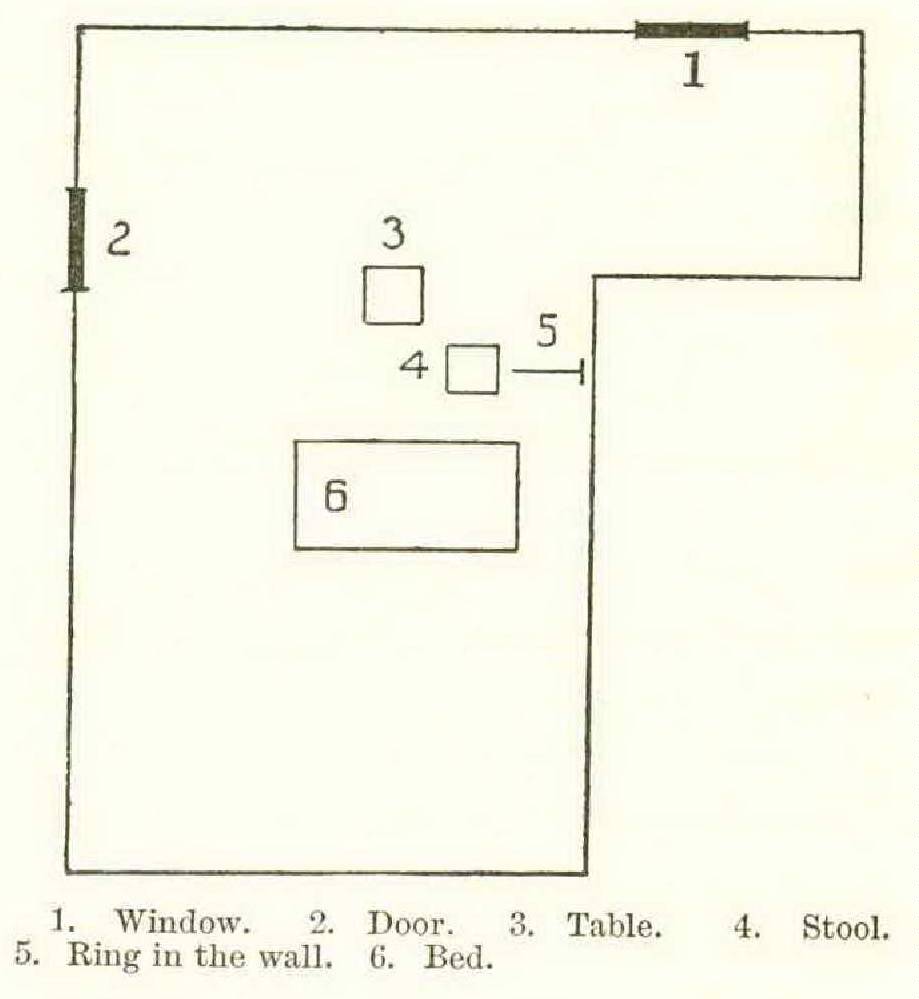
How stiff his arm was, but how little need he had of it! So the hours went by, and he sometimes slept and sometimes watched ; but it was late in the day, although he did not know it, when the tardy light shone in through the small high window of the cell. It was then he saw that just a foot or so away from him was a bed of straw, and on a table stood a candle, and flint and steel. This made up the furniture of his cell, which was a little irregular in shape, and thus arranged : —
Weeks after this, when he had become accustomed to the few sounds that reached him, and could localize them, he knew that he was in the tower of the prison, just where it jutted into the moat, and that the sentry’s walk was along the northern and western walls. The water was off to the north. By the shadows he found that his window was on a level with the ground, and more than once he saw the guard stoop and look down into the cell. So he knew that he was watched. It made him smile to think what a forlorn and monotonous spectacle he must present. He wondered if the guard were discontented, and if it ought not to make him happier to see how much worse off a prisoner could be than even the prisoner’s guard. But he doubted whether sentinels were any more likely than other people to be philosophers.
Once every day an officer and a blacksmith entered his cell; the latter tried his fetters, and once added some additional links, making the chain about six feet long, so that Pedro could enjoy a little more motion and greater ease in lying down. Neither of these men ever spoke, nor did they answer his questions ; so after a time he never cared to speak, and lived in total silence. He lay down very often, because he was greedy of sleep, and in his dreams he was always escaping. One day he was upon his bed, and, as was natural, stared steadily at the wall, thinking of what he should do were he once free. For this poor fellow had no materials, even had he had the knowledge, for writing a history of the world; and had there been spiders or flies, they would not have interested him. He would only have pitied them. There were snails near the window, but he detested them, and dreaded their possible approach to him. So he could only think, and his thoughts burst prison walls and flew out into the world.
One memorable day the sunshine was doubtless brilliant and the sky cloudless, because his cell was unusually light and everything very distinct, so that he saw several cracks and breaks in the masonry which before had escaped his notice. As his eye traveled on its short journeys, he fancied that on the western wall, opposite the foot of his bed, there were some lines made with regularity, as if they were drawn there. He started as though he had heard a voice, and crept over on his knees toward the spot. He went in this way because he could reach farther, as he thus added the length of his leg to that of the chain.
The lines had not deceived him. They were drawn with intention, and they were a plan of his room. But there was another line that he could not understand, and long did he ponder on it. In the night, as he lay awake, it became plain to him, and he sat up on his bed, and gave a great cry that startled the sentry so that he brought the officer of the guard ; and they listened at the window, but for nothing, as Pedro was now silent, and lay like a stone, although his brain was on fire. This was the plan which he found:
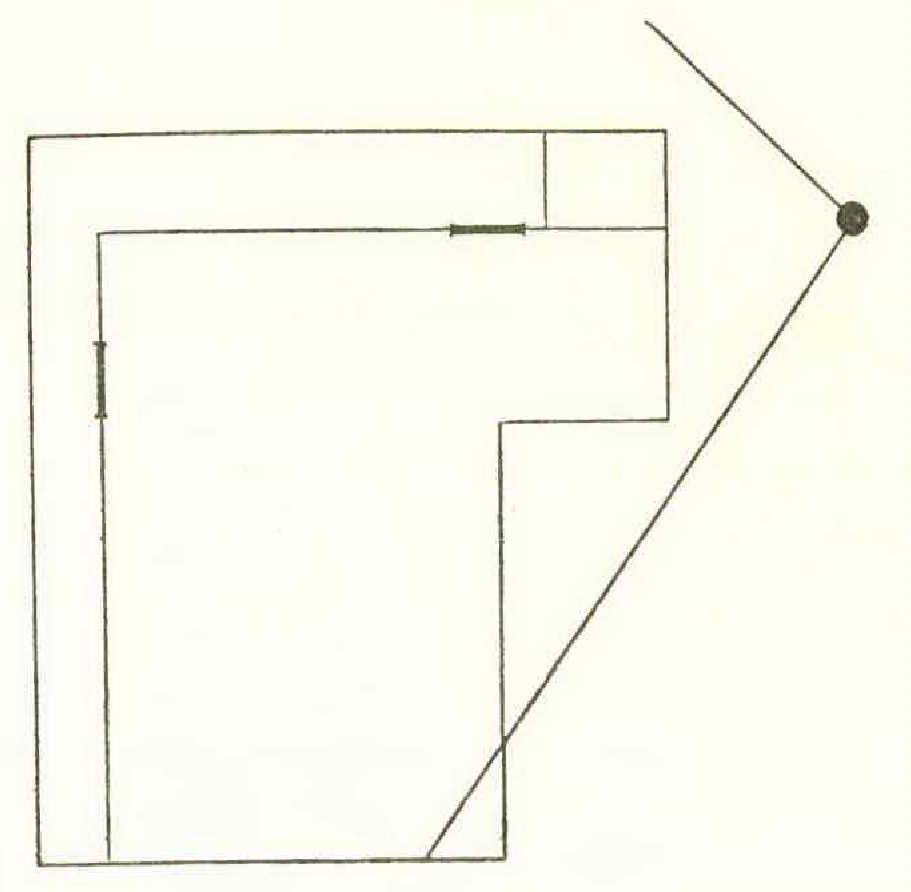
And this was the meaning which dawned upon him : His own room was plain to him, and also the sentinels’ walk around it, and he perceived that the square marked at the northeastern corner must be the guard-house. East of his prison there was, he knew, a paved court-yard, north of it the water. What then was the line starting in the southeastern corner of his cell, and which, making an angle, ended in the moat ? What should it be but a subterranean passage to freedom ?
The thought almost crazed him, and he began to tug at his chains, as if by pulling he could get them apart, but he only tore and wounded his hands. When the day came, he examined his fetters as the blacksmith never dreamed of doing, but vainly. The work was excellent, and not a link would give. So he sat and glared at the corner of his cell where the passage began ; it was as impossible to him as the open gate of the fortress. He crawled toward it ; he stretched out his arms ; and then he drew himself all into a heap on the floor, and cried, sobbing like a child.
When the officer and the blacksmith came, Pedro regarded them with profound scorn. Their precaution was so childish ; yet when they were gone he swore to himself that they should not prevail against him in the end. He stood up, and grasping the ring with both hands, while he braced his foot against the wall, he pulled long and steadily. After a while a small piece of plaster fell on the floor. So every day Pedro pulled at the ring, and he loosened little by little the plaster, and then the stone; he put back the plaster as well as he could, and repaired the breach with bread, so that the blacksmith never perceived the work he was doing. The plaster and crumbled stone which he could not replace he put under his bed ; as he felt the lumps, his bruised body thrilled with expectation.
In less than a month he had pulled the ring from the wall, and the moment it was out he flew across the room, and fell on his hands and knees to examine the ground. The spot did not differ from the rest of the cell, but on the wall was the rough impress of a hand, and one finger pointed downward.
Then he was sure. He saw his way to liberty. It was curious how this discovery calmed him. His feverish excitement faded out, and the fury of baffled desires no longer possessed him. In their stead came a great quiet and steady resolve. The absorption of labor was upon him, and he lived only when he worked; at other times he slept or mused, and the hours passed unheeded.
Now Pedro had discovered, long before, during hours of wakefulness, that before dawn the sentinels were apt to be neglectful and remittent in their walk, and he therefore fixed that time for the beginning of his labor. But better to secure himself, he put the table under the window, the chair upon it, and so managed to climb up and fasten his blanket over the grating, in order to keep his light from being seen. And because he wanted to save his candles he burnt them at no other time, but hid them; otherwise the jailer might have noticed, and not given him one each day, when he brought the loaf of bread and jug of water.
The floor was very hard, and the only tools Pedro had were a broken iron plate and a nail over six inches in length, which he had worked out of a board under his bed ; for the part of the cell where he sat and slept was floored over. But he had his two young, strong hands, and he did good work with them, no mole ever digging better. He toiled hard, but as he had to remove all traces of his labors, he had the less time to dig. After a while he was greatly helped by a discovery which other prisoners have made. He found that he had become so thin and meagre that the band around his ankle no longer fitted, and that he could, with some effort and pain, draw his foot out. Truly it was good to be free of the weight. He sprang into the air, he danced an airy measure, and sang to himself as he danced. It seemed to him as though gravitation were suspended, and only the walls and roof kept him from rising into the upper air.
From this moment he never doubted his escape, perhaps because, being free from his chain, he once more felt command of himself. All his thoughts turned unwavering toward plans for the future, and he worked with a perseverance and cheerfulness that never faltered. Not very far down the river lived Pedro’s cousin, and he had faith that, could he once get to him, he would be as safe as friendship could make him. After that it should be as his kinsman advised and God willed. His belief in the honesty of man was the stronger because he perceived that the plan was honest and faithful. He had to break his way, but he never went astray, for there were indications in irregular stones and looser soil that the way had been burrowed out, and then filled in again. He perceived that a prisoner had once escaped in this way, and that the authorities had discovered it and filled the tunnel again. Nothing was plainer than this, but what amused and strengthened Pedro was the knowledge of how Rodriguez had outwitted himself, and by putting him into this dismal dungeon had himself opened the avenue of release. So (Pedro went on to reason) will malice forever outrun its own goal, and if we will but be patient and faithful Fate or Providence will sometimes take our revenges into its own hand.
Even in the burrow, as he worked, Pedro would laugh, thinking of Rodriguez. But how it happened that his daily inspectors never noticed his hands he could not understand. He could hide his worn and broken finger-nails, but the marks of earth and of digging would not be rubbed from his hands and arms. But the young fellow did not realize how woe-begone and forlorn a figure he was. He was gaunt and wild, his beard was grown, his hair a tangled mass, and his torn and scanty garments were almost fantastic, with their rich texture and ragged condition ; and he was altogether covered with dirt and grime, and bore every mark of misery.
After some weeks he reached the apex of the angle, and there he found a walled-in chamber, narrowing to a pipe-like chimney, many feet high and open to the sky. Looking up, he saw a star, and he breathed an air purer and fresher than any he had breathed since he was thrust into his dungeon. But in this chamber, which was so narrow that he could scarcely turn in it, was a skull and some other bones, and a rosary. Pedro took the rosary in his hand, and looked up at the star overhead.
“ God! ” he said, drawing his breath, “0 God, burn them, burn them in hell, and never show them paradise, except to torture and confound them! ” Then, on the rosary of the dead man who had here been walled up, Espinosa prayed for his soul.
But behold, when he had broken out of this chamber he came to a passage, clear and open, as if the workmen had not thought it worth while to fill up this remote portion. It was higher and larger than the one Pedro had made, and much he wondered what tools his predecessor had used, and where he put the dirt and stones he brought from the excavation. He no longer wormed his way, but could with ease creep on his hands and knees ; and so he went along until he came to a wall, and knew that his work was almost over.
He had now been so long absent from his cell that, he could not delay to examine this wall, and he turned and went back, and found it was daylight, and so late that the jailer came in before he had got his foot well into the chain. But the chain was not the jailer’s affair. and he took no notice, but put down the jug and loaf, and went his way. When the officer and blacksmith came, the prisoner was asleep on the floor, and the men glanced at him; they did not waken him, for the chain was now in its place.
Pedro slept long, for he was very tired ; but when he awoke he felt well rested, and his youth was strong in every muscle of his body. He would have liked to make a toilet before he left his cell, knowing that his work this night would be his last; but he could only empty the jug of water into his hands and well lave his face and neck, and then run his damp fingers through his hair and push it off his brow.
He began to uncover the hole he had made in the floor, but this time carelessly, and with no heed whether the dirt scattered or not, and so he crept into his burrow, the long nail fastened in his belt, the broken plate in his hand; and poor enough tools were these for breaking through a stone wall! In the chamber he paused, and looked up at the star, which shone as yet dimly, the twilight still lingering.
“ Greet your comrades for me,” whispered he in a voice husky and strange for want of use, “ and say I shall see them all to-morrow night.” Then he took the rosary, knowing he should like to have it when he was again a free man.
It was slow and toilsome work breaking through this last wall, but the young fellow had now learned some lessons in quarrying, and he wasted neither time nor strength in idle or futile labor. Every effort told, and little by little the stones loosened and the fissure widened. He could hear sounds that he knew must be footsteps in the guard-house, and once he fancied he heard the dip of oars in the water. As the night grew older, he worked desperately, resolved never to reënter the cell, but to gain the river before daylight. The stones began to give more easily, and he at last thrust his hand into an empty space. Then he knew that he was through the wall. His haste was now nervous and fiery; the stones broke, crumbled, under his strong, eager hands, and he could hardly wait until the aperture was large enough for his body. He felt as though he must thrust himself through, push, pull, drag, himself. Still, he was wise enough to make the opening so large that with a little tugging he got safely out.
It was yet very dark, and he could see no stars. The air was close, and he did not hear the water. He stood still, trying to accustom his eyes to the darkness. Then he put out his right arm and touched a wall; his other arm, and behold, there was another wall; but he was not disconcerted, being sure he had entered some sort of shed or shelter. He could hear no sounds, so he crept softly on, feeling his way by the wall. When he had gone some fifteen feet or thereabouts, he found he was in a corner, and the wall turned. He hardly knew what to make of this, he had been so certain that he was groping his way into the open. Just then his foot struck something that jangled, and he stood stock still in terror; but the noise aroused no one, so he stooped to feel what it was that lay there.
A great terror took him, a hideous horror, and he turned and looked up, — up, through the barred window of his cell — his cell! — dimly outlined in the wan light of the morning.
He gave a loud cry, a horrible shout; at once the door opened, and, as if they had been called, the guard came in. Their torches flared, and Pedro saw the two heaps of rubbish, — the place where he had gone out, and the broken wall where he had come hack. Behind the soldiers came the governor of the fortress, smiling. Pedro sprang at him, and the fingers hardened by tearing out iron, and pulling away stones, and digging into the earth, closed on the throat of the traitor. But Rodriguez had his dagger; out it came, and quick and sharp cut into Pedro’s heart. But the fingers never loosened, so the two men fell down dead together.
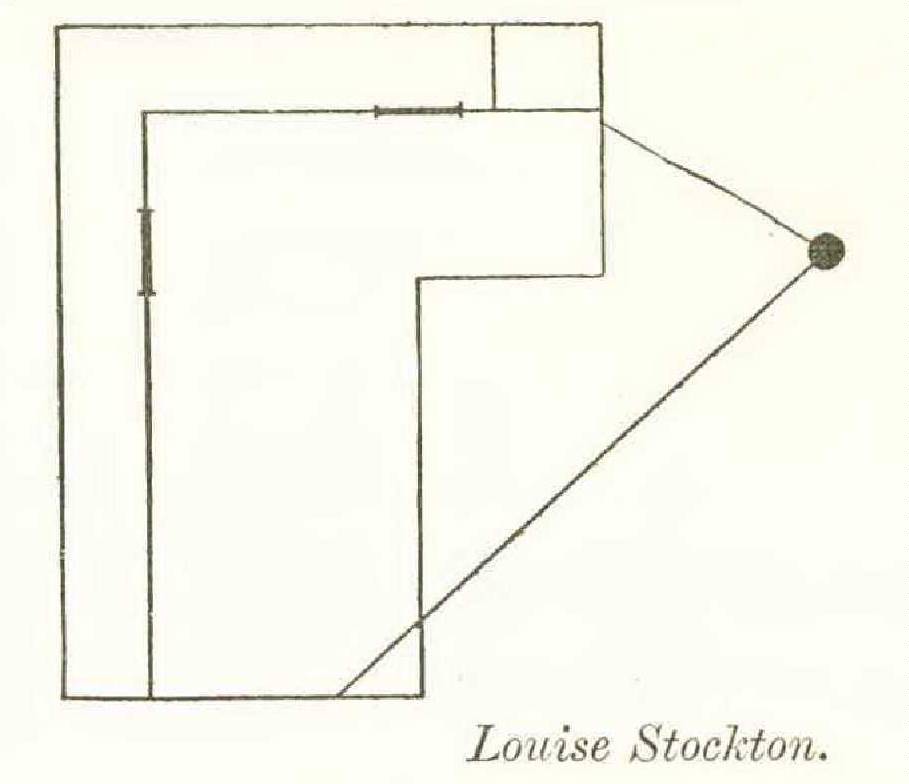
Thus did Don Pedro Espinosa, a grandee of Spain, gain his liberty, and by a road for which he had not looked did he put himself out of the reach of his jailer; but what happened next I cannot tell. Whether the two foes, at once and again, fell on each other, or whether they instantly parted, and without a backward glance went each on his own road, I know not. If they again fell into fight, Pedro must now have had the odds, seeing how much purer and stronger was his spirit, and how much more ardent and fiery was the nature God had given him. I could fancy that Rodriguez, all his armor, his plans, and stratagems left behind, and no longer supported by his soldiers, but taken alone, would show without disguise what a craven he could be. Indeed, no worse coward than he was ever born, because Pedro had once summoned him to equal fight, and that is better grace than most young noblemen would grant a traitor ; and instead of meeting him. the creature got him first into the prison, and then into this devil’s trap and excavated passage, of which the true plan was well known to Rodriguez. I have thought that had we wanted any further proof of the baseness of this man than his conduct toward Espinosa shows, we should have it in his knowledge of this most diabolic device. Vile secrets, when they are to be shared, are told to the vile, and Pedro might have been governor of the fortress all the days of his life, and never have known of this trap, except there had been intention to have destroyed it.
The whole scheme, as can be readily seen, was of the simplest character, but well calculated to deceive a man digging in the dark and without measurements, and that on a route pre-arranged for him.
The plan in the possession of Rodriguez was made in this manner : —
Louise Stockton .