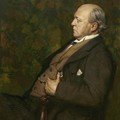
The Tragic Muse
XI.
WHEN she had descended into the street with Sherringham, Miriam informed him that she was thirsty, dying to drink something: upon which he asked her if she would have any objection to going with him to a café.
“Objection? I have spent my life in cafés ! ” she exclaimed. “ They are warm in winter, and they are full of gaslight. Mamma and I have sat in them for hours, many a time, with a consommation of three sous, to save fire and candles at home. We have lived in places we could n’t sit in, if you want to know — where there was only really room if we were in bed. Mamma’s money is sent out from England, and sometimes it did n’t come. Once it did n’t come for months — for months and months. I don’t know how we lived. There was n’t any to come ; there was n’t any to get home. That is n’t amusing when you 're away, in a foreign town, without any friends. Mamma used to borrow, but people would n’t always lend. You need n’t be afraid — she won’t borrow from you. We are rather better now. Something has been done in England; I don’t understand what. It’s only fivepence a year, but it has been settled ; it comes regularly; it used to come only when we had written and begged and waited. But it made no difference; mamma was always up to her ears in books. They served her for food and drink. When she had nothing to eat she began a novel in ten volumes — the old-fashioned ones ; they lasted longest. She knows every cabinet de lecture in every town ; the little cheap, shabby ones, I mean, in the back streets, where they have odd volumes and only ask a sou, and the books are so old that they smell bad. She takes them to the cafés — the little cheap, shabby cafés, too — and she reads there all the evening. That’s very well for her, but it does n’t feed me. I don’t like a diet of dirty old novels. I sit there beside her, with nothing to do, not even a stocking to mend ; she does n’t think that’s comme il faut. I don’t know what the people take me for. However, we have never been spoken to : any one can see mamma ’s a lady. As for me, I dare say I might be anything. If you 're going to be an actress, you must get used to being looked at. There were people in England who used to ask us to stay ; some of them were our cousins — or mamma says they were. I have never been very clear about our cousins, and I don’t think they were at all clear about us. Some of them are dead ; the others don’t ask us any more. You should hear mamma on the subject of our visits in England. It’s very convenient when your cousins are dead, because that explains everything. Mamma has delightful phrases: ' My family is almost extinct.’ Then your family may have been anything you like. Ours, of course, was magnificent. We did stay in a place once where there was a deer-park, and also private theatricals. I played in them; I was only fifteen years old, but I was very big, and I thought I was in heaven. I will go anywhere you like ; you need n’t be afraid, we have been in places ! I have learned a great deal that way ; sitting beside mamma and watching people, their faces, their types, their movements. There’s a great deal goes on in cafés ; people come to them to talk things over, their private affairs, their complications ; they have important meetings. Oh, I’ve observed scenes, between men and women — very quiet, terribly quiet, but tragic ! Once I saw a woman do something that I 'm going to do some day, when I 'm great — if I can get the situation. I ’ll tell you what it is some day ; I ’ll do it for you. Oh, it is the book of life ! ”
So Miriam discoursed, familiarly, disconnectedly, as the pair went their way down the Rue de Constantinople ; and she continued to abound in anecdote and remark after they were seated, face to face, at a little marble table in an establishment which Sherringham selected carefully, and he had caused her, at her request, to be accommodated with sirop d’orgeat. “ I know what it will come to: Madame Carré will want to keep me.” This was one of the announcements she presently made.
“ To keep you ? ”
“ For the French stage. She won’t want to let you have me.” She said things of that kind, astounding in selfcomplacency, the assumption of quick success. She was in earnest, evidently prepared to work, but her imagination flew over preliminaries and probations, took no account of the steps in the process, especially the first tiresome ones, the test of patience. Sherringham had done nothing for her as yet, given no substantial pledge of interest; yet she was already talking as if his protection were assured and jealous. Certainly, however, she seemed to belong to him very much indeed, as she sat facing him in the Paris café, in her youth, her beauty and her talkative confidence. This degree of possession was highly agreeable to him, and he asked nothing more than to make it last and go further. The impulse to draw her out was irresistible, to encourage her to show herself to the end; for if he was really destined to take her career in hand he counted on some pleasant equivalent — such, for instance, as that she should at least amuse him.
“ It’s very singular ; I know nothing like it,” he said — “your equal mastery of two languages.”
“ Say of half a dozen,” Miriam smiled.
“ Oh, I don’t believe in the others, to the same degree. I don’t imagine that, will all deference to your undeniable facility, you would be judged fit to address a German or an Italian audience in their own tongue. But you might a French, perfectly, and they are the most particular of all; for their idiom is supersensitive, and they are incapable of enduring the baragouinage of foreigners, to which we listen with such complacency. In fact, your French is better than your English — it’s more conventional ; there are little queernesses and impurities in your English, as if you had lived abroad too much. All, you must work that.”
“ I ’ll work it with you. I like the way you speak.”
“You must speak beautifully; you must do something for the standard.”
“ For the standard ? ”
“ There is n’t any, after all; it has gone to the dogs.”
“ Oh, I 'll bring it back. I know what you mean.”
“ No one knows, no one cares ; the sense is gone — it is n’t in the public, Sherringham continued, ventilating a grievance he was rarely able to forget, the vision of which now suddenly made a mission, full of sanctity, for Miriam Rooth. “ Purity of speech, on our stage, does n’t exist. Every one speaks as he likes, and audiences never notice; it, ’s the last thing they think of. The place is given up to abominable dialects and individual tricks, any vulgarity flourishes, and on top of it all the Americans, with every conceivable crudity, come in to make confusion worse confounded. And when one laments it, people stare ; they don t know what one means.”
“ Do you mean the grand manner, certain pompous pronunciations, the style of the Kembles ? ”
“ I mean any style that is a style, that is a system, an art, that contributes a positive beauty to utterance. When I pay ten shillings to hear you speak, I want you to know how, que diable! Say that to people, and they are mostly lost in stupor ; only a few, the very intelligent ones, exclaim, ‘ Then do you want actors to he affected ? ’ ”
“ And do you ? ” asked Miriam, full of interest.
“ My poor child, what else, under the sun, should they be ? Isn’t their whole art the affectation par excellence ? The public won’t stand that to-day, so one hears it said. If that be true, it simply means that the theatre, as I care for it, that is as a personal art, is at an end.”
“Never, never, never!" the girl cried, in a voice that made a dozen people look round.
“I sometimes think it — that the personal art is at an end, and that henceforth we shall have only the arts — capable, no doubt, of immense development in their way (indeed they have already reached it) — of the stage-carpenter and the costumer. In London the drama is already smothered in scenery ; the interpretation comes off as it can. To get the old personal impression, which used to be everything, you must go to the poor countries, and most of all to Italy.”
“Oh, I ve had it; it ’s very personal ! said Miriam, knowingly.
“ You ‘ve seen the nudity of the stage, the poor painted, tattered screen behind, and in the empty space the histrionic figure, doing everything it knows how, in complete possession. The personality is n’t our English personality, and it may not always carry us with it: but the direction is right, and it has the superiority that it’s a human exhibition, not a mechanical one.”
“ I can act just like an Italian.” said Miriam, eagerly.
“ I would rather you acted like an Englishwoman, it an Englishwoman would only act.”
“ Oh. I’ll show you !
“ But you ’re not English,” said Sherringham, sociably, with his arms on the table.
“ I beg your pardon ; you should hear mamma about our ' race.’ ”
“ You 're a Jewess — I 'm sure of that,” Sherringham went on.
She jumped at this, as he was destined to see, later, that she would jump at anything that would make her more interesting or striking ; even at things which, grotesquely, contradicted or excluded each other. “ That ’s always possible, if one’s clever. I ’m very willing, because I want to be the English Rachel.”
“ Then you must leave Madame Carré, as soon as you have got from her what she can give.”
“ Oh, you needn’t fear; you shan’t lose me,”the girl replied, with gross, charming fatuity. “ My name is Jewish,”she went on, “ but it was that of my grandmother, my father’s mother. She was a baroness, in Germany. That is, she was the daughter of a baron.”
Sherringham accepted this statement with reservations, but he replied, Put all that together, and it makes you very sufficiently of Rachel’s tribe.”
“ I don’t care, if I’m of her tribe artistically. I’m of the family of the artists ; je me fiche of any other ! I ’m in the same style as that woman ; I know it.”
“ You speak as if you had seen her,” said Sherringham, amused at the way she spoke of “ that woman.”
“ Oh, I know all about her ; I know all about all the great actors. But that won 't prevent me from speaking divine English.”
“ You must learn lots of verse ; you must repeat it to me,” Sherringham went on. “ You must break yourself in till you can say anything. You must learn passages of Milton, passages of Wordsworth.”
“ Did they write plays?”
“Oh, it isn’t only a matter of plays! You can’t speak a part properly till you can speak everything else, anything that comes up, especially in proportion as it ’s difficult. That gives you authority.”
“ Oh, yes, I 'm going in for authority. There ’s more chance in English,” the girl added, in the next breath. “ There are not so many others — the terrible competition. There are so many here — not that I’m afraid,” she chattered on. “ But we 've got America, and they have n’t. America’s a great place.”
“ You talk like a theatrical agent. They 're lucky not to have it as we have it. Some of them do go, and it ruins them.”
“ Why, it fills their pockets ! ” Miriam cried.
“Yes, but see what they pay. It’s the death of an actor to play to big populations that don’t understand his language. It’s nothing then but the gros moyens ; all his delicacy perishes. However. they ’ll understand you.”
“ Perhaps I shall be too affected,” said Miriam.
“ You won’t be more so than Garrick, or Mrs. Siddons, or John Kemble, or Edmund Kean. They understood Edmund Kean. All reflection is affectation, and all acting is reflection.”
“ I don’t know : mine is instinct,” Miriam replied.
“ My dear young lady, you talk of ‘ yours ; ’ but don’t be offended if I tell you that yours does n’t exist. Some day it will, if it comes off. Madame Carré’s does, because she has reflected. The talent, the desire, the energy are an instinct ; but by the time these things become a performance they are an instinct put in its place.”
“ Madame Carre is very philosophic. I shall never be like her.”
“ Of course you won’t ; you ’ll be original. But you 'll have your own ideas.”
“ I dare say I shall have a good many of yours,” said Miriam, smiling across the table.
They sat a moment, looking at each other.
“ Don’t go in for coquetry ; it ’s a waste of time.”
“ Well, that’s civil! ” the girl cried.
“ Oh, I don’t mean for me ; I mean for yourself. I want you to be so concentrated. I am bound to give you good advice. You don’t strike me as flirtatious and that sort of thing, and that’s in your favor.”
“ In my favor ? ”
“ It does save time.”
“ Perhaps it saves too much. Don’t you think the artist ought to have passions ? ”
Sherringham hesitated a moment; he thought an examination of this question premature. “ Flirtations are not passions,’’ he replied. " No, you are simple — at least I suspect you are ; for of course, with a woman, one would be clever to know.” She asked why he pronounced her simple, but he judged it best, and more consonant with fair play, to defer even a treatment of this branch of the question ; so that, to change the subject, he said, “ Be sure you don’t betray me to your friend Mr. Nash.”
“ Betray you ? Do you mean about your recommending affectation ? ”
“Dear me, no; he recommends it himself. That is, he practices it, and on a scale ! ”
“ But he makes one hate it.”
“ He proves what I mean,” said Sherringham : “ that the great comedian is the one who raises it to a science. If we paid ten shillings to listen to Mr. Nash, we should think him very fine. But we want to know what it’s supposed to be.”
“ It’s too odious, the way he talks about us! ” Miriam cried, assentingly.
“ About ‘ us ’ ? ”
“ Us poor actors.”
“ It’s the competition he dislikes,” said Sherringham, laughing.
“ However, he is very good-natured ; he lent mamma ten pounds,”the girl added, honestly. Sherringham, at this information, was not able to repress a certain small twinge, which his companion perceived and of which she appeared to mistake the meaning. “ Of course he 'll get it back,” she went on, while Sherringham looked at her in silence for a minute. Fortune had not supplied him profusely with money, but his emotion was not caused by the apprehension that he too would probably have to put his hand in his pocket for Mrs. Rooth. It was simply the instinctive recoil of a fastidious nature from the idea of familiar intimacy with people who lived from hand to mouth, and a sense that that intimacy would have to be defined, if it was to go much further.
He would wish to know what it was supposed to be, like Gabriel Nash’s histrionics. After a moment Miriam mistook his thought still more completely, and in doing so gave him a flash of foreknowledge of the way it was in her to strike from time to time a note exasperatingly, almost consciously vulgar, which one would hate for the reason, among others, that by that time one would be in love with her. “ Well, then, he won’t — if you don’t believe it! ” she exclaimed, with a laugh. He was saying to himself that the only possible form was that they should borrow only from him. “ You ’re a funny man. I make you blush,” Miriam persisted.
“ I must reply with the tu quoque, though I have not that effect on you.”
“ I don’t understand,” said the girl.
“ You ’re an extraordinary young lady.”
” You mean I’m horrid. Well. I dare say I am. But I’m better when you know me.”
Sherringham made no direct rejoinder to this, but after a moment he said, “ Your mother must repay that money. I ’ll give it to her.”
“ You had better give it to him! ” cried Miriam. “ If once we have it ” — She interrupted herself, and with another and a softer tone, one of her dramatic transitions, she remarked, “ I suppose you have never known any one that’s poor.”
“ I’m poor myself. That is, I’m very far from rich. But why receive favors ” — And here he, in turn, checked himself, with the sense that he was indeed taking a great deal on his back if he pretended already (he had not seen the pair three times) to regulate their intercourse with the rest of the world. But Miriam instantly carried out his thought, and more than his thought.
“ Favors from Mr. Nash ? Oh, he does n’t count! ”
The way she dropped these words (they would have been admirable on the stage) made him laugh and say, immediately, “ What I meant just now was that you are not to tell him, after all my swagger, that I consider that you and I are really required to save our theatre.”
“ Oh, if we can save it, he shall know it! ” Then Miriam’ added that she must positively get home; her mother would be in a state; she had really scarcely ever been out alone. He might n’t think it, but so it was. Her mother’s ideas, those awfully proper ones, were not all talk. She did keep her ! Sherringham accepted this — he had an adequate, and indeed an analytic vision of Mrs. Rooth’s conservatism ; but he observed at the same time that his companion made no motion to rise. He made none, either ; he only said —
“ We are very frivolous, the way we chatter. What you want to do, to get your foot in the stirrup, is supremely difficult. There is everything to overcome. You have neither an engagement nor the prospect of an engagement.”
“ Oh, you ’ll get me one ! ” Miriam’s manner expressed that this was so certain that it was not worth dilating upon ; so, instead of dilating, she inquired, abruptly, a second time, “ Why do you think I 'm so simple ? ”
“ I don’t, then. Did n’t I tell you just now that you were extraordinary ? That’s the term, moreover, that you applied to yourself, when yon came to see me — when you said a girl had to be, to wish to go on the stage. It remains the right one, and your simplicity does n’t mitigate it. What ’s rare in you is that you have — as I suspect, at least — no nature of your own.” Miriam listened to this as if she were preparing to argue with it or not, only as it should strike her as being a pleasing picture ; but as yet, naturally, she failed to understand. “You are always playing something; there are no intervals. It’s the absence of intervals, of a fond or background, that I don’t comprehend. You ’re an embroidery without a canvas.”
“ Yes, perhaps,” the girl replied, with her head on one side, as if she were looking at the pattern. “ But I 'm very honest.”
“ You can’t be everything, a consummate actress and a flower of the field. Yon’ve got to choose.”
She looked at him a moment. " I ’m glad you think I’m so wonderful.”
“ Your feigning may he honest, in the sense that your only feeling is your feigned one,” Sherringham went on. " That’s what I mean by the absence of a ground or of intervals. It’s a kind of thing that’s a labyrinth ! ”
“ I know what I am,” said Miriam, sententionsly.
But her companion continued, following his own train : " Were you really so frightened, the first day you went to Madame Carré’s ? ”
She stared a moment, and then, with a flush, throwing back her head, “ Do you think I was pretending ? ”
“ I think you always are. However, your vanity (if you had any I) would be natural.”
“ I have plenty of that — I am not ashamed to own it.”
“ You would be capable of pretending that you have! But excuse the audacity and the crudity of my speculations— it only proves my interest. What is it that you know you are ? ”
“ Why, an artist. Is n’t that a canvas ? ”
It Yres, an intellectual one, but not a moral.”
“ Oh yes, it is, too. And I ’m a good girl: won’t that do? ”
“ It remains to he seen! ” Sherringham laughed. “ A creature who is all an artist — I am curious to see that.”
“ Surely it has been seen, in lots of painters, lots of musicians.”
“ Yes, but those arts are not personal, like yours. I mean not so much so.
There is something left for — what shall I call it? — for character.”
Miriam stared again, with her tragic light. " And do you think I’ve got no character ? ” As he hesitated she pushed back her chair, rising rapidly.
He looked up at her an instant — she seemed so " plastic ; ” and then, rising too, he answered, “ Delightful being, you’ve got a hundred! ”
XII.
The summer arrived and the dense air of the Paris theatres became, in fact, a still more complicated mixture ; yet the occasions were not few on which Peter Sherringham, having placed a box, near the stage (most often a stuffy, dusky baignoire), at the disposal of Mrs. Booth and her daughter, found time to look in, as he said, to spend a part of the evening with them and point the moral of the performance. The pieces, the successes of the winter, had entered the perfunctory phase : they went on by the force of the impetus acquired, deriving little fresh life from the interpretation, and in ordinary conditions their strong points, as rendered by the actors, would have been as wearisome to Sherringham as an importunate repetition of a good story. But it was not long before he became aware that the conditions could not be regarded as ordinary. There was a new infusion in his consciousness — an element in his life which altered the relations of things. He was not easy till he had found the right name for it — a name the more satisfactory that it was simple, comprehensive and plausible. A new “ distraction ” was what he flattered himself he had discovered ; he could recognize that as freely as possible without being obliged to classify the agreeable resource as a new entanglement. He was neither haunted nor demoralized ; he had all his usual attention to give to his work : he had only an employment for his odd hours, which, without being imperative, had, over various others, the advantage of a certain continuity.
And yet, I hasten to add, he was not so well pleased with it but that, among his friends, he maintained for the present a considerable reserve in regard to it. He had no irresistible impulse to tell people that he had disinterred a strange, handsome girl whom he was bringing up for the theatre. She had been seen by several of his associates, at his rooms ; but she was not soon to he seen there again. Sherringliam’s reserve might by the ill-natured have been termed dissimulation, inasmuch as when asked by the ladies of the embassy what had become of the young person who amused them, that day, so cleverly, he gave it out that her whereabouts was uncertain and her destiny probably obscure ; he let it be supposed, in a word, that his interest in Miss Rooth had scarcely survived an accidental, charitable occasion. As he went, about his customary business, and perhaps even put a little more conscience into the transaction of it, there was nothing to suggest to his companions that he was engaged in a private speculation of a singular kind. It was perhaps his weakness that he carried the apprehension of ridicule too far; but his excuse may be said to be that he held it unpardonable for a man publicly enrolled in the service of his country to be ridiculous. It was of course not out of all order that such functionaries, their private situation permitting, should enjoy a personal acquaintance with stars of the dramatic, the lyric, or even the elioregraphic stage : high diplomatists had indeed not rarely, and not invisibly, cultivated this privilege without its proving the sepulchre of their reputation. That a gentleman who was not a fool should consent a little to become one for the sake of a celebrated actress or singer — cela s’était vu, though it was not perhaps to be recommended. It was not a tendency that was encouraged at headquarters, and it was scarcely open to the cleverest young men to pile up material for a scandal. Still, it might pass, if it were kept in its place ; and there were ancient worthies yet in the profession (not those, however, whom the tradition had helped to go furthest) who held that something of the sort was a graceful ornament of the diplomatic character. Sherringham was aware that he was one of the cleverest young men ; but Miriam Rooth was not yet a celebrated actress. She was only a youthful artist, in conscientious process of formation, encumbered with a mother still more conscientious than herself. She was a young English lady, very earnest about artistic, about remunerative problems. He had accepted the position of a formative influence; and that was precisely what might provoke a smile. He was a ministering angel — his patience and goodnature really entitled him to the epithet, and his rewards would doubtless some day define themselves ; but meanwhile other promotions were in contingent prospect, for the failure of which these would not, even in their abundance, be a compensation. He kept an undiverted eye upon Downing Street; and while it may frankly be said for him that he was neither a pedant nor a prig, he remembered that the last impression he ought to wish to produce there was that of frivolity.
He felt not particularly frivolous, however, when he sat behind Miriam at the play, and looked over her shoulder at the stage ; her observation being so keen and her comments so unexpected in their vivacity that his curiosity was refreshed and his attention stretched beyond its wont. If the spectacle before the footlights had now lost much of its annual brilliancy, the fashion in which Miriam followed it came near being spectacle enough. Moreover, in most cases the attendance of the little party was at the Théâtre Français ; and it has been sufficiently indicated that Sherringham, though the child of a skeptical age and the votary of a cynical science, was still candid enough to take the serious, the religious view of that establishment — the view of M. Sarcey and of the unregenerate provincial mind. “ In the trade that I follow we see things too much in the hard light of reason, of calculation,”he once remarked to his young companion ; “ but it’s good for the mind to keep up a superstition or two ; it leaves a margin, like having a second horse to your brougham, for night-work. The arts, the amusements, the æsthetic part of life, are night-work, if I may say so without suggesting the nefarious. At any rate, you want your second horse — your superstition that stays at home when the sun is high — to go your rounds with. The Théâtre Français is my second horse.”
Miriam’s avidity for this pleasure showed him vividly enough how rarely, in the past, it had been within her reach ; and she pleased him, at first, by liking everything, seeing almost no differences, and taking her deep draught undiluted. She leaned on the edge of the box with a sort of bright voracity; devouring both the story and the manner of the telling, watching each movement of each actor, attending to the way each thing was said or done as if it were the most important thing, and emitting from time to time applausive or protesting sounds. It was a very pretty .exhibition of enthusiasm, if enthusiasm be ever critical. Sherringham had his wonder about it, as it was a part of the attraction exerted by this young lady that she caused him to have his wonder about everything she did. Was it in fact an exhibition, a line taken for effect, so that, at the comedy, her own comedy was the most successful of all ? That question danced attendance on the liberal intercourse of these young people, and fortunately, as yet, did little to embitter Sherringham’s share of it. His general sense that she was personating had its especial moments of suspense and perplexity, and added variety and even occasionally a degree of excitement to their conversation. At the theatre, for the most part, she was really flushed with eagerness; and with the spectators who turned an admiring eye into the dim compartment of which she pervaded the front, she might have passed for a romantic, or at any rate an insatiable, young woman from the country.
Mrs. Rooth took a more placid view, but attended immensely to the story, in respect to which she manifested a patient good faith which had its surprises and its comicalities for Sherringham. She found no play too tedious, no entr’acte too long, no baignoire too hot, no tissue of incidents too complicated, no situation too unnatural and no sentiments too sublime. She gave Sherringham the measure of her power to sit and sit — an accomplishment to which she owed, in the struggle for existence, such superiority as she might be said to have achieved. She could outsit every one, everything else ; looking as if she had acquired the practice in repeated years of small frugality combined with large leisure — periods when she had nothing but time to spend, and had learned to calculate, in any situation, how long she could stay. “Staying” was so often a saving —a saving of candles, of fire, and even (for it sometimes implied a vision of light refreshment) of food. Sherringham perceived soon enough that she was complete, in her way, and if he had been addicted to studying the human mixture in its different combinations he would have found in her an interesting compendium of some of the infatuations that survive a hard discipline. He made, indeed, without difficulty, the reflection that her life might, have taught her the reality of things, at the same time that he could scarcely help thinking it clever of her to have so persistently declined the lesson. She appeared to have put it by with a deprecating, ladylike smile — a plea of being too soft and bland for experience.
She took the refined, sentimental, tender view of the universe, beginning with her own history and feelings. She believed in everything high and pure, disinterested and orthodox, and even at the Hotel de la Mayenne was unconscious of the shabby or the ugly side of the world. She never despaired : otherwise what would have been the use of being a Neville-Nugent ? Only not to have been one — that would have been discouraging. She delighted in novels, poems, perversions, misrepresentations and evasions, and had a capacity for smooth, superfluous falsification which made Sherringham think her sometimes an amusing and sometimes a tedious inventor. But she was not dangerous, even if you believed her ; she was not even a warning, if you did n’t. It was harsh to call her a hypocrite, because you never could have resolved her back into her character; there was no reverse to her blazonry. She built in the air, and was not less amiable than she pretended ; only that was a pretension too. She moved altogether in a world of genteel fable and fancy, and Sherringham had to live in it with her, for Miriam’s sake, in sociable, vulgar assent, in spite of his feeling that it was rather a low neighborhood. He was at a loss how to take what she said — she talked, sweetly and discursively, of so many things — until he simply perceived that he could only take it, always, for untrue. When Miriam laughed at her, he was rather disagreeably affected : “ dear mamma’s fine stories” was a sufficiently cynical reference to the immemorial infirmity of a parent. But when the girl backed her up, as he phrased it to himself, ho liked that even less.
Mrs. Rooth was very fond of a moral, and had never lost her taste for edification. She delighted in a beautiful character, and was gratified to find so many represented in the contemporary French drama. She never failed to direct Miriam’s attention to them and to remind her that there is nothing in life so precious as the ideal. Sherringham noted the difference between the mother and the daughter and thought it singularly marked — the way that one took everything for the sense, or behaved as if she did, caring above all for the subject and the romance, the triumph or defeat of virtue, and the moral comfort of it all, and that the other was especially hungry for the manner and the art of it, the presentation and the vividness. Mrs. Rooth abounded in impressive evocations, and yet he saw no link between her facile genius and that of which Miriam gave symptoms. The poor lady never could have been accused of successful deceit, whereas success in this line was exactly what her clever child went in for. She made even the true seem fictive, while Miriam’s effort was to make the fictive true. Sherringham thought it an odd, unpromising stock (that of the Is NevilleNugents) for a dramatic talent to have sprung from, till he reflected that the evolution was after all natural: the figurative impulse in the mother had become conscious, and therefore higher, through finding an aim. which was beauty, in the daughter. Likely enough the Hebraic Mr. Rooth, with his love of old pots and Christian altar-cloths, had supplied, in the girl’s composition, the aesthetic element, the sense of form. In their visits to the theatre there was nothing that Mrs. Rooth more insisted upon than the unprofitableness of deceit, as shown by the most distinguished authors — the folly and degradation, the corrosive effect upon the spirit, of tortuous ways. Sherringham very soon gave up the futile task of piecing together her incongruous references to her early life and her family in England. He renounced even the doctrine that there was a residuum of truth in her claim of great relationships, for, existent or not, he cared equally little for her ramifications. The principle of this indifference was at bottom a certain desire to disconnect Miriam; for it was disagreeable not to be independent in dealing with her, and he could be fully so only if she was.
The early weeks of that summer (they went on, indeed, into August) were destined to establish themselves in his memory as a season of pleasant things. The ambassador went away, and Sherringham had to wait for his own holiday, which he did, during the hot days, contentedly enough, in spacious halls, with a dim, bird-haunted garden. The official world and most other worlds withdrew from Paris, and the Place de la Concorde, a larger, whiter desert than ever, became, by a reversal of custom, explorable with safety. The Champs Elysées were dusty and rural, with little creaking booths and exhibitions which made a noise like grasshoppers ; the Arc de Triomphe threw its cool, sharp shadow for a mile ; the Palais de l’lndustrie glittered in the light of the long days ; the cabmen, in their red waistcoats, dozed in their boxes ; and Sherringham permitted himself a “pot" hat and rarely met a friend. Thus was Miriam still more disconnected, and thus was it possible to deal with her still more independently. The theatres on the boulevard closed, for the most part, but the great temple of the Rue de Richelieu, with an æsthetic responsibility, continued imperturbably to dispense examples of style. Madame Carré was going to Vichy, but she had not yet taken flight, which was a great advantage for Miriam, who could now solicit her attention with the consciousness that she had no engagements en ville.
“ I make her listen to me — I make her tell me,”said the ardent girl, who was always climbing the slope of the Rue de Constantinople, on the shady side, where, in the July mornings, there was a smell of violets from the moist flower-stands of fat, white-capped bouquetières, in the angles of doorways. Miriam liked the Paris of the summer mornings, the clever freshness of all the little trades and the open-air life, the cries, the talk from door to door, which reminded her of the south, where, in the multiplicity of her habitations, she had lived ; and most of all, the great amusement, or nearly, of her walk, the enviable baskets of the laundress, piled up with frilled and fluted whiteness — the certain luxury, she felt as she passed, with quick prevision, of her own dawn of glory. The greatest amusement, perhaps, was to recognize the pretty sentiment of earliness, the particular congruity with the hour, in the studied, selected dress of the little tripping women who were taking the day, for important advantages, while it was tender. At any rate, she always brought with her, from her passage through the town, good humor enough (with the penny bunch of violets that she stuck in the front of her dress) for whatever awaited her at Madame Carre’s. She told Sherringham that her dear mistress was terribly severe, giving her the most difficult, the most exhausting exercises — showing a kind of rage for breaking her in.
“So much the better.” Sherringham answered ; but he asked no questions, and was glad to let the preceptress and the pupil fight it out together. He wanted, for the moment, to know as little as possible about them ; he had been overdosed with knowledge, that second day he saw them together. He would send Madame Carré her money (she was really most obliging), and in the mean time he was conscious that Miriam could take care of herself. Sometimes he remarked to her that she need n’t always talk “ shop ” to him: there were times when he was very tired of shop — of hers. Moreover, he frankly admitted that he was tired of his own, so that the restriction was not brutal. When she replied, staring. “ Why, I thought, you considered it as such a beautiful, interesting art! ” he had no rejoinder more philosophic than “ Well, I do; but there are moments when I’m sick of it, all the same.” At other times he said to her, " Oh, yes, the results, the finished thing, the dish perfectly seasoned and served: not the mess of preparation — at least not always — not the experiments that spoil the material.”
“ I thought you thought just these questions of study, of the artistic education, as you have called it to me, so fascinating,” the girl persisted. Sometimes she was very lucid.
“ Well, after all I am not an actor myself,” Sherringham answered, laughing.
“ You might be one if you were serious,” said Miriam. To this her friend replied that Mr. Gabriel Nash ought to hear that: which made her exclaim, with a certain grimness, that she would settle him and his theories some day. Not to seem too inconsistent—•for it was cruel to bewilder her when he had taken her up to enlighten — Sherringham repeated over that for a man like himself the interest of the whole thing depended on its being considered in a large, liberal way, with an intelligence that lifted it out of the question of the little tricks of the trade, gave it beauty and elevation. Miriam let him know that Madame Carré held that there were no little tricks: that everything had its importance as a means to a great end ; and that if you were not willing to try to approfondir the reason why, in a given situation, you should scratch your nose with your left hand rather than with your right, you were not worthy to tread any stage that respected itself.
“ That’s very well; but if I must go into details read me a little Shelley,” said the young man, in the spirit of a high raffiné.
“You are worse than Madame Carré; you don’t know what to invent; between you, you’ll kill me ! ” the girl declared. “ I think there ’s a secret league between you to spoil my voice, or at least to weaken my wind, before I get it. But à la guerre comme à la guerre ! How can I read Shelley, however, when I don’t understand him ? ”
“That’s just what I want to make you do. It. ’s a part of your general training. You may do without that, of course — without culture and taste and perception ; but in that case you 'll be nothing but, a vulgar cabotine, and nothing will be of any consequence.” Sherringham had a theory that the great lyric poets (he induced her to read, and recite as well, long passages of Wordsworth and of Swinburne) would teach her many of the secrets of competent utterance, the mysteries of rhythm, the communicableness of style, the latent music of the language and the art of “ composing ” copious speeches and of keeping her breath in hand. He held, in perfect sincerity, that there was an indirect enlightenment which would be of the highest importance to her, and to which it was precisely, by good fortune. in his power to contribute. She would do better in proportion as she had more knowledge — even knowledge that might appear to have but a remote connection with her business. The actor’s talent was essentially a gift, a thing by itself, implanted, instinctive, accidental, equally unconnected with intellect and with virtue — Sherringham was completely of that opinion, but it seemed to him no contradiction to consider at the same time that intellect, (leaving virtue, for the moment, out of the question) might be brought into fruitful relation with it. It would be a larger thing if a better mind were projected upon it—without sacrificing the mind. So he lent Miriam books, which she never read (she was on almost irreconcilable terms with the printed page), and in the long summer days, when he had leisure, took her to the Louvre to admire the great works of painting and sculpture. Here, as on all occasions, he was struck with the queer jumble of her mind, her mixture of intelligence and puerility. He saw that she never read what he gave her, though she sometimes would have liked him to suppose so ; but in the presence of famous pictures and statues she had remarkable flashes of perception. She felt these things, she liked them, though it was always because she had an idea she could use them. The idea was often fantastic, but it showed what an eye she had to her business. " I could look just like that, if I tried.” “That’s the dress I mean to wear when I do Portia.” Such were the observations that were apt to drop from her under the suggestion of antique marbles or when she stood before a Titian or a Bonifazio.
When she uttered them, and many others besides, the effect was sometimes irritating to Sherringham, who had to reflect a little to remember that she was no more egotistical than the histrionic conscience demanded. He wondered if there were necessarily something vulgar in the histrionic conscience — something condemned only to feel the tricky personal question. Wasn’t it better to be perfectly stupid than to have only one eye open and wear forever, in the great face of the world, the expression of a knowing wink ? At the theatre, on the numerous July evenings when the Comédie Francaise played the repertory, with exponents determined the more sparse and provincial audience should have a revelation of the tradition, her appreciation was tremendously technical and showed it was not for nothing she was now in and out of Madame Carré’s innermost counsels. But there were moments when even her very acuteness seemed to him to drag the matter down, to see it in a small and superficial sense. What he flattered himself that he was trying to do for her (and through her for the stage of his time, since she was the instrument, and incontestably a fine one, that had come to his hand) was precisely to lift it up, make it rare, keep it in the region of distinction and breadth. However, she was doubtless right and he was wrong, he eventually reasoned : you could afford to be vague only if you had n’t a responsibility. He had fine ideas, but she was to do the acting, that is the application of them, and not he; and application was always of necessity a sort of vulgarization, a smaller thing than theory. If some day she should exhibit the great art that it was not purely fanciful to forecast for her, the subject would doubtless be sufficiently lifted up, and it would n’t matter that some of the onward steps should have been lame.
This was clear to him on several occasions when she repeated or acted something for him better than usual; then she quite carried him away, making him wish to ask no more questions but only let her disembroil herself in her own fashion. In these hours she gave him, fitfully but forcibly, that impression of beauty which was to be her justification. It was too soon for any general estimate of her progress; Madame Carré had at last given her an intelligent understanding, as well as a sore personal sense, of how bad she was. She had therefore begun on a new basis ; she had returned to the alphabet and the drill. It was a phase of awkwardness, like the splashing of a young swimmer, but harmony would certainly come out of it. For the present there was, for the most part, no great alteration of the fact that when she did things according to her own idea they were not as yet, and seriously judged, worth the devil, as Madame Carré said; and when she did them according to that of her instructress they were too apt to be a gross parody of that lady’s intention. None the less she gave glimpses, and her glimpses made him feel not only that she was not a fool (that was a small relief), but that he was not.
He made her stick to her English and read Shakespeare aloud to him. Mrs. Rooth had recognized the importance of an apartment in which they should be able to receive so beneficent a visitor, and was now mistress of a small salon, with a balcony and a rickety flower-stand (to say nothing of a view of many roofs and chimneys), a crooked, waxed floor, an empire clock, an armoire a glace (highly convenient for Miriam’s posturings), and several cupboard doors, covered over, allowing for treacherous gaps, with the faded magenta paper of the wall. The thing had been easily done, for Sherringham had said, “ Oh, we must have a sittingroom, for our studies, you know. I 'll settle it with the landlady.” Mrs. Rooth had liked his “ we ” (indeed, she liked everything about him), and he saw in this way that she had no insuperable objection to being under a pecuniary obligation so long as it was distinctly understood to be temporary. That he should have his money back with interest as soon as Miriam was launched was a comfort so deeply implied that it only added to intimacy. The window stood open on the little balcony, and when the sun had left it Sherringham and Miriam could linger there, leaning on the rail and talking, above the great hum of Paris, with nothing but the neighboring tiles and tall tubes to take account of. Mrs. Rooth. in limp garments, much ungirdled, was on the sofa with a novel, making good her frequent assertion that she could put up with any life that would yield her these two articles. There were romantic works that Sherringham had never read, and as to which he had vaguely wondered to what class they were addressed — the earlier productions of M. Eugène Sue, the once-fashionable compositions of Madame Sophie Gay —with which Mrs. Rooth was familiar and which she was ready to peruse once more if she could get nothing fresher. She had always a greasy volume tucked under her while her nose was bent upon the pages in hand. She scarcely looked up even when Miriam lifted her voice to show Sherringham what she could do. These tragic or pathetic notes all went out of the window and mingled with the undecipherable concert of Paris, so that no neighbor was disturbed by them. The girl shrieked and wailed when the occasion required it, and Mrs. Rooth only turned her page, showing in this way a great æsthetic as well as a great personal trust.
She rather annoyed Sherringham by the serenity of her confidence (for a reason that he fully understood only later), save when Miriam caught an effect or a tone so well that she made him, in the pleasure of it, forget her parent was there. He continued to object to the girl’s English, with the foreign patches which might pass in prose but were offensive in the recitation of verse, and he wanted to know why she could not speak like her mother. He had to do Mrs. Rooth the justice of recognizing the charm of her voice and accent, which gave a certain richness even to the foolish things she said. They were of an excellent insular tradition, full both of natural and of cultivated sweetness, and they puzzled him when other indications seemed to betray her — to relegate her to the class of the simply dreary. They were like the reverberation of far-off drawing-rooms.
The connection between the development of Miriam’s genius and the necessity of an occasional excursion to the country —the charming country that lies in so many directions, beyond the Parisian banlieue — would not have been immediately apparent to a merely superficial observer ; but a day, and then another, at Versailles, a day at Fontainebleau and a trip, particularly harmonious and happy, to Rambouillet, took their place in Sherringham’s programme as a part of the legitimate indirect culture, an agency in the formation of taste. Intimations of the grand style, for instance, would proceed in abundance from the symmetrical palace and gardens of Louis XIV. Sherringham was very fond of Versailles, and went there more than once with the ladies of the Hotel de la Mayenne. They chose quiet hours, when the fountains were dry; and Mrs. Rooth took an armful of novels and sat on a bench in the park, flanked by clipped hedges and old statues, while her young companions strolled away, walked to the Trianon, explored the long, straight vistas of the woods. Rambouillet was vague and pleasant and idle; they had an idea that they found suggestive associations there; and indeed there was an old white château which contained nothing else. They found, at any rate, luncheon, and a charming sense of summer and little brushed French pictures in the landscape.
I have said that in these days Sherringham wondered a good deal, and by the time his leave of absence was granted him this practice had engendered a particular speculation. He was surprised that he was not in love with Miriam Rooth, and he considered, in moments of leisure, the causes of his exemption. He had perceived from the first that she was a " nature,” and each time she met his eyes the more vividly it appeared to him that her beauty was rare. You had to get the view of her face, but when you did so it was a splendid mobile mask. And the possessor of this high advantage had frankness, and courage, and variety, and the unusual, and the unexpected. She had qualities that seldom went together — impulses and shynesses, audacities and lapses, something coarse, popular and strong, all intermingled with disdains and languors and nerves. And then, above all, she was there, she was accessible, she almost belonged to him. He reflected, ingeniously, that he owed his escape to a peculiar cause — the fact that they had together a positive outside object. Objective, as it were, was all their communion ; not personal and selfish, but a matter of art and business and discussion. Discussion had saved him, and would save him further; for they would always have something to quarrel about. Sherringham, who was not a diplomatist for nothing; who had his reasons for steering straight and wished neither to deprive the British public of a rising star nor to change his actual situation for that of a conjugal impresario, blessed the beneficence, the salubrity, the pure exorcism of art. At the same time, rather inconsistently, and feeling that he had a completer vision than before of the odd animal, the artist who happened to have been born a woman, he felt himself warned against a serious connection (he made a great point of the “serious”) with so slippery and ticklish a creature. The two ladies had only to stay in Paris, save their candle-ends, and, as Madame Carré had enjoined, practice their scales; there were, apparently, no autumn visits to English country-houses in prospect for Mrs. Rooth.
Sherringham parted with them on the understanding that, in London, he would look as thoroughly as possible into the question of an engagement for Miriam. The day before he began his holiday he went to see Madame Carré, who said to him, “ Vous devriez bien nous la laisser.”
“ She has got something, then ? ”
“ She has got most things. She 'll go far. It is the first time I ever was mistaken. But don’t tell her so — I don’t flatter her ; she ’ll be too puffed up.”
“ Is she very conceited ? " Sherringham asked.
“ Mauvais sujet ! ” said Madame Carr 5.
It was on the journey to London that he indulged in some of those questionings of his state which I have mentioned ; but I must add that by the time he reached Charing Cross (he smoked a cigar, deferred till after the Channel, in a compartment by himself) it suddenly came over him that they were futile. Now that he had left the girl, a subversive, unpremeditated heartheat told him — it made him hold his breath a minute in the carriage — that he had after all not escaped. He was in love with her : he had been in love with her from the first hour.
XIII.
The drive from Harsh to the Place, as it was called thereabouts, could be achieved by swift horses in less than ten minutes; and if Mrs. Dallow’s ponies were capital trotters the general high pitch of the occasion made it congruous that they should show their speed. The occasion was the polling-day, the hour after the battle. The ponies had worked, with all the rest, for the week before, passing and repassing the neat windows of the flat little town (Mrs. Hallow had the complacent belief that there was none in the kingdom in which the flowerstands looked more respectable between the stiff muslin curtains), with their mistress behind them in her low, smart trap. Very often she was accompanied by the Liberal candidate, but even when she was not the equipage seemed scarcely less to represent his pleasant, sociable confidence. It moved in a radiance of ribbons and handbills, and hand-shakes and smiles ; of quickened intercourse and sudden intimacy ; of sympathy which assumed without presuming and gratitude which promised without soliciting. But, under Julia’s guidance the ponies pattered now, with no indication of a loss of freshness, along the firm, wide avenue which wound and curved, to make up in picturesque effect for not undulating, from the gates opening straight into the town to the Palladian mansion, high, square, gray and clean, which stood, among parterres and fountains, in the centre of the park. A generous steed had been sacrificed to bring the good news from Ghent to Aix. but no such extravagance was after all necessary for communicating with Lady Agnes.
She had remained at the house, not going to the Wheatsheaf, the Liberal inn, with the others : preferring to await in privacy, and indeed in solitude, the momentous result of the poll. She had come down to Harsh with the two girls in the course of the proceedings. Julia had not thought they would do much good, but she was expansive and indulgent now, and she had liberally asked them. Lady Agnes had not a nice canvassing manner, effective as she might have been in the character of the high, benignant, affable mother — looking sweet participation, but not interfering — of the young and handsome, the shining, convincing, wonderfully clever and certainly irresistible aspirant. Grace Dormer had zeal without art, and Lady Agnes, who, during her husband’s lifetime. had seen their affairs follow the satisfactory principle of a tendency to defer to supreme merit, had never really learned the lesson that voting goes by favor. However, she could pray’ God if she could n’t flatter the cheesemonger. and Nick felt that she had stayed at home to pray for him. I must add that Julia Dallow was too happy now, flicking her whip in the bright summer air, to say anything so ungracious even to herself as that her companion had been returned in spite of his nearest female relatives. Besides, Biddy had been a rosy help : she had looked persuasively pretty, in white and blue, on platforms and in recurrent carriages, out of which she had tossed, blushing and making people remember her eyes, several words that were telling for their very simplicity.
Mrs. Dallow was really too glad for any definite reflection, even for personal exultation, the vanity of recognizing her own large share of the work. Nick was in, and he was beside her, tired, silent, vague, beflowered anil beribboned, and he had been splendid from beginning to end, delightfully good-humored and at the same time delightfully clever — still cleverer than she had supposed he could be. The sense that she had helped his cleverness and that she had been repaid by it, or by his gratitude (it came to the same thing), in a way she appreciated, was not triumphant and jealous: it was lost, for the present, in the general cheerful break of the long tension.
Nothing passed between them on their way to the house; there was no sound in the park but the pleasant rustle of summer (it seemed an applausive murmur) and the swift progress of the vehicle.
Lady Agnes already knew, for as soon as the result was declared Nick had dispatched a man on horseback to her, carrying the figures on a scrawled card. He had been far from getting away at once, having to respond to the hubbub of acclamation, to speak yet again, to thank his electors individually and collectively, to chaff the Tories, to be carried hither and yon, and above all to pretend that the interest of the business was now greater for him than ever. If he said never a word after he put himself in Julia’s hands to go home, perhaps it was partly because the consciousness began to glimmer within him that that interest had, on the contrary, now suddenly diminished. He wanted to see his mother, because he knew she wanted to see him, to fold him close in her arms. They had been open there for that purpose for the last half hour, and her expectancy, now no longer an ache of suspense, was the reason of Julia’s round pace. Yet this very expectancy somehow made Nick wince a little. Meeting His mother was like being elected over again.
The others had not come back yet, and Lady Agnes was alone in the large bright drawing-room. When Nick went in with Mrs. Dallow, he saw her at the further end ; she had evidently been walking to and fro, the whole length of it, and her tall, upright black figure seemed in possession of the fair vastness, like an exclamation-point at tlie bottom of a blank page. The room, rich and simple, was a place of perfection as well as of splendor in delicate tints, with precious specimens of French furniture of the last century ranged against walls of pale brocade, and here and there a small, almost priceless picture. George Dallow had made it, caring for these things and liking to talk about them (scarcely about anything else) ; so that it appeared to represent him still, what was best in his kindly, limited nature — a friendly, competent, tiresome insistence upon purity and homogeneity. Nick Dormer could hear him yet, and could see him, too fat and with a congenital thickness in his speech, lounging there in loose clothes, with his eternal cigarette. “ Now, my dear fellow, that’s what I call form : I don’t know what you call it ” — that was the way he used to begin. The room was full of flowers in rare vases, but it looked like a place of which the beauty would have had a sweet odor even without them.
Lady Agnes had taken a white rose from one of the clusters, and she was holding it to her face, which was turned toward the door, as Nick crossed the threshold. The expression of her figure instantly told him (he saw the creased card that he had sent her lying on one of the beautiful bare tables) how she had been sailing up and down in a majesty of satisfaction. The inflation of her long, plain dress, the brightened dimness of her proud face, were still in the air. In a moment he had kissed her and was being kissed, not in quick repetition, but in tender prolongation, with which the perfume of the white rose was mixed. But there was something else, too — her sweet, smothered words in his ear: “ Oh, my boy, my boy—oh, your father, your father!” Neither the sense of pleasure nor that of pain, with Lady Agnes (and indeed with most of the persons with whom this history is concerned), was a manifestation of chatter; so that for a minute all she said again was, ‘‘I think of Sir Nicholas. I wish he were here ; ” addressing the words to Julia, who had wandered forward without looking at the mother and son.
“ Poor Sir Nicholas! ” said Mrs. Dallow, vaguely.
“Did you make another speech?” Lady Agnes asked.
“I don’t know; did I?” Nick inquired.
“ I don’t know ! ” Mrs. Dallow replied, with her back turned, doing something to her hat before the glass.
“ Oh, I can fancy the confusion, the bewilderment! ” said Lady Agnes, in a tone rich in political reminiscences.
“ It was really immense fun! ” exclaimed Mrs. Dallow.
“ Dear Julia! ” Lady Agnes went on. Then she added, ” It was you who made it sure.”
“There are a lot of people coming to dinner,” said Julia.
“ Perhaps you ’ll have to speak again,” Lady Agnes smiled at her son.
“ Thank you ; I like the way you talk about it! ” cried Nick. " I’m like Iago : ‘from this time forth I never will speak word ! ’ ”
“ Don’t say that, Nick,” said his mother, gravely.
“ Don’t be afraid ; he 'll jabber like a magpie ! ” And Mrs. Dallow went out of the room.
Nick had flung himself upon a sofa with an air of weariness, though not of completely vanished cheer; and Lady Agnes stood before him, fingering her rose and looking down at him. His eyes looked away from hers; they seemed fixed on something she could n’t see. “ I hope you have thanked Julia,” Lady Agnes remarked.
“ Why, of course, mother.”
“ She has done as much as if you had n’t been sure.”
“ I was n’t in the least sure — and she has done everything.”
“ She has been too good — but we’ve done something. I hope you don’t leave out your father,” Lady Agnes amplified, as Nick’s glance appeared for a moment to question her “ we.”
“ Never, never ! ” Nick uttered these words perhaps a little mechanically, but the next minute he continued, as if he had suddenly been moved to think what he could say that would give his mother most pleasure: “Of course his name has worked for me. Gone as he is, he is still a living force.” He felt a good deal of a hypocrite, but one did n’t win a seat every day in the year. Probably, indeed, he should never win another.
“ He hears you, he watches you, he rejoices in you,”Lady Agnes declared.
This idea was oppressive to Nick — that of the rejoicing almost as much as of the watching. He had made his concession, but, with a certain impulse to divert his mother from following up her advantage, he broke out, “ Julia’s a tremendously effective woman.”
“ Of course she is ! ” answered Lady Agnes, knowingly.
“ Her charming appearance is half the battle,” said Nick, explaining a little coldly what he meant. But he felt that his coldness was an inadequate protection to him when he heard his mother observe, with something of the same sapience —
A woman is effective when she likes a person.”
It discomposed him to be described as a person liked, and by a woman ; and he asked abruptly, ‘‘ When are you going away ? ”
“ The first moment that’s civil — tomorrow morning. You 'll stay here, I hope.”
“ Stay ? What shall I stay for ? ”
“ Why, you might, stay to thank her.”
“ I have everything to do.”
I thought everything was done,” said Lady Agnes.
“ Well, that’s why,” her son replied, not very lucidly. “ 1 want to do other things — quite other things. I should like to take the next train.” And Nick looked at his watch.
“ When there are people coming to dinner to meet you ? ”
“ They ’ll meet you — that’s better.”
“ I am sorry any one is coming,” Lady Agnes said, in a tone unencouraging to a deviation from the reality of things. " I wish we were alone — just as a family. It would please Julia to-day to feel that we are one. Do stay with her to-morrow.”
“ How will that do, when she’s alone ? ”
“ She won’t be alone, with Mrs. Gresham.”
“ Mrs. Gresham does n’t count.”
“ That’s precisely why I want you to stop. And her cousin, almost her brother: what an idea that it won’t do! Have n’t you stayed here before, when there has been no one ? ”
“ I have never stayed much, and there have always been people. At any rate, now it’s different.”
It’s just because it is different. Besides, it is n’t different, and it never was, " said Lady Agnes, more incoherent, in her earnestness, than it often happened to her to be. “ She always liked you, and she likes you now more than ever, if you call that different! ” Nick got up at this and, without meeting her eyes, walked to one of the windows, where he stood with his back turned, looking out on the great greenness. She watched him a moment, and she might well have been wishing, while he remained gazing there, as it appeared, that it would come to him with the same force as it had come to herself (very often before, but during these last days more than ever), that the level lands of Harsh, stretching away before the window ; the French garden, with its symmetry, its screens and its statues; and a great many more things, of which these were the superficial token, were Julia’s very own, to do with exactly as she liked. No word of appreciation or envy, however, dropped from the young man’s lips, and his mother presently went on : " What could be more natural than that, after your triumphant contest, you and she should have lots to settle and to talk about — no end of practical questions, no end of business? Are n’t you her member, and can’t her member pass a day with her, and she a great proprietor ? ”
Nick turned round at this, with an odd expression. “ Her member — am I hers ? ”
Lady Agnes hesitated a moment; she felt that she had need of all her tact. " Well, if the place is hers, and you represent the place ” —she began. But she went no further, for Nick interrupted her with a laugh.
“ What a droll thing to ‘ represent,’ when one thinks of it! And what does it represent, poor stupid little borough, with its smell of meal and its curiously fat-faced inhabitants ? Did you ever see such a collection of fat faces, turned up at the hustings ? They looked like an enormous sofa, with the cheeks for the gathers and the eyes for the buttons.”
“ Oh, well, the next time you shall have a great town,” Lady Agnes replied, smiling and feeling that she was tactful.
“ It will only be a bigger sofa! I’m joking, of course,”Nick went on, “ and I ought to be ashamed of myself. They have done me the honor to elect me, and I shall never say a word that’s not civil about them, poor dears. But even a new member may joke with his mother.”
“ I wish you 'd be serious with your mother,” said Lady Agnes, going nearer to him.
“ The difficulty is that I 'm two men ; it’s the strangest thing that ever was.” Nick pursued, bending his bright face upon her. “ I’m two quite distinct human beings, who have scarcely a point in common ; not even the memory, on the part of one. of the achievements or the adventures of the other. One man wins the seat, but it’s the other fellow who sits in it.”
“ Oh, Nick, don’t spoil your victory by your perversity ! ” Lady Agnes cried, clasping her hands to him.
“ I went through it with great glee — I won’t deny that ; it excited me, it interested me, it amused me. When once I was in it I liked it. But now that I’m out of it again ” —
“ Out of it ? ” His mother stared. " Is n’t the whole point that you ’re in ? ”
“Ah, now I 'm only in the House of Commons.”
Henry James.