An American at Home in Europe
III.
A FRENCH MOVING ; A YEAR IN A MEDITERRANEAN VILLA ; AND A HOUSEHUNTING TOUR IN ENGLAND.
THE armchairs were pinioned, gagged, and thrown upon their backs. They had sat upon the balcony in easy fashion, of late, looking out at the shining dome of the Invalides, and they might be supposed to resent it. The tables were unceremoniously stood upon their heads, and filled in with miscellaneous breakable objects.
Everything was taken down to the boulevard before the door, — that spacious Paris boulevard which serves for all the respectable domestic concerns of its inhabitants, — and crammed securely into the straw of the packing-cases. Mazagran, of the Rue du Four, had provided the cases and the labor for sixtyfive francs. His men wrenched to pieces a few articles not naturally reducible, in the professional pride of making a very close fit; but, on the whole, the work was very well done, and I say nothing against Mazagran for that. Where we find fault with Mazagran, however, is for engaging for us Grumet. of the Rue de 1’Odéon, assuring us that, as the season was dull, this latter would do the cartage for us at less than the fixed tariff of the railway’s own cartage bureau. Mazagran was of prepossessing aspect and manners, but Grumet certainly looked the small villainy he was about to commit. He contrived not to reach the freight depot at Berry with the goods that night, and I was thus obliged to depart without my receipts, which enabled him to collect, through the railway company, about thrice his proper charges.
Have you ever made a réclamation, a demand for redress, against a French railway company or other large public administration? Well, don’t, except in the general view of the duty to humanity invariably to protest when things are wrong. It will tire you out; it will consider the incident closed; it will call attention to unnoticed regulations that vitiate the claim on one side, while it is allowed on another; it may even get to the point of admitting that it regrets the circumstance, and may undertake that it shall not be repeated in the future ; but as to getting back in actual cash the loss sustained, I fancy that is of pretty rare occurrence. Some varied experiences I have seen incline to a skeptical frame of mind, like that of Don Quixote’s honest squire towards dying for love. There are those who talk of it, he says, “ but as for doing it, believe it Judas ! " I wish this could be held to show that there are no failings of a corresponding sort in the United States and England, but that would be rather too hold a thesis to maintain.
You can transport freight either by Grande Vitesse or Petite Vitesse,—by Great Quickness or Little Quickness. Furniture would naturally go by Little Quickness. It might arrive within four or five days, and it must arrive within a fortnight as the maximum. An extra half-rate per ton is charged for furniture, with extras besides for trunks, etc., which thus do not escape the usual luggage tariff. If you take an entire ear, un wagon complet, you get a somewhat lower rate, but you have to pay for five tons complete. In taking an entire car, also, it is supposed that you can pack your effects in it very carefully, and, as there is nothing to interfere with them, you may save the expense of boxing. I have tried this plan twice. Once it did very well; but on the second occasion, in returning from a sojourn in Italy, everything was turned topsy-turvy, probably by the customs officers at the frontier, and plenty of things were broken. I was assured, in answer to observations on this point, that from the moment the car was a wagon complet the company was not in any way responsible. From the moment that it was a wagon complet, also,— and this seemed the most mysterious of all, — the company could not grant you the advantage of its own cheap rates of cartage, but threw you into the hands of outsiders. Thus, on the one hand one set of difficulties, and on the other another. You could take your choice. It all arrived at about the same thing.
In the present case, the railway charge was fifty dollars to transport about a ton and a quarter weight of household effects from Paris to Villefranche-sur-Mer, close by Nice, a distance of about seven hundred miles. Add ten dollars for cartage at either end, and then our railway fares, and you have about a hundred and twenty-five dollars in all to join to the very moderate rental of the coining year as a condition of reaching it. Really cheap living abroad would of course mean that, having got to a cheap place, you should never budge from it.
While our effects went by Marseilles, entirely through French territory, we ourselves, by way of variety, went by Turin. I recollect that, in taking the train from the Gare de Lyon, we were almost as much incommoded in fleeing the great Exposition as if seeking the midst of it. People had been to see it, and now were going back to their homes again. But. with all drawbacks, there could hardly have been a more satisfactory moment than when we had the prospect of going by such pleasant ways to our yet pleasanter goal.
The infant born in Paris, and registered with all the due formalities at the mairie of a Paris arrondissement, was taking his earliest journey out into the world, and the very first thing, forsooth, he must plunge through the Mont Cenis tunnel. He smiled, with a mile or so of mountain upon his head, as if it were the merest nothing. Surely the contrast was grand. The people in the train were charming to him. I don’t know whether people in a train are always charming to an infant, or that I ought to mention it to the especial credit of French kindness of heart. I think they gave him as many as two places complete to make a little bed upon, though he was not specifically provided by the railway company with any. He had arrived at an age to " take notice,” — to interfere, with courteous good humor, in the conductor’s punching of tickets, and to admire the clinquant of officers’ uniforms, — which I am told is a momentous epoch in human destiny. But I am sure it is not warranted to speak of such a midget except for the very disproportionate part he had already contrived to take in all this matter of the choice of gardens, locations, and climates.
Smooth, calm, restful Turin was a grateful relief after the roar of Paris. If we had not already elipsen, there was a pretty furnished villa, at two hundred and fifty francs for the season, up on the grass-grown top of the small neighboring mountain of the Superga, where the kings of Savoy are buried, which it would not have been unpleasant at all to take.
We passed a week at Alassio, in the Genoese Riviera. It was on the smooth sands of that pretty resort, where summer bathers succeed the winter residents gone to the northward, that the dispatch reached us announcing the arrival of our effects. We took train, sped through the long series of Riviera towns, great and small, each at the mouth of its dry torrent, of the same type, each with its embowering orange-trees and palm-trees, and through tunnels so numerous that somebody has aptly compared the journey to riding in a flute and looking out through the stops, and arrived at Villefranche-sur-Mer from the eastward.
I looked for the effect upon my companions. The edge of the novelty had been a little taken off, in my own case. There is almost a greater pleasure than enjoying one’s self, in these matters : it. is to make others enjoy. One and both approved, but S —— not unreservedly. The cliffs approach nearer the shore here, and there was at first a rather sun-baked and arid effect as compared with the fuller greenery of Alassio. It was not till we were amid the embowering shades of our own domain, not, indeed, till the fascination that inheres in every detail of the prospect was experienced, that the new life began to be as full of charm as of strangeness.
A town of thirty-five hundred inhabitants, looking what it is, a survival, if not from the fourteenth century, when it got its name and privileges as a free city from Charles of Anjou, at least from ages but little following that, since when it has undergone slight change. If there is one casual figure more often seen than another, it is that of some artist sketching the approach to it through the group of buildings which were once part of the maritime dignity of the dukes of Savoy, when this was their port and Nice was their capital. A vestige of Saracen tower juts up piquantly among the rock-ledges high above ; and it has always seemed to me tliat those formless bits of wall down at the edge of the limpid water, below the parapeted walk, may well enough have belonged to the works of a Roman or Saracen port vastly more ancient than that which sheltered the galleys of Emmanuel Philibert, and has come to shelter fine yachts and men-of-war of many nations, and an important division of the French Mediterranean fleet.
It was this union of antiquity with the rest that chiefly attracted me to Villefranclie. Most of the Riviera towns, that is to say the important ones, like Nice and Cannes, where people make it a matter of fashion to live, are new, in spite of a quite impossible section of “old town ” pertaining to each. Climate is everything, and one is constantly tempted, in seeing the dwellings in which the stranger colony house themselves, luxurious though they may be, to quote the opinion of the Chevalier Chardin, who found that “ where nature is easy and fruitful art is rude and little known.” Villefranehe was not sought by the villa residents, though now, when an enterprising mayor talks of gas works and an electric-light, plant, and the premier of England is upon the territory of the commune, and Indian rajahs and American millionaires close by at Saint Jean and Beaulieu, there is no saying how long this state of things may continue. There were a few boxlike houses, close to the parade-ground, in the town, occupied by the pleasant young officers of the garrison, and a few quite small villas, all furnished, I think, scattered round about. You might have had one for about twenty dollars per month, but they were too near the dust and glare of the white route, too public, too cramped as to ground, for my taste. Americans are continually taxed with liking to live in the full light of publicity, but surely no one who has looked into the matter can maintain that there is not a far greater proportional care among Americans than abroad for the genial seclusion that constitutes the restfulness and charm of a home.
The great chateaux behind their jealous walls excluded, nothing is harder to find than a detached house for moderate means, where the chez soi can he enjoyed quite secure from intrusion or other annoyance. Even where the first outlook would seem to he favorable, measures are taken as if expressly to defeat this object. Often it is the spot where the gardener or other custodian is located. I have seen one place spoiled, for instance, by lodging the gardener exactly under the charming terrace, so that not a motion or sound of the family could be escaped ; and naturally they could not live without moving and breathing, Again, just as the peasant population concentrate in villages that imitate the street of a solid town, and do not live on isolated farms, so there is a much too sociable bundling together of houses even in properties where a great extent of ground is offered. The garden, if of any size at all, is considered as a thing apart, and the right to cultivate it. is tenaciously held to. or else it is yielded only at a large increase of the original rent. What is usually granted is only the right to promenade, and of course the right to promenade may have to be shared with many others. Alas ! even our Villa des Amandiers, as I shall call it. had one or more of these defects ; and though we did not find out the really serious one till the end, it was even then too soon.
Little Quickness had deposited our furniture at the small station under the slope. No carrier (no cabs, either) was to be looked for at so primitive a spot. At a limestone quarry I found some teamsters. and induced them to take their large drays away from that work and transport the goods up the hill for us. One must climb in that country ; the Riviera is the sunny south slope of Europe, and on that slope but few level sites for houses are found. The typical plan of the rise is a series of terraces like a vast flight of steps, each level supported by a retaining-wall. The labor and money put into retaining - walls alone have been prodigious ; had they not been distributed over centuries, could they ever have been accomplished ?
A narrow, cool street, with a strip of neatly kept brick pavement in the centre, the Rue Droite, received us as we entered the town. The people in the little shops, who could almost have touched us as we went along, regarded its with an indifferent curiosity. At the crossing by the market stairs a little group was standing, as it was always standing there, which might have been a chorus assembled to discuss the fortunes of some confrères, in a piece at the theatre. There was always a marine head or two in it, for Villefranche is a marine town. As it enjoys the unusual distinction of receiving scarcely anything but the aristocracy of the sailor’s profession, the man-of-war’s men, and these can be kept under strict, martial orders, there are no discords, no squalor, no noisy establishments, even at the water’s edge. Down there, a dusky street, called the Rue Obsenr, runs completely beneath the houses, and you see men leading donkeys in, to put them up in mausoleum-like stables.
There is no " architecture,” as such ; that is to say, nothing magnificent, scarcely any carving, no luxury of decoration. It is not the custom of the country. One might quote Chardin again: “Where nature is easy, art is little known.”But there are plenty of ancient dates: escutcheons, nearly lost under lime-wash ; remarkable straining - arches : moulded door-heads ; quaint corbeling and chamfering-off of house corners ; and, above all, the fantasies growing out of every variety of level.
Above, we found a red-grav Vauban citadel, with moat and drawbridge, and palm-trees growing out of some free space in the interior; and above the whole, on a majestic hill, the ancient fort of Mont Alban, a landmark to all the country oi Nice from far and near. When Emmanuel Philibert was building these gray old monuments, in 1560, it seems he was within an ace of being snatched away by Barbary pirates. These forts could be knocked to pieces with a single shot from one of the guns of the Formidable or the Duguesclin, or other of the dozen fullarmored ships that come and lie here, dark and leviathan-like, in cruising back and forth from Toulon. So they serve no more useful purpose at present than the storage of clothing and the like, except as they embellish the landscape to the eye of the painter. That they certainly do, and it is more than will ever he said of the sullen, mound-like, halfhidden modern forts that crown every high mountain peak around, to the Italian frontier. The Mont Alban fort was directly over our heads, in the villa; one ol the hits we had, like a dream-castle, through the upward vistas of the olive orchards.
1‘he villa was ten minutes or more irom the town. We Went up by a charming sentier in an olive orchard, a short cut that was always useful to us, leaving the great gate to some more leisurely time. An olive orchard is not unlike an apple orchard. On the one hand, it is not to be compared to the apple orchard in foliage or fruit; but, on the other, it is perennially green, and it allows you to conjure up your classic traditions: you are at liberty at any time to imagine you are in a sacred wood of Apollo and the nymphs.
I went on in advance, to throw open every door and window. Adriano, the Italian peasant who farmed the place on shares, gave me a most obliging hand. Here, perhaps, the sweet music of Mignon’s “Connais-tu le pays?” should have softly breathed: and, had there been some one of accurate memory, he should have quoted the invocation of Meluotte, Prince of Como, to his palace lifting to eternal summer its marble walls, while the air was heavy with the scent of orange groves.
Imagine it is done. The rest come on. Well, there it was. the Villa des Amandiers 1 I wish I could convey the vivid feeling attending that transfer from the gloom and chill of Paris, from vast, clamorous, cramping, high-stair-compelling Paris, to that sweet and perfumed air, the empire of the sun, country life, twostory levels, the expansion of amplest elhow-room ; but it would be useless to try.
The house was not " a palace lifting to eternal summer its marble walls: ” it was a plain, large, comfortable two-story house, stuccoed and lime-washed. It. was fifty feet long and of shallow depth, so that all the important rooms came squarely to the south, On the top was a loggia, once open, now glazed in, of which, after fitting it up as a half-studio, we ultimately made a fine winter playroom for the aggressive infant. What a cabasse, as his patois - speaking attendant, called it, there used to be ! What a merry shouting used to descend distantly from there, robbed of all its terrors !
Just now it all looked its worst. When we left it. it was much more the ideal of what a villa by the Mediterranean ought to be than at first, for I had not foreseen its capacities in vain. Since our time it has declined anew : and if, by chance, any one should be inspired with sufficient curiosity to go and look it up, in our wake, finding the terrace swept hare of all its embellishments and the house left to its nakedness, he might not think great enthusiasm justified. It stood in the centre of a large estate with great variety of scenery, in which we had the right of promenade, and we were to pay six hundred francs a year for it. This seemed a ridiculous nothing at the time, and I should almost have justified the proprietor in charging roundly for his delicious climate ; but afterwards I heard that the very nice family of an artillery captain of the garrison had it for five hundred francs.
A shady long walk, some three hundred feet in length, led out from the dooryard terrace. We found favorable nooks in it for passing the time. Below was a garden overflowing with oranges and roses. A whole vast domain, cultivated and wild, cliffs, wood, orchard, garden, leading up to a remote iron gate opening into a fragrant pine forest, had fallen to our lot and awaited our explorations.
At six o’clock the tops of our bulky packing-crates appeared, coming up the inclines. It proved to be a night of full moon, almost as bright as day. and, late though we began, everything was finally unpacked without the necessity of lighting so much as a candle.
An unromantic circumstance disturbed that first night. Who could have foreseen mosquitoes in the Riviera? Who has ever written about them, what poet, what traveler ? The only mosquitoes I know of that have got into poetry are those that recalled Mireio to life, when she fell, overcome by sunstroke. " Vito, jolie. léve-toi.”they said. “ Quick, pretty one, rise, for the heat of the salt marsh is deadly.” But though that was in Provence, not far away, it was at the mouths of the Rhone, where they might be expected. We were almost eaten alive by mosquitoes. We were much on foot that night, but there was the redeeming advantage of the mysterious vistas of the orchard, and the long walk flooded by the radiance of moonlight, and the somnolent croak of frogs and tree-toads, that seemed to keep up their song till the moon went down.
The truth is that mosquitoes must be counted with from June, or earlier, to December. The very first thing to do, the next morning, was to go to Nice and procure the necessary nettings, and then these pests were reduced to their proper place. As to fleas, in these countries you have them always with you to some extent, and a certain philosophy must be cultivated from the beginning. We had the train to go to Nice, but it was along pull up and down the hill, and we generally went by the omnibus, which passed our gate nearly every hour. It took you to Nice, about four miles along the lower Cortiiche road, — a famous drive, which affords some of the loveliest and most satisfying views in the world.
I proceeded at once to veil the too glaring brightness of the house and of a small pavilion opposite our windows with quickly growing vines; to set orangetrees. roses, and oleanders in boxes along the front, and pots of flowers on the parapet of the terrace ; to grub up the gravel and sow grass-seed, making a refreshing carpet of green ; to put a rustic seat in a corner; and to establish a rustic hood over the west doorway, which morning-glories and a climbing rosebush were soon wreathing. When an awning was stretched over the greater part of the terrace, it became a spacious outof-door chamber preceding all those of the house. The making of the grassplot was a work of difficulty: the ants carried off the seed by the peek ; the sun scorched it; it needed interminable watering; and the native critics looked upon it with smiling disdain,—for not verdure, but a stretch of arid gravel before your door is considered the correct and desirable rural feature, — but it was filially a success.
To honor the great god of day, in whose cult we so largely came to the south, I had also a fancy for adding a sun-dial as an ornament to our facade. There were plenty of them upon old-fashioned buildings in the country, but the art of making them seemed to have disappeared. I could find no one to establish it for me, and so was obliged to do it myself. A large border and frame surrounded the hour lines and figures, and at the top was this motto (Ecclesiastes xi. 7): “Truly the light is sweet, and a pleasant thing it is for the eyes to behold the sun.” Perhaps it was not worth all the figuring it cost, all the climbing up and down Adriano’s borrowed ladder, but the gnomon was finally set so as to tell the time within five minutes, and that was an aid in a confusion of watches and clocks.
The plan of the Villa des Amandiers had several excellent things about it. I cannot call it a typical plan, for it was a better house than many that cost much more money. A tiresome square box-like plan is now most prevalent, but ours belonged to an earlier day.
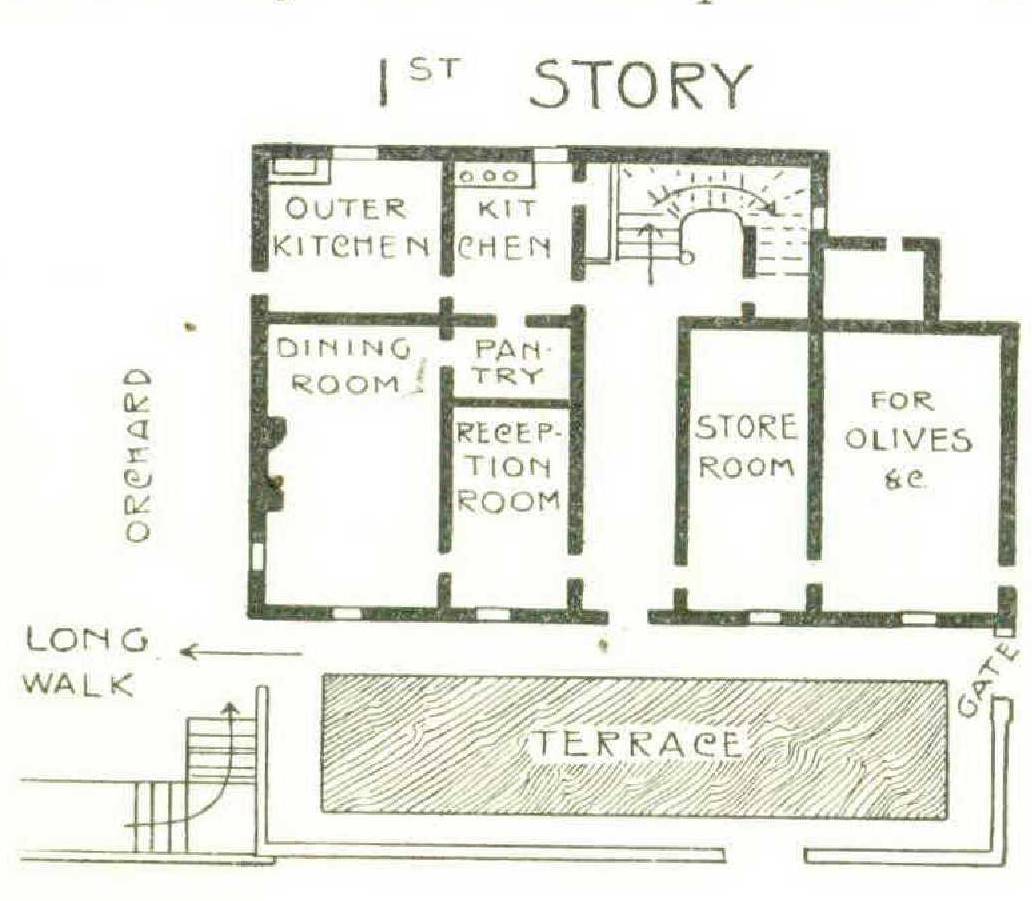
We put a comfortable sofa, chairs, and pictures in the wide entrance hall, which became a lounging-place while waiting for dinner, or after it. The dining-room opened to the left through a small antechamber ; on the right were storagerooms, of which more presently. The dining-room was frescoed with a complete view on each wall representing marine landscapes of this coast. It was not high art. but it was not badly done, either ; it was in good tone, original at least. Our bottles, cups, and candlesticks on the sideboard and mantel were mixed up in an amusing way with the landscapes against which they stood, and made a naturalistic foreground.
The kitchen had a tolerable range, — they usually have only primitive charcoal holes. — and water from a spring, which ran at first, but later did n’t and would n’t, owing to want of the proper repairs. Water was then taken from a pipe on the terrace, rising from an irrigating basin belonging to the system of the Nice Water Company. The works of the company are now extended all along this main part of the Riviera; and, though they still leave much to be desired, they have been a blessing to it second only to the opening of the railway.
Water for drinking came from a deep well at a distance; and generally the finishing touch of faithful Angele to the banquets she set for us at the beginning of the long walk, month in and month out, was to bring cool water in a dripping green Moorish-looking jug of porous pottery, to be had for a few sous, and with it a handful of wild flowers or a particularly choice rose or two which she had a knack and taste for discovering.
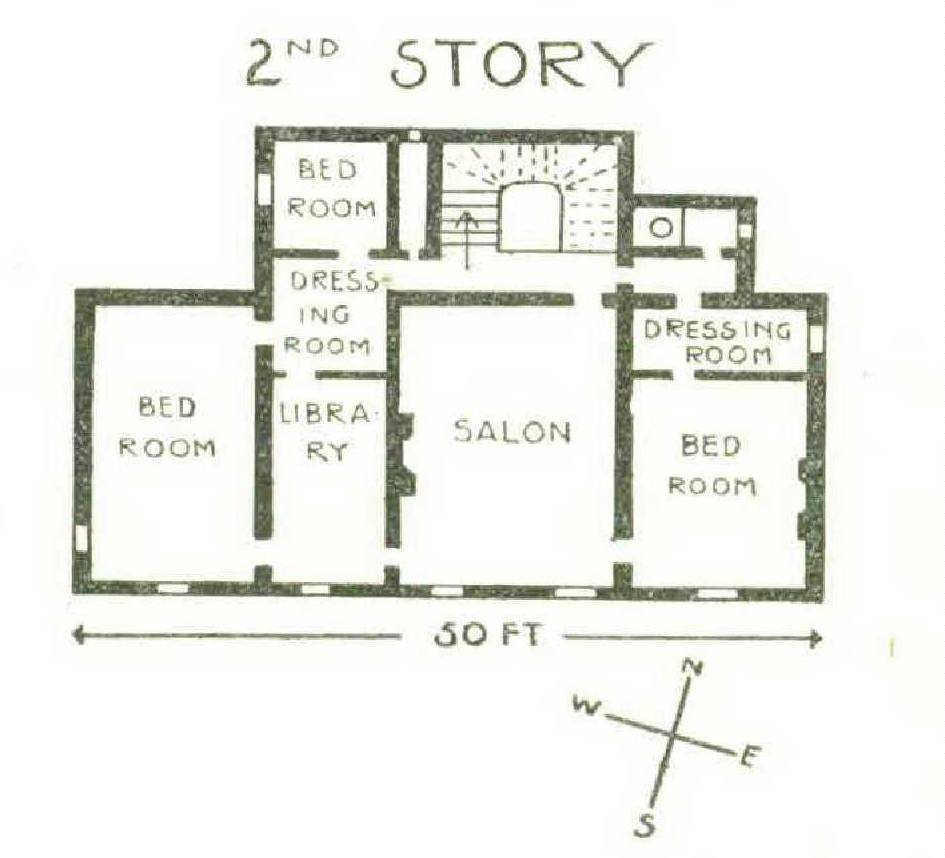
The principal part of the house was upstairs. That was what I always liked about it, both because, if there were any dampness below, as there is apt to be on the best of ground-floors, we were high and dry above it, — the air is always better somewhat above the soil, — and the salon windows were at such a height in relation to the tops of trees as to give their ravishing views veiled and softened, but in no way hidden. When the house was closed at night and we had retired thither, it seemed as if we had climbed up our ladder and drawn it up after us. like Robinson Crusoe in his secure bower. We looked across the harbor to the long green back of Cap Remit, and thence to the open sea. It is impossible to be extreme in insisting how blue the water was.
Charles V., Francis I., and I don’t know what great paladins beside have landed in that harbor. Sometimes it gave us a patriotic feeling to see the American flag waving pinkishly down there, on one of a quartette of the new white cruisers. They gave entertainments in the winter, and then Villefranche was a jam with all the disposable carriages of Nice ; but I think this must have sounded better at a distance than it really was, for there was motion on, and the weather was more often rude and cold than not. Our real view was from the loggia at the top of the house ; but this was almost too wide and dazzling a panorama, and we used to keep it as a tour de force.
As the doors of communication were all opposite one another, quite a stately sort of effect could he got by leaving them open the whole length of the suite. T remember how the sun used to throw the pattern of the window-guards upon the red-tiled floors in a line. The westward view ended in the bedroom window. with the green tracery of the orchard seen through it. The whole house was stone and brick ; we could not possibly have burned down. It is a curious thing that there was not a right angle, and perhaps hardly a perpendicular, really “plumb” in it. I have noticed the same thing in other houses ; I do not quite know how universal it is. It was built by “ rule of thumb,” but the grossest rule of thumb would hardly make one side of a room a foot longer than the other, throw the front and back out. of parallel with each other and with the natural alignment of the building lot, and so on, except on purpose. I have been told that it is considered unlucky to keep a regular symmetry in those matters.
Now as to the storage space below. These rooms were reserved for the storage of the olive crop, and were entered from an outer door. They were an element in the cheapness of the house, and, as our family was small, we could amply spare the space. There is rarely a separate granary for crops, and this dated back to a time when the proprietor, though well to do and living at. his ease, liked to have things under his own eye. Furthermore, as the olive crop is good only every two years, and this was the off year, there was very little in it. Adriano’s women folk were picking up the small olives gradually, as they fell off, all the winter, and when he got a small pile together on the stone floor he used to carry them off up towards Sahit Andrd, to a rude mill resembling an American eider-mill, and have them ground into oil.
We came down here in midsummer, and expected only to settle ourselves, and then go away to the mountains when the necessity came ; but the necessity never came. I can hardly hope to set the mode, —that is rather for those so opulent that no suspicion of economy can enter into their movements ; but I maintain sincerely that the Riviera is even more agreeable in summer than in winter. Instead of an advance to extreme heats from the mildness — or shall I say chilliness? — of winter, a surprising moderation and evenness of temperature are found. There is no heat comparable to that of the suffocating sort at New York and other places where much moisture abounds in the air. Owing to the dry air, there is, in summer as in winter, a remarkable difference between the sun and the shade. The shade of the merest bush will often be a sufficient, protection from the glaring white hot road. I never found the air enervating; it was always favorable to physical exertion ; and that was a surprise, too, for I had feared a sort of tropical languor.
Curtail cliff threw its grateful shadow over us ; the sea breeze fanned us ; we carried umbrellas in the sun ; we bathed in the bight of the harbor. The ground was as dry as a bone ; yon could throw yourself down upon it at ease anywhere. Some new wild flower was always blossoming along the garden-path; roses sprang out of that soil like weeds, and almost every weed was fragrant. Wild thyme, particularly, grew in great profusion, and mingled its balsamic perfume with that of eucalyptus and pine, all brought out at their best by the genial warmth.
The place was an old one; I have found it marked on an Italian ordnance map dating years before Nice was ceded to France. The proprietors lived in Italy, as many owners of property about Nice still do, and left us in the hands of an agent, who served neither his master’s interests nor ours. It had been stately, and was now rather neglected ; not too much,—just enough to give it another delicate sort of charm. I have rung the changes on that sort of attraction considerably, have sought it in many countries, and do not tire of it. Those who want only the trim and proper will be duly surprised ; those who like it will understand me.
I preferred it that there were only some prehistoric - looking piers left of what had once been a conservatory, and that the grass was growing on the long walk. That long walk was the clou, the principal charm of the place. It is a feature the older gardeners so well understood, and which is far too much neglected in our day. Let makers of symbolisms properly explain it. Our long, straight walk led on and on, like a clear and pleasant course marked out in life ; free from uneasy turnings and doublings, — free from the attempt to make something seem what it is not, and to make the petty great, by fatiguing hypocrisies, which is so much the aim of the modern landscape gardener. When you add that it was almost as green below as above, nothing was more restful. It ended at the cliff, where I set up two large urns on a hit of low wall. In the side of the alley opened vistas of the sea with white sails upon it, as if windows were there, set with lapis: lazuli and pearl.
As to a hecolmmied facade which had been established against the chief watertank, I must admit that that really was too much out of repair. There was a roccola, such as is still used in Italy, — a shallow basin for luring small gamebirds down to diink, with shelters for the fowlers to spring their nets and catch them; hut this was long a thing of the past, and forbidden by the law.
The property contained other villas. There was a lieutenant of the garrison, with his orderly, in a cottage at the gate ; the commandant of the place occupied the principal villa; while opposite ns was a pavilion which had been tenanted at times by an officer alone or an artist, and was taken for a couple of months, soon after our arrival, by a nice old abbe, whose cassock and gray head lent themselves well to the picturesqueness of the scene. If we could have just the right, sort of neighbors, it was naturally much more interesting than to have none. Always in the hope of seeing some new delight and improvement arrive from that source, we left, the opportunity to dispose of it open to our landlord, whose ideas of taste were ipiite different. We should have hired it ourselves ; and yet that was an expense which otherwise there was no need of our incurring. No, it never should have been built there.
We dined upon our terrace month in and month out. I recollect that a lamp used to burn almost as steadily there, if we were late and had occasion for one, as in a salon. The infant dozed there in a hammock or played in a rustic bed, shut in with his toys, safe from all harm, He joined his chirping to that of the birds in the boughs over his head. He passed almost his whole existence out of doors, and gained a prodigious fund of health and strength. His effects, the chairs, rugs, books, anything and everything remained out about as well by night as by day. And the rain ? There was none. When there came the first brief shower, a few weeks after oitr arrival, we sat close to the doorway in the hall, watching it with a pleasure I have never got out of a shower elsewhere. Every drop had a preciousness from its rarity. The thirty orange-trees in their boxes took the ample drenching with a refreshment no move wateringpot could ever give them ; the rain-odor came up gratefully from the grass-plot and paths ; the carelessly dancing blue sea below was beaten down for once to a peaceful gray.
The place was cultivated by Adriano, who had a stone bouse of bis own, making an upper story to the commandant’s stable. He had never been to school. He bad come from Italy, near the Loano region, only a couple of years before, yet he had learned French very well, though bis wife and mother could not speak a word of it. For his knack in turning his band to a little of everything we agreed in thinking him quite as intelligent as the usual Yankee farmer. Our agent —whose opinions, having found him slippery, we did not trust—used to grumble that lie was not enterprising, and did not get, enough out of the place; but Adriano said that they should have given him a mule and other proper facilities to work the ground.
His principal resource was the olives. Then he had caroubes, a long, sweet bean, good food for horses, which is said to have been the original of the locusts of John the Baptist, when he ate “ locusts and wild honey.” It, was more profitable to sell the product of the orange-trees in the flower than the fruit. The orange blossoms go to the perfumeries. I have seen them sell as low as fifty cent imes a kilogramme, and they have been as high as two francs and a half. Fancy, ten cents for over two pounds weight of orange blossoms ! We paid Adriano two cents a dozen for oranges. They were small, and by no means equal in quality to oranges of California or Florida; but they were, at that price, a welcome and hygienic luxury in which one could afford to revel. Adriano had not gone in much for flowers for market, the great industry of the region, but he used to talk of doing so. Pinks are the most profitable crop, of late years. There are farmers who make their living entirely out of Parma violets. That is a kind of farming worth while. It seems that, in the season, a “violet train ’ goes to Paris from this region, the benison of their day for the employees in the dry Gare de Lyon. It carries tons of the flowers, which are thence distributed over Paris, and sold tor little more than the price here, Adriano may have raised one of the little bouquets you buy for two sous apiece at the Arc de Triomphe.
His mother, particularly erect and well poised at. sixty, from the habit of carrying burdens on her head, occupied herself principally, a sort of elderly Esmeralda, in leading about a Cashmere goat and finding choice places for it to pasture. His sister of fourteen used to go about, too, with a sickle, cutting wisps of grass for the same goat, — a sort of gypsy-like Ceres with her gleaming sickle, endowed witli the dark Italian comeliness, and an excellent model for an artist. She was half tamed at first to the service of nurse for the important infant, the pichoun. or pigeon ; but she put him through every species of hairbreadth ’scape, and had to he given up. Later on, however, I know not how, some wonderful change of character came over her. She turned steady and tractable, and we parted from her with real regret. Later still there was some falling out in the family, and she went away to take service in Italy. I don’t know that Adriano was brutal, but he believed in governing his household with a true peasant tyranny.
Angéle, a native of Monaco, with a family of her own in the village, came up to do the cooking and other work. She was quiet, devoted, simple in character. free from small wiles and impositions,— a person for whom you could not but have respect and sympathy in her hard-working lot. Her only failing was shortness of memory, a very common one in the class of domestics. As she could not read, it was useless to put up before her a written list of the tilings she had to do. It, had to be endured. The wages for a femme de ‘ménage, in that part of the world, for the day, or the best part of it, are forty francs per month, and thirty francs for a fair sort of a bonne. The more modest domestic service consists largely of Italians from Piedmont, who work for less than the French or Swiss; but then you have to put. up with a dialect which is not improving, except, it may he, to a student of philology. They and the speakers of the Nice patois understand each other very well. There are even Arabic words in all these coast patois, as there are Arabic types in the population. It is so well known that each spot has its own local variations that once, when we were on an excursion, somebody asked us what our patois was.
The price of provisions scarcely differs from that at Paris. It ought to be much cheaper, owing to nearness to the peculiar land of plenty over the Italian frontier ; but the clapping on of heavy duties and the economic war with Italy of these late years have ruined all that advantage. Why not go and establish one’s self in Italy instead, then ? That is a question to he decided by each person for himself. For our part, the access to the metropolitan advantages of Nice, to some books (it has not very many), theatre, music, the stir of cosmopolite life that winters there, — to be of it, but not in it, — these were considerations that had a large share in determining us.
Our fournissenrs, the people who supplied us with the necessities of life from the village, made nothing of running up and down the hill for the merest trifle. They were pleasant, respectful, ingratiating. forgetful, jealous of one another about our small custom, yet, with all, indifferent to a very un-American extent about preserving it. There was a great deal more in their small shops titan you would think. When there was a catch, we had fresh sardines enough to supply the largest family, for a few sous ; but generally the fish market was at Nice. In these days of the phylloxera you do not expect native wines. It was a small cask of Majorca that our wine merchant in the funny little Place de la Paix used to bring us up once a month, and pour anew into his loaned bottles, after having first carefully washed them. His vaulted chamber was like an ancient resort for brigands, but there was no touch of the brigand about him; and. if I thought he would ever see this, I should like to congratulate him here on his late election as a member of the steadv-going municipal council, a body which governs the community with the order and thrift of so many Connecticut deacons. You see no peasant dress in all this country, no wooden shoes, no fantastic head-gear. The men are all in slop-dothing. They are modern, everyday, and complacently independent.
There was more in their houses, too, than one would imagine. Though the entrances in the narrow streets were dark and dismal, when you climbed up within you were met by a hurst of bright blue sea, all the more startling from the contrast, due to the step-ladder character of the town. This did not prevent most of the women going about with their heads tied up for a swollen cheek or other evidence of cold. They ascribed the trouble, as a rule, to a coup ;le song. If you inquired into it, the standard answer was, “ (Test le sang qui lait ca. (It’s the blood that does that.) And the standard remedy, I believe, was to press a five-franc piece against the afflicted place.
Our programme of life was simple. The commandant’s amiable family in the villa below was a social resource for us. The parents were domestic, devoting themselves greatly to their children. The commandant himself, in his hours of respite, ran and romped with them. He was of a type which rtmst be increasing, now that war has become such a serious and methodical matter, and did not correspond at all to the conventional dashing military tradition. He was a student and scientist, in his way, rather than cavalier; conservative and church-goer, too. He looked after the efficiency of his battalion of chassetirs much as a careful merchant might look after his countinghouse.
Next door was a fine old gentleman, a military surgeon on his pension, who was interesting himself at the time in a movement, after the American plan, which seems destined to do much good in the country. I shall do well, I think, to name Dr. Jeannel, who has founded the Soeietd des Amis des Arbres. for the purpose of remedying, by private initiative, the evils of desiccation. I know of no more useful and commendable enterprise. Their first step was to plant the borders of the hare parade - ground at Villefrauehe, which made an unsightly spot in the landscape.
The mayor of our commune, rich and leisurely beyond the good fortune of most mayors, I fancy, pleased himself with offering a large hospitality ; and the mayoress, his kindly helpmeet, made it a benevolent duty to include the strangerresidents within their jurisdiction in this way as in others. They entertained not only the notables of greatest distinction, but the artistic, musical, and literary class. I have never seen a more stately and beautiful mom than that in which now naval officers danced, now a fine voice from the opera at Nice discoursed excellent music, or an actor, or perhaps some modest young girl in white, rendered selections of poetry or sparkling French comedy. It was always in the afternoon ; and the while, through the large windows, and one end of the room which was entirely of glass, shaded with graceful awnings, appeared enchanting view’s of orange-and-rose-tree-studded foregrounds and distant, sea, an embowering garden which was without reserve an earthly paradise.
Once settled, we made excursions into the surrounding country. It was a new delight to find that, hack of the margin of modern settlement on the coast, it abounded in mediaeval villages, often perched on all but inaccessible crags, as a refuge from Saracen pirates and the other terrors of their day. It almost seemed as if we had discovered all this, so little is heard of it. Nothing in that way can surpass Eza, above Monte Carlo, — no Rhine castle, no stronghold of Umbrian marches or Spanish foothills : hut Chateau Neuf has an added touch of strangeness in being abandoned, a dead town with its houses yet standing ; and then Antibes, from whose battlements you see the snow mountains, all Switzerland piled on top of the Riviera; and Saint Paul du Var, with its double fortifications; and Saint Jemmet, where the women are all witches. Monte Carlo, of course. You go and look your fair share at that source of lurid interest. Everybody who arrives wants to go there as soon as possible, to see if they really could lose their money, and perhaps by extra ingenuity gain a pile. It is the standing joke and amusement. The more I see of it, the worse I think it is, the more subtle and deadly and cynical; but, as its concession runs on till the year 1913, it is not of the least use to talk about it.
The first chilly weather began with the September equinoctial storm. There came a powdering of snow on the nearer hills, and even a few Hakes fell on the roses. In the winter we burned little coal, but we often thought we were as cold as elsewhere. While we were shivering in heavy clothing and going our smartest pace to keep up a circulation, wo could half believe the roses about us were but of paper, the palm branches of tin, the show of eternal summer but a clever theatrical decoration. The actual bad weather was condensed into a few short periods, leaving all the rest free to count upon. An unlooked-for drawback to our content with the villa appeared : the shadow of the cliff, for winter, stole up the long walk, and settled upon us much too soon. The early arrival of twilight made it seem even colder than it was. The sun set like a beacon tire on top of the mountain ; then we could walk up to the top of a pass close by and see it shining for a couple of hours longer over N ice. It is a drawback incident to the spurs of bill that run down into the sea, and is to he looked out for. The sites that wholly escape such an interception of sun are rare, and they are the more exposed to the wind. No matter: in Paris we had lived without sun practically altogether. but here we could not -spare a moment of it.
What pleasure, then, when the shadow began to recede again ! Spring came in its cool, deliberate way. The lovely almond blossoms, pink and white, never hurried by undue heat, remain upon the trees a month at a time. It is not warm enough to put on summer clothing till near the end of May.
We planned to change our residence, and, if we were to move at all, why should it not he to another foreign country ? Should it be Italy or England ? Italy would keep. The presence of friends there, some sentimental, halfbusiness considerations as to the advantage of acquainting one’s self well with the centre of the language and the cradle of the English-speaking race, gave England for the moment the preference.
I passed through Paris again, the last half of April, — rainy, dark, and making no new efforts to create an illusion ; and I crossed the Channel for a house-hunting exploration of England. I had at no time thought of Eondon ; it was to be country life there as elsewhere. But on a map London looks so near as to be easily accessible from anywhere, if there were occasion for it.
A cathedral town, a university town, and the most taking London suburb, which was at the same time a court town, — this was the programme, by way of testing the typical forms of attraction.
Canterbury, twenty-two thousand people. The rooks were cawing in the cathedral close, as they should be in a cathedral town. It is understood that I do not compete with the books of description which exist in many sorts. There were tourists strolling in the interior, but I bad nothing to do with them. It was a singular sensation: my quest gave me a sort of permanence, even though it should end in nothing. Some ecclesiastical persons, servants of the noble gray temple, wondered, no doubt, why I stared so bard at their brass doorplates and neat doorways around the close. No, nothing there. All was given up to prebendaries and canons. Few bills were out, in the town. A new, large house, with bathroom, for £70. Too new and too dear!
Then to a house-agent. He was a prim, staid man, interested as to my responsibility, but having a meagre list, indeed. There I recalled a half-forgotten truth, already learned, that it is a work of time and difficulty to discover a suitable bouse in a small town.
I wanted something old and to a certain extent romantic, that goes without saying; something itself making a part of the traditions for which it was worth while to seek such a place. The only thing that even promised to come within iny conditions was a house on a small street called Best Lane, near the little old church of All Saints, and a bit off “the Igh,” or High Street. But when I came to see it, its front seemed more dingy with soot than age, and it resembled an ugly schoolhouse. It was not “ done up ” within, the repairs awaiting the coming of a tenant; and it was showing its displeasure, after the way of an abandoned house, by dropping its plaster and loosening its wall-paper, it was three stories high, — large enough, so far as that was concerned, — and was without " conveniences.” It cost £35 a year and the taxes, generally calculated at one fifth more, amounting to £42 in all, — $210. A back yard had a little wooden pavilion in it, which an amateur photographer had used for his workroom, and which partly overhung a brook or river, the Stour. So far so good; the stream looked too clear and swift to breed any fevers. The cathedral towers were in sight, and there was a touch of quaintness about the rest of the houses in Best lane. Notably, you could go through a doorway, just below, into a diminutive quadrangle called Best Lane Square, on the Stour also, where half a dozen low brick dwellings, with lace hall-curtains and flowerpots on their window-ledges, gave a neat, pleasant picture of English lower middleclass life.
Bref! it might do at a pinch, a great pinch. Canterbury was noted down. I began to know about what to expect, and to penetrate the obscurity of relative English prices.
I traversed London tins time without stop, on my way to Oxford, sixty-three miles by rail. We know what Hawthorne has said of Oxford. “ It is a despair to sec such a place and ever to leave it.” So it seems almost like wickedness to approach it from its practical side; but if I should once begin as to its green quadrangles and meadows, its rich, gray, sculptured, ivy-clad antiquity, all - pervading, pensive, and haunting, I should never have done, and there must be an end some time.
It was out of term-time, and so quieter than usual. An agent to whom I addressed myself had been in America and brought back some American ideas. He took me a long stroll, down St. Aldate’s Street, past Pembroke and magnificent Christ Church colleges, and across Folly Bridge to the Abingdon Road, where be was building some bouses of his own. They were even houses on the American plan, a block of them, small, neat threestory brick dwellings, with all the conveniences, at £42 a year, inclusive of taxes. They were near the boating facilities, if one liked to indulge in that pleasure, Folly Bridge being the focus of the activity on the classic river Isis. A stretch of marshy meadow land extended in front, which I much fear me went completely under water in the winter. There are times when, what with the abundance of the floods, Oxford proper is little more than an island of the far-spreading Thames.
But had I come to Oxford to live in a modern American abode, every question of comfort or price apart ? There must be a section of a ruined abbey, a moated grange or manor of moderate size, a hermitage redeemed to modern uses. My agent was puzzled at the taste, apparently. Even an American family, who had come there lately with some purpose of study, had said to him, We want no more old rookeries.
He was at a loss, too. What I wanted was not easy to find. Out on the Ifiley Road, across the other bridge, the beautiful stone Magdalen Bridge over the Cherwell, was a shabby little stuccoed house, in a row, for £48; and then another which was said to be to let, but was not to let at all. I heard that all was modern up in the fashionable northward quarter, near the University Park, the direction in which the city was finding its most popular expansion. My painstaking agent promised to make me up a list. I returned for it at the appointed time, but, if he had any choice of such things as I wanted, he had not put them in it. There was a large, damp, musty old house on New Inn I tall Street, opposite t he Union, long on the street, with a separate servants’ entrance and some wainscoted rooms, but public in situation without escape, and £120 a year. What could not one get in the Riviera for $600 a year?
Then I began to look with zeal in the streets about the colleges, abandoning agents. I secretly hoped to find something habitable on the High Street, opposite that exquisite porch of St. Mary the Virgin, with its twisted pillars and its statue, or by the grass-plot in Oriel Street, or at that focus of charm in Merton Street where Corpus Christi College and Oriel and the fine gate to a Christ Church quadrangle come all together. You will see what ideas I had. Bref! nothing, again. The streets about the eolleges are occupied either by shops or students’ lodgings.
It was on this quest that I had occasion to look into some of these lodgings. You saw the students’ caps, foils, and characteristic knickknacks hung up in some very gloomy, damp, unhealthy interiors. In the worst, the keeper had the assurance to inform me, " The rooms are very h-airy, sir.” Men can live anywhere, perhaps, especially those of this line young breed, so devoted to all athletic sports ; but I had to wish there, as I have had to wish in other university towns nearer home, that the authorities would abate a part of their august wisdom, throw erudite science into a practical form, and descend to the duty of making the hygienic well-being of the students their most pressing consideration.
I was driven at last to the new quarter. Taking the train from Carfax up St. Giles Street and the Banbury Road, a longish ride, I arrived near the University Park. Being driven there, it did not prove a regrettable fate at all. Comfortable modernness, softened by gardens, by the forever old and forever new caress of nature, has nothing disagreeable in it. The new Margaret Hall, for women, is in that part of the town. The late Prince Leopold lived out that way, when he was in residence. It is a long way from marketing, — he of course cared nothing for that, — but, on the other hand, you have the tramway, at a penny the trip.
To live out there, and have venerable Oxford to descend to every day, — a new idea and a good one at last!
East Broxley House, then, — so let us call it, — Norham Road ! The other half was West Broxley, after a stately fashion they have of giving titles even to dwellings not very important. A pretty, double brick house, standing free amid vegetation : three stories and mansard, a covered porch, a bay-window to the drawing-room, all in excellent order, for £54. I saw the other half, charmingly furnished, and saw what could he made of it. For such a house in New Haven (U. S.) $500 or $600 would he demanded, — plus a bathroom, however.
Oxford, forty-five thousand people. Outside of the colleges a small shopkeeping community. The town governed with a Puritanical strictness ; no cafés-chuntants, none of the conventional animation of Continental life. It might be rather dull for strangers, in a social way; but that would not disturb us. The legion of generous youth pouring through it must give it at least a pleasant surface gayety. In winter, bare and chilly ; it you get a cold there, it hangs on as if it never meant to abandon its grip.
For a maid servant it would cost ns from £12 to £20 a year. Would that she might wear a pretty pink ribbon in her cap, like the one at the Mitre. They call them “ generals,” and to get a good “ general ” now, in England, is not as easy as it once was; they want to he employed three together, to cover all the divisions of labor. Provisions would cost what I have come to call the usual prices ; there seems to be some law by which beef is about a shilling a pound, and eggs are from a shilling to a shilling and a half a dozen, everywhere.
Next, to get our traps over, by sea, from the Riviera to London, and by rail from London to Oxford, we must count upon, say, one hundred dollars, and also count upon their going back again some day. And then all our railroad fares, for the distance is long, — hum ! hum! Still. Oxford would do. I distinctly put it. down that Oxford would do, on the afternoon that I stood alone in the noble dark quadrangle of Christ Church. The bell, famous Great Tom,”pealed out its measured chimes with a real sort of heartbreak in the rich, sweet notes, while the rain fell gently upon the grass. Rain was falling in Merton Fields and rain on Addison’s Walk, soaking the green meadows and veiling the deer in the pensive vistas. A price is paid for all that delightful verdure in the ceaseless drift of rain. My thoughts went back to the orange and rose trees of Villefrauche, to the shadow turning round the sun-dial, to the table set upon the terrace, and the summer days coming back. Still, there was not the slightest doubt that Oxford was one of the places that would do.
The court town and London suburb was Windsor, fifteen thousand people. As a court town I seemed to prefer Versailles, even though its court was gone for a hundred years. The royal standard and a few sentries in scarlet did not save the castle, which had a prisonlike austerity in its vast masses of cold gray granite. A renewal of acquaintance with the Vandykes in the somewhat florid state apartments, a jaunt to Eton College, and part way to Virginia Water by the Long Walk. The town, apart from the castle, is respectable, ephemeral, without interest. The obliging houseand-estate agent who sent me down to Osborne Terrace, Osborne Road, is perhaps still looking for me to come back. I had to take the key of an honest man, a butcher or baker, in Frances Road. They left me quite alone in the house. On the way thither one would often be reminded of Orange, New Jersey, or some other proper American town. Then there were whole tracts covered with petty brick cottages of an humble order. Not a few of these had ambitious names, as “ Primrose Cottage,” " Britannia Villas,” and the like, though so poor, shabby, and untenably damp that it would be gross flattery to call them genteel.
Osborne Terrace was £60 a year, a three-story, high-stoop,” brick, eighteenfoot dwelling, with becoltunned portico ; iron balcony before the drawing-room window ; a patch of yard, with an evergreen, in front, and a long strip at the rear, divided from the neighbors by hedges. It would be a very good house for the money in an American town. The only peculiarity I recollect about it within was that it was all squarely divided into line large rooms, and had none of the boxes we call hall bedrooms. The outlook at the ends of the street was pleasant ; on the east, towards the trees of the Long Walk. Anybody might go and stroll there. Those trees were practically leafless still, royal though they were ; and. in the matter of long walks, there was a personal long walk, far to the southward, which would insist on seeming superior to all others.
Why speak of London ? I looked about a little there, but not with much heart in it. I was told we could have lived somewhere respectably tor a rent of £60. Supposing we had been flattened down there under the murky gloom of Bedford Park, or other level monotonous half-suburb ? Would an occasional run in lvew Gardens, when the heavens did not lower, compensate for it ? Or we might have gone to Hampstead Heath. I hear there is quite a literary and artistic colony there. All the same, we should have been miles from everywhere. Englishmen like to talk to us about our haste and worry of living ; but it seems to me there can ho no other spot in the world where such fatigues, such uncounted miles of travel by rail or cab, are a necessary preliminary to every detail of life, every petty visit, every attempted profit or pleasure. Life is being defeated, in short, by its own mere unwieldiness.
That there is a pleasant bustle about it cannot be denied. Would it be a sufficient offset to fatigues to learn to swing a knowing umbrella through Saville Clubs, the Hogarth, the Cri, the Seven Bells ; to take a bus knowingly to Hyde Park Corner; to come cheek by jowl with great names, the publishing interest, the American leaven, with pictures, books, measures of the day? Would the complacent infant at Villefrancho consider it a fair exchange ? I see Hissing, in that book which seems to embody so many woeful experiences with an appearance of vivid truth, New Grub Street, thinks literary men ought not to live in London at all.
“ Not after they know it,” you hasten to add.
I stand corrected; and so I shall hope to know it some time, under favorable circumstances.
Meanwhile, there was nothing that seemed to shine in murky London hut an occasional door-knocker. Could one he contented with the gleam of a brass door-knocker when he has had the sun of the Mediterranean ? I determined that, if we moved at all, we would move to Italy.
William Henry Bishop.