The Folklore of Capitalism
by
[Yale University Press, $3.00]
The Folklore of Capitalism might well have been subtitled ‘Fun at the Operating Table,’ for it is essentially the gleeful record of a number of cruel and bloody operations in which Mr. Arnold laid wide the abdomen of capitalism, without benefit of anæsthetics, in order, not to cure the patient, but merely to ascertain and list the diseases that are ravaging its body. Our surgeon duly records the diseases that he found, plus an inventory of a miscellaneous assortment of objects, ranging from old house slippers of the seventeenth century to stuffed shirts of the twentieth century, with which the abdominal cavity was crammed. Throughout the record the surgeon tries hard to adhere to the scientific canon nil admirari, but the effort is sometimes too much for him and he indulges often in the nonscientific luxury of a smile. Occasionally, when his keen sense of the ridiculous gains the upper hand, we hear him piping little songs of glee, and catch fleeting glimpses of a cloven hoof beneath the surgeon’s gown.
The groundwork for our present clinician was laid, of course, long ago by that dour and solemn Norseman, Thorstein Veblen. whose travels in the arid, mirage-filled realms of economics were set down in a tortuous and difficult style strangely reminiscent of the style of Doughty recording in Arabia Deserta his journeys in the awful desert. But where Veblen was dour and solemn Mr. Arnold is gleeful, amused, and amusing. And this is no mean feat at a time when pomposity parades so largely as profundity, and vituperation as virility.
The author’s flashing wit plays illuminatingly upon such subjects as ‘The Psychology of Social Institutions,’ ‘The Place of Learning in the Distribution of Goods,’ “The Personification of the Corporation, and ‘The Effect of the Antitrust Laws in Encouraging Large Corporations.’ In a period when every burning bush conceals, not God, but a planner, Mr. Arnold calmly says: ‘Actually there has never been such a thing as a planned organization of society, even in times where there is the most planning. . . . Goods are distributed, not through plans, but through habit and ceremony.’ In an era when hard-boiled politicians, either out of sheer distress or in response to fashion, call in for consultation the professors and economists whom they have always regarded as academic sissies, Mr. Arnold says that the ‘total effect of the learning of law and economies is not in any sense a present guide for either business or government. . . . Scholars like to think of legal and economic principles . . . as a practical guide. It is difficult to convince most of them that they are not practical advisers because when their guesses go wrong they can always ascribe the blame to factors such as human nature or politics, which lies outside their sciences.’
Mr. Arnold says that there is no such animal as ‘the thinking man’ — ‘the fellow we might all become if the demagogues would only let us alone.’ For man lives by creeds. ‘Social creeds. laws, economics, and so on have no meaning whatsoever [author’s emphasis] apart from the organization to which they are attached.’ And man does not choose his creeds as a free-willing individual. ‘Men become bound by loyalties and enthusiasms to existing organizations. If they obtain security and prestige from these organizations, they come to regard them as the ultimate in spiritual and moral perfection.’ Hence man’s resistance to change. Hence the futility of the search for universal truth in the political world, and the hopelessness of appealing to men in the political world through universal truth.
Such words and phrases, Mr. Arnold maintains, as ‘inflation,’ ‘private enterprise,’ ‘government regimentation,’ and ‘budget balancing,’ are merely part of a vast folklore jungle in which we wander lost. This thesis is illustrated with the lavishness of example employed by Frazer in TheGolden Bough. One would think, therefore, that the author might have deduced some monumental, guiding principle out of all this. Instead, the conclusion to which he comes is no more startling than that reached by a candidate for a doctor’s degree (he got it, too) who proved in a long dissertation that sugar was put in ice cream to sweeten it. Mr. Arnold’s conclusion is that successful organizations, such as yesterday’s Tammany Hall or to-day’s New Deal (my examples), maintain themselves by ‘identifying themselves with the faiths and loyalties of the people’; that ‘tears and parades, not factual psychological discussion, are the moving forces in the world in which we live.’ This is a fact that has been known by all politicians from Pericles (witness the Funeral Oration) to Jim Farley.
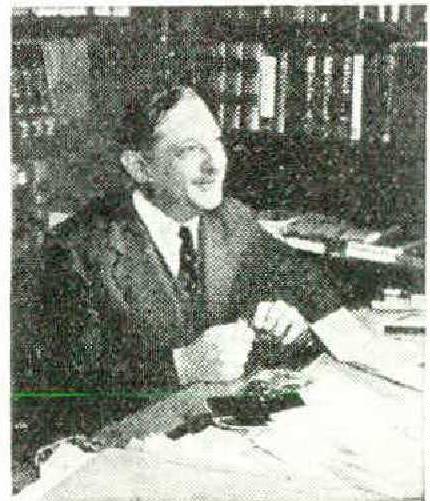
The Folklore of Capitalism is not, as some of its admirers claim, the second coming of Karl Marx, and that is fortunate for Mr. Arnold, because second comings tend so often to be anticlimactic. But it is a brilliant, witty, corrosively skeptical examination of some of the myths and illusions by which man lives— myths which the author grants are imperative to his existence. And Mr. Arnold, however mistaken he may sometimes be, has that rare form of intellectual courage which enables him to look calmly, not only upon the fair face of truth, but also upon the peristaltic convulsions of its viscera — the kind of courage which Swift exhibited in one of his poems ‘To Celia’ that is not in the genteel anthologies.
DAVID L. COHN