Hearken Unto the Voice
by
[Viking, $3.00]
I SUSPECT that most of us. if asked any questions about the prophet Jeremiah, would reply, like Dorothy Cowell in this novel: ‘I don’t know much about him. My religious education has been neglected.’ My own knowledge consisted of two items; that he gave us the noun ‘jeremiad’ and that he was the author of Lamentations. I find now, however, that his lugubriousness has been exaggerated; that his life was to the last degree exciting; and that he was a brave man.
By nature sensitive and timid, he had, he thought, been chosen by Jehovah even before birth to be the vehicle of divine warning. As the last major prophet before the Exile, he spent his forty years of adult life — in Judea, Egypt, and Chaldea — amid invasion and siege, social tumult and war. He was derided, scourged, starved, imprisoned. Once he was all but killed by a cowardly blow, and once was lowered into a cesspool and left to die. And yet, when the voice of Jehovah sounded in his mind, he spoke, even though his body was shaken by human’ fears. Josiah, the reformer-king, relied upon his honesty, the weak kings Jehoiakim and Zedekiah feared it, and Pharaoh of Egypt and Nebuchadnezzar respected it. Nevertheless, he was never free from the worst of doubts — that Jehovah had rejected him or had even deceived him.
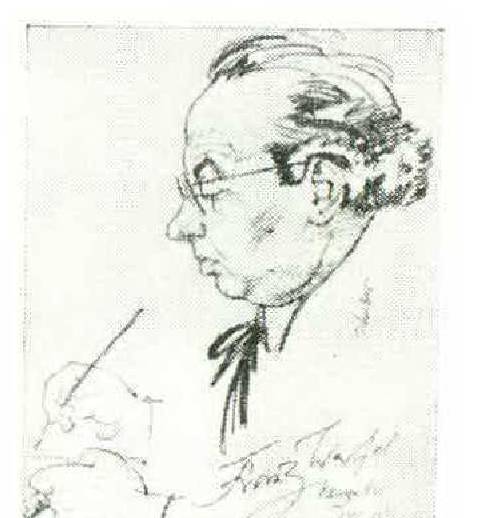
This is the man whom Franz Werfel has portrayed in Hearken unto the Voice. All that the Bible tells us about Jeremiah would hardly fill a chapter of the novel. A hint conveyed in a sentence is developed into pages; a parable is made the basis of a stirring narrative; men and women who are nothing but names are given a history. If the prophet goes to Egypt or to Chaldea, a voluntary exile with the royal family, the novelist initiates us into the mysteries, gruesome or bizarre, of pagan religious rites. We sail with Jeremiah up the River of the Dead in Egypt and ride with him through the sky of the star-worshiping Chaldeans. With him we are spectators at the execution of the prophet Urijah and the blinding of King Zedekiah, and ride into the battle of Megiddo behind brave King Josiah.
As an imaginative reconstruction of a past era the novel is at times superb. But the author is not primarily concerned with history, but with an example. Jeremiah, impelled by his divine mission, presents the spectacle of a man whose heart is divided against itself. His affections lead him to sympathize with those whom God makes him denounce. He must take his stand against popular feeling and national ambition, and advise king after king to submit to the Assyrians, because only by that means can they hope to save Jerusalem. Like Cassandra, he is always right but never believed. His prophecies are all fulfilled, but the fulfillment is the ruin of his country. He looked into his own heart. What he found there he called the voice of God; and he proclaimed it, whatever the consequences.
This is the author’s plea for mysticism; his demonstration that ‘the fear of God is the beginning of wisdom.’ We call Jeremiah’s wisdom intuition nowadays, but we have not explained it; and whatever timeliness his story has for us lies in his not only having inspirations or intuitions, but having the courage to voice them. That his story is presented as timely is suggested by a prologue and epilogue concerning a novelist of to-day who seems to be a reincarnation of the prophet.
This modern machinery is a definite blemish, because it is unnecessary and because it strikes one as spurious and a little cheap. The story could have conveyed its moral without such help. Clayton Reeves, the novelist, however, admirably sums up the moral intention. ‘Jeremiah,’ he says at the end, ‘was a sensitive man, who was implacably opposed to his world and his age. Though he was timid, even the evident and potent iniquities of this earth could not vanquish him. For he obeyed no other than the voice of God, which spoke to him and within him.’
We can only agree that such men are sorely needed to-day. But Jeremiah had one advantage that a contemporary prophet might lack: a public that believed in God, even when it forgot that it did. The people might try to kill their teacher, but they still felt the force of his dramatic parables, tirades, and invectives. When he walked the streets with a heavy ox yoke on his shoulders, they knew what he meant, as they did when he told of the loincloth hidden in the cleft of the rock. And they believed in the Voice, even though they might not believe that it spoke through him.
Religious people will perhaps agree with the author that wisdom may be found by abrogating reason; but others will feel that what the world needs to-day is not less reason but more. We have plenty of prophets still, and, like the ancient Judeans, our trouble is in knowing which to believe. Jeremiah, we now know, was right. But who is to point out to us our Jeremiahs?
R. M. GAY